Okay, we can all agree that our children (those adorable young cyberspacers) need some coaching on how to safely use social media. There are apparent security risks, like predators and stalkers, and being mindful not to post too much personal information (which may mean not posting when and where you are in real-time, not posting pictures taken by a camera that include the physical location of where the photo was taken).
We encourage our children to be polite and respectful and warn them not to engage in gossip or put others (including classmates) down for fear of promoting cyberbullying or creating disrespectful or dangerous social situations in real-life school.
Our kids
When we think about the dangers of social media, we think about the young people who may be putting themselves at risk by engaging in a technology they were born into. Like it or not, social media is an integral part of their lives. Unlike you, they do not know a world without it.
You
What about the dangers of social media to you?
You don’t think about that much, do you? I’m not talking about the potential threat of Big Brother nosing around your data or tracking every move you make. No, I’m talking about what danger you might expose yourself to by using social media.
We’re aware of the threats and consequences we’ve read about in the headlines like people posting their vacation photos in real-time and coming home to a home that’s been robbed while they were away (and a hundred, if not more, stories related to posting your location).
For families, the same threats apply to attracting predators for proud parents, as it does for our children (but we might be less likely to consider that). For single adults, there are different kinds of narcissistic predators, psychopaths, and stalkers waiting to exploit your social media postings, and the list goes on and on…
Not to mention what social media is doing to us as a culture. Most of our face-to-face relationships, even voice-to-voice relationships, as we move our social interactions from real life and even talking on the phone to the more convenient and less intrusive social media platforms. It appears that authentic social interaction is morphing into reclusive voyeurism. I’m not convinced this is an upgrade.
More importantly, I am concerned about the dark side of social media, a place where people can mock, put down, bully, disrespect, and spread hate like wildfire without any social responsibility. Personally, I choose not to participate in negative social media campaigns, and there are so many to avoid.
Then there are the haters. A hater’s gonna hate, and there’s nothing you can do about it. The best advice if a hater starts hating on you is to ignore it. Responding to haters or attempting to defend yourself only adds fuel to the fire.
But mostly, I’m concerned about what we inflict upon ourselves by posting our own negative campaigns. I see people I deeply care about in real life destroying their lives by posting negative comments. These seemingly harmless postings attract more of what they don’t want by declaring to the universe in the most poignant way possible, “I don’t like,” or even worse, “I hate,” whatever follows… and whatever follows is like placing your prepaid order with Amazon for even more of what you posted, with free shipping.
It breaks my heart to see this simple rule of thumb proven over and over again. I see someone posting about how much they dislike or disapprove of something, and then in a few days or weeks, they’re posting about how they were visited by something worse—and if their declaration was extremely vehement, far worse.
On the other hand, there is a camp of folk who are completely the opposite. They post primarily positive and supportive items on social media and they seem to attract more good news and happiness to their lives. I believe there is a connection.
Avoid the danger of adding more misery to your life by posting negative comments online.
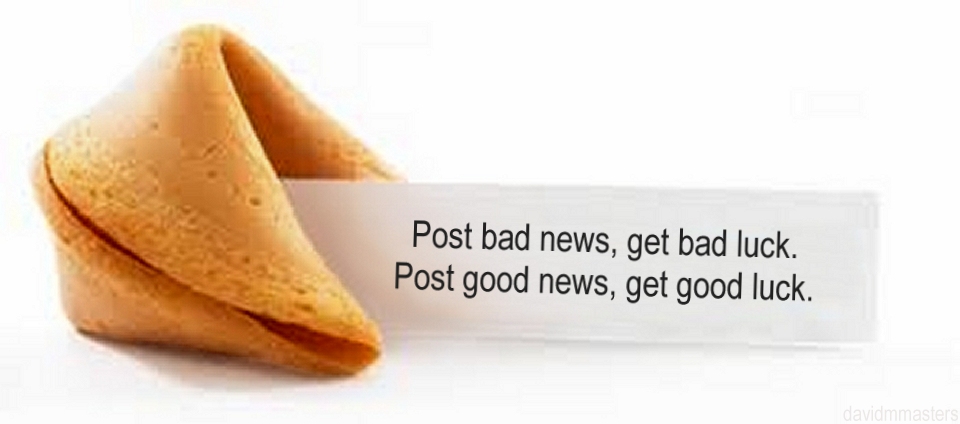
Reduced to its simplest form (trying not to sound like a Chinese fortune cookie):
Post bad news, get bad luck.
Post good news, get good luck.