KER-CHUNK! Somebody Said the Word

I’ve discovered a peculiar form of entertainment. I probably shouldn’t admit this. But lately, when I notice someone has a particularly reliable trigger word, I’m occasionally tempted to work it innocently into a conversation just to watch what happens.
Someone says: God.

KER-CHUNK.

Autoplay engaged. And we’re off.

The six-minute God presentation has begun.

Someone else casually mentions going to their: Doctor. KER-CHUNK. “Well, let me tell you about doctors…”

Nobody asked. But apparently the program was already loaded.

    • Police.
    • Attorney.
    • Military.
    • Weight loss.
    • Immigration.
    • Gender.
    • Vaccines.
    • Guns.
    • Republican.
    • Democrat.

And God forbid somebody says: Trump. KER-CHUNK. Cancel your dinner reservations. We may be here a while.

The Human Autoplay Feature

I’m having some fun with this, but I think something rather important is happening. Human beings automate things. We have to. Imagine waking up every morning and having to rediscover how doorknobs work.

Automation is enormously useful. But we don’t automate only physical tasks. We automate associations. Interpretations. Emotional responses. Conclusions. Stories. Sometimes we even automate entire speeches.

Someone says the magic word and – before we’ve really considered what this particular person is saying in this particular moment – the familiar recording begins.

KER-CHUNK. Autoplay.

And this has nothing to do with whether your position is liberal, conservative, religious, atheist, conventional, alternative, mainstream, rebellious, or somewhere out beyond Pluto. Autoplay doesn’t care.

A six-minute glowing tribute is just as automatic as a six-minute tirade.

I Don’t Want to Be a Jukebox

Personally, I don’t want to be reduced to a jukebox with a limited playlist.

Push B-7 and get my God speech. C-12 plays my doctor recording. D-4 launches politics. Same record. Same scratches. Same chorus. Every time.

Because if somebody knows which button to push and can predict what I’m going to say for the next six minutes, they don’t need mind control.

I’ve automated the job for them. LOL.

That’s what I playfully think of as the mind-control grid. Not some sinister organization operating from an underground bunker. Our grids are much more ordinary.

Family. Culture. Education. Pain. Religion. Politics. Media.Tribal belonging. People we’ve trusted. People who hurt us. Things we’ve experienced repeatedly.

Over time, we build an internal model of reality. And that model is useful. Until we forget it’s a model.

Your Recording May Be Right

This is important. I’m not suggesting that your beliefs are wrong.

    • Maybe you have very good reasons for distrusting doctors.
    • Maybe doctors saved your life.
    • Maybe religion wounded you.
    • Maybe faith transformed you.
    • Maybe your experience with law enforcement was terrible.
    • Maybe a police officer once stood between you and disaster.

Keep your experiences. Keep your conclusions if they still make sense to you.

The question isn’t: “Is my opinion wrong?” The more interesting question is: “Did I choose this response just now?”

Because your beliefs aren’t necessarily the prison. Your inability to stop them from going on autoplay might be.

Curiosity Interrupts Autoplay

This is where it gets interesting to me. Someone says one of my words.

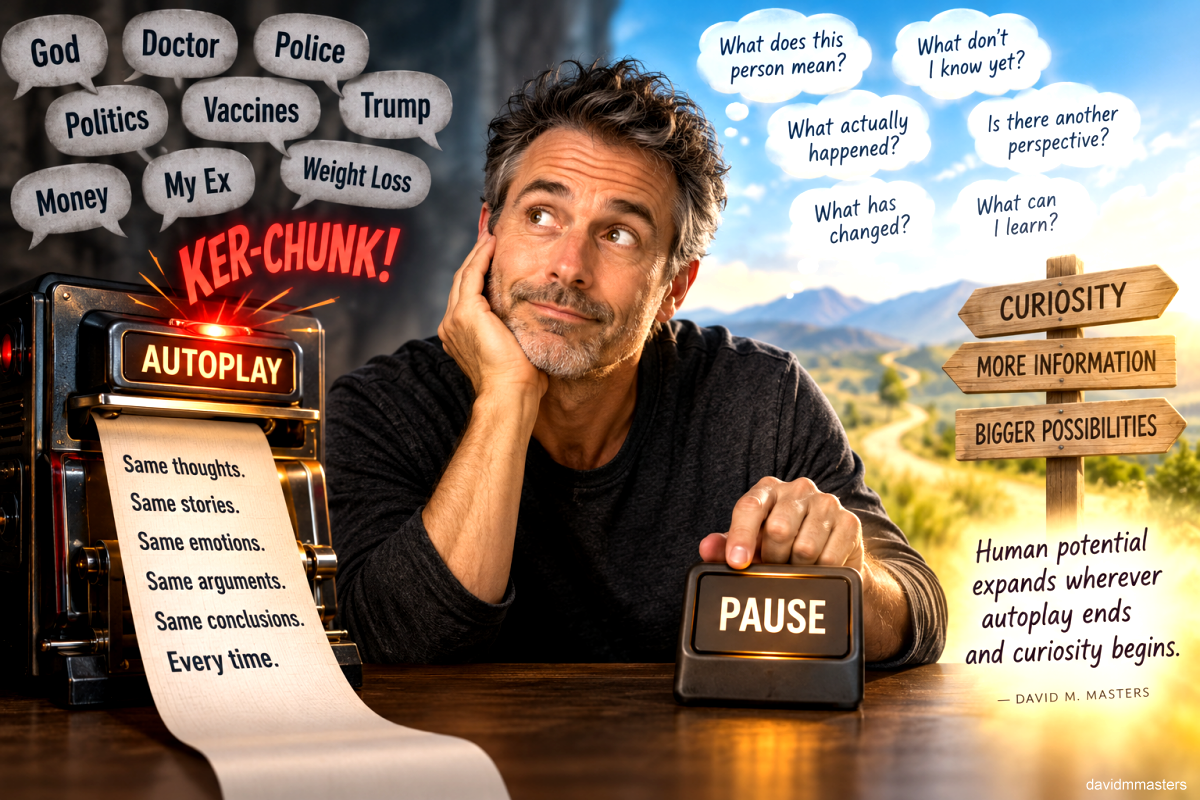
KER-CHUNK. I can feel the familiar program loading. But before it gets very far: Pause.

    • What does this particular person mean?
    • What actually happened?
    • What don’t I know yet?
    • Is there information here that doesn’t fit my existing model?
    • What has changed since I formed this opinion?
    • What might I notice if I weren’t trying to prove anything?

Now I’m not merely reacting. I’m accumulating data. I’m expanding. And after listening, investigating, and considering the new information, I may arrive at exactly the same conclusion I had before. Fine. Except this time, I chose it.

The Three-Second Experiment

Try it sometime. You don’t have to change your beliefs. You don’t have to become neutral. You don’t have to hug anyone. Just notice when one of your programs starts.

KER-CHUNK.

Then give yourself three seconds.

Instead of immediately asking, “What do I already know about this?”

Try: “What is actually happening here?”

That’s a very different question.

Certainty says: “I already have the answer.” Curiosity says: “Let’s see what else reality has brought us.”

I prefer the second one. Not because certainty is always wrong. But because reality has not finished introducing itself. And I don’t want to spend the rest of my life playing the same twelve records simply because somebody keeps pushing the buttons.

There are more songs. More information. More observations. More possibilities. More surprises. More life.

Maybe escaping the so-called mind-control grid isn’t discovering the correct collection of opinions. That could just become another jukebox. Maybe freedom is becoming increasingly difficult to reduce to predictable output.

Someone pushes the button.

KER-CHUNK.

Oh, lookie there. One of mine. And then, instead of automatically pressing PLAY…

I get curious.

Because human potential expands wherever autoplay ends and curiosity begins.
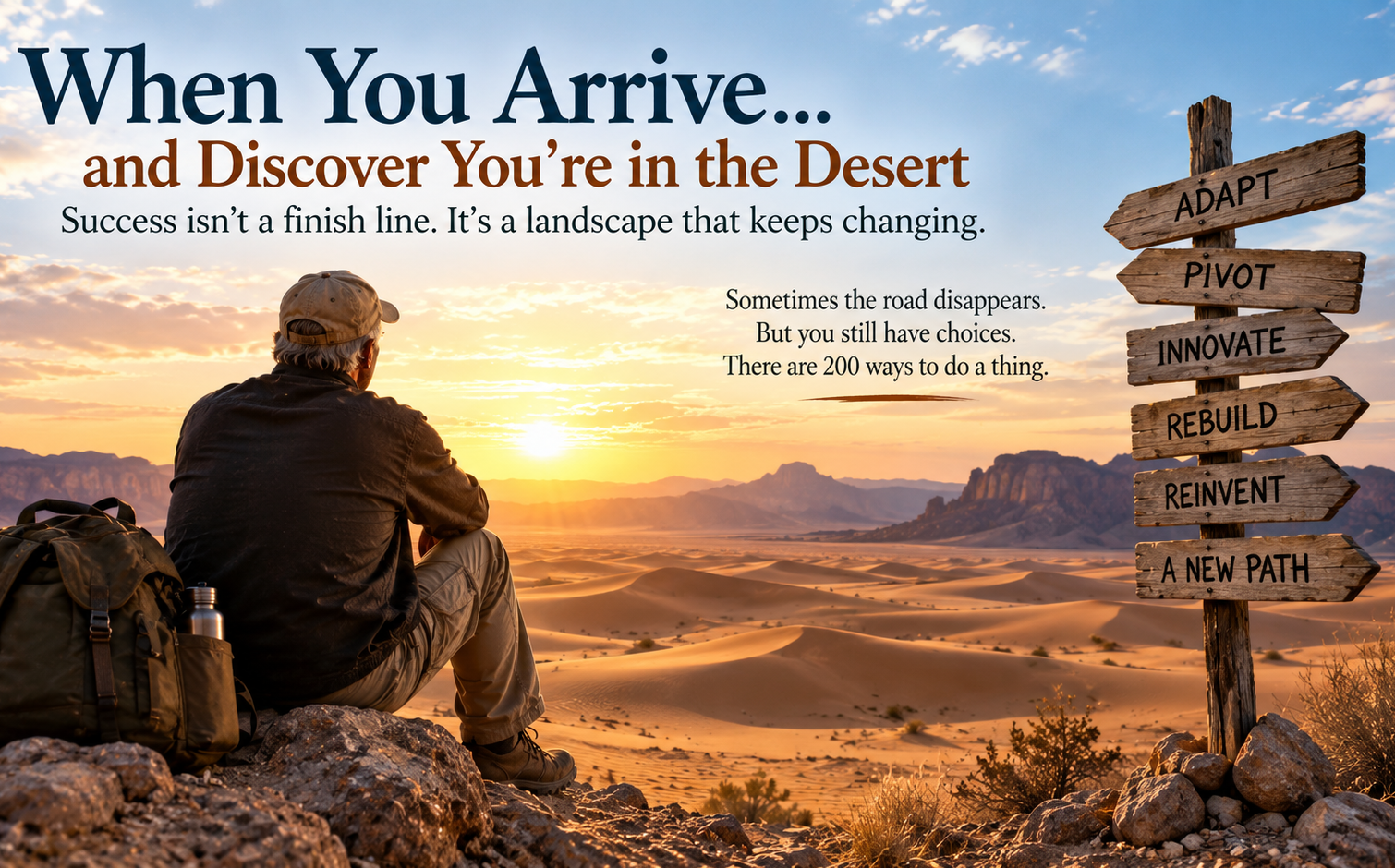


When a Successful Business Suddenly Stops Working: What Next?

There is an interesting thing that happens in business. You struggle. You experiment. You make mistakes. You lose money. You try something else. You finally figure out what works. Then one day you look around and think, We made it.

The business is working. Customers are coming. Bills are being paid. Maybe you’re making more money than you ever expected. Wonderful.

I’ve watched clients reach this place many times. And quite often, that’s the last time I see them. Which is perfectly fine with me. Great. No problem. I’ve done my job. Go forth and prosper.

But every once in a while, I hear from one of them again. And the conversation sounds considerably different.

Somehow, between We made it! and What happened? they woke up alone in the desert. Nothing in sight but sand.

Meanwhile, somewhere miles behind them, the business they thought was safely established is beginning to crumble.

Nobody Moved the Desert

That’s the strange part. Usually, they didn’t suddenly become stupid. They didn’t forget how to run a business. They may have been doing exactly what made them successful.

The world around the business changed.

    • The foreign supplier manufacturing a critical component goes under.
    • The FDA prohibits an ingredient central to the product line.
    • A manufacturer discontinues something you’ve built your entire offering around.
    • Your biggest wholesale customer changes management and drops you.
    • A competitor undercuts your pricing.
    • Black-hat competitors attack your online presence.
    • Your payment processor suddenly decides your perfectly legal industry is too risky.
    • Your shopping-cart platform is acquired, “improved,” glitches repeatedly, and eventually becomes unusable.
    • A social-media platform changes its rules and your reach disappears almost overnight.
    • Search algorithms change and suddenly customers who used to find you easily can’t find you at all.
    • Advertising costs double.
    • Shipping rates make your previously profitable product difficult to sell.
    • A tariff turns yesterday’s margins into today’s losses.
    • A landlord sells the building.
    • A key employee leaves and takes years of institutional knowledge with them.
    • Your best salesperson retires.
    • A trademark dispute appears from nowhere.
    • Your bank changes its lending policies.
    • Customer tastes change.
    • Technology makes part of your offering obsolete.
    • A new regulation changes how you’re allowed to operate.
    • Someone who controls a piece of technology your company depends upon decides to shut it down.

Or perhaps nothing dramatic happens at all. Sales simply begin slipping. Five percent. Then another five. Nothing alarming enough to panic over.

Until one morning you look at the numbers and realize you’ve been walking into the desert for eighteen months.

Success Is Not a Finish Line

Running a business, brick-and-mortar, online, or some combination of the two, is rarely a do it once and you’re done forever proposition.

If it were, many of the brands we grew up loving would still be here.

Markets move. People move. Technology moves. Culture moves. Money moves. Your customers move. Even you move.

A business that remains exactly the same is operating in a world that doesn’t. That’s worth thinking about. Because one of the most dangerous moments in business can actually arrive immediately following success.

When something isn’t working, we’re curious. We investigate. We experiment. We ask questions.

When something works spectacularly, we have a completely different response:

Don’t touch anything!

LOL.

Understandable. But dangerous.

Yesterday’s Answer Can Become Tomorrow’s Problem

This doesn’t mean constantly changing everything. That’s another excellent way to destroy a perfectly good business. There is a difference between reacting to every gust of wind and noticing that the climate is changing.

The business owners I’ve worked with who tend to weather major disruptions aren’t necessarily smarter than everybody else.

They keep looking. They notice anomalies.

    • Why did inquiries drop this month?
    • Why are customers suddenly asking that question?
    • Why are returns increasing?
    • Why did our advertising cost change?
    • Why is this supplier taking longer?
    • Why is everybody suddenly finding us through a channel that barely mattered last year?

Individually, these may mean nothing. Sometimes they are footprints in the sand.

The Early Warning System

You don’t need to live terrified that something will destroy your business. That would be exhausting. You can remain curious instead.

Periodically ask: What are we depending upon that we don’t control?

That’s a magnificent business question.

    • One supplier?
    • One employee?
    • One social platform?
    • One search engine?
    • One customer?
    • One product?
    • One payment processor?
    • One advertising channel?
    • One person who knows how everything works?

Then ask: If that disappeared tomorrow, what would we do?

You don’t necessarily have to do anything. You’re simply looking around. Curiosity is considerably cheaper than panic.

And Then the Desert Appears Anyway

Even with preparation, things happen. You can be diligent, intelligent, diversified, and paying attention… and still get blindsided.

Suddenly, there you are. Sand. Sand. More sand. Now what?

First, don’t automatically assume the business must be saved. That’s important.

Sometimes the price of rebuilding is greater than what you are willing to pay. Maybe you’ve changed. Maybe your priorities have changed. Maybe you’ve already given this business twenty years of your life and the disruption gives you permission to ask a question you’ve secretly wanted to ask for five: Do I even want to do this anymore?

Closing a business isn’t necessarily failure. Sometimes it’s completion.

But if you look at the wreckage and say, “No. I’m not finished yet,” then we have a different conversation.

There Are 200 Ways to Do a Thing

I say this all the time: There are 200 ways to do a thing. Probably more.

The problem is that when Way Number 1 made us successful, we tend to forget Ways 2 through 200 exist.

Supplier disappeared?

There may be another supplier, another material, another design, another manufacturing method, another country, or another product configuration.

Marketing channel collapsed?

There are other channels, audiences, partnerships, messages, referral systems, media, and ways of becoming discoverable.

Product became impossible to sell?

Maybe the knowledge surrounding the product becomes the new product.

Location disappeared?

Maybe the business no longer needs that location.

The original model may be dead while the value underneath it remains very much alive. That’s where recovery often begins.

Not with: How do we put everything back exactly the way it was?

But: What were we really giving people, and what other form could that take now?

That’s a much more interesting question.

Don’t Build Your House in the Sand

This isn’t a solicitation for consulting work. If your business is thriving, I’m delighted. Enjoy it. Celebrate it. Take everybody out for dinner. Just don’t confuse success with permanence.

Occasionally walk around the edges of what you’ve built. Look for cracks. Look toward the horizon. Ask inconvenient questions while you can still afford leisurely answers.

And if you wake up one morning and discover that somehow you’ve wandered into the desert… don’t immediately conclude you’re stranded.

Look around. You have choices. You can decide the journey has cost enough and walk away with your head held high. Or you can start looking for another route.

Because the disappearance of the way you were doing it does not necessarily mean the disappearance of what you were meant to do.

There are 200 ways to do a thing.

You only need to find the next one.


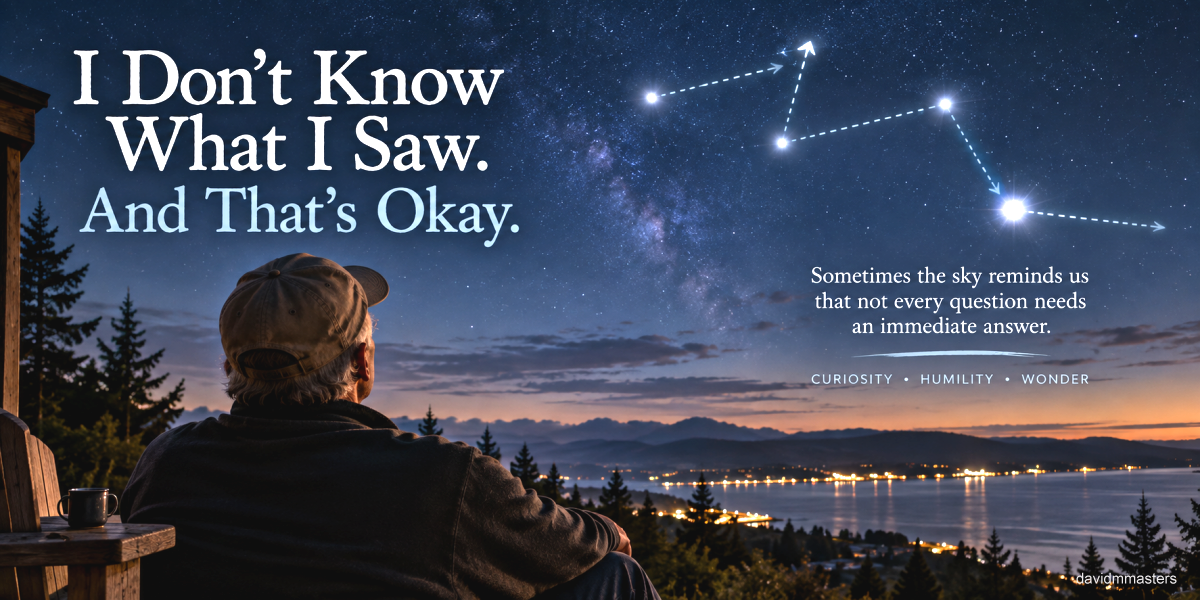
Strange Lights in the Sky I Don’t Know What I Saw and That’s Okay

Last night I went outside and looked up. This may have been a mistake.  There was a light moving across the night sky, and I assumed I was looking at an airplane. Nothing unusual about that. Then it moved sideways. Not turned sideways. Moved sideways.

It continued traveling in one direction and then suddenly jumped rapidly on a diagonal before continuing again.

Okay. That got my attention. Then it did it again.

At one point, there was a flash, and the light appeared to jump a considerable distance backward from the direction it had been traveling.

I stood there watching it.

I don’t do drugs. I wasn’t drinking. And unless weather balloons have received a rather impressive technological upgrade, I’m reasonably confident I wasn’t watching one of those.

I don’t know what I saw. There. I said it.

Interestingly, those five words seem extraordinarily difficult for human beings.

I don’t know what I saw.

Not: “It was aliens.”
Not: “It was a secret government spacecraft.”
Not: “It was an airplane and your eyes were playing tricks on you.”
Not even: “David has finally lost it.”

Although you’re certainly entitled to that one. I simply don’t know. And I’ve discovered that not knowing is actually a wonderful place to stand.

I’ve Been Here Before

The strange thing is, this wasn’t my first experience with something behaving oddly in the sky. The last time was more than fifty years ago. I was a youngster living in Astoria, Oregon.

Sometime around 1970, the local radio station DJ, KAST, began talking about reports of strange lights in the sky. Naturally, I went outside.

Then I ran next door because one of the kids had a telescope. The telescope wasn’t much help.

But before long, we didn’t need one. As I remember that night, people started coming out of their houses. Neighbors stood in their yards looking upward. More and more people joined them.

Eventually, it seemed as though everybody was outside watching the show.

And these weren’t simply lights traveling neatly from one horizon to another. They appeared to make abrupt changes in direction.

Things weren’t behaving the way things in the sky were supposed to behave. My recollection is that military aircraft were eventually sent up in response.

I couldn’t wait for the newspaper the next morning. Surely this was going to be front-page news.

At the crack of dawn, the newspaper landed on our porch. Nothing.

I went to school. Some kids laughed when I talked about it. Others had seen it too.

Later, I called KAST. As I remember it, suddenly nobody knew what I was talking about.

That was a peculiar experience for a kid.

And apparently I filed it away somewhere in the cabinet marked:

THINGS I CANNOT EXPLAIN.

I didn’t spend the next fifty years obsessing about it. Life had plenty of other material.

Then Last Night Happened

More than half a century later, I’m standing beneath another night sky watching something I cannot explain.

So, naturally, I did what any modern human being does when confronted by one of life’s mysteries.

I asked a machine. That didn’t go particularly well. I was given several perfectly reasonable explanations for why human perception can be unreliable.

And that’s true. Our eyes can fool us. Our brains fill gaps. Distance is difficult to judge against a dark sky. Lights can appear to move strangely. Atmospheric conditions can create peculiar effects.

All true.

But there’s a funny thing about explanations. An explanation can be possible without being the explanation.

Sometimes we’re so uncomfortable saying “I don’t know” that we’ll grab the nearest plausible answer and promote it immediately to certainty.

That works in both directions.

“Obviously aliens!” Really? How do you know?
“Obviously an optical illusion!” Really? How do you know?

What if we simply left one chair empty for mystery?

Reality Doesn’t Owe Us an Explanation

I think this reaches considerably farther than strange lights in the night sky. We do this everywhere.

Something happens in a relationship. We decide why.
Someone doesn’t return our call. We know what they’re thinking.
A business opportunity collapses. We immediately construct the story explaining what happened.
Someone behaves strangely. Within minutes, we’ve diagnosed their motives, childhood, attachment style, and probably their mother.

Maybe we know. Maybe we don’t.

Reality is an excellent collaborator. It just refuses to rehearse.

There are things we experience that won’t immediately fit inside the filing system we’ve built for the world.

That’s okay.

We don’t have to force them in.

You Don’t Have to Choose a Camp

This may be the most freeing part.

I don’t have to become a UFO guy because I saw something I can’t explain.
I don’t have to buy a telescope.
I don’t have to start a podcast.
I don’t have to build a bunker.
And I don’t have to convince you.

Likewise, I don’t have to pretend I didn’t see what I saw simply because somebody else has a more comfortable explanation for it. I can remain curious. That’s enough.

Maybe somebody reading this knows exactly what I witnessed. Maybe there is a wonderfully ordinary explanation. I’d actually enjoy hearing it. Or maybe I’ll wait another fifty years.

Although at this stage of the game, that particular research strategy may be overly optimistic.

Leave Room for Wonder

I went looking online for the Astoria event I remember from childhood. Years ago, I did find it documented. No such luck today.

Interestingly, there are documented reports of unusual aerial sightings around Astoria from other years. So apparently that little corner of Oregon has had its share of people looking upward and scratching their heads.

Does that prove anything about what I saw? Nope.

And I rather like it that way. Because maybe every unexplained thing doesn’t need to become a belief. Maybe some things can simply become a question.

We can observe carefully. We can investigate. We can consider conventional explanations. We can change our minds when better information arrives. And after we’ve done all that, occasionally we may still be left with three magnificent words: I don’t know.

There is humility there. There is curiosity there. And if we resist filling that empty space too quickly… there might even be wonder.

So, yes. I’ll probably go outside and look at the night sky again. Eventually.

But if anything up there starts jumping backward again… I’m going inside. I’ve got work to do.

God Bless Him. He Made Another Nickel.

My phone rings a lot. I’m a professional, so I answer it.  That’s what you do. It could be a client. It could be someone interested in working with me. It could be something important. So I pick it up. “Hello?” And nine times out of ten… Nothing. A pause. A click. Then: “Hello, this is Jennifer calling about your eligibility for—” Click.

Or someone wants to buy a property I don’t own. Extend the warranty on a vehicle I don’t have. Loan money to a business they know nothing about. Fix my Google listing. Save me from the IRS. Or inform me of some financial catastrophe requiring immediate action involving gift cards.

And somehow they all seem to be calling from a perfectly ordinary local telephone number.

Aargh.

For years, every one of those calls irritated me. Not terribly. Just enough.

That’s the interesting thing about little irritations. They don’t ruin your life. They just take a tiny bite out of it.

Ring. Bite. Ring. Bite. Ring. Bite.

Until one day I decided I needed a better story.

Meet My Imaginary Businessman

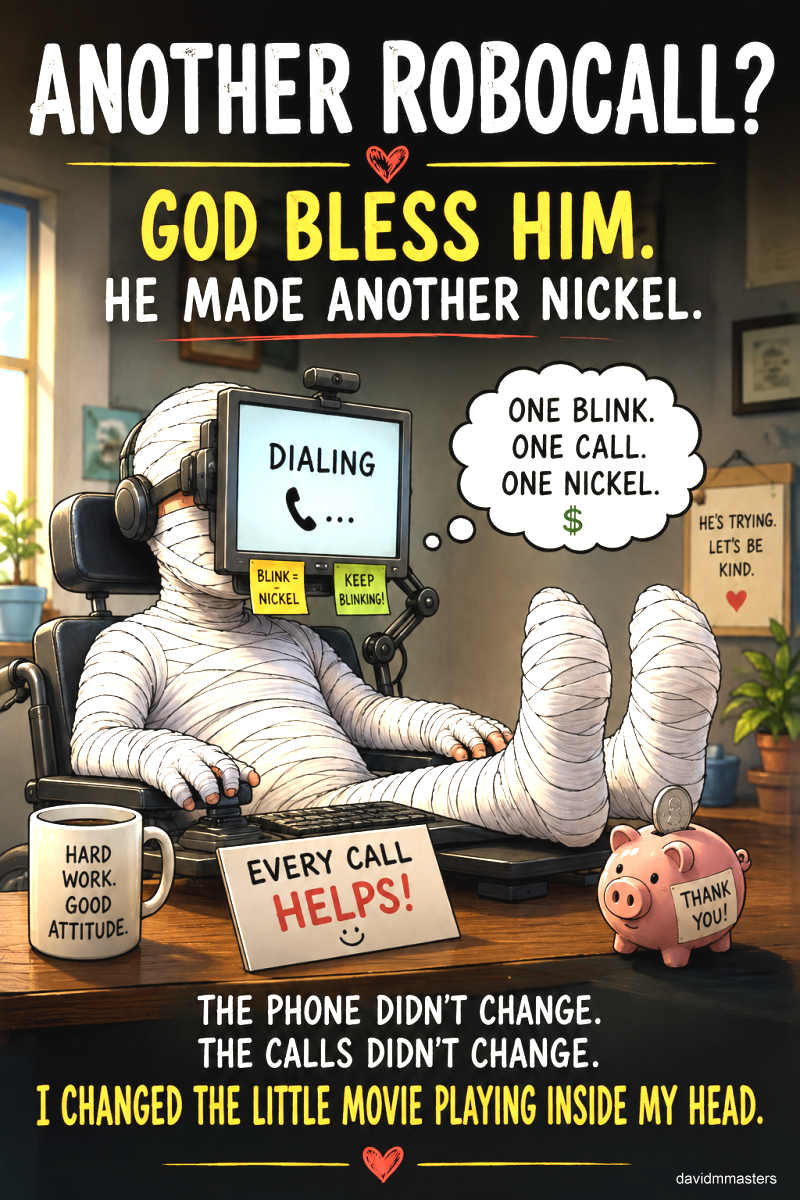
In my imagination, I created a friend. Very successful businessman. Great guy. Then he was in a terrible accident. He became quadriplegic. Couldn’t run his company anymore. The business collapsed.

Unfortunately, he hadn’t created much of a financial backup plan for himself. Things got pretty rough. But eventually somebody found him a job.

They positioned him comfortably in front of a computer. The computer watches his eyes. Every time he blinks… it dials another telephone number. And he gets paid a nickel.

That’s it.

Blink. Nickel. Blink. Nickel.

Then one afternoon my phone rang. I answered. There was that familiar little delay. Immediately I knew. Robocall. And instead of getting irritated, I thought:

God bless him. He made another nickel.

Click. I hung up. And smiled.

Nothing Changed

That’s the ridiculous part. Absolutely nothing changed. The calls didn’t stop. The telemarketers didn’t suddenly develop manners. Nobody removed my number from a database. The technology didn’t improve.

My phone still rings. I still answer it. I still hang up.

The only thing that changed was the little movie playing inside my head. And somehow… that was enough.

We Do This All Day Long Anyway

Human beings are meaning-making machines. Someone doesn’t return our text. We make up a story. Someone looks at us strangely. We make up a story. Traffic stops. Story.

Someone walks past without saying hello. Story. Our spouse gets quiet. Oh boy. Story.

Most of the time, we don’t even realize we’re doing it. Something happens… and our mind supplies the meaning.

The fascinating part is that the first story isn’t necessarily any more accurate than the second one.

So if I’m going to make something up anyway… why not occasionally make up something that makes my life better?

I’m not suggesting we ignore reality.

    • If something needs attention, give it attention.
    • If someone is taking advantage of you, deal with it.
    • If you can block the number, block it.

This isn’t about becoming passive. It’s about noticing those little situations where nothing useful is accomplished by becoming irritated.

That’s where imagination can become surprisingly practical.

You Don’t Have to Change Reality to Change Your Experience of It

Sometimes we spend enormous amounts of energy trying to rearrange the world so that we can finally feel better. And sometimes that’s exactly what needs to happen. But occasionally the world doesn’t need rearranging. Maybe the story does.

The crying baby on the airplane? Maybe Mom hasn’t slept in two days and she’s doing the best she can.

The person driving ridiculously slowly in front of you? Maybe he’s carrying a wedding cake.

The cashier taking forever? Maybe it’s her first day.

The person who forgot your name? Maybe they’ve remembered 300 other people’s names this week.

Are any of those stories true? I have absolutely no idea.

That’s not really the point. Neither was the irritated story I was about to tell myself.

We get to participate in the meaning we assign to ordinary life. That’s a remarkable little freedom. And sometimes all it takes is a ridiculous imaginary friend sitting in front of a computer somewhere…

Blinking.

Working hard. Trying to make ends meet.

So these days, when my phone rings and I discover another completely useless solicitation on the other end, I don’t have to surrender even thirty seconds of my day to irritation.

I just hang up. Smile. And think:

There you go, buddy. Another nickel.

Call me anytime.


One + One = One: How to Love Someone Without Losing Yourself

I have spent a considerable portion of my life running ahead of people. Not running away from them. Running ahead for them. There’s a difference. Someone would come along who appeared to be headed in roughly the same direction I was going, and I would think, “Wonderful! A traveling companion!” And off I’d go.

I’d invest my time. I’d invest my energy. Sometimes I’d invest my money. I’d make introductions, open doors, solve problems, clear obstacles, and start paving the road ahead because I could see where we were going. Or at least I thought I could.

Eventually, I’d look behind me… and nobody was there.

Apparently, my traveling companion had taken an exit about forty miles back. Ugh.

There I’d be with half a bridge, three miles of freshly paved highway, a depleted bank account, and nobody particularly interested in going where I had worked so hard to make it easier for us to go.

There was camaraderie. There were probably some wonderful memories. But eventually I had to ask myself:

How did I get so far off my own path?

It took me a while, but I finally learned something. Today, I call it:

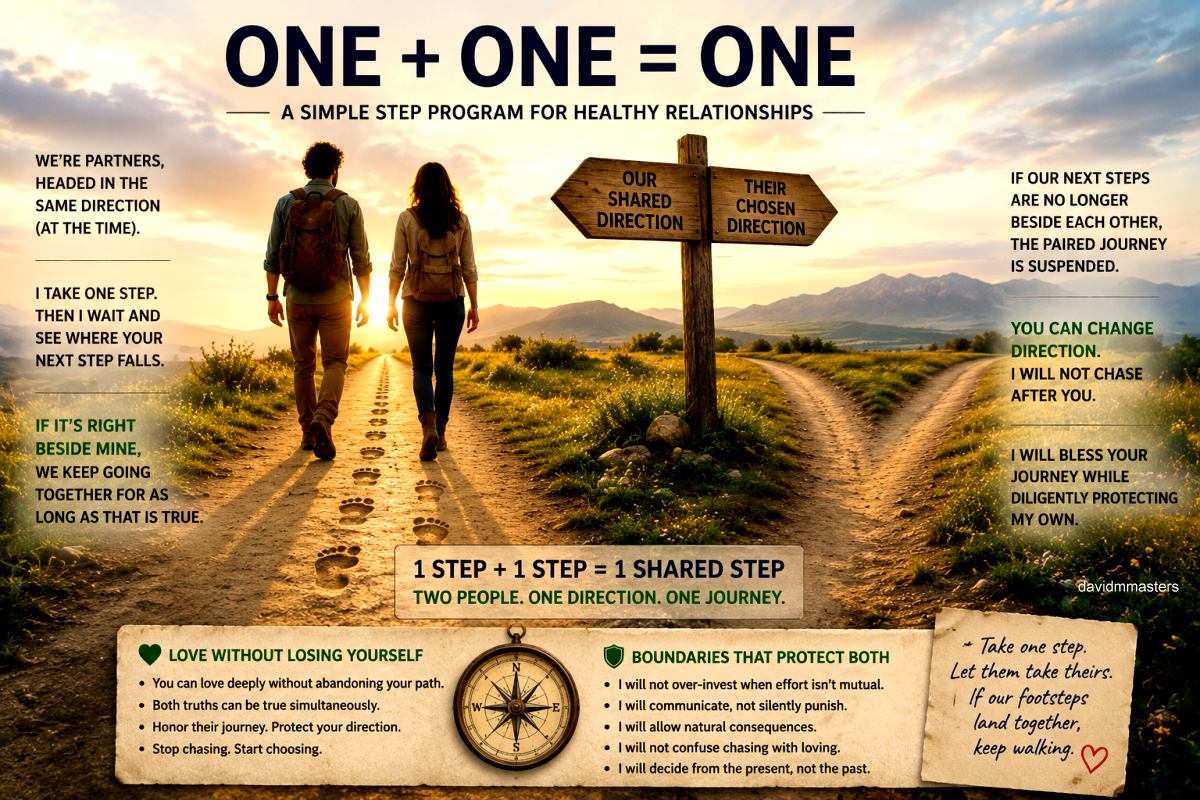
1 + 1 = 1

It’s a simple step program. You take one step. I take one step. And together, we’ve taken one step. That’s it.

If we’re business partners, friends, collaborators, lovers, family members, coach and client, or two people attempting almost anything together, we can walk side by side for as long as our footsteps continue landing beside each other.

I take a step. You take a step. I take another. You take another. Look at us go. But if I take my next step and yours doesn’t appear beside it, something changes.

I don’t necessarily get angry. I don’t have to judge you. I don’t have to decide that you’re unreliable, lazy, selfish, afraid, broken, or wrong. And I certainly don’t need to chase you down.

I simply stop advancing our shared journey until there is another shared step.

That’s 1 + 1 = 1.

You Are Allowed to Change Direction

This is where things get interesting. You are absolutely allowed to change direction. So am I.

Maybe something changed. Maybe you learned something. Maybe what seemed important six months ago doesn’t matter anymore. Maybe you’ve discovered another road that belongs to you.

Wonderful. Go explore it.

I can love you while you’re over there. I can cheer for you from here. I can even be curious about what you discover.

What I don’t have to do is abandon my road and run after you merely because we were once walking together. That’s a distinction I wish I’d understood much earlier in life.

For years, I sometimes valued maintaining the relationship more highly than maintaining my own direction.

That can feel like love. Sometimes it even looks like love. But there is a subtle question worth asking:

Am I loving this person, or am I abandoning myself to preserve our proximity?

Ouch. There are questions that don’t need to yell to get your attention.

Love Doesn’t Require Pursuit

This becomes especially interesting when unconditional love enters the conversation. I believe unconditional love represents one of the highest expressions available to us.

Most people would love to receive it. Giving it? Well… that’s where things get interesting.

Unconditional love doesn’t mean unconditional participation.

    • You can love someone without financing their latest detour.
    • You can love someone without cleaning up every mess.
    • You can love someone without abandoning your priorities.
    • You can love someone without following them somewhere you do not belong.
    • You can love someone and say, “It looks like you’re going that way now. I love you. I’m still going this way.” Both things can be true.

That’s one of the great freedoms of emotional maturity.

But They May Feel Abandoned

Here’s the tricky part. When you stop chasing someone, they may believe you’ve abandoned them.

From their perspective, you always followed before.

    • You always rescued.
    • You always caught up.
    • You always adjusted your direction.

Then suddenly… you didn’t.

To them, your healthy boundary may initially feel like rejection. That doesn’t make their feelings invalid. Their perspective deserves respect too.

This is where communication becomes important. You might say,

“I’m not abandoning you. I’m honoring the direction you’ve chosen. I’m simply not abandoning my direction in order to follow you.”

That’s a very different message.

There may be angst. There may be misunderstanding. There may even be anger.

People see life from different vantage points.

If we want others to respect ours, it seems reasonable to extend the same courtesy to theirs.

Reframing the Moment

If you’d like to experiment with the 1 + 1 = 1 approach, here are a few reframes that may help.

Instead of: “Why aren’t they doing what they said they would do?”

Try: “Their next step belongs to them.”

Instead of: “I need to get them back on track.”

Try: “I need to remain aware of my own track.”

Instead of: “If I don’t help, everything might fall apart.”

Try: “Maybe reality has something to teach here that doesn’t require my interference.”

Instead of: “They’ve abandoned me.”

Try: “Our paths may have separated for now.”

And this is one of my favorites:

Instead of: “How far am I willing to go for this person?”

Ask: “How far can I go without leaving myself behind?”

That’s a completely different question.

Some 1 + 1 = 1 Boundaries

The step program isn’t a collection of demands imposed upon another person. It’s an agreement you make primarily with yourself.

You might decide:

    • I will not continually invest more effort in a shared goal than the other participant is willing to invest.
    • I will take the next reasonable step without taking someone else’s step for them.
    • I will not repeatedly rescue someone from the natural consequences of changing direction.
    • I will communicate rather than silently punish.
    • I will not use withdrawal as manipulation.
    • I will distinguish between patiently waiting and indefinitely putting my own life on hold.
    • I will allow another person to change their mind without making their change a judgment about me.
    • I will periodically ask whether the journey we’re taking is still genuinely shared.
    • I will remain willing to renegotiate our direction when both of us want to.
    • I will love people without requiring myself to follow them everywhere they go.
    • I will respect their path while protecting mine.
    • If our footsteps meet again, I will decide from the present moment—not from obligation to the past—whether walking together still makes sense.

And perhaps the most important:

I will not confuse chasing someone with loving them.

Look Down Occasionally

Relationships can become complicated very quickly.

We make promises. Circumstances change. People change. We change. Nobody needs to become the villain.

Sometimes two people simply stop walking in the same direction. If that happens, you don’t necessarily need a dramatic ending.

You may only need to look down. There’s your footprint. Is theirs beside it? Wonderful. Take another step.

If it isn’t… you don’t have to panic. You don’t have to chase. You don’t have to condemn. You don’t even have to close the door forever.

You can simply stand where you are long enough to notice what is actually happening.

Maybe they’ll return. Maybe you’ll discover a new direction together. Maybe they’ll wave happily from another road. Maybe someone else will eventually come walking alongside you.

You don’t have to know. You can bless another person’s journey without making it your own. You can love someone tremendously without losing yourself in the process.

And when two people really are headed in the same direction?

One step. One step. One shared movement forward.

1 + 1 = 1.

Funny math.

Pretty good traveling.


Maybe You Don’t Need to Ask the Question

There was a time when I placed an enormous amount of importance on people telling me the truth. Honesty. Openness. Integrity. These things mattered to me. They still do. But after nearly a lifetime of being invited into some of the darkest, most private, occasionally unbelievable recesses of people’s lives, I’ve learned something about human beings. People lie. Good people lie. Honest people sometimes lie. People who love you may lie to you.

People lie because they’re afraid. They lie because they’re embarrassed. They lie because they haven’t forgiven themselves yet. They lie because they don’t know how you’ll respond. Sometimes they lie because they don’t know the truth themselves. And sometimes what we call lying is another person desperately trying to protect a room inside themselves that they aren’t ready to open.

That doesn’t make dishonesty good. It doesn’t mean deception should be tolerated when truth is necessary to the health or safety of a relationship. But it has changed the way I ask questions.

These days, before asking someone something deeply personal, I sometimes think:

Would I be disappointed if they lied to me?

That’s an interesting question. Because if the answer is yes, another question immediately follows.

Then do I really need to ask?

Maybe I don’t.

Curiosity Does Not Create Entitlement

We can become curious about something another person has experienced and unconsciously decide that our curiosity gives us a right to know. It doesn’t.

People have sacred spaces. There are memories they may not want to revisit. Experiences they haven’t figured out. Things they regret. Things they don’t understand. Things they may someday tell us. And things they may never tell anyone.

That space belongs to them.

One of the unexpected expressions of wisdom may be learning to stand outside that door without knocking. Not because we don’t care. Because we do.

Every Question Creates a Moment

Suppose there’s something you suspect about someone you love. You could ask.

Maybe they’ll

    • tell you the truth
    • lie
    • tell you half the truth
    • become defensive
    • feel exposed
    • answer honestly and you’ll discover you weren’t prepared for the answer.

Suddenly something that wasn’t damaging the relationship five minutes ago is sitting at the dinner table with both of you.

What did we gain? Sometimes quite a lot.

There are questions that need to be asked. There are things that truly matter, like

    • Safety
    • Consent
    • Commitments
    • Health
    • Finances
    • Faithfulness

Anything materially affecting another person’s ability to make informed choices may require uncomfortable truth.

Love isn’t an excuse for avoiding reality. But there are other questions whose answers change almost nothing. Except perhaps the relationship. Those deserve another moment of consideration.

You Can Leave the Door Open

Something wonderful happens when people discover they don’t have to defend themselves around you. They start talking. Maybe not today. Maybe not next Tuesday. But trust has an interesting way of opening doors that interrogation keeps locked.

You don’t necessarily have to extract someone’s story. You can become a person with whom the story feels safe. That’s different. And it requires patience.

Maybe

    • the answer eventually arrives while you’re driving somewhere
    • it appears over coffee three years later
    • one evening they look at you and say, “There’s something I’ve wanted to tell you.”

And because you never demanded it, they’re finally able to give it freely.

Or maybe they never tell you. Then what?

Well…

Did you

    • love them?
    • enjoy their company?
    • laugh together?
    • encourage one another?
    • build something beautiful?
    • become better human beings because you knew each other?

Then perhaps nothing was missing.

Connection Is Not an Investigation

I think we sometimes approach relationships as though intimacy means knowing everything. I’m no longer convinced that’s true.

Maybe intimacy is not having access to every room. Maybe intimacy is knowing there are rooms you haven’t entered and loving the person anyway.

That’s a different kind of trust. It doesn’t require blindness. It requires discernment.

There will always be questions worth asking. There will always be truths worth pursuing. And there will certainly be moments when someone’s deception must be confronted. But wisdom doesn’t only teach us how to ask better questions.

Sometimes wisdom whispers,

You don’t need to ask this one.

Let it go. Give them their sacred space. Keep walking together.

If the answer needs to become part of your relationship, perhaps someday it will. Meanwhile, you’ve protected something precious.

    • Momentum
    • Dignity
    • Safety
    • Connection

The growing confidence that neither person must live under interrogation to remain loved.

Maybe that’s what leading with love occasionally looks like. Not knowing everything. Not demanding everything. Not resolving everything. Just leaving one door closed… and making sure the person on the other side knows they’re still welcome in your life.

FAQ

Should people in a relationship tell each other everything?

Healthy intimacy does not necessarily require complete access to every memory, thought, or experience. People can maintain personal boundaries while remaining loving, honest, and deeply connected.

Is privacy the same as secrecy in a relationship?

Not necessarily. Privacy preserves personal space and autonomy. Secrecy becomes more concerning when withheld information materially affects another person’s choices, safety, commitments, or wellbeing.

Why do people lie when asked personal questions?

Fear, shame, embarrassment, uncertainty, self-protection, and concern about another person’s reaction can all influence how someone responds to a deeply personal question.

How do you know whether to ask a difficult question?

Consider why you need the information and what you intend to do with it. If the answer materially affects safety, consent, health, finances, faithfulness, or an important commitment, the question may need to be asked. If it primarily satisfies curiosity, allowing privacy may sometimes serve the relationship better.

Can giving someone privacy actually build trust?

Yes. Knowing that personal disclosure will not be demanded can create emotional safety. Sometimes people voluntarily share more when they know they are free not to.


Tomorrow Doesn’t Need Your Permission Amidst Uncertain Times

There are seasons of life when tomorrow feels exciting. A new job. A new relationship. A long-awaited vacation. A dream finally beginning to take shape. And then there are seasons when tomorrow feels like something to survive. Loss has a way of doing that.

Grief rearranges the furniture inside the soul. What once felt familiar suddenly feels foreign. Ordinary routines require extraordinary effort. Even getting dressed, making coffee, or answering a text message can feel surprisingly heavy.

People on the outside may not notice. But inside, everything has changed. Perhaps that’s why so many people quietly wonder if something is wrong with their faith.

“I know what I believe,” they tell themselves. “So why does everything still feel so uncertain?”

The truth is, uncertainty has never been a sign that faith has disappeared. Sometimes it is simply evidence that life has become larger than the answers we currently possess.

We often imagine faith as standing confidently on a mountaintop with both hands lifted toward heaven. But much of real faith doesn’t look like that at all.

    • It looks like making breakfast after you’ve cried yourself to sleep.
    • It looks like driving to work with an empty seat beside you.
    • It looks like paying bills you never expected to face alone.
    • It looks like praying without eloquence because all the polished words have worn out.

Sometimes faith is simply taking one more step when the road ahead disappears into fog. Not because the fog has lifted. Because Love hasn’t.

There is something deeply human about wanting tomorrow explained. \

    • We want details.
    • We want guarantees.
    • We want a map with every twist highlighted before we take the first step.
    • We want to know how long the pain will last.
    • We want to know that the people we love will be okay.
    • We want to know that we will be okay.

Life smiles kindly at those questions… and answers very few of them. Instead, something quieter is offered.

Presence. Not explanations. Presence. Not certainty. Presence.

The older I get, the more I notice that God often gives us enough light for today while keeping tomorrow folded safely in His own hands.

At first, that can feel frustrating. We would rather receive an itinerary. Instead, we receive companionship. Perhaps certainty was never the greater gift. Perhaps companionship always was.

That realization doesn’t erase grief. It doesn’t suddenly refill the empty chair at the dinner table. It doesn’t silence the ache that catches you off guard when you hear a familiar song, smell someone’s cologne, or walk past the grocery shelf where they always reached for the same brand of coffee.

Love remembers. And remembrance can be both beautiful and painful.

Yet somewhere in that sacred tension, another realization quietly begins to emerge.

The Father has not abandoned you simply because the road became difficult. He has not stepped away because your prayers have become shorter. He has not become disappointed because your confidence occasionally gives way to tears.

Some of the strongest faith you’ll ever discover doesn’t look strong at all.

    • It looks like whispering, “Father… please stay close.”
    • It looks like choosing kindness when your heart is tired.
    • It looks like getting out of bed one more morning.
    • It looks like believing that even if you cannot see beyond today, the One who loves you already can.

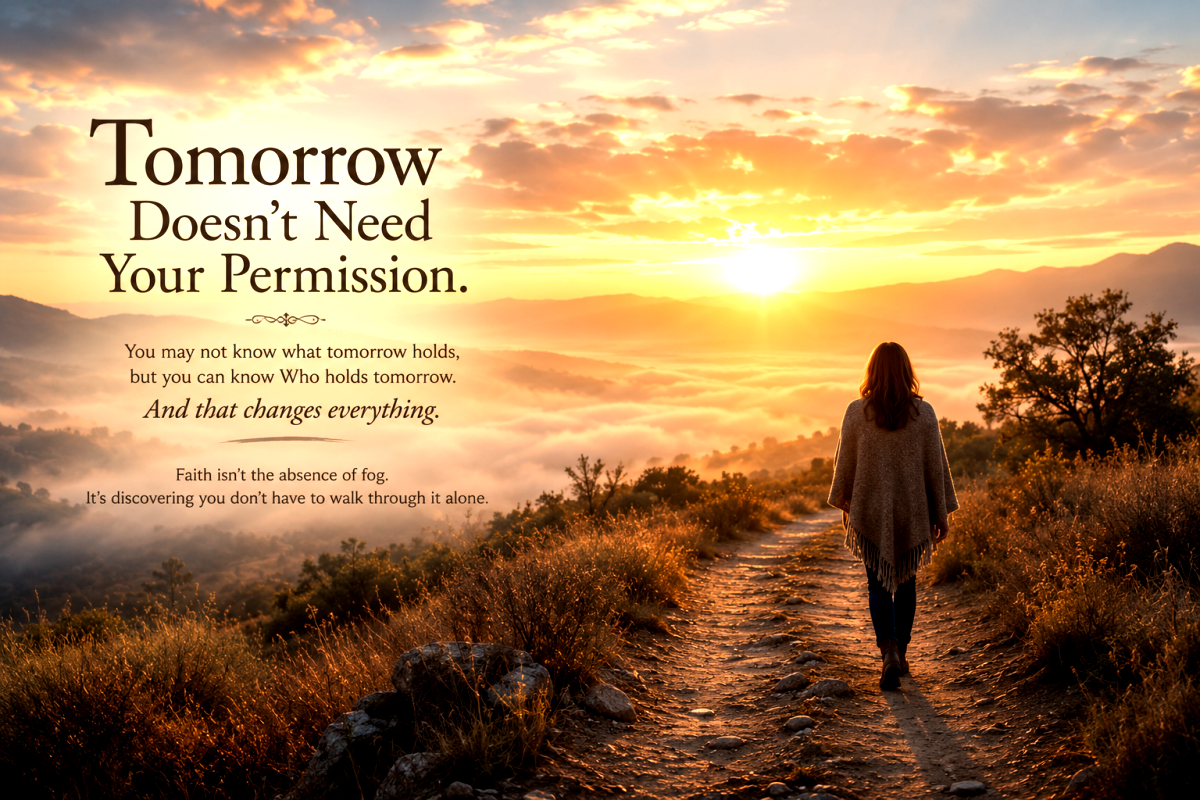
Perhaps faith isn’t the absence of fog. Perhaps faith is discovering you don’t have to walk through it by yourself.

If today feels uncertain, you’re in good company.

Throughout history, countless men and women of deep faith have stood where you are standing now. They didn’t always understand what God was doing. They didn’t always receive immediate answers. They didn’t always feel courageous. But they discovered something that certainty could never have taught them.

God is often most deeply experienced in the places where we finally run out of our own ability to see.

Maybe that’s where you are today.

If so, be gentle with yourself.

    • You are allowed to miss someone.
    • You are allowed to feel overwhelmed.
    • You are allowed to have questions that remain unanswered for a while.
    • You are allowed to rest.

God has never required perfect emotional weather before walking with His children. He has always been willing to meet them in storms.

If all you can manage today is one small step… take one.

If all you can pray is, Fatherstay close.”  That is enough.

If all you can do is breathe deeply and trust that Love has not forgotten your address… that is enough too.

Tomorrow will arrive when it arrives. And when it does, you may discover something beautiful. The strength you needed wasn’t waiting for you yesterday. It will arrive with tomorrow’s grace. Because the Father has always been faithful that way.

You may not be able to see tomorrow. Neither can anyone else. But perhaps the goal was never to see farther. Perhaps it was simply to discover that Love can see farther than you can…

and has been quietly walking beside you the entire time.

Your Friends Are Not Your Clients | Professional Boundaries

If you’re a coach, consultant, counselor, practitioner, therapist, financial advisor, attorney, minister, or just about any other professional, you’ve probably heard some version of this: “Can I ask you a quick question?” Of course they can. And because they’re your friend, you usually answer.

Five minutes later, you’re halfway through what would normally be a paid consultation. Twenty minutes later, they’re asking follow-up questions. An hour later, they’ve mentally enrolled in your expertise without ever enrolling in your process.

Then comes my favorite part. Several weeks later they tell you… “I tried what you said.” Followed by, “It didn’t really work.”

Or perhaps… “I thought you were going to help me with the rest.”

Wait… The rest?

Here’s the part that’s easy to forget. Professional results rarely come from professional answers. They come from professional processes.

A paid client doesn’t simply receive information. They receive observation. Clarification. Questions they didn’t know to ask. Context. History. Strategy. Accountability. Adjustments. Encouragement. Honest feedback. Someone walking beside them long enough to notice when they’re unknowingly sabotaging themselves.

Most breakthroughs don’t happen because of one brilliant sentence. They happen because someone stays with the process. That’s difficult to do over coffee.

Friends often hear the conclusion. Clients experience the journey. Those are very different things.

Imagine asking a surgeon one question at a backyard barbecue. You wouldn’t expect them to perform surgery beside the potato salad. The conversation isn’t the procedure.

The same is true in nearly every profession. Your accountant can answer a tax question. That doesn’t replace a comprehensive tax strategy.

Your attorney may explain a law. That doesn’t establish legal representation.

A mechanic may suspect what’s making the noise. That isn’t the same as diagnosing the vehicle.

Likewise, a coach may offer an idea. But coaching isn’t advice. It’s partnership.

Something else quietly happens when people become paying clients. They become invested. Investment changes attention. Attention changes implementation. Implementation changes outcomes.

People tend to value what they’ve intentionally committed themselves to.

That isn’t about money. It’s about ownership.

Friends also have another advantage that clients don’t. They already know us. Sometimes a little too well. Because they know us socially, they unconsciously assume our expertise must also be casual. It isn’t.

Our friendship is casual. Our profession is not.

Healthy boundaries don’t protect income. They protect relationships.

I’ve found it helpful to say things like:

“I’d be happy to give you a quick thought, but I don’t want to pretend that’s the same as walking through the whole process together.”

Or…

“There’s a much bigger picture here than I can responsibly answer over lunch.”

Or simply…

“That’s a great coaching question, not a coffee question.”

People usually understand. And if they don’t… That tells you something important too.

The professionals reading this already know the feeling. You genuinely want your friends to succeed.

You care.

You hope they flourish.

But caring about someone doesn’t require pretending that a casual conversation can replace a thoughtful professional engagement.

Your friends deserve honesty.

Your clients deserve excellence.

Fortunately…

Those two things can coexist beautifully.

Sometimes the most caring thing a professional can say isn’t,

“Sure, let’s solve your life in fifteen minutes.”

Sometimes it’s,

“I care too much about you to offer a shortcut where a process is needed.”

That isn’t withholding your gifts.

That’s respecting them.

And perhaps respecting your friend enough to invite them into the kind of transformation that only commitment can produce.


Prison Warden or the Love Warrior Choosing Love Over Control

When someone we love is making destructive choices, something interesting happens inside of us. Part of us wants to rescue. Part of us wants to reason. Part of us wants to fix. And if none of that works, another part quietly begins building a prison. Not always with steel bars. Sometimes with lectures. Sometimes with ultimatums. Sometimes with shame. Sometimes with silence. Sometimes with rules that quietly say, “Become who I think you should be… and then I’ll feel okay.”

I understand. I’ve been there. Watching someone you care about spiral is one of the most painful experiences a human being can endure. When love hurts, control begins looking like compassion. It rarely is.

Two Ends of the Spectrum

Human relationships exist across a wide spectrum. There are moments when immediate protection is necessary. If someone is violent, abusive, or placing others in danger, society has created systems designed to establish boundaries and accountability. Those systems have their place. But most of us aren’t judges. We’re parents. Friends. Spouses. Children. Co-workers. Neighbors. And in those relationships, another option exists. I call it becoming a Love Warrior.

The Love Warrior Leads with Love

A Love Warrior doesn’t pretend destructive behavior is healthy. A Love Warrior doesn’t excuse addiction. Or abuse. Or manipulation. Or dishonesty.

Love doesn’t become blind. It simply refuses to stop seeing the person beneath the behavior. That changes everything.

Instead of asking, “How do I make them stop?”

The Love Warrior begins asking, “What kind of pain could create behavior like this?”

That question changes the atmosphere. Not because it solves the problem. Because it changes the person asking it.

Walking Around in Their Shoes

Here’s an experiment. The next time someone disappoints you… Instead of saying, “I would never do that.” Try asking, “If I were behaving exactly like that… what might be happening inside me?”

Not because you’re right. Because you don’t know. And neither do I.

No one can fully know another person’s internal world.

We see behavior. We rarely see the emotional weather producing it. Fear. Loneliness. Shame. Trauma. Confusion. Exhaustion. Grief. Mental illness. Old wounds. Or perhaps something we’ve never experienced ourselves.

Curiosity opens doors that certainty quietly locks.

The Illusion of Intervention

Many interventions begin with beautiful intentions. “We’re doing this because we love you.” Sometimes they’re necessary. Often they’re not. Too frequently, they create temporary compliance while resentment quietly accumulates beneath the surface.

Pressure can change behavior. It rarely transforms the heart.

The person learns what everyone wants to hear. The performance improves. The relationship doesn’t.

Eventually, the pressure cooker finds a release. Usually with greater damage than before.

You cannot force someone into becoming themselves.

Sacred Space

One of the greatest gifts you can give another human being is sacred space. Not approval. Not agreement. Not enabling. Space.

Space to wrestle. Space to fail. Space to discover. Space to become responsible for their own life.

That can feel unbearable for the people standing nearby. Especially when we desperately want to help. But another person’s journey belongs to them. Not to us.

Boundaries Are Still Love

Choosing love does not mean abandoning wisdom. Love has boundaries.

You may need distance. You may need to protect your family. You may need to protect your finances. You may even need to say, “I love you deeply, but I cannot participate in this.”

Those aren’t contradictions. Those are healthy expressions of love.

Boundaries are not punishment. They are clarity.

A boundary protects both people. Control attempts to own both people.

There is a tremendous difference.

Will You Lose Them?

Maybe. That possibility hurts. Deeply. But remember something important.

You are responsible for your choices. They are responsible for theirs.

Loving someone does not make you responsible for becoming their conscience. Or their jailer. Or their rescuer.

Every one of us arrives carrying a different story. Different wounds. Different fears. Different lessons. Different timing.

We cannot legislate another person’s transformation. Growth is always an inside job.

Choosing Your Uniform

Every difficult relationship quietly asks us a question. Which uniform will you put on today? The Prison Warden? Or the Love Warrior?

One manages behavior. The other protects dignity. One relies primarily on fear. The other invests relentlessly in hope.

One asks, “How do I make them change?” The other wonders, “How can I become a safe place while they discover who they are?”

Not everyone will change. Some won’t. But everyone deserves to be seen as more than their worst day.

Love does not guarantee a happy ending. Neither does control. But love allows us to remain fully human while someone else finds their own path. And sometimes… that is the greatest gift we can possibly give.

Reframing Tools for Becoming a Love Warrior

When you notice your inner Prison Warden taking over, pause and try one of these instead.

    1. Replace Judgment with Curiosity

Instead of: “What’s wrong with them?”

Ask: “What might be hurting inside them?”

    1. Separate the Person from the Behavior

The behavior may be unhealthy.

The person still possesses dignity.

Hold both truths at the same time.

    1. Try On Their Shoes

Ask: “If I were acting exactly like this… what experiences might have brought me here?”

Not to excuse. To understand.

    1. Remember You Cannot Read Minds

Behavior is visible.

Motives rarely are.

Humility creates compassion.

    1. Exchange Control for Influence

You cannot control another adult.

You can become someone whose presence is safe enough to influence them.

    1. Protect Without Punishing

Healthy boundaries say, “This is what I need.”

Punishment says, “Now you’ll suffer.”

There is a world of difference.

    1. Bless Instead of Fix

Sometimes the greatest prayer is, “May you find your own way.”

Not every battle belongs to you.

    1. Let Reality Become the Teacher

Natural consequences often teach more effectively than lectures.

Resist interrupting every lesson life is offering.

    1. Practice Sacred Waiting

Growth is rarely immediate.

Love learns patience.

Control demands schedules.

    1. Ask Better Questions

Instead of, “How do I change them?”

Ask, “Who do I become while walking beside them?”

That question changes everything. Because the Love Warrior’s greatest victory is not controlling another person’s life. It is refusing to lose their own heart while loving someone through theirs.

If You Have a Time Machine | Don’t Start Podcasting About It

I’ve been thinking about time travel lately. No, not because I built a flux capacitor in my garage. And no, this isn’t one of those moments when I try to convince you that Elvis is living on Mars with three government accountants and someone’s pet iguana. Relax. This is just one of those little thought experiments that wandered into my head, sat down, and refused to leave.

Let’s suppose, for the sake of conversation, that someone actually could see the future.

    • Maybe they have a crystal ball.
    • Maybe they have a sophisticated quantum machine.
    • Maybe they simply had one incredibly vivid glimpse of tomorrow.

Here’s my question. The moment they tell you what they saw… haven’t they already started changing it?

Imagine someone says, “On October 17th, the bridge will collapse.” Well… now what?

    • Do people stay home?
    • Does the city inspect the bridge?
    • Does someone reinforce it?
    • Does traffic reroute?
    • Does a construction crew accidentally discover an unrelated problem that saves thousands of lives?

In other words, the prediction itself just entered history.

    • It became another variable.
    • It didn’t merely describe the future.
    • It participated in creating it.

That’s why I’ve always been a little cautious around people who confidently announce, “This is exactly what’s going to happen.”

Maybe. Maybe not.

If the future is alive, then every decision, every conversation, every warning, every prayer, every act of courage, and every unexpected kindness becomes another pebble thrown into the pond. The ripples keep changing.

Even Charles Dickens understood this. Ebenezer Scrooge wasn’t shown the future so he could panic. He was shown one possible future so he could change the present. That’s a very different lesson.

Now, before someone writes me a strongly worded email… No, I’m not dismissing prophecy.

If God intends for certain events to unfold exactly as He has declared, I have absolutely no interest in debating His ability to accomplish His own purposes. I suspect He is entirely capable of protecting His plans without my assistance. This article isn’t about arguing with God. It’s about remembering that most of us aren’t Him.

Most predictions we hear, from experts, influencers, anonymous internet accounts, neighbors, or the guy at the coffee shop who always seems to know somebody who knows somebody, should probably be held with open hands. Take the insight. Leave the certainty.

Use the information to become wiser today instead of becoming obsessed with tomorrow.

There’s another reason I like this approach. Fear spreads quickly. Certainty spreads even faster. Curiosity slows us down just enough to ask better questions.

    • “What if?”
    • “How do we know?”
    • “What could I do today that would make tomorrow better, regardless?”

Those questions have improved far more lives than panic ever has.

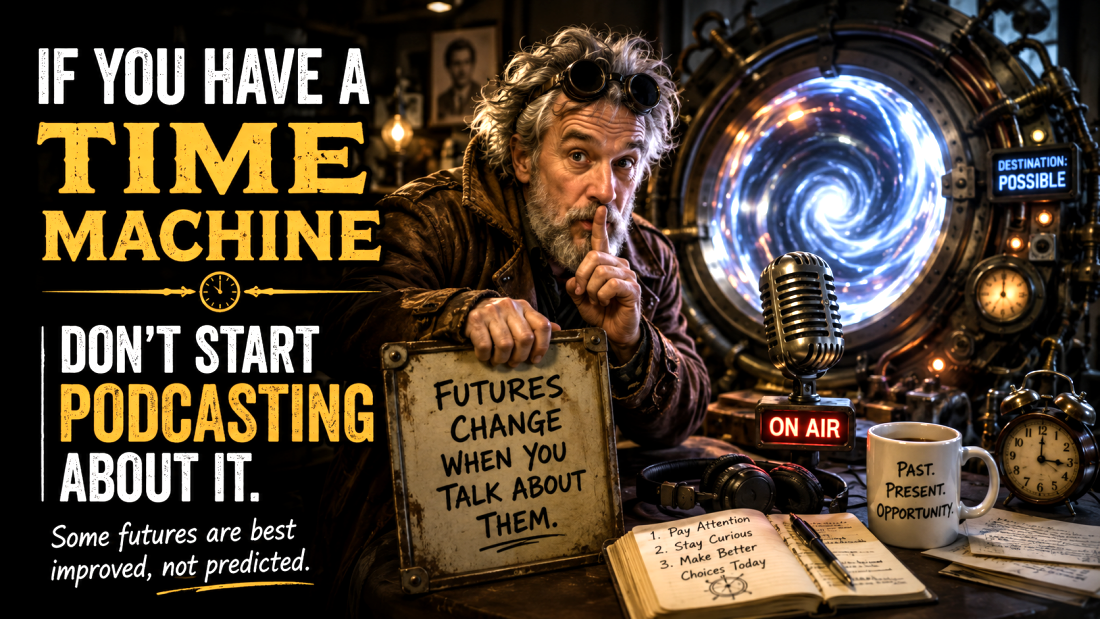
If someone really did invent a working time machine, the smartest thing they could do would be to keep their mouth shut. Because the instant they announced what they saw, millions of people would begin reacting to it.

      • Politicians.
      • Investors.
      • Scientists.
      • Criminals.
      • Journalists.
      • Neighbors.
      • Entire governments.

Suddenly the future they reported wouldn’t be the future anymore. It would become history’s first draft. Maybe that’s one of life’s lessons.

The future isn’t simply something we discover.
It’s also something we participate in.

So, if tomorrow offers you a glimpse of itself, through wisdom, experience, prayer, intuition, good counsel, or even one of those wonderfully strange conversations that makes you think, you don’t have to cling to it.

Receive what is useful. Become a little wiser. Make one better decision today. Then let tomorrow continue being wonderfully alive.

After all, the best way to improve the future has never been arguing about it. It’s living well today.