I’ve been thinking about time travel lately. No, not because I built a flux capacitor in my garage. And no, this isn’t one of those moments when I try to convince you that Elvis is living on Mars with three government accountants and someone’s pet iguana. Relax. This is just one of those little thought experiments that wandered into my head, sat down, and refused to leave.
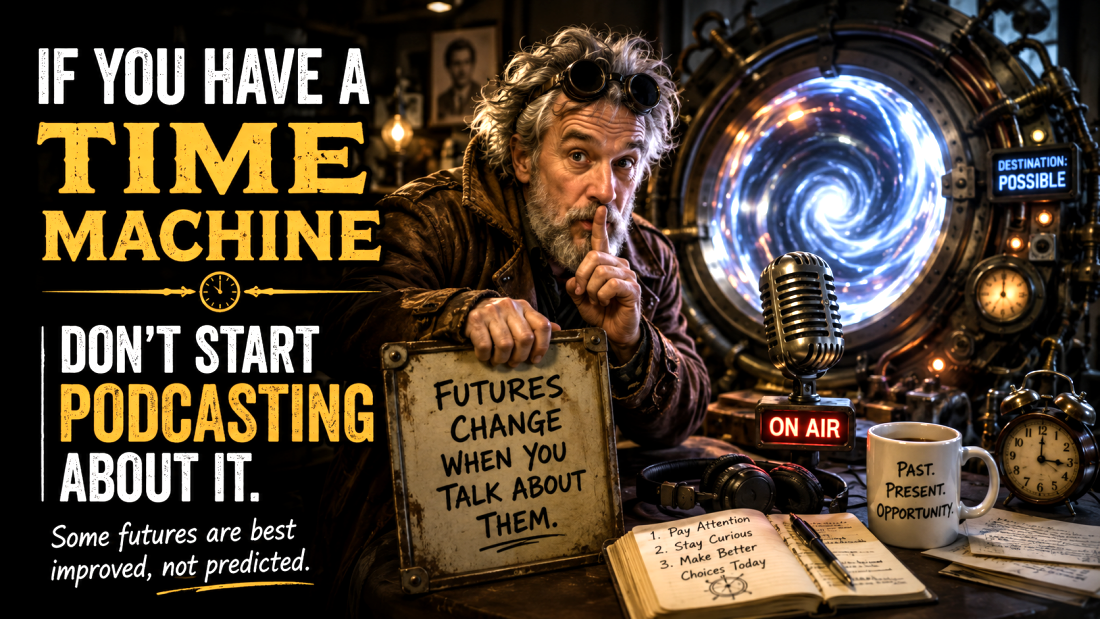
Let’s suppose, for the sake of conversation, that someone actually could see the future.
-
- Maybe they have a crystal ball.
- Maybe they have a sophisticated quantum machine.
- Maybe they simply had one incredibly vivid glimpse of tomorrow.
Here’s my question. The moment they tell you what they saw… haven’t they already started changing it?
Imagine someone says, “On October 17th, the bridge will collapse.” Well… now what?
-
- Do people stay home?
- Does the city inspect the bridge?
- Does someone reinforce it?
- Does traffic reroute?
- Does a construction crew accidentally discover an unrelated problem that saves thousands of lives?
In other words, the prediction itself just entered history.
-
- It became another variable.
- It didn’t merely describe the future.
- It participated in creating it.
That’s why I’ve always been a little cautious around people who confidently announce, “This is exactly what’s going to happen.”
Maybe. Maybe not.
If the future is alive, then every decision, every conversation, every warning, every prayer, every act of courage, and every unexpected kindness becomes another pebble thrown into the pond. The ripples keep changing.
Even Charles Dickens understood this. Ebenezer Scrooge wasn’t shown the future so he could panic. He was shown one possible future so he could change the present. That’s a very different lesson.
Now, before someone writes me a strongly worded email… No, I’m not dismissing prophecy.
If God intends for certain events to unfold exactly as He has declared, I have absolutely no interest in debating His ability to accomplish His own purposes. I suspect He is entirely capable of protecting His plans without my assistance. This article isn’t about arguing with God. It’s about remembering that most of us aren’t Him.
Most predictions we hear, from experts, influencers, anonymous internet accounts, neighbors, or the guy at the coffee shop who always seems to know somebody who knows somebody, should probably be held with open hands. Take the insight. Leave the certainty.
Use the information to become wiser today instead of becoming obsessed with tomorrow.
There’s another reason I like this approach. Fear spreads quickly. Certainty spreads even faster. Curiosity slows us down just enough to ask better questions.
-
- “What if?”
- “How do we know?”
- “What could I do today that would make tomorrow better, regardless?”
Those questions have improved far more lives than panic ever has.
If someone really did invent a working time machine, the smartest thing they could do would be to keep their mouth shut. Because the instant they announced what they saw, millions of people would begin reacting to it.
-
-
- Politicians.
- Investors.
- Scientists.
- Criminals.
- Journalists.
- Neighbors.
- Entire governments.
-
Suddenly the future they reported wouldn’t be the future anymore. It would become history’s first draft. Maybe that’s one of life’s lessons.
The future isn’t simply something we discover.
It’s also something we participate in.
So, if tomorrow offers you a glimpse of itself, through wisdom, experience, prayer, intuition, good counsel, or even one of those wonderfully strange conversations that makes you think, you don’t have to cling to it.
Receive what is useful. Become a little wiser. Make one better decision today. Then let tomorrow continue being wonderfully alive.
After all, the best way to improve the future has never been arguing about it. It’s living well today.
