Strange Lights in the Sky I Don’t Know What I Saw and That’s Okay

Last night I went outside and looked up. This may have been a mistake.  There was a light moving across the night sky, and I assumed I was looking at an airplane. Nothing unusual about that. Then it moved sideways. Not turned sideways. Moved sideways.
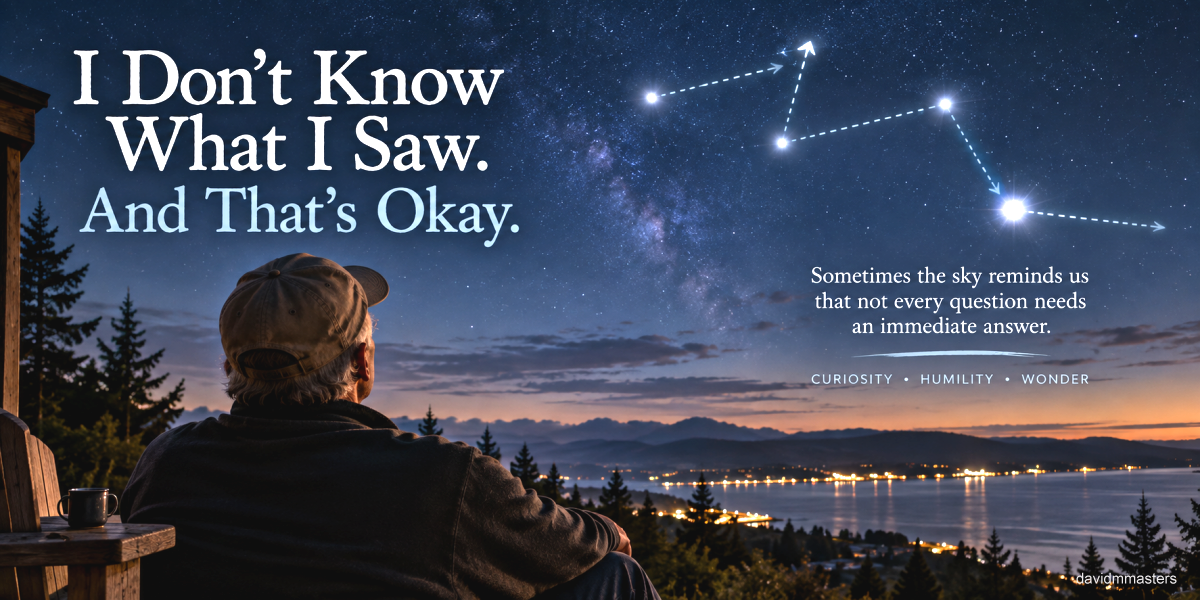
It continued traveling in one direction and then suddenly jumped rapidly on a diagonal before continuing again.

Okay. That got my attention. Then it did it again.

At one point, there was a flash, and the light appeared to jump a considerable distance backward from the direction it had been traveling.

I stood there watching it.

I don’t do drugs. I wasn’t drinking. And unless weather balloons have received a rather impressive technological upgrade, I’m reasonably confident I wasn’t watching one of those.

I don’t know what I saw. There. I said it.

Interestingly, those five words seem extraordinarily difficult for human beings.

I don’t know what I saw.

Not: “It was aliens.”
Not: “It was a secret government spacecraft.”
Not: “It was an airplane and your eyes were playing tricks on you.”
Not even: “David has finally lost it.”

Although you’re certainly entitled to that one. I simply don’t know. And I’ve discovered that not knowing is actually a wonderful place to stand.

I’ve Been Here Before

The strange thing is, this wasn’t my first experience with something behaving oddly in the sky. The last time was more than fifty years ago. I was a youngster living in Astoria, Oregon.

Sometime around 1970, the local radio station DJ, KAST, began talking about reports of strange lights in the sky. Naturally, I went outside.

Then I ran next door because one of the kids had a telescope. The telescope wasn’t much help.

But before long, we didn’t need one. As I remember that night, people started coming out of their houses. Neighbors stood in their yards looking upward. More and more people joined them.

Eventually, it seemed as though everybody was outside watching the show.

And these weren’t simply lights traveling neatly from one horizon to another. They appeared to make abrupt changes in direction.

Things weren’t behaving the way things in the sky were supposed to behave. My recollection is that military aircraft were eventually sent up in response.

I couldn’t wait for the newspaper the next morning. Surely this was going to be front-page news.

At the crack of dawn, the newspaper landed on our porch. Nothing.

I went to school. Some kids laughed when I talked about it. Others had seen it too.

Later, I called KAST. As I remember it, suddenly nobody knew what I was talking about.

That was a peculiar experience for a kid.

And apparently I filed it away somewhere in the cabinet marked:

THINGS I CANNOT EXPLAIN.

I didn’t spend the next fifty years obsessing about it. Life had plenty of other material.

Then Last Night Happened

More than half a century later, I’m standing beneath another night sky watching something I cannot explain.

So, naturally, I did what any modern human being does when confronted by one of life’s mysteries.

I asked a machine. That didn’t go particularly well. I was given several perfectly reasonable explanations for why human perception can be unreliable.

And that’s true. Our eyes can fool us. Our brains fill gaps. Distance is difficult to judge against a dark sky. Lights can appear to move strangely. Atmospheric conditions can create peculiar effects.

All true.

But there’s a funny thing about explanations. An explanation can be possible without being the explanation.

Sometimes we’re so uncomfortable saying “I don’t know” that we’ll grab the nearest plausible answer and promote it immediately to certainty.

That works in both directions.

“Obviously aliens!” Really? How do you know?
“Obviously an optical illusion!” Really? How do you know?

What if we simply left one chair empty for mystery?

Reality Doesn’t Owe Us an Explanation

I think this reaches considerably farther than strange lights in the night sky. We do this everywhere.

Something happens in a relationship. We decide why.
Someone doesn’t return our call. We know what they’re thinking.
A business opportunity collapses. We immediately construct the story explaining what happened.
Someone behaves strangely. Within minutes, we’ve diagnosed their motives, childhood, attachment style, and probably their mother.

Maybe we know. Maybe we don’t.

Reality is an excellent collaborator. It just refuses to rehearse.

There are things we experience that won’t immediately fit inside the filing system we’ve built for the world.

That’s okay.

We don’t have to force them in.

You Don’t Have to Choose a Camp

This may be the most freeing part.

I don’t have to become a UFO guy because I saw something I can’t explain.
I don’t have to buy a telescope.
I don’t have to start a podcast.
I don’t have to build a bunker.
And I don’t have to convince you.

Likewise, I don’t have to pretend I didn’t see what I saw simply because somebody else has a more comfortable explanation for it. I can remain curious. That’s enough.

Maybe somebody reading this knows exactly what I witnessed. Maybe there is a wonderfully ordinary explanation. I’d actually enjoy hearing it. Or maybe I’ll wait another fifty years.

Although at this stage of the game, that particular research strategy may be overly optimistic.

Leave Room for Wonder

I went looking online for the Astoria event I remember from childhood. Years ago, I did find it documented. No such luck today.

Interestingly, there are documented reports of unusual aerial sightings around Astoria from other years. So apparently that little corner of Oregon has had its share of people looking upward and scratching their heads.

Does that prove anything about what I saw? Nope.

And I rather like it that way. Because maybe every unexplained thing doesn’t need to become a belief. Maybe some things can simply become a question.

We can observe carefully. We can investigate. We can consider conventional explanations. We can change our minds when better information arrives. And after we’ve done all that, occasionally we may still be left with three magnificent words: I don’t know.

There is humility there. There is curiosity there. And if we resist filling that empty space too quickly… there might even be wonder.

So, yes. I’ll probably go outside and look at the night sky again. Eventually.

But if anything up there starts jumping backward again… I’m going inside. I’ve got work to do.
Tomorrow Doesn’t Need Your Permission Amidst Uncertain Times

There are seasons of life when tomorrow feels exciting. A new job. A new relationship. A long-awaited vacation. A dream finally beginning to take shape. And then there are seasons when tomorrow feels like something to survive. Loss has a way of doing that.

Grief rearranges the furniture inside the soul. What once felt familiar suddenly feels foreign. Ordinary routines require extraordinary effort. Even getting dressed, making coffee, or answering a text message can feel surprisingly heavy.

People on the outside may not notice. But inside, everything has changed. Perhaps that’s why so many people quietly wonder if something is wrong with their faith.

“I know what I believe,” they tell themselves. “So why does everything still feel so uncertain?”

The truth is, uncertainty has never been a sign that faith has disappeared. Sometimes it is simply evidence that life has become larger than the answers we currently possess.

We often imagine faith as standing confidently on a mountaintop with both hands lifted toward heaven. But much of real faith doesn’t look like that at all.

    • It looks like making breakfast after you’ve cried yourself to sleep.
    • It looks like driving to work with an empty seat beside you.
    • It looks like paying bills you never expected to face alone.
    • It looks like praying without eloquence because all the polished words have worn out.

Sometimes faith is simply taking one more step when the road ahead disappears into fog. Not because the fog has lifted. Because Love hasn’t.

There is something deeply human about wanting tomorrow explained. \

    • We want details.
    • We want guarantees.
    • We want a map with every twist highlighted before we take the first step.
    • We want to know how long the pain will last.
    • We want to know that the people we love will be okay.
    • We want to know that we will be okay.

Life smiles kindly at those questions… and answers very few of them. Instead, something quieter is offered.

Presence. Not explanations. Presence. Not certainty. Presence.

The older I get, the more I notice that God often gives us enough light for today while keeping tomorrow folded safely in His own hands.

At first, that can feel frustrating. We would rather receive an itinerary. Instead, we receive companionship. Perhaps certainty was never the greater gift. Perhaps companionship always was.

That realization doesn’t erase grief. It doesn’t suddenly refill the empty chair at the dinner table. It doesn’t silence the ache that catches you off guard when you hear a familiar song, smell someone’s cologne, or walk past the grocery shelf where they always reached for the same brand of coffee.

Love remembers. And remembrance can be both beautiful and painful.

Yet somewhere in that sacred tension, another realization quietly begins to emerge.

The Father has not abandoned you simply because the road became difficult. He has not stepped away because your prayers have become shorter. He has not become disappointed because your confidence occasionally gives way to tears.

Some of the strongest faith you’ll ever discover doesn’t look strong at all.

    • It looks like whispering, “Father… please stay close.”
    • It looks like choosing kindness when your heart is tired.
    • It looks like getting out of bed one more morning.
    • It looks like believing that even if you cannot see beyond today, the One who loves you already can.

Perhaps faith isn’t the absence of fog. Perhaps faith is discovering you don’t have to walk through it by yourself.

If today feels uncertain, you’re in good company.

Throughout history, countless men and women of deep faith have stood where you are standing now. They didn’t always understand what God was doing. They didn’t always receive immediate answers. They didn’t always feel courageous. But they discovered something that certainty could never have taught them.

God is often most deeply experienced in the places where we finally run out of our own ability to see.

Maybe that’s where you are today.

If so, be gentle with yourself.

    • You are allowed to miss someone.
    • You are allowed to feel overwhelmed.
    • You are allowed to have questions that remain unanswered for a while.
    • You are allowed to rest.

God has never required perfect emotional weather before walking with His children. He has always been willing to meet them in storms.

If all you can manage today is one small step… take one.

If all you can pray is, Fatherstay close.”  That is enough.

If all you can do is breathe deeply and trust that Love has not forgotten your address… that is enough too.

Tomorrow will arrive when it arrives. And when it does, you may discover something beautiful. The strength you needed wasn’t waiting for you yesterday. It will arrive with tomorrow’s grace. Because the Father has always been faithful that way.

You may not be able to see tomorrow. Neither can anyone else. But perhaps the goal was never to see farther. Perhaps it was simply to discover that Love can see farther than you can…

and has been quietly walking beside you the entire time.

If You Have a Time Machine | Don’t Start Podcasting About It

I’ve been thinking about time travel lately. No, not because I built a flux capacitor in my garage. And no, this isn’t one of those moments when I try to convince you that Elvis is living on Mars with three government accountants and someone’s pet iguana. Relax. This is just one of those little thought experiments that wandered into my head, sat down, and refused to leave.

Let’s suppose, for the sake of conversation, that someone actually could see the future.

    • Maybe they have a crystal ball.
    • Maybe they have a sophisticated quantum machine.
    • Maybe they simply had one incredibly vivid glimpse of tomorrow.

Here’s my question. The moment they tell you what they saw… haven’t they already started changing it?

Imagine someone says, “On October 17th, the bridge will collapse.” Well… now what?

    • Do people stay home?
    • Does the city inspect the bridge?
    • Does someone reinforce it?
    • Does traffic reroute?
    • Does a construction crew accidentally discover an unrelated problem that saves thousands of lives?

In other words, the prediction itself just entered history.

    • It became another variable.
    • It didn’t merely describe the future.
    • It participated in creating it.

That’s why I’ve always been a little cautious around people who confidently announce, “This is exactly what’s going to happen.”

Maybe. Maybe not.

If the future is alive, then every decision, every conversation, every warning, every prayer, every act of courage, and every unexpected kindness becomes another pebble thrown into the pond. The ripples keep changing.

Even Charles Dickens understood this. Ebenezer Scrooge wasn’t shown the future so he could panic. He was shown one possible future so he could change the present. That’s a very different lesson.

Now, before someone writes me a strongly worded email… No, I’m not dismissing prophecy.

If God intends for certain events to unfold exactly as He has declared, I have absolutely no interest in debating His ability to accomplish His own purposes. I suspect He is entirely capable of protecting His plans without my assistance. This article isn’t about arguing with God. It’s about remembering that most of us aren’t Him.

Most predictions we hear, from experts, influencers, anonymous internet accounts, neighbors, or the guy at the coffee shop who always seems to know somebody who knows somebody, should probably be held with open hands. Take the insight. Leave the certainty.

Use the information to become wiser today instead of becoming obsessed with tomorrow.

There’s another reason I like this approach. Fear spreads quickly. Certainty spreads even faster. Curiosity slows us down just enough to ask better questions.

    • “What if?”
    • “How do we know?”
    • “What could I do today that would make tomorrow better, regardless?”

Those questions have improved far more lives than panic ever has.

If someone really did invent a working time machine, the smartest thing they could do would be to keep their mouth shut. Because the instant they announced what they saw, millions of people would begin reacting to it.

      • Politicians.
      • Investors.
      • Scientists.
      • Criminals.
      • Journalists.
      • Neighbors.
      • Entire governments.

Suddenly the future they reported wouldn’t be the future anymore. It would become history’s first draft. Maybe that’s one of life’s lessons.

The future isn’t simply something we discover.
It’s also something we participate in.

So, if tomorrow offers you a glimpse of itself, through wisdom, experience, prayer, intuition, good counsel, or even one of those wonderfully strange conversations that makes you think, you don’t have to cling to it.

Receive what is useful. Become a little wiser. Make one better decision today. Then let tomorrow continue being wonderfully alive.

After all, the best way to improve the future has never been arguing about it. It’s living well today.