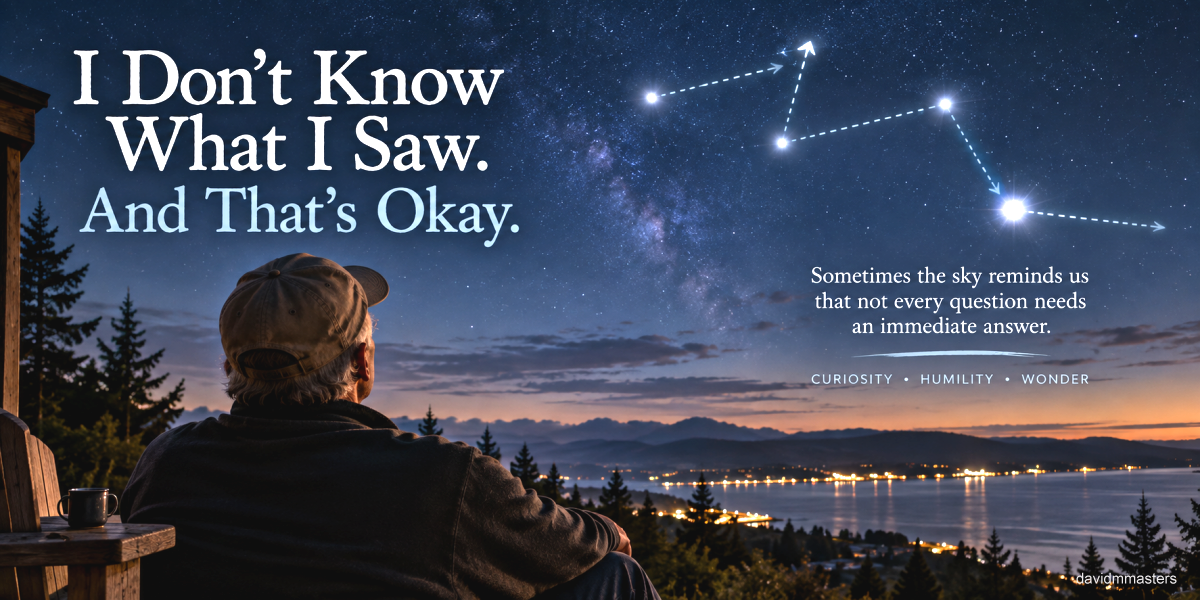
Maybe You Don’t Need to Ask the Question

There was a time when I placed an enormous amount of importance on people telling me the truth. Honesty. Openness. Integrity. These things mattered to me. They still do. But after nearly a lifetime of being invited into some of the darkest, most private, occasionally unbelievable recesses of people’s lives, I’ve learned something about human beings. People lie. Good people lie. Honest people sometimes lie. People who love you may lie to you.

People lie because they’re afraid. They lie because they’re embarrassed. They lie because they haven’t forgiven themselves yet. They lie because they don’t know how you’ll respond. Sometimes they lie because they don’t know the truth themselves. And sometimes what we call lying is another person desperately trying to protect a room inside themselves that they aren’t ready to open.

That doesn’t make dishonesty good. It doesn’t mean deception should be tolerated when truth is necessary to the health or safety of a relationship. But it has changed the way I ask questions.

These days, before asking someone something deeply personal, I sometimes think:

Would I be disappointed if they lied to me?

That’s an interesting question. Because if the answer is yes, another question immediately follows.

Then do I really need to ask?

Maybe I don’t.

Curiosity Does Not Create Entitlement

We can become curious about something another person has experienced and unconsciously decide that our curiosity gives us a right to know. It doesn’t.

People have sacred spaces. There are memories they may not want to revisit. Experiences they haven’t figured out. Things they regret. Things they don’t understand. Things they may someday tell us. And things they may never tell anyone.

That space belongs to them.

One of the unexpected expressions of wisdom may be learning to stand outside that door without knocking. Not because we don’t care. Because we do.

Every Question Creates a Moment

Suppose there’s something you suspect about someone you love. You could ask.

Maybe they’ll

    • tell you the truth
    • lie
    • tell you half the truth
    • become defensive
    • feel exposed
    • answer honestly and you’ll discover you weren’t prepared for the answer.

Suddenly something that wasn’t damaging the relationship five minutes ago is sitting at the dinner table with both of you.

What did we gain? Sometimes quite a lot.

There are questions that need to be asked. There are things that truly matter, like

    • Safety
    • Consent
    • Commitments
    • Health
    • Finances
    • Faithfulness

Anything materially affecting another person’s ability to make informed choices may require uncomfortable truth.

Love isn’t an excuse for avoiding reality. But there are other questions whose answers change almost nothing. Except perhaps the relationship. Those deserve another moment of consideration.

You Can Leave the Door Open

Something wonderful happens when people discover they don’t have to defend themselves around you. They start talking. Maybe not today. Maybe not next Tuesday. But trust has an interesting way of opening doors that interrogation keeps locked.

You don’t necessarily have to extract someone’s story. You can become a person with whom the story feels safe. That’s different. And it requires patience.

Maybe

    • the answer eventually arrives while you’re driving somewhere
    • it appears over coffee three years later
    • one evening they look at you and say, “There’s something I’ve wanted to tell you.”

And because you never demanded it, they’re finally able to give it freely.

Or maybe they never tell you. Then what?

Well…

Did you

    • love them?
    • enjoy their company?
    • laugh together?
    • encourage one another?
    • build something beautiful?
    • become better human beings because you knew each other?

Then perhaps nothing was missing.

Connection Is Not an Investigation

I think we sometimes approach relationships as though intimacy means knowing everything. I’m no longer convinced that’s true.

Maybe intimacy is not having access to every room. Maybe intimacy is knowing there are rooms you haven’t entered and loving the person anyway.

That’s a different kind of trust. It doesn’t require blindness. It requires discernment.

There will always be questions worth asking. There will always be truths worth pursuing. And there will certainly be moments when someone’s deception must be confronted. But wisdom doesn’t only teach us how to ask better questions.

Sometimes wisdom whispers,

You don’t need to ask this one.

Let it go. Give them their sacred space. Keep walking together.

If the answer needs to become part of your relationship, perhaps someday it will. Meanwhile, you’ve protected something precious.

    • Momentum
    • Dignity
    • Safety
    • Connection

The growing confidence that neither person must live under interrogation to remain loved.

Maybe that’s what leading with love occasionally looks like. Not knowing everything. Not demanding everything. Not resolving everything. Just leaving one door closed… and making sure the person on the other side knows they’re still welcome in your life.

FAQ

Should people in a relationship tell each other everything?

Healthy intimacy does not necessarily require complete access to every memory, thought, or experience. People can maintain personal boundaries while remaining loving, honest, and deeply connected.

Is privacy the same as secrecy in a relationship?

Not necessarily. Privacy preserves personal space and autonomy. Secrecy becomes more concerning when withheld information materially affects another person’s choices, safety, commitments, or wellbeing.

Why do people lie when asked personal questions?

Fear, shame, embarrassment, uncertainty, self-protection, and concern about another person’s reaction can all influence how someone responds to a deeply personal question.

How do you know whether to ask a difficult question?

Consider why you need the information and what you intend to do with it. If the answer materially affects safety, consent, health, finances, faithfulness, or an important commitment, the question may need to be asked. If it primarily satisfies curiosity, allowing privacy may sometimes serve the relationship better.

Can giving someone privacy actually build trust?

Yes. Knowing that personal disclosure will not be demanded can create emotional safety. Sometimes people voluntarily share more when they know they are free not to.


Prison Warden or the Love Warrior Choosing Love Over Control

When someone we love is making destructive choices, something interesting happens inside of us. Part of us wants to rescue. Part of us wants to reason. Part of us wants to fix. And if none of that works, another part quietly begins building a prison. Not always with steel bars. Sometimes with lectures. Sometimes with ultimatums. Sometimes with shame. Sometimes with silence. Sometimes with rules that quietly say, “Become who I think you should be… and then I’ll feel okay.”

I understand. I’ve been there. Watching someone you care about spiral is one of the most painful experiences a human being can endure. When love hurts, control begins looking like compassion. It rarely is.

Two Ends of the Spectrum

Human relationships exist across a wide spectrum. There are moments when immediate protection is necessary. If someone is violent, abusive, or placing others in danger, society has created systems designed to establish boundaries and accountability. Those systems have their place. But most of us aren’t judges. We’re parents. Friends. Spouses. Children. Co-workers. Neighbors. And in those relationships, another option exists. I call it becoming a Love Warrior.

The Love Warrior Leads with Love

A Love Warrior doesn’t pretend destructive behavior is healthy. A Love Warrior doesn’t excuse addiction. Or abuse. Or manipulation. Or dishonesty.

Love doesn’t become blind. It simply refuses to stop seeing the person beneath the behavior. That changes everything.

Instead of asking, “How do I make them stop?”

The Love Warrior begins asking, “What kind of pain could create behavior like this?”

That question changes the atmosphere. Not because it solves the problem. Because it changes the person asking it.

Walking Around in Their Shoes

Here’s an experiment. The next time someone disappoints you… Instead of saying, “I would never do that.” Try asking, “If I were behaving exactly like that… what might be happening inside me?”

Not because you’re right. Because you don’t know. And neither do I.

No one can fully know another person’s internal world.

We see behavior. We rarely see the emotional weather producing it. Fear. Loneliness. Shame. Trauma. Confusion. Exhaustion. Grief. Mental illness. Old wounds. Or perhaps something we’ve never experienced ourselves.

Curiosity opens doors that certainty quietly locks.

The Illusion of Intervention

Many interventions begin with beautiful intentions. “We’re doing this because we love you.” Sometimes they’re necessary. Often they’re not. Too frequently, they create temporary compliance while resentment quietly accumulates beneath the surface.

Pressure can change behavior. It rarely transforms the heart.

The person learns what everyone wants to hear. The performance improves. The relationship doesn’t.

Eventually, the pressure cooker finds a release. Usually with greater damage than before.

You cannot force someone into becoming themselves.

Sacred Space

One of the greatest gifts you can give another human being is sacred space. Not approval. Not agreement. Not enabling. Space.

Space to wrestle. Space to fail. Space to discover. Space to become responsible for their own life.

That can feel unbearable for the people standing nearby. Especially when we desperately want to help. But another person’s journey belongs to them. Not to us.

Boundaries Are Still Love

Choosing love does not mean abandoning wisdom. Love has boundaries.

You may need distance. You may need to protect your family. You may need to protect your finances. You may even need to say, “I love you deeply, but I cannot participate in this.”

Those aren’t contradictions. Those are healthy expressions of love.

Boundaries are not punishment. They are clarity.

A boundary protects both people. Control attempts to own both people.

There is a tremendous difference.

Will You Lose Them?

Maybe. That possibility hurts. Deeply. But remember something important.

You are responsible for your choices. They are responsible for theirs.

Loving someone does not make you responsible for becoming their conscience. Or their jailer. Or their rescuer.

Every one of us arrives carrying a different story. Different wounds. Different fears. Different lessons. Different timing.

We cannot legislate another person’s transformation. Growth is always an inside job.

Choosing Your Uniform

Every difficult relationship quietly asks us a question. Which uniform will you put on today? The Prison Warden? Or the Love Warrior?

One manages behavior. The other protects dignity. One relies primarily on fear. The other invests relentlessly in hope.

One asks, “How do I make them change?” The other wonders, “How can I become a safe place while they discover who they are?”

Not everyone will change. Some won’t. But everyone deserves to be seen as more than their worst day.

Love does not guarantee a happy ending. Neither does control. But love allows us to remain fully human while someone else finds their own path. And sometimes… that is the greatest gift we can possibly give.

Reframing Tools for Becoming a Love Warrior

When you notice your inner Prison Warden taking over, pause and try one of these instead.

    1. Replace Judgment with Curiosity

Instead of: “What’s wrong with them?”

Ask: “What might be hurting inside them?”

    1. Separate the Person from the Behavior

The behavior may be unhealthy.

The person still possesses dignity.

Hold both truths at the same time.

    1. Try On Their Shoes

Ask: “If I were acting exactly like this… what experiences might have brought me here?”

Not to excuse. To understand.

    1. Remember You Cannot Read Minds

Behavior is visible.

Motives rarely are.

Humility creates compassion.

    1. Exchange Control for Influence

You cannot control another adult.

You can become someone whose presence is safe enough to influence them.

    1. Protect Without Punishing

Healthy boundaries say, “This is what I need.”

Punishment says, “Now you’ll suffer.”

There is a world of difference.

    1. Bless Instead of Fix

Sometimes the greatest prayer is, “May you find your own way.”

Not every battle belongs to you.

    1. Let Reality Become the Teacher

Natural consequences often teach more effectively than lectures.

Resist interrupting every lesson life is offering.

    1. Practice Sacred Waiting

Growth is rarely immediate.

Love learns patience.

Control demands schedules.

    1. Ask Better Questions

Instead of, “How do I change them?”

Ask, “Who do I become while walking beside them?”

That question changes everything. Because the Love Warrior’s greatest victory is not controlling another person’s life. It is refusing to lose their own heart while loving someone through theirs.

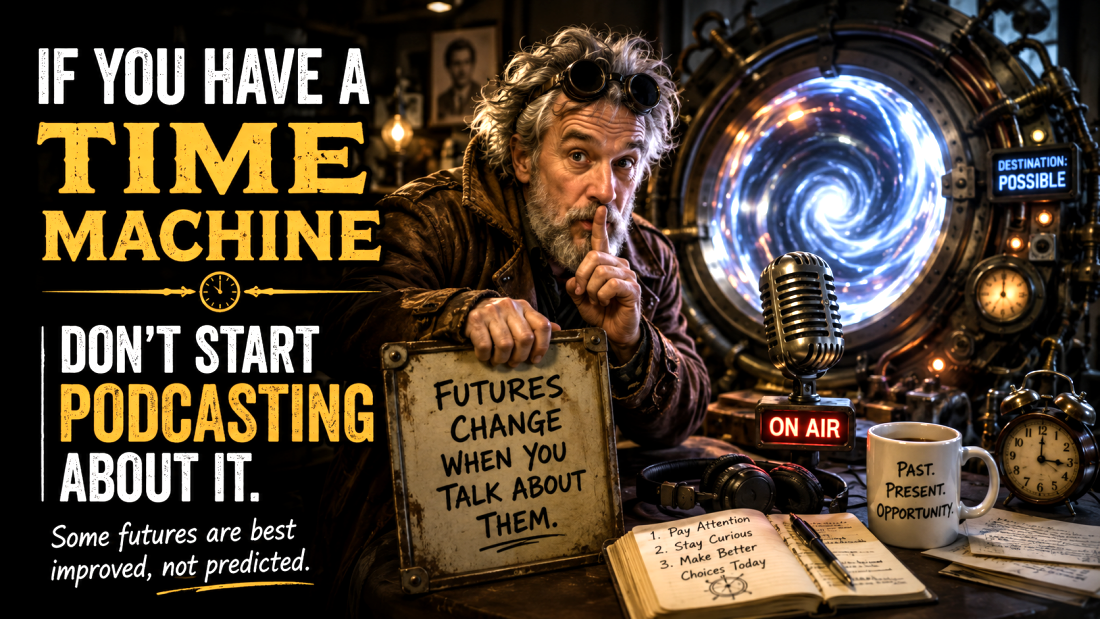
If You Have a Time Machine | Don’t Start Podcasting About It

I’ve been thinking about time travel lately. No, not because I built a flux capacitor in my garage. And no, this isn’t one of those moments when I try to convince you that Elvis is living on Mars with three government accountants and someone’s pet iguana. Relax. This is just one of those little thought experiments that wandered into my head, sat down, and refused to leave.

Let’s suppose, for the sake of conversation, that someone actually could see the future.

    • Maybe they have a crystal ball.
    • Maybe they have a sophisticated quantum machine.
    • Maybe they simply had one incredibly vivid glimpse of tomorrow.

Here’s my question. The moment they tell you what they saw… haven’t they already started changing it?

Imagine someone says, “On October 17th, the bridge will collapse.” Well… now what?

    • Do people stay home?
    • Does the city inspect the bridge?
    • Does someone reinforce it?
    • Does traffic reroute?
    • Does a construction crew accidentally discover an unrelated problem that saves thousands of lives?

In other words, the prediction itself just entered history.

    • It became another variable.
    • It didn’t merely describe the future.
    • It participated in creating it.

That’s why I’ve always been a little cautious around people who confidently announce, “This is exactly what’s going to happen.”

Maybe. Maybe not.

If the future is alive, then every decision, every conversation, every warning, every prayer, every act of courage, and every unexpected kindness becomes another pebble thrown into the pond. The ripples keep changing.

Even Charles Dickens understood this. Ebenezer Scrooge wasn’t shown the future so he could panic. He was shown one possible future so he could change the present. That’s a very different lesson.

Now, before someone writes me a strongly worded email… No, I’m not dismissing prophecy.

If God intends for certain events to unfold exactly as He has declared, I have absolutely no interest in debating His ability to accomplish His own purposes. I suspect He is entirely capable of protecting His plans without my assistance. This article isn’t about arguing with God. It’s about remembering that most of us aren’t Him.

Most predictions we hear, from experts, influencers, anonymous internet accounts, neighbors, or the guy at the coffee shop who always seems to know somebody who knows somebody, should probably be held with open hands. Take the insight. Leave the certainty.

Use the information to become wiser today instead of becoming obsessed with tomorrow.

There’s another reason I like this approach. Fear spreads quickly. Certainty spreads even faster. Curiosity slows us down just enough to ask better questions.

    • “What if?”
    • “How do we know?”
    • “What could I do today that would make tomorrow better, regardless?”

Those questions have improved far more lives than panic ever has.

If someone really did invent a working time machine, the smartest thing they could do would be to keep their mouth shut. Because the instant they announced what they saw, millions of people would begin reacting to it.

      • Politicians.
      • Investors.
      • Scientists.
      • Criminals.
      • Journalists.
      • Neighbors.
      • Entire governments.

Suddenly the future they reported wouldn’t be the future anymore. It would become history’s first draft. Maybe that’s one of life’s lessons.

The future isn’t simply something we discover.
It’s also something we participate in.

So, if tomorrow offers you a glimpse of itself, through wisdom, experience, prayer, intuition, good counsel, or even one of those wonderfully strange conversations that makes you think, you don’t have to cling to it.

Receive what is useful. Become a little wiser. Make one better decision today. Then let tomorrow continue being wonderfully alive.

After all, the best way to improve the future has never been arguing about it. It’s living well today.

Are You a Curious Cat? Ask Questions

If you are a curious cat, ask questions.

As evolved as you might be, no one could possibly know everything, and if you’re like me, you have a lust for understanding, knowledge and seeing things from alternate perspectives. There are some things that are not offered as college classes, and the only way you could possibly have access to this information is to research it on your own and to query others who may have some knowledge or information about any particular topic.

Don’t be afraid. If you’re curious, ask questions. This is a powerful approach to higher learning.

Are You a Curious Cat? Ask Questions
Are you a curious cat? Ask questions.

If you’re of the persuasion to be more curious than your peers, the way you go about asking questions can make a difference. Here are some things to keep in mind that will support your curiosity, without being offensive to those who may have the answer to your questions.

Think about how you like to be approached by someone asking questions. Who gets access to the best information? If you’re like me, it’s the people who have a connection with and care about me.

Be Authentic

You don’t want to seem like you’re an underground reporter for the National Enquirer. People who have access to information or experiences that few of the rest of us have access to are used to being queried about the surface questions, dirty secrets or tabloid-worthy aspects of their particular area of expertise.

Since they are used to having people inquire about their area of expertise, they are normally somewhat on guard and have standard surface replies or sound bites that satisfy the people who ask them questions about what they do, where they’ve been, or what they know. If you want to get to the deeper knowledge or meaning, you need to connect with them and gain their trust.

What Are You Looking For?

Have an idea about what you’d like to know. If you have time, prepare by getting some basic information on their area of expertise beforehand. The Internet can be a powerful tool in preparing you with the basics, as well as possibly indicating questions that others may have about the topic.

If most of your opportunities are spontaneous, you can use this opportunity to honestly state upfront that you are a novice in their area a expertise, and first desire to know some basics.

Exercise Humility

Try to ask questions that come up along the way, while remembering to find was to relate their area of expertise to their personal life, without getting too personal. Once they have briefed you on the basics, you can dig deeper because you are respecting their position as the master, and you as the learner. They are more likely to divulge more than surface information to someone who sees them as more of a mentor. So, honor them with this respect.

Never exert your expertise or knowledge indicating that you are to be considered a comrade on an equal level. There’s no more certain way to get them to not let you in too deep. Don’t challenge them or appear to be adversarial, rather take on the perspective of a respectful student and you will learn more by being humble.

Give and Receive

Certainly, when you are the inquisitor, you are receptive to any information you might be able to gain access to, but seek to give even more. While you may not be an expert in their arena of knowledge, caring about them as a person, and also showing an interest in him or her as a person can help them engage more freely and openly.

One thing I do when I am in a powerful opportunity to exchange information is to add value to them by being open to the idea that the person I’m talking to, the keeper of the information, can learn something from me, or see something from a different perspective, from engaging in a conversation with me.

Even though I might know very little about their area of expertise, quite often, their own knowledge can somewhat expand, and they might even be inspired to dig deeper or start asking new questions as a light goes on inside their head or heart.

Listen and Connect

If you’re blessed enough to be experiencing an exchange of information with this person, then by all means be very attentive and listen to what they have to say. Feed their own words back to them and try to put your own understanding into it to gain a better understanding of what they are saying. This also communicates to them that you are interested in what they have to say.

Active listening creates a connection between people. This connection will indicate you are not just out to obtain data, or are merely passing the time away. Connected people communicate on a higher level.

Is There Anything You Can Do?

As you are exchanging information with this person, be thinking about ways you can support them, their effort (even if it’s just emotional support and empathy), or know someone who might be able to help their cause. You want to be supportive. Your support is not just limited to you, your skills, abilities, or personal resources; it also includes your network of family, friends and other connections. You might be able to refer them to an article or book you have read recently.

The more supportive you are to them, the more likely they will be to continue the conversation. By being interested in, and offering assistance to them and their cause, the more likely they will be to offer to help you out, quid pro quo.

Keep the Door Open

Once you have made a connection with someone, keep the door open. In this day and age everyone is busy, if this person reaches out to you, do not ignore them. Don’t let them monopolize your attention, but keep in contact, briefly (use your resources, such as email, text or brief phone calls). By keeping the door open and maintaining connection, this may come in handy and put you in an advantageous position to be invited to participate in something, or be referred to someone, you might not have otherwise had access to.

If you put them off or ignore them, your connection is lost.

Keep asking questions. Keep learning from others when you have the opportunity.

Are You a Curious Cat? Ask Questions.