One + One = One: How to Love Someone Without Losing Yourself

I have spent a considerable portion of my life running ahead of people. Not running away from them. Running ahead for them. There’s a difference. Someone would come along who appeared to be headed in roughly the same direction I was going, and I would think, “Wonderful! A traveling companion!” And off I’d go.
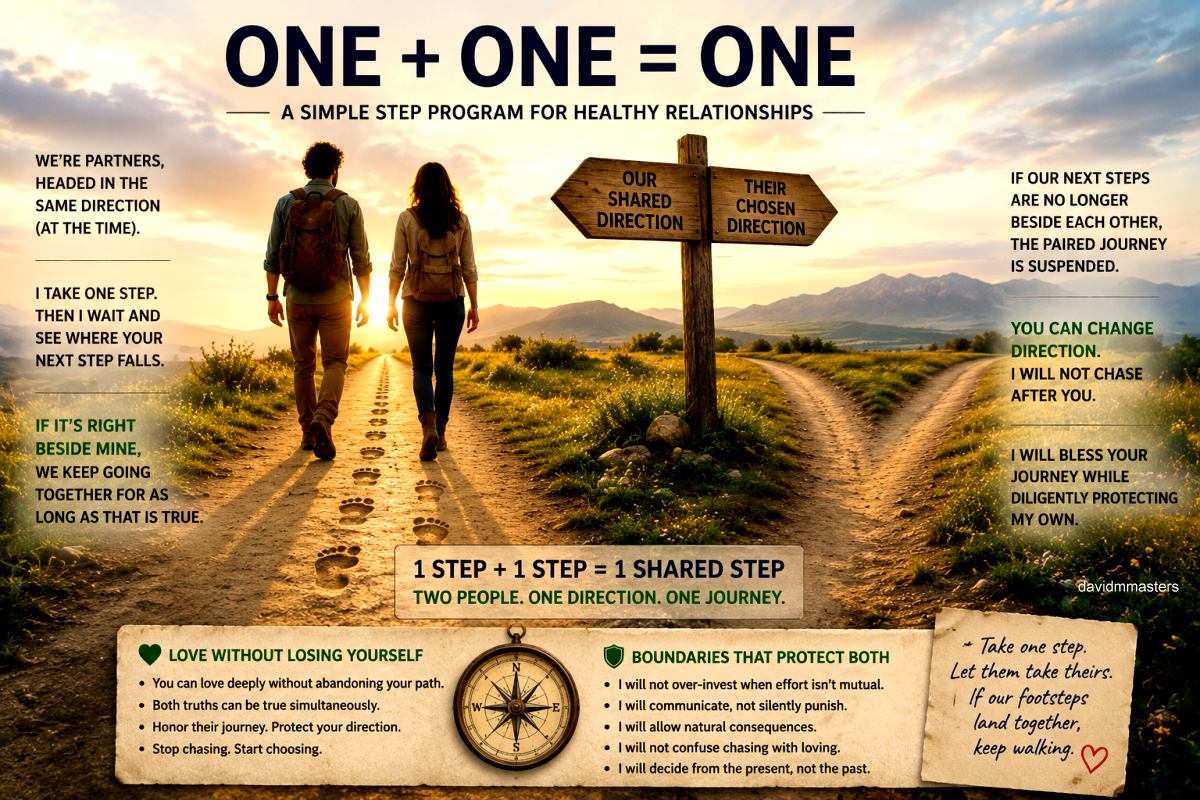
I’d invest my time. I’d invest my energy. Sometimes I’d invest my money. I’d make introductions, open doors, solve problems, clear obstacles, and start paving the road ahead because I could see where we were going. Or at least I thought I could.

Eventually, I’d look behind me… and nobody was there.

Apparently, my traveling companion had taken an exit about forty miles back. Ugh.

There I’d be with half a bridge, three miles of freshly paved highway, a depleted bank account, and nobody particularly interested in going where I had worked so hard to make it easier for us to go.

There was camaraderie. There were probably some wonderful memories. But eventually I had to ask myself:

How did I get so far off my own path?

It took me a while, but I finally learned something. Today, I call it:

1 + 1 = 1

It’s a simple step program. You take one step. I take one step. And together, we’ve taken one step. That’s it.

If we’re business partners, friends, collaborators, lovers, family members, coach and client, or two people attempting almost anything together, we can walk side by side for as long as our footsteps continue landing beside each other.

I take a step. You take a step. I take another. You take another. Look at us go. But if I take my next step and yours doesn’t appear beside it, something changes.

I don’t necessarily get angry. I don’t have to judge you. I don’t have to decide that you’re unreliable, lazy, selfish, afraid, broken, or wrong. And I certainly don’t need to chase you down.

I simply stop advancing our shared journey until there is another shared step.

That’s 1 + 1 = 1.

You Are Allowed to Change Direction

This is where things get interesting. You are absolutely allowed to change direction. So am I.

Maybe something changed. Maybe you learned something. Maybe what seemed important six months ago doesn’t matter anymore. Maybe you’ve discovered another road that belongs to you.

Wonderful. Go explore it.

I can love you while you’re over there. I can cheer for you from here. I can even be curious about what you discover.

What I don’t have to do is abandon my road and run after you merely because we were once walking together. That’s a distinction I wish I’d understood much earlier in life.

For years, I sometimes valued maintaining the relationship more highly than maintaining my own direction.

That can feel like love. Sometimes it even looks like love. But there is a subtle question worth asking:

Am I loving this person, or am I abandoning myself to preserve our proximity?

Ouch. There are questions that don’t need to yell to get your attention.

Love Doesn’t Require Pursuit

This becomes especially interesting when unconditional love enters the conversation. I believe unconditional love represents one of the highest expressions available to us.

Most people would love to receive it. Giving it? Well… that’s where things get interesting.

Unconditional love doesn’t mean unconditional participation.

    • You can love someone without financing their latest detour.
    • You can love someone without cleaning up every mess.
    • You can love someone without abandoning your priorities.
    • You can love someone without following them somewhere you do not belong.
    • You can love someone and say, “It looks like you’re going that way now. I love you. I’m still going this way.” Both things can be true.

That’s one of the great freedoms of emotional maturity.

But They May Feel Abandoned

Here’s the tricky part. When you stop chasing someone, they may believe you’ve abandoned them.

From their perspective, you always followed before.

    • You always rescued.
    • You always caught up.
    • You always adjusted your direction.

Then suddenly… you didn’t.

To them, your healthy boundary may initially feel like rejection. That doesn’t make their feelings invalid. Their perspective deserves respect too.

This is where communication becomes important. You might say,

“I’m not abandoning you. I’m honoring the direction you’ve chosen. I’m simply not abandoning my direction in order to follow you.”

That’s a very different message.

There may be angst. There may be misunderstanding. There may even be anger.

People see life from different vantage points.

If we want others to respect ours, it seems reasonable to extend the same courtesy to theirs.

Reframing the Moment

If you’d like to experiment with the 1 + 1 = 1 approach, here are a few reframes that may help.

Instead of: “Why aren’t they doing what they said they would do?”

Try: “Their next step belongs to them.”

Instead of: “I need to get them back on track.”

Try: “I need to remain aware of my own track.”

Instead of: “If I don’t help, everything might fall apart.”

Try: “Maybe reality has something to teach here that doesn’t require my interference.”

Instead of: “They’ve abandoned me.”

Try: “Our paths may have separated for now.”

And this is one of my favorites:

Instead of: “How far am I willing to go for this person?”

Ask: “How far can I go without leaving myself behind?”

That’s a completely different question.

Some 1 + 1 = 1 Boundaries

The step program isn’t a collection of demands imposed upon another person. It’s an agreement you make primarily with yourself.

You might decide:

    • I will not continually invest more effort in a shared goal than the other participant is willing to invest.
    • I will take the next reasonable step without taking someone else’s step for them.
    • I will not repeatedly rescue someone from the natural consequences of changing direction.
    • I will communicate rather than silently punish.
    • I will not use withdrawal as manipulation.
    • I will distinguish between patiently waiting and indefinitely putting my own life on hold.
    • I will allow another person to change their mind without making their change a judgment about me.
    • I will periodically ask whether the journey we’re taking is still genuinely shared.
    • I will remain willing to renegotiate our direction when both of us want to.
    • I will love people without requiring myself to follow them everywhere they go.
    • I will respect their path while protecting mine.
    • If our footsteps meet again, I will decide from the present moment—not from obligation to the past—whether walking together still makes sense.

And perhaps the most important:

I will not confuse chasing someone with loving them.

Look Down Occasionally

Relationships can become complicated very quickly.

We make promises. Circumstances change. People change. We change. Nobody needs to become the villain.

Sometimes two people simply stop walking in the same direction. If that happens, you don’t necessarily need a dramatic ending.

You may only need to look down. There’s your footprint. Is theirs beside it? Wonderful. Take another step.

If it isn’t… you don’t have to panic. You don’t have to chase. You don’t have to condemn. You don’t even have to close the door forever.

You can simply stand where you are long enough to notice what is actually happening.

Maybe they’ll return. Maybe you’ll discover a new direction together. Maybe they’ll wave happily from another road. Maybe someone else will eventually come walking alongside you.

You don’t have to know. You can bless another person’s journey without making it your own. You can love someone tremendously without losing yourself in the process.

And when two people really are headed in the same direction?

One step. One step. One shared movement forward.

1 + 1 = 1.

Funny math.

Pretty good traveling.

 

Maybe You Don’t Need to Ask the Question

There was a time when I placed an enormous amount of importance on people telling me the truth. Honesty. Openness. Integrity. These things mattered to me. They still do. But after nearly a lifetime of being invited into some of the darkest, most private, occasionally unbelievable recesses of people’s lives, I’ve learned something about human beings. People lie. Good people lie. Honest people sometimes lie. People who love you may lie to you.

People lie because they’re afraid. They lie because they’re embarrassed. They lie because they haven’t forgiven themselves yet. They lie because they don’t know how you’ll respond. Sometimes they lie because they don’t know the truth themselves. And sometimes what we call lying is another person desperately trying to protect a room inside themselves that they aren’t ready to open.

That doesn’t make dishonesty good. It doesn’t mean deception should be tolerated when truth is necessary to the health or safety of a relationship. But it has changed the way I ask questions.

These days, before asking someone something deeply personal, I sometimes think:

Would I be disappointed if they lied to me?

That’s an interesting question. Because if the answer is yes, another question immediately follows.

Then do I really need to ask?

Maybe I don’t.

Curiosity Does Not Create Entitlement

We can become curious about something another person has experienced and unconsciously decide that our curiosity gives us a right to know. It doesn’t.

People have sacred spaces. There are memories they may not want to revisit. Experiences they haven’t figured out. Things they regret. Things they don’t understand. Things they may someday tell us. And things they may never tell anyone.

That space belongs to them.

One of the unexpected expressions of wisdom may be learning to stand outside that door without knocking. Not because we don’t care. Because we do.

Every Question Creates a Moment

Suppose there’s something you suspect about someone you love. You could ask.

Maybe they’ll

    • tell you the truth
    • lie
    • tell you half the truth
    • become defensive
    • feel exposed
    • answer honestly and you’ll discover you weren’t prepared for the answer.

Suddenly something that wasn’t damaging the relationship five minutes ago is sitting at the dinner table with both of you.

What did we gain? Sometimes quite a lot.

There are questions that need to be asked. There are things that truly matter, like

    • Safety
    • Consent
    • Commitments
    • Health
    • Finances
    • Faithfulness

Anything materially affecting another person’s ability to make informed choices may require uncomfortable truth.

Love isn’t an excuse for avoiding reality. But there are other questions whose answers change almost nothing. Except perhaps the relationship. Those deserve another moment of consideration.

You Can Leave the Door Open

Something wonderful happens when people discover they don’t have to defend themselves around you. They start talking. Maybe not today. Maybe not next Tuesday. But trust has an interesting way of opening doors that interrogation keeps locked.

You don’t necessarily have to extract someone’s story. You can become a person with whom the story feels safe. That’s different. And it requires patience.

Maybe

    • the answer eventually arrives while you’re driving somewhere
    • it appears over coffee three years later
    • one evening they look at you and say, “There’s something I’ve wanted to tell you.”

And because you never demanded it, they’re finally able to give it freely.

Or maybe they never tell you. Then what?

Well…

Did you

    • love them?
    • enjoy their company?
    • laugh together?
    • encourage one another?
    • build something beautiful?
    • become better human beings because you knew each other?

Then perhaps nothing was missing.

Connection Is Not an Investigation

I think we sometimes approach relationships as though intimacy means knowing everything. I’m no longer convinced that’s true.

Maybe intimacy is not having access to every room. Maybe intimacy is knowing there are rooms you haven’t entered and loving the person anyway.

That’s a different kind of trust. It doesn’t require blindness. It requires discernment.

There will always be questions worth asking. There will always be truths worth pursuing. And there will certainly be moments when someone’s deception must be confronted. But wisdom doesn’t only teach us how to ask better questions.

Sometimes wisdom whispers,

You don’t need to ask this one.

Let it go. Give them their sacred space. Keep walking together.

If the answer needs to become part of your relationship, perhaps someday it will. Meanwhile, you’ve protected something precious.

    • Momentum
    • Dignity
    • Safety
    • Connection

The growing confidence that neither person must live under interrogation to remain loved.

Maybe that’s what leading with love occasionally looks like. Not knowing everything. Not demanding everything. Not resolving everything. Just leaving one door closed… and making sure the person on the other side knows they’re still welcome in your life.

FAQ

Should people in a relationship tell each other everything?

Healthy intimacy does not necessarily require complete access to every memory, thought, or experience. People can maintain personal boundaries while remaining loving, honest, and deeply connected.

Is privacy the same as secrecy in a relationship?

Not necessarily. Privacy preserves personal space and autonomy. Secrecy becomes more concerning when withheld information materially affects another person’s choices, safety, commitments, or wellbeing.

Why do people lie when asked personal questions?

Fear, shame, embarrassment, uncertainty, self-protection, and concern about another person’s reaction can all influence how someone responds to a deeply personal question.

How do you know whether to ask a difficult question?

Consider why you need the information and what you intend to do with it. If the answer materially affects safety, consent, health, finances, faithfulness, or an important commitment, the question may need to be asked. If it primarily satisfies curiosity, allowing privacy may sometimes serve the relationship better.

Can giving someone privacy actually build trust?

Yes. Knowing that personal disclosure will not be demanded can create emotional safety. Sometimes people voluntarily share more when they know they are free not to.


What “Don’t Throw the Baby Out with the Bathwater” Really Is

One of my early ministry mentors, Brother Bryan, had a saying he repeated often. “Don’t throw the baby out with the bathwater.” At the time, I smiled politely. I understood the words, but I wasn’t sure I understood their weight. Years later, I think I finally do.

The old expression comes from a simple picture. After everyone in the household had bathed, the water was dirty. Really dirty. When it was finally time to dump the tub, you had one more job. Make sure the baby isn’t still in it.

The point wasn’t about bathing. It was about judgment. It was about remembering that something precious can be hidden among things that genuinely need to be discarded.

I think we’ve become remarkably skilled at doing the opposite.

Today, we often throw away the baby first.

    • Someone hears that a priest abused a child. Suddenly, every priest becomes suspect.
    • A teacher commits a terrible crime. Now every teacher must prove they are safe.
    • A police officer acts dishonorably. Every officer wears the stain.
    • A politician lies. Therefore, politicians can’t be trusted.
    • A man betrays his wife. “Once a cheater, always a cheater.”
    • Someone commits a felony. “They’ll always be a criminal.”
    • One member of a race behaves badly. The entire race inherits the accusation.
    • One immigrant.
    • One business owner.
    • One coach.
    • One pastor.
    • One doctor.
    • One stepfather.
    • One teenager.
    • One generation.
    • One denomination.
    • One political party.

Our minds are astonishingly quick at taking one painful story and quietly attaching it to millions of people we’ve never met. Perhaps it’s because our brains are trying to protect us.

Patterns help us survive. If one berry made someone sick, avoid berries. If one cave held a bear, check caves carefully.

Those instincts served our ancestors well. But human beings are not berries.

People are not statistics. And they certainly are not headlines. The news has a difficult job. It reports what is unusual. Very few reporters stand outside a school to announce that every child arrived safely today.

No one interrupts your dinner because another hundred thousand fathers came home from work, hugged their children, and quietly loved their families.

Ordinary goodness is rarely spectacular enough to become breaking news. Extraordinary failure almost always is.

The problem isn’t that we hear about terrible things. The problem is that we begin believing terrible things are ordinary. And somewhere along the way, our curiosity quietly dies.

    • We stop asking.
    • We stop meeting individuals.
    • We stop allowing people to surprise us.

Instead, we file them. Category. Label. Case closed.

Jesus seemed unusually unwilling to do that. He met people one person at a time.

    • Tax collector.
    • Roman soldier.
    • Religious leader.
    • Woman at the well.
    • Fisherman.
    • Leper.
    • Thief.

He somehow managed to see the individual without pretending the problem didn’t exist.

That takes wisdom. It’s easy to condemn an entire group. It’s harder to remain curious. Curiosity isn’t naïve. Curiosity simply refuses to let someone else’s story become everyone else’s sentence.

    • I’ve known remarkable pastors.
    • I’ve known terrible pastors.
    • I’ve known honest business owners.
    • I’ve known dishonest ones.
    • I’ve known people with criminal records who became among the safest, kindest human beings I’ve ever met.

I’ve also known people with spotless résumés who quietly destroyed lives.

Character doesn’t travel in packs. Neither does integrity.

Every human being deserves the dignity of being encountered before being categorized.

Brother Bryan was right. Don’t throw the baby out with the bathwater.

You may discover that the thing worth protecting was there all along. Perhaps the real baby isn’t the person you’re judging. Perhaps it’s your own ability to see people clearly. And that’s something worth protecting.

Everybody Lies | Now What Are You Going to Do About It?

Everybody lies. Some lies are tiny. Some are catastrophic. Some are told to protect others. Some are told to protect ourselves. Some are told because we are afraid of losing love, losing status, losing control, losing security, or losing the carefully constructed image we want the world to believe about us. And every once in a while, someone lies to you that you never expected would.

That one lands differently. Not because the lie itself was necessarily devastating, but because it woke you up. It shook your assumptions. It cracked open your illusion that certain people are somehow above human weakness.

Recently, someone I had known and respected for years lied to me. Not a stranger. Not someone I expected it from. Someone I trusted. And for a brief moment, it threw me for a loop. Not because I do not understand human behavior. I have worked in counseling, coaching, consulting, and personal transformation for a very long time. I know people lie. I know it intellectually. I know it professionally. But sometimes we forget emotionally.

We create little islands of certainty around people we love, admire, or trust. We quietly place them into categories where we no longer expect ordinary human behavior from them. Then one lie reminds us that every single person on this earth is still wrestling with fear, identity, survival, insecurity, shame, ego, and the desperate need to feel safe. Including us. That realization can harden you. Or it can deepen you. That is the crossroads.

Every Lie Is an Opportunity

One of the most valuable tools I have ever developed in my work with people is the willingness to allow space for dishonesty without immediately punishing it. That surprises some people. They expect confrontation. Exposure. Correction. Consequences. But I learned something a long time ago: People often lie before they feel safe enough to tell the truth. Especially in the beginning of a coaching or counseling relationship.

If something does not feel right, sound right, or line up with the facts, I simply make note of it. I do not necessarily attack it immediately. I observe it. I hold awareness around it. I allow the story to breathe. Then something interesting happens.

Over time, the fabricated version becomes exhausting to maintain. The contradictions begin stacking up. The emotional energy required to maintain the false identity becomes heavier and heavier. People start tangling themselves in the barbed wire of their own stories. One lie requires another. Then another. Then another. And eventually, if enough trust and safety exist, many people come clean on their own. Not because they were forced into submission. But because they became exhausted from carrying the weight of separation between who they are and who they pretend to be.

That moment is sacred. Not humiliating. Sacred. Because when a human being finally feels safe enough to be honest, something profound happens inside them. Relief enters the room. Their nervous system softens. Their breathing changes. The armor begins to fall away. And for many people, that may be one of the first moments in their lives they have ever truly felt accepted while being fully seen.

That changes people.

We live in a culture obsessed with justice, exposure, consequences, outrage, and public destruction. Catch the liar. Expose the liar. Punish the liar. Destroy the liar. But very little attention is given to understanding why people lie in the first place.

Fear. Shame. Trauma. Survival. Rejection. Embarrassment. Insecurity. Childhood conditioning. Loss of identity. Fear of abandonment.

Most people do not wake up in the morning plotting evil. Most people are simply terrified of losing something they believe they need in order to survive emotionally. Now, that does not mean accountability disappears. Far from it. Truth matters. Boundaries matter. Integrity matters. But accountability without love often creates better liars instead of transformed people.

Fear-based correction teaches concealment. Love-based awareness teaches integration. That is a very different path.

I was fortunate to grow up around ideas like: “I’m okay, you’re okay.” “Do unto others as you would have them do unto you.” “We are all doing the best we can with what we have.” Those ideas grounded me. Not because they excuse destructive behavior, but because they remind us that human beings are unfinished creatures trying to find their way through life while carrying invisible burdens.

When you approach people with compassion instead of immediate condemnation, something extraordinary becomes possible. Growth. Real growth. Not performative compliance. Not fear-driven obedience. Not temporary behavioral suppression. Actual transformation. And transformation almost never happens through humiliation. It happens through awareness. It happens when people discover truth inside themselves.

That is why I have never been overly interested in controlling clients through rigid systems, punishments, or demands. Yes, structure matters. Yes, accountability matters. But lasting change usually occurs when people arrive at their own realization.

When the light bulb turns on inside them. When they see themselves clearly for the first time. When they finally become tired of running from themselves. That moment cannot be forced. It can only be invited.

People sometimes ask me why I continue doing this work after all these years. The answer is simple. I live for the moment of epiphany. The moment a client suddenly sees the truth about themselves with complete clarity.

The moment the masks fall away. The moment they stop defending their pain and begin understanding it. The moment self-awareness replaces self-deception. That is the payoff for me. To sit in the room while another human being reconnects with themselves is one of the most sacred experiences I know. Not because I “fixed” them. I did not. They found themselves. I simply created enough safety, enough love, enough accountability, enough space, and enough patience for truth to emerge naturally. That is very different from forcing compliance.

So What Are You Going to Do About It?

When someone lies to you, you stand at a fork in the road. You can become cynical. Suspicious. Closed off. Controlling. Punitive. Emotionally armored. Or…

      • You can become wiser without becoming harder.
      • You can develop discernment without losing compassion.
      • You can learn to see human weakness without abandoning human love.

That is the challenge. Not to become naive. But not to become cold either. Because the truth is this:

Every single one of us has lied.
Every single one of us has hidden.
Every single one of us has protected an image.
Every single one of us has feared rejection.

And every single one of us longs to be loved beyond our imperfections. That realization changes the way you see people. Including yourself.

A Practical Guide:

Moving from Strict Accountability to Love-Based Growth

This does not mean becoming weak, passive, or enabling destructive behavior. It means learning how to create environments where transformation becomes possible.

    1. Separate the Person from the Behavior

A lie is behavior.
It is not the entirety of the person.

When you attack identity instead of addressing behavior, people become defensive instead of reflective.

Say:
“That story doesn’t seem consistent.”

Instead of:
“You’re a liar.”

One invites awareness.
The other invites war.

    1. Stay Calm When You Discover Dishonesty

Most people expect emotional punishment.

When you remain calm, observant, and grounded, it creates psychological space for truth to emerge later.

Overreaction often drives dishonesty deeper underground.

    1. Observe Patterns Instead of Isolated Incidents

One contradiction may be confusion.
Repeated contradictions reveal deeper issues.

Notice:

        • Emotional inconsistencies
        • Changing narratives
        • Avoidance patterns
        • Sudden defensiveness
        • Over-explaining
        • Excessive justifications

Observe without becoming consumed by suspicion.

    1. Build Safety Before Demanding Vulnerability

People rarely tell the truth where they feel emotionally unsafe.

If someone believes honesty will lead only to shame, rejection, ridicule, or abandonment, concealment becomes survival.

Safety does not eliminate accountability.
It makes accountability productive.

    1. Ask Questions Instead of Making Accusations

Questions open doors.

Accusations slam them shut.

Try:
“Help me understand something.”

Instead of:
“You’re obviously lying.”

Questions invite self-reflection.

    1. Allow Natural Consequences Without Cruelty

Compassion does not mean removing all consequences.

Trust may need rebuilding.
Boundaries may need strengthening.
Access may need limitation.

But consequences delivered without hatred create opportunity for maturity instead of retaliation.

    1. Recognize Your Own Capacity for Self-Deception

Humility changes everything.

When you understand your own imperfections, you stop approaching others from a throne of moral superiority.

That softens your delivery without weakening your standards.

    1. Leave Room for Redemption

Many people become trapped inside the identity others assign to them.

When you leave room for people to evolve, they sometimes rise into that opportunity.

Not always.

But far more often than cynicism would have you believe.

    1. Focus on Awakening, Not Winning

Winning arguments is easy.

Awakening consciousness is rare.

Ask yourself:
“Do I want revenge, or do I want healing?”

That question changes the entire interaction.

    1. Become the Kind of Person Safe Enough for Truth

This may be the most important step of all.

People tell the truth around people who can handle truth.

Can you?

Can you hear difficult things without collapsing, exploding, condemning, or retaliating?

Can you remain loving while still remaining discerning?

That is emotional maturity.

And that level of love changes lives.

Including your own.


Everyone Wants Unconditional Love Until It Costs Them Something

There’s a moment I’ve seen happen more times than I can count. It taps on your shoulder in a conversation or a relationship, sometimes in the middle of an ordinary day, and if you’re paying attention, you can feel it. Someone says they want to be loved unconditionally. I believe them. They’re not being manipulative or trying to take advantage of anything. They really mean it. They want to be known… and not rejected. They want to be seen clearly… and not reduced to their worst moment. They want to feel safe enough to be human without constantly feeling evaluated. That desire is real and honest. It runs deeper than most people are willing to admit.

Here’s what I’ve also seen: The moment unconditional love stops being an idea… and starts becoming an experience… something shifts. Not outside of them; inside.

I remember sitting with a couple, not in crisis, not on the edge of collapse, but in that quiet place where something had started to feel… off.

Nothing explosive happened. No betrayal or major event. Just tension that didn’t quite make sense. The kind that lingers in the room even when no one is speaking.

At one point, she said, “I just want to feel loved without having to earn it all the time.” And he nodded. Not defensively, no eyeroll; he actually agreed.

Then something subtle happened over the next few weeks. He started changing, not in personality, but in posture. He became… steadier, less reactive. Less pulled into every emotional shift and less likely to defend himself or escalate when tension rose.

Instead of creating peace right away, it created confusion.

She said to me, “I don’t know what’s happening. He’s not reacting the way he used to.”

And I asked her, “Do you feel less loved… or less able to control the rhythm of the interaction?”

She paused. Not because she didn’t understand the question. Because she did.

Unconditional love sounds beautiful until it removes the patterns we’ve learned how to navigate. Because most relationships, whether we realize it or not, run on some form of emotional exchange.

If I lean in, you respond. If I pull back, you pursue. If I get upset, something shifts. There’s a rhythm to it. A predictability, and over time, people learn how to move inside that rhythm. Not always consciously, but effectively.

Then unconditional love enters the room, and it doesn’t follow that rhythm.

Unconditional love doesn’t withdraw when pressure rises, it doesn’t escalate when challenged, nor does it perform to stabilize the moment. It stays. Calm. Clear. Unmoved in the ways people expect, and that’s when things get interesting.

I have seen spouses grow uneasy when their partner remained steady instead of reactive, not because something was wrong, but because something familiar was missing.

I have seen leaders become suspicious when they were corrected without being diminished. No edge or humiliation; just clarity, and strangely, that made them more cautious, not less.

I have seen children push harder against calm, consistent boundaries than they ever did against explosive ones. Why? Because reaction is something you can work with, but calm, anchored presence? You have to adjust yourself to meet that. You can’t move it.

This is where most people begin to feel the cost.

Unconditional love is going to cost you. Not like you might think.

Unconditional love won’t cost you your voice, your boundaries, or your ability to walk away when something is not right. It will cost you something more subtle than that.

Unconditional love will cost you your ability to rely on reaction as a form of control. It costs you the small, almost invisible ways we try to stabilize relationships by influencing how others feel, and for many people, that’s disorienting, because they don’t realize how much of their relational security has been built on that exchange.

Some people hear “unconditional love” and assume it means: Stay no matter what. Accept everything. Endure without question.

I don’t see it that way. Not at all.

Unconditional love, as I’ve come to understand it, and as I’ve watched it actually work in people’s lives, has nothing to do with removing standards. It has everything to do with removing reactivity.

It’s the ability to say, “I care about you. And I’m not going to participate in something that damages either of us.”

No anger or performance, without needing the other person to agree in order for you to stay grounded.

That’s not weakness. That’s strength most people haven’t practiced yet.

There’s a turning point.

You don’t arrive there through theory. You arrive there in a moment where things could go the way they always have… but don’t.

Where you could react… but choose not to.

Where you could try to shape the outcome… but instead stay clear, present, and steady.

Afterward, something feels different. Not necessarily easier. But cleaner. More aligned. More… true.

If I were to reduce this into something simple enough to carry, it would be this:

Unconditional love does not remove boundaries. It removes the need to control.

Maybe even more honestly:

Most people want unconditional love, until it asks them to grow beyond the patterns they rely on.

If you’ve ever found yourself saying, “I just want to be loved for who I am…” That’s not wrong or naive. But there is a second part to that truth that doesn’t get talked about as often. To receive that kind of love… you have to become someone who can stand inside it.

Without needing to shape it. Without needing to test it. Without needing it to behave the way you’re used to.

That’s where this becomes less about what you receive… and more about who you become.

Love Like It’s the Only Thing That Matters

These ideas are explored more deeply in Love Like It’s the Only Thing That Matters, where unconditional love is not treated as a feeling, but as a disciplined, steady way of being that reshapes relationships over time.


Unequal Energetic Break up with a Cheater

Many problems can occur within the bounds of relationships, especially when there is an unequal energetic break up with a cheater at hand. Relationships can bring out the best or the worst among the participants and one partner may be shocked at how everything shifts immediately when they have been unequally yoked with a cheater.

In the throes of a love relationship, everything appears to be equal, as this can be an intimate time of sharing and caring. You might even entertain the of growing in a relationship together, even to become “one flesh,” as they say, or there may be an undercurrent of relationship imbalance that you are unaware of.

Sometimes, even the best of couples can find themselves at odds as they realize their paths are no longer headed in the same direction, and parting, as difficult as it can be, appears to be the only logical thing to do.

There is an unequivocal shift of balance at the end of the relationship when one discovers that he or she has been embroiled with a cheater.

They say that, “He who loves the least rules the relationship.” That is to say one of the partners is a little more demanding of subservience, a sort of, “It’s my way or the highway,” attitude. If one of these lovers is a cheater, the one who is cheating is a little more demanding (for he or she loves the least) insisting that, “If you make one wrong move, I am out of here.” And may add, “and you will never hear from or see me again as long as you live,” or something to that effect.

So, it can come as quite a shock to the lover who has caught his or her partner cheating. The offended partner may have undertaken the rigorous painstaking procedures to launch a personal investigation in the hopes of being able to confront the cheater and have a conversation about the offender’s desire to seek intimate attention outside of the relationship.

Often, this is a good way to go about it, because as many jilted partners have found out, to accuse a partner without any evidence can easily be dismissed as blind jealousy or mental instability.

You are ready. You have exerted much meticulous effort to have the documentation necessary to approach your cheating partner, only to find that at the very first mention of infidelity, your partner responds with something, like, “I told you that if you,” (insert any number of conditions) “that I would be gone, forever.”

Then he or she promptly packs his or her bags and leaves to start his or her new life. The groundwork for which has already been laid. The cheater already has new romantic interests in the wings, may have casual sex partners (nowadays, both physical and virtual) , has a strong network of people set up to party and celebrate with, and can easily defame the partner he or she cheated on, proclaiming that the victim was a jealous psycho who accused him or her (the cheater) of horrendous, unbelievable things (though many of them would be, in fact, truths, if not all of them).

All of this was premeditated and put in place, ready to launch in an instant. All you had to do was to question the cheater. The cheater is under no obligation to respond to any of your accusations or proof. Why? Because it is over.

Only you may still be in love. You may be emotionally and physically suffering from the impact of the reality of this situation, and maybe your intention was to try to work through this crisis to see of your relationship would be one of the great relationships which could survive infidelity. And believe me, many do.

I have seen so many couples recover from infidelity, even from the worst-case scenarios and recover in the most miraculous ways, but it takes faith, dedication, commitment, and a willingness to do the deep (most likely the hardest) work to break through to true love. It happens.

Far more often, though, these relationships end abruptly (though many may go through many break-ups on the way to the final one) with one partner joyously celebrating their new life and freedom, while the other one suffers. This is a clear and present unequal energetic break up with a cheater, which is extremely difficult for the partner cheated upon to recover from.

If the cheater is narcissistic, sociopathic, or has psychopathic tendencies, he or she may be very pleased with him- or her-self the more devastating his or her departure is to the victim of the breakup. The more wounded you are, the more powerful they feel. So, they will often flaunt their new celebratory life in your face as they discredit you all the way, just to add insult to any preexisting injury.

Has this ever happened to you?

If it has, please understand that you did nothing wrong. You may feel bad due to being suddenly shocked by the infidelity, the lies, the cheating, and no one would blame you. You are still in love and your ex- not so much. He or she is gone and trashing you all the way as they embark on their new life, while your heart is broken and bleeding.

Try not to give them the satisfaction of seeing you suffer. Healing will take time. Surround yourself with anyone who will not discredit you or call you a liar. Hopefully, you can find someone who will tell you something nice about you for a change. When you find these people keep them close and find your strength from within to feel good about yourself… without the need to strike out at your ex.

Most people will seek some revenge and want to expose the cheater with the truth of the proof they have gathered. Believe me, this will only prolong your healing process, and make your life even more drama prone. Resist seeking revenge.

The best revenge is to live a vastly successful and amazing life, regardless of what challenges you may have faced. Focus on doing that, as you ignore your naysayers.

You may find yourself participating in poor self-talk, ruminating about the past, thinking about the time and energy you wasted truly loving this person, beating yourself up for not seeing this sooner, or any other type of negative thought patterns. Please find ways to resist doing so, and thank God, that you found out now, and not later. (This could have been far worse if it had been allowed to continue even longer.)

You are better off without this person’s deceit and lies in your life.

Though it may not seem like it right now, know this: There is someone out there who is so well suited for you that every moment you spend with him or her will seem like a miracle in comparison to this experience.


I Almost Married a Mexican Hooker!

Six months ago, a business consulting client of mine comes in for his regularly scheduled appointment and says, “I almost married a Mexican hooker!” I think he gets the award for the most shocking opening line. If that doesn’t get your attention, I don’t know what does.

As a business consultant, coach, and counselor, if you are worth your salt in this line of work, your intuitive resources are vast and you’re able to shift your focus quickly and precisely or be able to call in backup in a heartbeat.

In this circumstance, I was able to shift gears and swap hats to help my client navigate this drastic distraction from his forward momentum focused on his track of personal growth and business success.

As a business consultant, I was casually aware of James’ engagement to Maria, and they have been cohabitating for a year since becoming engaged. He had also mentioned before that communication between him and his betrothed was periodically complex due to English being her second language. He had intimated those misunderstandings were commonplace and she would get upset and react negatively once she had misunderstood what he had said.

After a while, James would be able to explain what he had meant to her satisfaction and she would drop her defensive attacks, but bring them up amidst later complicated entanglements where details lost in translation were seen as attacks on Maria’s unquestionable character.

One day, about three months earlier, his brother saw Maria leave her car in a restaurant parking lot and get into another car driven by a man. James’ brother felt uneasy about witnessing this event that his intention was to follow her in this car to see where she was headed but lost them at the traffic light.

Still feeling uneasy about the situation, he told James about what he had seen. James thought he had felt a mysterious disconnection in their relationship, so he had decided to hire a Private Investigator. I was not aware of this chapter taking place as James and I were focused on his buying another business at the time. This says a lot about his ability to move forward even when facing an otherwise distracting time of life at the same time.

He said that he felt he could release the pressure of worrying about the situation by hiring the PI, and that was his intention for just hiring someone else to deal with it. If it turned out to be nothing, no problem. If it ended up being something to be dealt with, he would tend to it when it came to light. (Had he asked me, I might have advised against hiring a detective, as I am of the opinion that it should be a last-ditch effort, not the first line of defense.)

It turns out his brother’s concerns were warranted, but she was not having an affair. This was not a boyfriend. No, he was one of a long line of casual sex partners that she was servicing throughout the week for over a year. Two to three times a week Maria would have them pick her up in an agreed-upon public parking lot and return her to her car after the deed was done (which usually took about an hour and a half). Most of them were one-time-only clients.

According to the investigator, and unbeknownst to James, Maria has two high-functioning cell phones to conduct her affairs that are not related to her personal cell phone account. One phone utilizes an app that functions as a discrete hook-up device for live meetups. This app accounts for meetings, like the one James’ brother witnessed. Maria’s parking lot rendezvous average 26 minutes from pickup to return to her car.

The other phone uses another app that is used for paid live video mutual masturbation as an alternative source of revenue. The jury is still out on whether the live parking lot meetings are also an alternate source of funding, but James’ inclination is that these are paid trysts as well.

Armed with evidence and verifiable data provided by the P.I., James confronted his fiancé and she denied everything and caused a huge quarrel with Maria where she accused James of being a jealous and vindictive person who judged her cruelly for being Mexican, packed her bags, and exited the premises.

James is confused and distraught, as he was well in love with Maria and desired to marry her, but rather than talking this out and seeing their relationship could continue, she just took off and him holding the empty bag. He has dodged the bullet of a potentially toxic marriage.

I am helping to support him with his varying issues and feelings about all this as we continue to move forward with his business dealings, hoping not to let any complications of his personal life interfere with his professional performance.

A good consultant, coach, or counselor should be able to be highly adaptive to the client’s needs as challenges arise. Had I not had these skills onboard, I would have called in some relationship back up right away. I work with a wide variety of consultants, coaches, and counselors, with wide-spanning areas of expertise. My clients and I are comforted knowing help is just a call, text, or email away.

Let life have its way with you but don’t let it stop your forward momentum professionally.*

* =Or at least try to keep it to a minimum.

This Relationship’s Going Nowhere I’m Out

“I am just not feeling it. My husband and I, it’s like we’re from two different planets. I just can’t live in a relationship that’s going nowhere. Can’t do it. I’m out.”

From that to,

“I was in a loveless relationship with my husband and ready to cash-out when I realized that he was my soul mate and now we share the deepest and romantic relationship together forever.”

If you find yourself in a difficult relationship (this applies to all relationships, not just those of the romantic persuasion) you could just bail out when it doesn’t seem to suit your needs (no one would blame you, this is your right) or you might consider, as some have, calling on the power of the universe to have your back.

Those who do, often experience dramatic changes within a year. So, be aware this is not normally instantaneous change. Change, evolution, real change takes time. If you’re interested in giving it a go, consider adopting some of the basic principles that can get you miraculously from where you are now to where you’d love to be with very little effort (though effort is required).

As much as it seems like it’s all about how incompatible this person seems to be in the moment, you might be surprised that this process starts with you. Yes, you.

You have been raised and trained to accept what’s been put on your plate and to expect nothing more. You’ve been programmed for mediocrity and “settling” for less than your highest and best, when that is not what you came here for.

You came here to have it all, and this is your birthright. It’s time you decided to take back your divinity as a child of God and reclaim your sacred life, now.

And it starts with you, getting to know and love you, the true authentic you, with all the blessings that have been bestowed upon you in this life. Even if it looks lackluster, and may have been incredibly painful, causing you to accept anything less than your best life, but has brought you to this moment in time. And the you who you’ve become and as transforming into through this magnificent evolutionary process is nothing less than magnificent.

If you’ve quashed and squelched your special purpose, skills, abilities, and unique message, the universe has caused you to experience life which would further prepare you for this moment, the moment of awakening to your unlimited potential.

Now is the time to start to embrace your divinity and find ways to express who you are through the words you speak and the deeds you do. By activating your 7 points of evolving expansion, you can raise your vibration to love and above.

You must get to know who you really are and love everything that you are and can be in this life and beyond, all of it, even the stuff you thought was not good (and no one was saying it wasn’t bad) but it helped to bring you to who and what you are today, and will magnify your future potential.

Don’t wait for anyone to validate or love you. You are the love of your life. Love yourself deeply, now, more than ever, every day more and more. As you find ways to fill your heart with love, this overflowing love can spill over to the others you care deeply about, your family, your community, and the world at large. Any other form of giving love is really servitude and generosity, if your heart is not full and overflowing with love. (And there’s nothing wrong with that. We need all the love we can get.)

So fill your loving cup by learning to love who you are, accepting and embracing the life that has brought you to this point in time, find ways to fill your heart with love, and take full responsibility for looking after yourself and seeing that your needs are tended to.

When your loving cup is full, then you can truly spread the love that overflows to others.

Sometimes you encounter situations and circumstances that rub you the wrong way. Find ways to take another look at the scenario, from an alternate perspective, keeping in mind that your desire is to raise your vibration to love and above, and maintain this higher frequency.

With any circumstance, there is a full spectrum of responses you can initiate in response to the situation or thought. On one end, you can stand and fight because you’re justifiably “pissed off,” and on the other end of the spectrum, you can choose to apply love and see the event from God’s perspective.

Often perception interpretation can lead to misunderstanding, and no one would blame you for going there. After all, you’ve endured many life experiences that have caused you to reach conclusions rapidly as a form of self-defense. Thankfully, this skill has gotten you this far.

If a person’s words or actions have set off your inner alarms, instead of jumping to conclusions, try jumping into the other person’s perspective. Why would he or she say or do such a thing? What life traumas might be underneath it all? Can you find compassion for someone who might act or react in such a way? Put yourself in the other person’s shoes. What does that feel like?

And if that weren’t enough, look at it from God’s perspective. I could be with a completely indiscriminate person that I do not get, at all, but if I were to ask for God’s opinion, God would say, “I love him” (or her). Could I then, by seeing through the eyes of love, see those redeeming qualities that God sees?

Yeah, I might not agree with them, but they do have that God-loves-‘em-so-much quality about them. Who am I to judge? A little tolerance goes a long way. Try asking yourself What are People Like Who are Tolerant?

The quicker you are to change the way you think about a negative thought and turn it into a loving thought, your love quotient remains at the high level you are practicing to regulate. As with anything, the more often you do it, the easier it gets.

As you start to turnaround how you think about things, the whole world starts to turnaround, adjusting to your new perspective, but you must shift your point of view, first.

Raising your vibration makes you start to expect more positive responses and good things to happen to you, and they do.

If your attention is focused upon this person who you might like to be a better match for you but is not in the moment, no problem. You respect the fact that we’re all doing the best we can with what we have, and this is a beautiful child of God you’re looking at, regardless of how off-base or weird he or she may appear right now.

You can be proactive by giving him or her a chance to respond in a manner which is more befitting of your new higher vibration. You may go through an entire scenario and have it come up leaving you feeling unconnected and empty inside. By all means, do not just walk away in silence. This is the new you, with your full awakened presence intact. Give him or her another chance.

Speak up. Let him or her know that you thought this could have gone better. Try reframing the situation and all the two of you to give it another go, to see if you can come up with a more favorable outcome. If this is practiced in love, with a pure heart, the outcome will be more to your liking. Maybe not to meet your fullest expectation, but look how closer you are to having the synchronicity you desire. Good job.

As you do this, the person you’re practicing with begins to anticipate this as opportunities arise and he or she rises to meet your positive loving expectation. You expect more, receive more of what you want in connection, and love grows.

Love is all there really is  …

When Someone Kicks You Out of Their Life

You were friends connected at a deeper level than other beings. You intrinsically shared the same vibration and trusted each other with your innermost thoughts, guarded feelings, and hidden desires. When someone kicks you out of their life, it leaves an indelible mark, a bruise on your heart, leaving you feeling as though you’ve been betrayed by your most trusted friend.

Navigating Loss and Finding Love Again

Few things sting as deeply as losing someone you thought would be in your life forever. You trusted them with your innermost thoughts, shared moments of connection, and resonated on a level that felt rare and irreplaceable. When someone kicks you out of their life, it’s not just a rejection—it feels like a betrayal, leaving a bruise on your heart that’s hard to heal.

The Unique Pain of Losing a Close Friend

Unlike a marital relationship, where legal and societal frameworks create a sense of security, friendships—no matter how deep—exist without a safety net. There’s no recourse when someone decides to walk away, no way to demand answers or accountability. They simply vanish, and you’re left to pick up the pieces.

If you’ve experienced abandonment in the past, the pain of losing a close friend can hit even harder. You might feel guilt for trusting too much or for letting your guard down. You may wonder, “Should I have seen this coming? Should I have protected myself better?”

The Complexity of Shared Spaces

To make matters worse, you might still have to see this person in professional or social settings. Watching them move through life as if you no longer matter can feel like salt in the wound. Each encounter can reopen the hurt, reminding you of what you’ve lost.

The Grief of Losing a Friend

The loss of a close friend is not unlike the grief that follows death. In fact, it’s sometimes more complicated because they’re still alive—you just no longer exist in their world. This kind of separation can feel like a living loss, akin to someone intentionally removing themselves from your life, much like emotional suicide.

Grief is a natural response, and it’s likely you’ll move through the seven stages of grief: shock, denial, anger, bargaining, depression, testing, and acceptance. Allow yourself the space to process these emotions.

Avoid the Trap of Overthinking

When a friendship ends, it’s natural to wonder, “Why?” Your mind races, trying to piece together what went wrong. But this is a dangerous trap. Overanalyzing the situation or imagining scenarios that may not be true can lead to obsessive thoughts, which only prolong your pain.

Even more concerning, negative thought patterns can weaken your immune system, not just while you’re thinking them, but for hours afterward. This physiological toll only compounds the emotional pain.

Shift Your Focus to Love

Instead of dwelling on what went wrong, redirect your imagination to places where love resides. Reflect on the good times you shared, reliving those moments with gratitude and joy. Immerse yourself in the warmth of those memories without letting them devolve into feelings of betrayal or loss.

This shift in focus has a powerful effect. When you dwell in the frequency of love, your immune system gets a boost that lasts for hours. Love isn’t just a feeling—it’s a state of being that heals, energizes, and uplifts you.

Celebrate the Connection You Had

Even if the relationship is no longer part of your present, you can cherish the moments you were blessed to share. Feel gratitude for the laughter, the connection, and the memories.

While it’s natural to mourn the loss, it’s equally important to celebrate what was. Recognize that not every connection is meant to last forever, but that doesn’t diminish its value.

Rebuild and Move Forward

When someone kicks you out of their life, it’s an opportunity to rediscover yourself and make space for new connections. Here are some ways to move forward:

    • Raise Your Vibration: Find new ways to embrace joy and celebrate life. Engage in activities that bring you happiness and fulfillment.
    • Make New Friends: Open yourself to new relationships. The world is full of people waiting to connect with someone like you.
    • Focus on Self-Love: Reinvest in yourself. The love you cultivate within will attract love from others.

Letting go doesn’t mean you stop caring—it means you release the need for their presence in your life.

The Freedom of Letting Go

When someone chooses to exclude you from their life, they may be missing out on something incredible. But that’s their choice. Your journey continues, and it’s filled with endless possibilities for growth, connection, and love.

Release the hurt. Let go of the questions. Focus on what brings you joy and fulfillment.

Love-On, My Friend

Life is too precious to be spent clinging to what no longer serves you. Embrace the love within you and let it guide your path.

When someone kicks you out of their life, it’s their loss—not yours. You have the power to heal, grow, and thrive.

So, love-on, my friend. Love-on.

Happy Easter

Today, I wished a dear friend, “Happy Easter,” and was met by a highly negative response, verbalized as, “I don’t celebrate Easter,” turning his back to me and walking away.

I get it. Everyone has a right to their own opinion, and I honor that in other people.

Over the course of my life, there are a few holidays that have special meaning for me and my family. In my life, there is a particular hierarchy of these holidays and in order, they have been,

1. Christmas
2. Fourth of July
3. Easter
4. Thanksgiving

The values of the celebration of these holidays decreased due to extreme trauma suffered by me and my family, but basically, the hierarchy remains in place, and as recovery continues, the overall value of these holidays remain as somewhat sacred tradition.

I must admit, when my friend abruptly shut down my friendly gesture of sharing something important to me, I was initially surprised and offended.

I thought of all the times that I supported my friend in the things that were important to him, that I could care less about. Always supportive, never rejecting him, his ideas, or the battles he chose to fight. Celebrating with him his wins and consoling him when struggling without judgment.

I was shocked at his response my simple, friendly salutation.

I was not imposing any belief, trying to convey any importance to the idea of it being Easter or any religious reference which may have been offensive.

Then I realized this was not about me. There was something within my friend which had been triggered by my, “Happy Easter,” and he responded appropriately based on his own inner wounds and fear. His response was not directed at me, even though I had initiated the phrase that triggered an inner child tantrum.

All things considered, he probably did an exceptional job of subduing the inner child’s outburst, had I taken it personally and decided to defend myself, the inner child’s ranting could have expressed itself as a full-on catastrophe.

So, I send love to my friend as he has the rest of the day to struggle with whatever his concerns are about his idea of Easter, and why he is unable to share in someone else’s joy during this (or any other) day that he may respond to negatively.

I understand that he, just like I am, is doing the best with what he has, and I allow him his own sacred space to work out the details, or not, without judgment.

For me, Easter remains to be one of my Top 4 holidays, and it does have spiritual significance for me.

I’ve never been so glad to find out that someone was not where they were supposed to be.

I cannot speak for anyone else and bless you no matter what you think or believe because I believe in you.

I love you.