I’ve discovered a peculiar form of entertainment. I probably shouldn’t admit this. But lately, when I notice someone has a particularly reliable trigger word, I’m occasionally tempted to work it innocently into a conversation just to watch what happens.
Someone says: God.
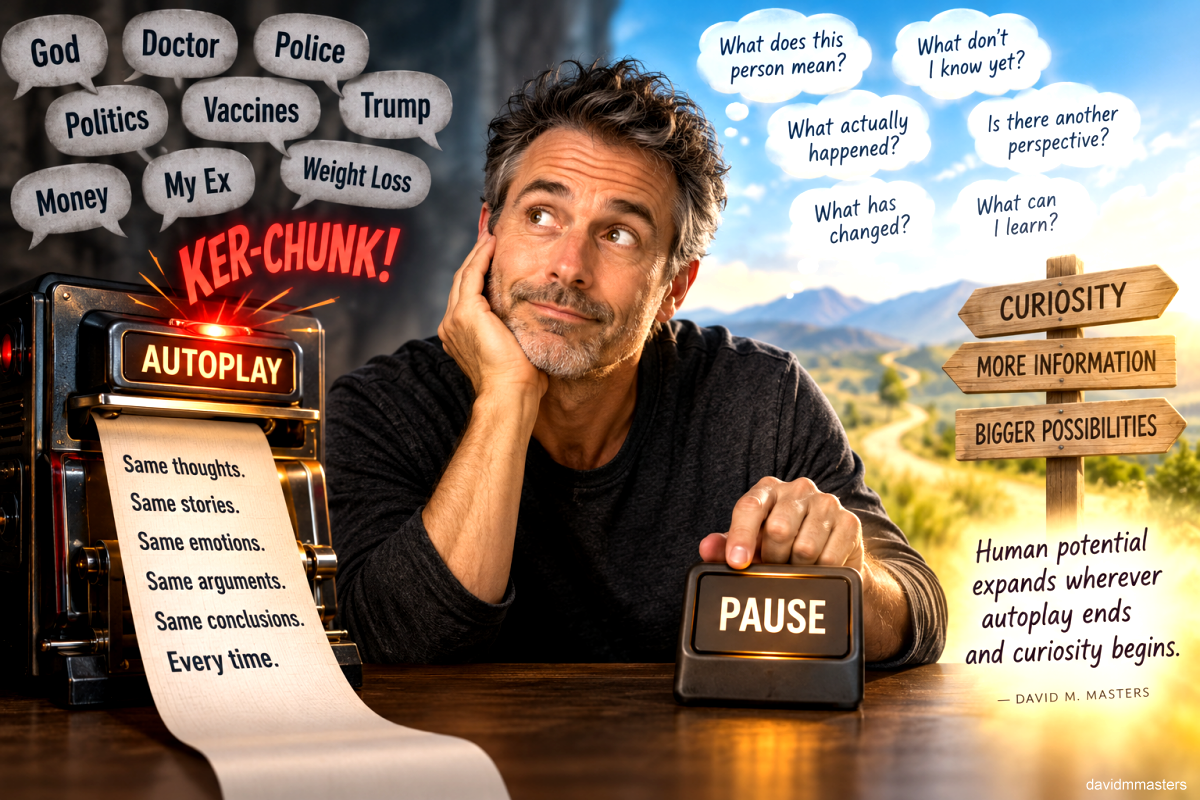
KER-CHUNK.
Autoplay engaged. And we’re off.
The six-minute God presentation has begun.
Someone else casually mentions going to their: Doctor. KER-CHUNK. “Well, let me tell you about doctors…”
Nobody asked. But apparently the program was already loaded.
-
- Police.
- Attorney.
- Military.
- Weight loss.
- Immigration.
- Gender.
- Vaccines.
- Guns.
- Republican.
- Democrat.
And God forbid somebody says: Trump. KER-CHUNK. Cancel your dinner reservations. We may be here a while.
The Human Autoplay Feature
I’m having some fun with this, but I think something rather important is happening. Human beings automate things. We have to. Imagine waking up every morning and having to rediscover how doorknobs work.
Automation is enormously useful. But we don’t automate only physical tasks. We automate associations. Interpretations. Emotional responses. Conclusions. Stories. Sometimes we even automate entire speeches.
Someone says the magic word and – before we’ve really considered what this particular person is saying in this particular moment – the familiar recording begins.
KER-CHUNK. Autoplay.
And this has nothing to do with whether your position is liberal, conservative, religious, atheist, conventional, alternative, mainstream, rebellious, or somewhere out beyond Pluto. Autoplay doesn’t care.
A six-minute glowing tribute is just as automatic as a six-minute tirade.
I Don’t Want to Be a Jukebox
Personally, I don’t want to be reduced to a jukebox with a limited playlist.
Push B-7 and get my God speech. C-12 plays my doctor recording. D-4 launches politics. Same record. Same scratches. Same chorus. Every time.
Because if somebody knows which button to push and can predict what I’m going to say for the next six minutes, they don’t need mind control.
I’ve automated the job for them. LOL.
That’s what I playfully think of as the mind-control grid. Not some sinister organization operating from an underground bunker. Our grids are much more ordinary.
Family. Culture. Education. Pain. Religion. Politics. Media.Tribal belonging. People we’ve trusted. People who hurt us. Things we’ve experienced repeatedly.
Over time, we build an internal model of reality. And that model is useful. Until we forget it’s a model.
Your Recording May Be Right
This is important. I’m not suggesting that your beliefs are wrong.
-
- Maybe you have very good reasons for distrusting doctors.
- Maybe doctors saved your life.
- Maybe religion wounded you.
- Maybe faith transformed you.
- Maybe your experience with law enforcement was terrible.
- Maybe a police officer once stood between you and disaster.
Keep your experiences. Keep your conclusions if they still make sense to you.
The question isn’t: “Is my opinion wrong?” The more interesting question is: “Did I choose this response just now?”
Because your beliefs aren’t necessarily the prison. Your inability to stop them from going on autoplay might be.
Curiosity Interrupts Autoplay
This is where it gets interesting to me. Someone says one of my words.
KER-CHUNK. I can feel the familiar program loading. But before it gets very far: Pause.
-
- What does this particular person mean?
- What actually happened?
- What don’t I know yet?
- Is there information here that doesn’t fit my existing model?
- What has changed since I formed this opinion?
- What might I notice if I weren’t trying to prove anything?
Now I’m not merely reacting. I’m accumulating data. I’m expanding. And after listening, investigating, and considering the new information, I may arrive at exactly the same conclusion I had before. Fine. Except this time, I chose it.
The Three-Second Experiment
Try it sometime. You don’t have to change your beliefs. You don’t have to become neutral. You don’t have to hug anyone. Just notice when one of your programs starts.
KER-CHUNK.
Then give yourself three seconds.
Instead of immediately asking, “What do I already know about this?”
Try: “What is actually happening here?”
That’s a very different question.
Certainty says: “I already have the answer.” Curiosity says: “Let’s see what else reality has brought us.”
I prefer the second one. Not because certainty is always wrong. But because reality has not finished introducing itself. And I don’t want to spend the rest of my life playing the same twelve records simply because somebody keeps pushing the buttons.
There are more songs. More information. More observations. More possibilities. More surprises. More life.
Maybe escaping the so-called mind-control grid isn’t discovering the correct collection of opinions. That could just become another jukebox. Maybe freedom is becoming increasingly difficult to reduce to predictable output.
Someone pushes the button.
KER-CHUNK.
Oh, lookie there. One of mine. And then, instead of automatically pressing PLAY…
I get curious.
Because human potential expands wherever autoplay ends and curiosity begins.