Prison Warden or the Love Warrior Choosing Love Over Control

When someone we love is making destructive choices, something interesting happens inside of us. Part of us wants to rescue. Part of us wants to reason. Part of us wants to fix. And if none of that works, another part quietly begins building a prison. Not always with steel bars. Sometimes with lectures. Sometimes with ultimatums. Sometimes with shame. Sometimes with silence. Sometimes with rules that quietly say, “Become who I think you should be… and then I’ll feel okay.”

I understand. I’ve been there. Watching someone you care about spiral is one of the most painful experiences a human being can endure. When love hurts, control begins looking like compassion. It rarely is.

Two Ends of the Spectrum

Human relationships exist across a wide spectrum. There are moments when immediate protection is necessary. If someone is violent, abusive, or placing others in danger, society has created systems designed to establish boundaries and accountability. Those systems have their place. But most of us aren’t judges. We’re parents. Friends. Spouses. Children. Co-workers. Neighbors. And in those relationships, another option exists. I call it becoming a Love Warrior.

The Love Warrior Leads with Love

A Love Warrior doesn’t pretend destructive behavior is healthy. A Love Warrior doesn’t excuse addiction. Or abuse. Or manipulation. Or dishonesty.

Love doesn’t become blind. It simply refuses to stop seeing the person beneath the behavior. That changes everything.

Instead of asking, “How do I make them stop?”

The Love Warrior begins asking, “What kind of pain could create behavior like this?”

That question changes the atmosphere. Not because it solves the problem. Because it changes the person asking it.

Walking Around in Their Shoes

Here’s an experiment. The next time someone disappoints you… Instead of saying, “I would never do that.” Try asking, “If I were behaving exactly like that… what might be happening inside me?”

Not because you’re right. Because you don’t know. And neither do I.

No one can fully know another person’s internal world.

We see behavior. We rarely see the emotional weather producing it. Fear. Loneliness. Shame. Trauma. Confusion. Exhaustion. Grief. Mental illness. Old wounds. Or perhaps something we’ve never experienced ourselves.

Curiosity opens doors that certainty quietly locks.

The Illusion of Intervention

Many interventions begin with beautiful intentions. “We’re doing this because we love you.” Sometimes they’re necessary. Often they’re not. Too frequently, they create temporary compliance while resentment quietly accumulates beneath the surface.

Pressure can change behavior. It rarely transforms the heart.

The person learns what everyone wants to hear. The performance improves. The relationship doesn’t.

Eventually, the pressure cooker finds a release. Usually with greater damage than before.

You cannot force someone into becoming themselves.

Sacred Space

One of the greatest gifts you can give another human being is sacred space. Not approval. Not agreement. Not enabling. Space.

Space to wrestle. Space to fail. Space to discover. Space to become responsible for their own life.

That can feel unbearable for the people standing nearby. Especially when we desperately want to help. But another person’s journey belongs to them. Not to us.

Boundaries Are Still Love

Choosing love does not mean abandoning wisdom. Love has boundaries.

You may need distance. You may need to protect your family. You may need to protect your finances. You may even need to say, “I love you deeply, but I cannot participate in this.”

Those aren’t contradictions. Those are healthy expressions of love.

Boundaries are not punishment. They are clarity.

A boundary protects both people. Control attempts to own both people.

There is a tremendous difference.

Will You Lose Them?

Maybe. That possibility hurts. Deeply. But remember something important.

You are responsible for your choices. They are responsible for theirs.

Loving someone does not make you responsible for becoming their conscience. Or their jailer. Or their rescuer.

Every one of us arrives carrying a different story. Different wounds. Different fears. Different lessons. Different timing.

We cannot legislate another person’s transformation. Growth is always an inside job.

Choosing Your Uniform

Every difficult relationship quietly asks us a question. Which uniform will you put on today? The Prison Warden? Or the Love Warrior?

One manages behavior. The other protects dignity. One relies primarily on fear. The other invests relentlessly in hope.

One asks, “How do I make them change?” The other wonders, “How can I become a safe place while they discover who they are?”

Not everyone will change. Some won’t. But everyone deserves to be seen as more than their worst day.

Love does not guarantee a happy ending. Neither does control. But love allows us to remain fully human while someone else finds their own path. And sometimes… that is the greatest gift we can possibly give.

Reframing Tools for Becoming a Love Warrior

When you notice your inner Prison Warden taking over, pause and try one of these instead.

    1. Replace Judgment with Curiosity

Instead of: “What’s wrong with them?”

Ask: “What might be hurting inside them?”

    1. Separate the Person from the Behavior

The behavior may be unhealthy.

The person still possesses dignity.

Hold both truths at the same time.

    1. Try On Their Shoes

Ask: “If I were acting exactly like this… what experiences might have brought me here?”

Not to excuse. To understand.

    1. Remember You Cannot Read Minds

Behavior is visible.

Motives rarely are.

Humility creates compassion.

    1. Exchange Control for Influence

You cannot control another adult.

You can become someone whose presence is safe enough to influence them.

    1. Protect Without Punishing

Healthy boundaries say, “This is what I need.”

Punishment says, “Now you’ll suffer.”

There is a world of difference.

    1. Bless Instead of Fix

Sometimes the greatest prayer is, “May you find your own way.”

Not every battle belongs to you.

    1. Let Reality Become the Teacher

Natural consequences often teach more effectively than lectures.

Resist interrupting every lesson life is offering.

    1. Practice Sacred Waiting

Growth is rarely immediate.

Love learns patience.

Control demands schedules.

    1. Ask Better Questions

Instead of, “How do I change them?”

Ask, “Who do I become while walking beside them?”

That question changes everything. Because the Love Warrior’s greatest victory is not controlling another person’s life. It is refusing to lose their own heart while loving someone through theirs.

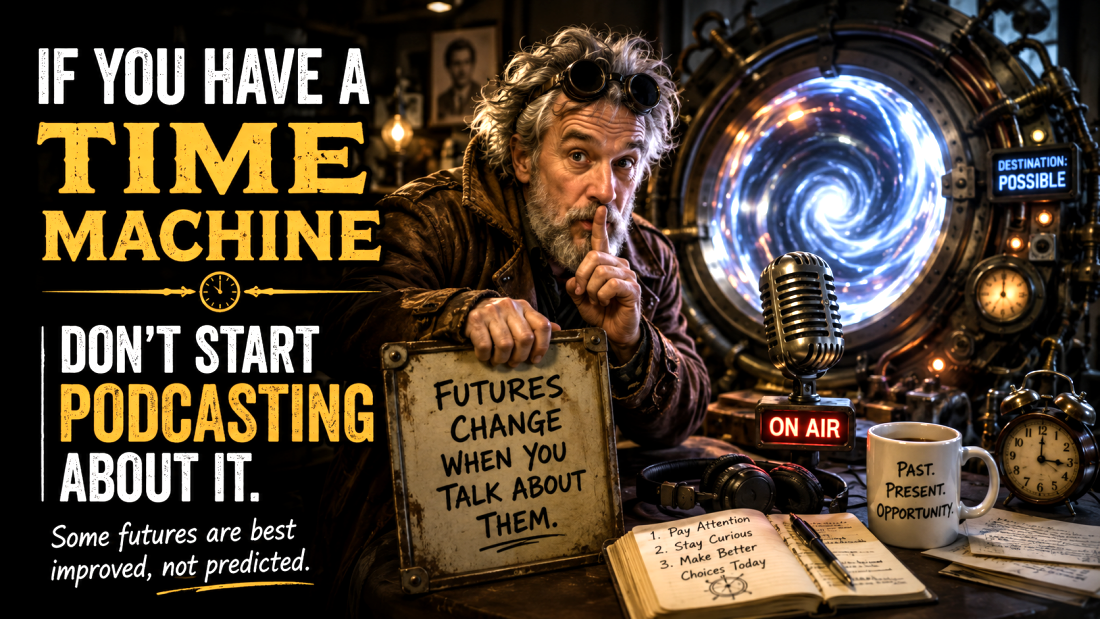
If You Have a Time Machine | Don’t Start Podcasting About It

I’ve been thinking about time travel lately. No, not because I built a flux capacitor in my garage. And no, this isn’t one of those moments when I try to convince you that Elvis is living on Mars with three government accountants and someone’s pet iguana. Relax. This is just one of those little thought experiments that wandered into my head, sat down, and refused to leave.

Let’s suppose, for the sake of conversation, that someone actually could see the future.

    • Maybe they have a crystal ball.
    • Maybe they have a sophisticated quantum machine.
    • Maybe they simply had one incredibly vivid glimpse of tomorrow.

Here’s my question. The moment they tell you what they saw… haven’t they already started changing it?

Imagine someone says, “On October 17th, the bridge will collapse.” Well… now what?

    • Do people stay home?
    • Does the city inspect the bridge?
    • Does someone reinforce it?
    • Does traffic reroute?
    • Does a construction crew accidentally discover an unrelated problem that saves thousands of lives?

In other words, the prediction itself just entered history.

    • It became another variable.
    • It didn’t merely describe the future.
    • It participated in creating it.

That’s why I’ve always been a little cautious around people who confidently announce, “This is exactly what’s going to happen.”

Maybe. Maybe not.

If the future is alive, then every decision, every conversation, every warning, every prayer, every act of courage, and every unexpected kindness becomes another pebble thrown into the pond. The ripples keep changing.

Even Charles Dickens understood this. Ebenezer Scrooge wasn’t shown the future so he could panic. He was shown one possible future so he could change the present. That’s a very different lesson.

Now, before someone writes me a strongly worded email… No, I’m not dismissing prophecy.

If God intends for certain events to unfold exactly as He has declared, I have absolutely no interest in debating His ability to accomplish His own purposes. I suspect He is entirely capable of protecting His plans without my assistance. This article isn’t about arguing with God. It’s about remembering that most of us aren’t Him.

Most predictions we hear, from experts, influencers, anonymous internet accounts, neighbors, or the guy at the coffee shop who always seems to know somebody who knows somebody, should probably be held with open hands. Take the insight. Leave the certainty.

Use the information to become wiser today instead of becoming obsessed with tomorrow.

There’s another reason I like this approach. Fear spreads quickly. Certainty spreads even faster. Curiosity slows us down just enough to ask better questions.

    • “What if?”
    • “How do we know?”
    • “What could I do today that would make tomorrow better, regardless?”

Those questions have improved far more lives than panic ever has.

If someone really did invent a working time machine, the smartest thing they could do would be to keep their mouth shut. Because the instant they announced what they saw, millions of people would begin reacting to it.

      • Politicians.
      • Investors.
      • Scientists.
      • Criminals.
      • Journalists.
      • Neighbors.
      • Entire governments.

Suddenly the future they reported wouldn’t be the future anymore. It would become history’s first draft. Maybe that’s one of life’s lessons.

The future isn’t simply something we discover.
It’s also something we participate in.

So, if tomorrow offers you a glimpse of itself, through wisdom, experience, prayer, intuition, good counsel, or even one of those wonderfully strange conversations that makes you think, you don’t have to cling to it.

Receive what is useful. Become a little wiser. Make one better decision today. Then let tomorrow continue being wonderfully alive.

After all, the best way to improve the future has never been arguing about it. It’s living well today.

When Clicks Matter More Than Credibility Becomes Empty Purse

Today I had one of those conversations that stayed with me. Not because it was dramatic. Because it was honest. I was meeting with a client who is active on social media. She had found a story she was about to post. The headline was shocking.

The problem was, it wasn’t actually a news story. It was speculation dressed up as certainty. Designed to provoke. Designed to travel. Designed to make people stop scrolling.

I gently suggested she might not want to post it. “It isn’t really based on fact,” I said. “If people discover that, doesn’t it slowly erode your credibility?”

She didn’t hesitate. “I don’t care.” Then she smiled. “Do you know how much traffic I get on this stuff?”

I appreciated her honesty. Because in that moment she said out loud what much of our culture quietly rewards.

Attention has become a currency. And sometimes it’s worth more than trust. The algorithms don’t ask if something is true. They ask if someone will click.

Outrage performs well. Fear performs well. Suspicion performs well. Half-truths often outperform whole truths. And certainty usually gets more engagement than curiosity.

We’re beginning to live in an economy where integrity doesn’t always pay immediately. That can be discouraging. Especially for people who care about accuracy. But here’s what keeps me thinking.

Traffic isn’t the same thing as trust. Visibility isn’t the same thing as credibility. Influence isn’t the same thing as wisdom.

You can have millions of views and still have very few people who genuinely trust your heart.

Respect grows differently. Respect grows slowly.

    • One honest conversation.
    • One accurate statement.
    • One careful correction.
    • One admission of, “I don’t know.”
    • One decision not to exaggerate.
    • One refusal to pass along something simply because it’s exciting.

Respect is expensive. Clicks are cheap.

The strange thing is that most of us say we want relationships built on trust.

We want leaders with integrity. We want businesses that tell the truth. We want friends who are honest. Yet every day we quietly reward the opposite.

Every click is a tiny vote. Every share says, “Give me more of this.” Whether we realize it or not.

I’m not writing this to criticize my client. I suspect she simply recognized the rules of the current game.

The question is whether those rules deserve to stay. Because every culture eventually becomes what it rewards.

    • If outrage pays better than honesty… we’ll manufacture outrage.
    • If exaggeration pays better than accuracy… we’ll exaggerate.
    • If division pays better than understanding… we’ll divide.

None of that happens overnight. It happens one click at a time.

Jesus once said that where your treasure is, your heart will be also.

I’ve wondered lately if the opposite is equally revealing.

Where our clicks go… our culture follows.

Perhaps integrity has become an empty purse. Or perhaps we’ve simply forgotten how valuable it really is.

The beautiful thing about values is that they don’t need everyone. They begin with one person deciding, “I’d rather be trusted than trending.”

That may not make us famous. But it just might make us someone worth believing.

What “Don’t Throw the Baby Out with the Bathwater” Really Is

One of my early ministry mentors, Brother Bryan, had a saying he repeated often. “Don’t throw the baby out with the bathwater.” At the time, I smiled politely. I understood the words, but I wasn’t sure I understood their weight. Years later, I think I finally do.

The old expression comes from a simple picture. After everyone in the household had bathed, the water was dirty. Really dirty. When it was finally time to dump the tub, you had one more job. Make sure the baby isn’t still in it.

The point wasn’t about bathing. It was about judgment. It was about remembering that something precious can be hidden among things that genuinely need to be discarded.

I think we’ve become remarkably skilled at doing the opposite.

Today, we often throw away the baby first.

    • Someone hears that a priest abused a child. Suddenly, every priest becomes suspect.
    • A teacher commits a terrible crime. Now every teacher must prove they are safe.
    • A police officer acts dishonorably. Every officer wears the stain.
    • A politician lies. Therefore, politicians can’t be trusted.
    • A man betrays his wife. “Once a cheater, always a cheater.”
    • Someone commits a felony. “They’ll always be a criminal.”
    • One member of a race behaves badly. The entire race inherits the accusation.
    • One immigrant.
    • One business owner.
    • One coach.
    • One pastor.
    • One doctor.
    • One stepfather.
    • One teenager.
    • One generation.
    • One denomination.
    • One political party.

Our minds are astonishingly quick at taking one painful story and quietly attaching it to millions of people we’ve never met. Perhaps it’s because our brains are trying to protect us.

Patterns help us survive. If one berry made someone sick, avoid berries. If one cave held a bear, check caves carefully.

Those instincts served our ancestors well. But human beings are not berries.

People are not statistics. And they certainly are not headlines. The news has a difficult job. It reports what is unusual. Very few reporters stand outside a school to announce that every child arrived safely today.

No one interrupts your dinner because another hundred thousand fathers came home from work, hugged their children, and quietly loved their families.

Ordinary goodness is rarely spectacular enough to become breaking news. Extraordinary failure almost always is.

The problem isn’t that we hear about terrible things. The problem is that we begin believing terrible things are ordinary. And somewhere along the way, our curiosity quietly dies.

    • We stop asking.
    • We stop meeting individuals.
    • We stop allowing people to surprise us.

Instead, we file them. Category. Label. Case closed.

Jesus seemed unusually unwilling to do that. He met people one person at a time.

    • Tax collector.
    • Roman soldier.
    • Religious leader.
    • Woman at the well.
    • Fisherman.
    • Leper.
    • Thief.

He somehow managed to see the individual without pretending the problem didn’t exist.

That takes wisdom. It’s easy to condemn an entire group. It’s harder to remain curious. Curiosity isn’t naïve. Curiosity simply refuses to let someone else’s story become everyone else’s sentence.

    • I’ve known remarkable pastors.
    • I’ve known terrible pastors.
    • I’ve known honest business owners.
    • I’ve known dishonest ones.
    • I’ve known people with criminal records who became among the safest, kindest human beings I’ve ever met.

I’ve also known people with spotless résumés who quietly destroyed lives.

Character doesn’t travel in packs. Neither does integrity.

Every human being deserves the dignity of being encountered before being categorized.

Brother Bryan was right. Don’t throw the baby out with the bathwater.

You may discover that the thing worth protecting was there all along. Perhaps the real baby isn’t the person you’re judging. Perhaps it’s your own ability to see people clearly. And that’s something worth protecting.

The Seven Transitions of Human Change

Over the years, I began noticing something interesting about people who genuinely changed their lives. Not temporary motivation, self-help excitement, or a three-day breakthrough that faded by next Tuesday. I mean real change. The kind that changes the atmosphere around a person, where old patterns stop feeling natural, and someone who once reacted one way now responds entirely differently without even trying.

The more I worked with people through relationships, trauma, business struggles, identity crises, spiritual searching, emotional collapse, reinvention, and recovery, the more I noticed that transformation seemed to move through recognizable stages. Not as a perfectly reproducible framework but often enough that I started paying attention.

Curiously, many of these stages naturally fell under “trans” language. Which makes sense, because the word “trans” simply means: to move across, to move beyond, to move through. And maybe that’s what growth really is. Not becoming someone else. But moving through the layers that were never fully you to begin with.

    1. Transaction

Every change begins with some form of transaction.

Something happens.

You say something you regret.
You tolerate something you shouldn’t.
You abandon yourself to keep someone else comfortable.
You repeat a destructive habit.
You betray your values.
You overreact.
You shut down emotionally.
You give away your power for approval, attention, safety, or temporary relief.

Sometimes the transaction is obvious. Sometimes it’s subtle.

A child learning that love must be earned is a transaction.
A teenager discovering that hiding emotions prevents conflict is a transaction.
An adult realizing they built their entire personality around survival is a transaction.

Most people live inside repeated transactions for years without realizing they are repeating them.

The same emotional exchanges, wounds, or outcomes… just with different faces and different scenery. But eventually, something begins to wake up.

    1. Transcription

This is where honesty enters. Transcription means writing it down. Speaking it aloud. Admitting what actually happened.

Not the polished version or the version designed to protect your ego, and not the version that makes everybody else the villain. Just the truth.

This is one reason journaling can become life-changing. Not because writing itself is magical, but because clarity begins forming when experience is translated into language.

A surprising number of people never fully heal because they never honestly describe the event.

They explain around it.
Defend it.
Minimize it.
Intellectualize it.
Or bury it under spirituality, positivity, productivity, or distraction.

But once you can calmly say, “This is what happened,” something begins changing. Because truth has structure. And structure begins stabilizing chaos.

    1. Translation

After the event is honestly observed, the deeper question naturally follows: What does this mean?

Why did that affect me so deeply?
Why do I keep repeating this pattern?
Why do certain situations trigger reactions that feel larger than the moment itself?
What belief is hiding underneath the behavior?

This is where many people begin uncovering the deeper architecture beneath their lives.

The anger may actually be fear.
The perfectionism may be an attempt to avoid rejection.
The constant rescuing of others may be connected to a childhood need to feel valuable.
The attraction to emotionally unavailable people may reflect familiar emotional terrain from early life.

Translation is where patterns begin revealing themselves. And once patterns become visible, they become harder to unconsciously obey.

    1. Transgression

This stage is deeply personal. Not religious necessarily, moralistic, or performative.

It is the moment where something inside you quietly says: “I don’t want to continue this anymore.”

Not because somebody threatened you, you got caught, or society disapproved, but because the behavior itself no longer feels aligned.

You begin noticing the cost.

The emotional cost.
The relational cost.
The spiritual cost.
The physical cost.
The nervous-system cost.

And eventually you reach a point where continuing the old pattern starts feeling heavier than changing it.

This is where many people first begin separating from an identity they previously thought was permanent.

    1. Transformation

Now the real work begins. Transformation is not usually dramatic. Most often, it is repetitive.

This is where someone begins consciously redirecting the old pattern into something healthier.

The person who

used to explode learns to pause.
used to numb out learns to feel.
chased validation learns to self-regulate.
constantly abandoned themselves begins setting boundaries.

At first, it feels unnatural. That’s because the nervous system tends to prefer familiar suffering over unfamiliar peace.

People underestimate how physical emotional patterns become.

The body memorizes reactions.
The mind rehearses identity.
The nervous system automates survival strategies.

Which means transformation often requires repetition long before it feels natural. And honestly, this phase can feel discouraging at times. Because you may intellectually understand the change long before your body fully trusts it. But if someone continues practicing the new pattern with enough compassion and consistency, something remarkable eventually begins happening.

The new response slowly becomes the natural one.

    1. Transmission

This is where change stops being private.

At some point, transformed people begin affecting the emotional atmosphere around them. Not because they are trying to, not because they are preaching, and not because they became perfect. But because regulated people regulate people.

Grounded people calm rooms.
Authentic people create safety.
Honest people give others permission to become honest.

Without realizing it, people begin transmitting what they embody.

A healed parent transmits stability to children.
A centered leader transmits steadiness into a business.
A compassionate partner transmits emotional safety into a relationship.

And the opposite is true as well.

Fear transmits.
Bitterness transmits.
Chaos transmits.
Resentment transmits.

We are constantly affecting one another more than we realize. This is why personal healing matters far beyond the individual. Because eventually, who you become enters every room before you say a word.

    1. Transfiguration

There is a stage beyond effort. A stage where someone is no longer trying to become different because, in many ways, they already are.

The old reactions no longer fit naturally.
The old identities feel too small.
The old emotional addictions lose their grip.

This does not mean life becomes perfect. It does not mean someone becomes enlightened or superior. It simply means something fundamental has changed. The transformation became integrated.

And people who reach this stage often become softer, not harder.

Less reactive.
Less performative.
Less obsessed with proving themselves.
Less desperate for approval.

Because once someone truly changes internally, much of the external performance begins falling away on its own. They stop trying so hard to become someone. And begin feeling more comfortable simply being.

Maybe that is the deeper purpose behind all of this.

Not self-improvement for the sake of image.

But becoming increasingly honest,
increasingly conscious,
and increasingly aligned with the person underneath all the conditioning, fear, coping, performance, and survival.

Transaction.
Transcription.
Translation.
Transgression.
Transformation.
Transmission.
Transfiguration.

Seven movements of human change.

Seven ways we move through ourselves.


Everybody Lies | Now What Are You Going to Do About It?

Everybody lies. Some lies are tiny. Some are catastrophic. Some are told to protect others. Some are told to protect ourselves. Some are told because we are afraid of losing love, losing status, losing control, losing security, or losing the carefully constructed image we want the world to believe about us. And every once in a while, someone lies to you that you never expected would.

That one lands differently. Not because the lie itself was necessarily devastating, but because it woke you up. It shook your assumptions. It cracked open your illusion that certain people are somehow above human weakness.

Recently, someone I had known and respected for years lied to me. Not a stranger. Not someone I expected it from. Someone I trusted. And for a brief moment, it threw me for a loop. Not because I do not understand human behavior. I have worked in counseling, coaching, consulting, and personal transformation for a very long time. I know people lie. I know it intellectually. I know it professionally. But sometimes we forget emotionally.

We create little islands of certainty around people we love, admire, or trust. We quietly place them into categories where we no longer expect ordinary human behavior from them. Then one lie reminds us that every single person on this earth is still wrestling with fear, identity, survival, insecurity, shame, ego, and the desperate need to feel safe. Including us. That realization can harden you. Or it can deepen you. That is the crossroads.

Every Lie Is an Opportunity

One of the most valuable tools I have ever developed in my work with people is the willingness to allow space for dishonesty without immediately punishing it. That surprises some people. They expect confrontation. Exposure. Correction. Consequences. But I learned something a long time ago: People often lie before they feel safe enough to tell the truth. Especially in the beginning of a coaching or counseling relationship.

If something does not feel right, sound right, or line up with the facts, I simply make note of it. I do not necessarily attack it immediately. I observe it. I hold awareness around it. I allow the story to breathe. Then something interesting happens.

Over time, the fabricated version becomes exhausting to maintain. The contradictions begin stacking up. The emotional energy required to maintain the false identity becomes heavier and heavier. People start tangling themselves in the barbed wire of their own stories. One lie requires another. Then another. Then another. And eventually, if enough trust and safety exist, many people come clean on their own. Not because they were forced into submission. But because they became exhausted from carrying the weight of separation between who they are and who they pretend to be.

That moment is sacred. Not humiliating. Sacred. Because when a human being finally feels safe enough to be honest, something profound happens inside them. Relief enters the room. Their nervous system softens. Their breathing changes. The armor begins to fall away. And for many people, that may be one of the first moments in their lives they have ever truly felt accepted while being fully seen.

That changes people.

We live in a culture obsessed with justice, exposure, consequences, outrage, and public destruction. Catch the liar. Expose the liar. Punish the liar. Destroy the liar. But very little attention is given to understanding why people lie in the first place.

Fear. Shame. Trauma. Survival. Rejection. Embarrassment. Insecurity. Childhood conditioning. Loss of identity. Fear of abandonment.

Most people do not wake up in the morning plotting evil. Most people are simply terrified of losing something they believe they need in order to survive emotionally. Now, that does not mean accountability disappears. Far from it. Truth matters. Boundaries matter. Integrity matters. But accountability without love often creates better liars instead of transformed people.

Fear-based correction teaches concealment. Love-based awareness teaches integration. That is a very different path.

I was fortunate to grow up around ideas like: “I’m okay, you’re okay.” “Do unto others as you would have them do unto you.” “We are all doing the best we can with what we have.” Those ideas grounded me. Not because they excuse destructive behavior, but because they remind us that human beings are unfinished creatures trying to find their way through life while carrying invisible burdens.

When you approach people with compassion instead of immediate condemnation, something extraordinary becomes possible. Growth. Real growth. Not performative compliance. Not fear-driven obedience. Not temporary behavioral suppression. Actual transformation. And transformation almost never happens through humiliation. It happens through awareness. It happens when people discover truth inside themselves.

That is why I have never been overly interested in controlling clients through rigid systems, punishments, or demands. Yes, structure matters. Yes, accountability matters. But lasting change usually occurs when people arrive at their own realization.

When the light bulb turns on inside them. When they see themselves clearly for the first time. When they finally become tired of running from themselves. That moment cannot be forced. It can only be invited.

People sometimes ask me why I continue doing this work after all these years. The answer is simple. I live for the moment of epiphany. The moment a client suddenly sees the truth about themselves with complete clarity.

The moment the masks fall away. The moment they stop defending their pain and begin understanding it. The moment self-awareness replaces self-deception. That is the payoff for me. To sit in the room while another human being reconnects with themselves is one of the most sacred experiences I know. Not because I “fixed” them. I did not. They found themselves. I simply created enough safety, enough love, enough accountability, enough space, and enough patience for truth to emerge naturally. That is very different from forcing compliance.

So What Are You Going to Do About It?

When someone lies to you, you stand at a fork in the road. You can become cynical. Suspicious. Closed off. Controlling. Punitive. Emotionally armored. Or…

      • You can become wiser without becoming harder.
      • You can develop discernment without losing compassion.
      • You can learn to see human weakness without abandoning human love.

That is the challenge. Not to become naive. But not to become cold either. Because the truth is this:

Every single one of us has lied.
Every single one of us has hidden.
Every single one of us has protected an image.
Every single one of us has feared rejection.

And every single one of us longs to be loved beyond our imperfections. That realization changes the way you see people. Including yourself.

A Practical Guide:

Moving from Strict Accountability to Love-Based Growth

This does not mean becoming weak, passive, or enabling destructive behavior. It means learning how to create environments where transformation becomes possible.

    1. Separate the Person from the Behavior

A lie is behavior.
It is not the entirety of the person.

When you attack identity instead of addressing behavior, people become defensive instead of reflective.

Say:
“That story doesn’t seem consistent.”

Instead of:
“You’re a liar.”

One invites awareness.
The other invites war.

    1. Stay Calm When You Discover Dishonesty

Most people expect emotional punishment.

When you remain calm, observant, and grounded, it creates psychological space for truth to emerge later.

Overreaction often drives dishonesty deeper underground.

    1. Observe Patterns Instead of Isolated Incidents

One contradiction may be confusion.
Repeated contradictions reveal deeper issues.

Notice:

        • Emotional inconsistencies
        • Changing narratives
        • Avoidance patterns
        • Sudden defensiveness
        • Over-explaining
        • Excessive justifications

Observe without becoming consumed by suspicion.

    1. Build Safety Before Demanding Vulnerability

People rarely tell the truth where they feel emotionally unsafe.

If someone believes honesty will lead only to shame, rejection, ridicule, or abandonment, concealment becomes survival.

Safety does not eliminate accountability.
It makes accountability productive.

    1. Ask Questions Instead of Making Accusations

Questions open doors.

Accusations slam them shut.

Try:
“Help me understand something.”

Instead of:
“You’re obviously lying.”

Questions invite self-reflection.

    1. Allow Natural Consequences Without Cruelty

Compassion does not mean removing all consequences.

Trust may need rebuilding.
Boundaries may need strengthening.
Access may need limitation.

But consequences delivered without hatred create opportunity for maturity instead of retaliation.

    1. Recognize Your Own Capacity for Self-Deception

Humility changes everything.

When you understand your own imperfections, you stop approaching others from a throne of moral superiority.

That softens your delivery without weakening your standards.

    1. Leave Room for Redemption

Many people become trapped inside the identity others assign to them.

When you leave room for people to evolve, they sometimes rise into that opportunity.

Not always.

But far more often than cynicism would have you believe.

    1. Focus on Awakening, Not Winning

Winning arguments is easy.

Awakening consciousness is rare.

Ask yourself:
“Do I want revenge, or do I want healing?”

That question changes the entire interaction.

    1. Become the Kind of Person Safe Enough for Truth

This may be the most important step of all.

People tell the truth around people who can handle truth.

Can you?

Can you hear difficult things without collapsing, exploding, condemning, or retaliating?

Can you remain loving while still remaining discerning?

That is emotional maturity.

And that level of love changes lives.

Including your own.


From Trauma to Transfiguration: Turning Pain Into Freedom

There was a time in my life when I believed trauma was something to overcome, suppress, hide from, or somehow “get past.” Like many people, I thought healing meant eventually becoming unaffected by the pain. I believed freedom meant erasing the memory, numbing the impact, or outrunning the shadow of what had happened. I now see things very differently.

The wounds that once imprisoned me eventually became the very doorways that liberated me. The experiences I once begged God to remove from my life became some of the greatest teachers I have ever known. The moments that once filled me with shame, confusion, grief, fear, hypervigilance, distrust, anger, or emotional paralysis eventually became the catalysts that shaped my strength, depth, compassion, discernment, intuition, and purpose.

That does not mean trauma was “good.” It means something greater emerged through it. There is a profound difference.

Many people spend their entire lives fighting their past. They attempt to silence it, bury it, intellectualize it, medicate it, spiritualize it away, or pretend it never happened. Yet unresolved trauma has a way of leaking into every area of life. It appears in relationships, health, finances, identity, intimacy, confidence, addictions, self-sabotage, perfectionism, emotional shutdown, explosive reactions, or an inability to trust love itself.

Trauma does not always scream. Sometimes it whispers.

Sometimes it looks like

    • overachievement
    • isolation
    • needing constant approval
    • emotional numbness
    • the inability to rest
    • attraction to chaos because peace feels unfamiliar

Many people who believe they are “fine” are simply functioning inside survival adaptations they have mistaken for personality traits.

One of the most common forms of trauma begins in childhood. A child who grows up in criticism may become a perfectionist adult. A child raised in unpredictability may become hypervigilant. A child ignored emotionally may spend adulthood trying to earn love through achievement, people-pleasing, or self-sacrifice.

The survival child learns quickly.

“If I stay quiet, I stay safe.”
“If I become useful, maybe I will be loved.”
“If I never trust anyone, I cannot be hurt.”
“If I become emotionally hard, nobody can control me.”

Those strategies may save a child emotionally. But they can imprison an adult.

The problem is not that the child adapted. The problem is that many adults never realize the danger has passed. Their nervous system still lives in yesterday.

Repressed Sexual Trauma and the Hidden Weight of Shame

Some trauma goes even deeper because it becomes entangled with shame, secrecy, identity confusion, fear, self-worth, intimacy, spirituality, or the body itself.

Repressed sexual trauma can create profound fragmentation. Many people disconnect from parts of themselves in order to survive overwhelming experiences. They compartmentalize memories, suppress emotions, numb sensations, or avoid vulnerability entirely.

Some victims of intimate trauma

    • become emotionally frozen.
    • become compulsively sexual.
    • fear intimacy altogether.
    • live with constant anxiety they cannot explain.
    • unconsciously recreate familiar dysfunction because the nervous system seeks what feels familiar, even when it is harmful.

Many survivors carry secret shame for decades over experiences that were never their fault. Yet healing often begins when the silence finally breaks. Not necessarily publicly, but honestly.

Healing accelerates the moment a person stops running from their own story.

Post-Traumatic Stress Disorder and the Body That Remembers

Post-traumatic stress disorder is not weakness. It is survival energy that never completed its cycle. The body remembers what the mind tries to forget.

This is why people can experience panic, nightmares, triggers, hypervigilance, dissociation, emotional flooding, insomnia, tension, digestive problems, or sudden fear responses long after the danger has ended.

The nervous system becomes conditioned for survival.

For some, trauma came through war.
For others, betrayal, abuse, abandonment, medical trauma, spiritual manipulation, or years of emotional invalidation.

Trauma is not measured only by the event itself. It is measured by how overwhelmed the nervous system became and whether the person had sufficient support to process it safely. That is important to understand.

Two people can experience similar events and emerge very differently depending on support systems, emotional resilience, spiritual grounding, meaning-making, and whether they felt alone inside the experience.

The Great Reframe

One of the most important turning points in my own healing journey came when I stopped asking, “Why did this happen to me?” And began asking, “What was born inside me because of this?” That question changed my life.

The very experiences that once nearly destroyed me taught me discernment. They taught me compassion, boundaries, depth, how to recognize manipulation, how to recognize authenticity, how to sit with people in pain without judgment, that survival itself can become wisdom.

The trauma was not my identity. It was part of my initiation. That does not minimize suffering. It transforms relationship to suffering.

There is tremendous power in reframing trauma not as proof that you are broken, but as evidence that you survived something difficult and are now capable of extraordinary transformation.

The wound becomes wisdom.
The scar becomes discernment.
The survival becomes service.

Transcending Trauma Without Denying It

True healing is not pretending something did not happen. It is becoming so integrated that the experience no longer controls your identity, emotional state, relationships, choices, or sense of worth.

You do not heal by deleting the past. You heal by metabolizing it.

This is where many people become trapped. They either:

    • drown inside trauma identity,
      or
    • spiritually bypass their pain and pretend they are unaffected.

Neither creates true freedom.

Real healing allows you to say:

“Yes, that happened.”
“Yes, it hurt.”
“Yes, it changed me.”
“And yes, I can still become something beautiful.”

That is power.

Practical Ways to Begin Trauma Reversal

Healing trauma is not usually a single event. It is often a gradual process of nervous system restoration, identity reconstruction, emotional integration, spiritual reconnection, and compassionate self-awareness.

Here are several practices that helped transform my own life and may help others begin the same journey.

    1. Stop Fighting Your Own Story
      Many people remain trapped because they are still emotionally arguing with reality.

The event happened. Healing begins when resistance softens.

        • Acceptance is not approval.
        • Acceptance is ending the internal war against what already occurred.
    1. Remove Shame From the Equation
      Trauma survives in secrecy and shame.

When shame dissolves, healing accelerates.

        • You are not disqualified because of what happened to you.
        • You are not ruined.
        • You are not contaminated.
        • You are not less valuable.

Many of the deepest, wisest, strongest people I have ever met walked through unimaginable pain.

    1. Regulate the Nervous System
      Trauma is stored physiologically, not just mentally.

Breathing practices, grounding, nature exposure, sleep restoration, gentle movement, prayer, meditation, mindfulness, massage, emotional safety, and healthy human connection all help retrain the nervous system toward safety.

A dysregulated nervous system cannot heal effectively while remaining in constant survival mode.

    1. Stop Building Your Identity Around the Wound
      This is extremely important.

Your trauma may be part of your story, but it is not the totality of who you are.

Do not build a permanent home inside survival identity.

You are more than what happened to you.

    1. Reclaim Meaning and Purpose
      One of the most powerful healing mechanisms available to human beings is meaning.

When suffering becomes wisdom, guidance, compassion, creativity, ministry, teaching, art, advocacy, protection, or service, something extraordinary happens.

Pain begins transforming into purpose.

    1. Learn to Feel Safe Receiving Love
      This is difficult for many trauma survivors.
        • Love can feel unfamiliar.
        • Peace can feel suspicious.
        • Calm can feel unsafe.

Some survivors unconsciously sabotage healthy relationships because dysfunction feels more emotionally recognizable.

Healing often involves learning that safety is no longer dangerous.

    1. Practice Gratitude for the Strength That Emerged
      This may take years.

Do not force it prematurely.

But eventually, many survivors reach a moment where they realize:
“I would never have become who I am without walking through that fire.”

That realization is sacred.

Not because suffering is desirable. But because human beings are capable of extraordinary transfiguration.

The Freedom Beyond Trauma

Today, I no longer feel the need to hide from my past, deny it, sanitize it, or pretend it did not affect me.

I can look directly at every chapter of my life with honesty, compassion, gratitude, and peace.

The fear is gone. The shame is gone. The fragmentation is gone.

What remains is wisdom.

And perhaps most importantly, compassion for others still walking through the darkness I once knew so well.

If you are struggling with trauma right now, I want you to understand something clearly: Your current pain is not necessarily your final form. The part of you that survived is stronger than you realize.

Within the very experiences you wish had never happened may eventually lie the seeds of your deepest freedom, greatest purpose, strongest boundaries, clearest discernment, and most authentic identity.

Sometimes the

    • prison was also the classroom
    • wound was also the doorway
    • thing that nearly broke you becomes the thing that finally awakens you.

Thank God for the journey.


How to Build a Meaningful Legacy… And You Can Start Today.

Once you realize your stuff doesn’t become your legacy… and once you begin to understand that your legacy lives in people… there’s a natural next question: “Okay… but what do I actually do with that?”

Because most people hear the idea of “building a legacy” and immediately feel one of two things:

      • Pressure
      • Or distance

It sounds big. It sounds like something reserved for later. It sounds like something you get around to once everything else is handled.

But here’s what’s real:

You are already building your legacy.

The only question is whether you’re doing it on purpose.

Legacy Is Not a Project; It’s a Pattern

Most people think legacy is something you create at the end of your life. It’s not. It’s something you reinforce every day.

Not through grand gestures… but through repeated patterns:

      • How you respond
      • How you treat people
      • What you prioritize
      • What you ignore

These patterns become your signature, and your signature becomes your legacy.

You Don’t Need to Change Everything

This is where people get tripped up.

They think:

“I need to reinvent myself.”
“I need to do something big.”
“I need to leave some kind of major mark.”

No. You don’t need to change your whole life. You just need to adjust what already exists, because legacy isn’t built by intensity… it’s built by consistency.

Five Simple Ways to Start Building Legacy Today

These aren’t dramatic. They’re not complicated. But they are powerful—because they’re repeatable.

    1. Become More Intentional in Small Interactions

Every conversation leaves something behind. Most people don’t get that.

Before you walk away from an interaction, ask yourself:

“What did I leave with this person?”

          • Encouragement?
          • Clarity?
          • Tension?
          • Nothing at all?

Legacy accumulates in moments like this.

    1. Say What You Meant to Say—Now

There are things people think… and never say.

          • Appreciation
          • Gratitude
          • Respect
          • Acknowledgment

They assume there will be time later. Sometimes there isn’t.

Say it now. Not dramatically. Just clearly.

    1. Reduce What Doesn’t Carry Forward

Not everything you do contributes to your legacy.

Some things:

          • Drain your energy
          • Scatter your attention
          • Lead nowhere

You don’t have to eliminate everything… but you can begin to notice:

“Does this carry forward… or does it end here?”

That awareness alone changes your behavior.

    1. Share What You’ve Learned

You don’t need a platform. You don’t need a following. You just need to be willing to pass something on.

          • A lesson
          • A realization
          • A better way of seeing something

You never know which one becomes the thing someone else carries for life.

    1. Align Your Daily Actions With What You Value

Most people say they value certain things… but their daily actions don’t reflect it. Legacy forms in that gap.

So instead of asking:

“What do I believe?”

Ask:

“What do my actions prove?”

That’s where alignment begins.

What This Looks Like Over Time

At first, these changes feel small. Almost insignificant. But over time… they compound.

And what begins as:

      • A few more intentional conversations
      • A little more presence
      • A few better decisions

Becomes:

      • A consistent way of being
      • A recognizable presence in people’s lives
      • A quiet but powerful influence

That’s how legacy forms. Not in bursts. But in patterns.

The Hidden Advantage

When you start living this way… something unexpected happens. You don’t just build a legacy for later. You improve your life now.

      • Relationships become more real
      • Conversations become more meaningful
      • Your time feels better spent

You stop waiting for life to matter… and start experiencing it as meaningful in real time.

Lend me your ear…

You don’t need more time. You don’t need more resources. You don’t need a different life.

You just need a slightly different level of awareness… applied consistently. Because legacy isn’t built in the future. It’s built in moments like this one.

And the more intentional you become… the more you realize:

You’ve been building it all along.


What Actually Becomes Your Legacy, (If It’s Not Your Stuff)?

After you come to terms with the idea that your belongings eventually become cash or trash, something deeper begins to surface. A more important question surfaces. If it’s not your stuff… then what actually remains? Because something does. It has to. Otherwise, what are we doing here?

Most people spend their lives building a collection. Fewer people spend their lives building a legacy. And at first, those two things can feel like the same thing. You work hard. You acquire things. You create a life that looks meaningful from the outside. But when you strip away the objects… when you remove the physical layer… you begin to see what was actually being built underneath it all. Or in some cases… what wasn’t.

Your legacy is not something that sits on a shelf. It doesn’t gather dust. It doesn’t need to be sorted, sold, or thrown away.

Your legacy lives in places that don’t require storage:

    • In the way someone hears your voice in their mind when making a hard decision
    • In the confidence you helped someone discover in themselves
    • In the moment someone chose differently because of something you once said
    • In the feeling people carry when they think of you

That’s where it lives. And unlike your stuff… it doesn’t depreciate.

If you look closely, you’ll start to recognize the real assets you’ve been building all along. Not the ones in your house… The ones in people.

Things like:

    1. Emotional Imprints

How did people feel around you?

        • Safe?
        • Judged?
        • Seen?
        • Dismissed?

Those impressions don’t get packed into boxes. They stay.

    1. Perspective Shifts

Did you help people see life differently?

Sometimes a single conversation becomes a turning point in someone’s life.

You may not even remember it. They will.

    1. Encouragement Given at the Right Time

Most people can point to one moment… When someone believed in them before they believed in themselves.

If you’ve ever been that person for someone else… that’s part of your legacy.

    1. Standards You Lived By

Not what you said. What you consistently demonstrated.

Integrity, kindness, discipline, presence…

People remember patterns more than moments.

    1. The Way You Handled Difficulty

Your response to challenge becomes a reference point for others. Whether you intended it or not.

Why Is It Time to Consider Your Legacy?

Because legacy is not something you leave behind. It’s something you are building… in real time. Every interaction. Every response. Every decision. You are either reinforcing something… or weakening it. And most people don’t realize this until much later, if ever.

Once you see this clearly, something begins to change. You don’t have to give up your stuff. You don’t have to become extreme or detached.

But you start to ask different questions:

    • “What will this moment mean later?”
    • “What am I leaving with this interaction?”
    • “Is this building something that continues… or something that ends with me?”

That shift alone begins to recalibrate everything.

What’s the Deal?

At the end of it all… People don’t gather to talk about what you owned.

They gather to talk about:

      • Who you were
      • How you showed up
      • What you stood for
      • What it felt like to be around you

That’s the conversation. That’s the continuation.

If your stuff doesn’t define your legacy… then your legacy becomes something far more powerful.

Something that

      • doesn’t rely on preservation.
      • doesn’t need protection.
      • can’t be taken, sold, or discarded.

It becomes…

the part of you that continues in others.

And the moment you recognize that… You stop trying to hold onto everything. And you start becoming someone worth remembering.


Cash or Trash: What Happens to Your Belongings After You Die

Everybody’s heard the phrase, “You can’t take it with you.” Most people nod their heads, agree with it… and then go right back to accumulating, protecting, organizing, insuring, and worrying about their stuff. Because while we say we understand it… we don’t actually live like we understand it. But every now and then, life brings you close enough to the truth that you can’t ignore it anymore.

For me, it started with my dad’s things. Then it continued with friends who passed. And what I began to notice, a subtle hint at first, then increasingly troubling, was this: No one cares about your stuff like you do. Not even close.


When someone is gone, their belongings go through a predictable process. Not emotionally… but practically.

Their “treasures” become:

    • Consolidated
    • Sorted
    • Sold
    • Donated
    • Taken
    • Or thrown away

Sometimes respectfully. Sometimes carelessly. Sometimes opportunistically or even nefariously. And in the end, almost everything falls into one of two categories:

Cash… or trash.

That’s not cynical. That’s observable reality. The object that meant something to you… is just an object to someone else.

Why Does This Feel So Unsettling?

Because deep down, we don’t just collect things. We attach meaning to them. That chair isn’t just a chair. That tool isn’t just a tool. That collection isn’t just a collection.

It represents:

    • Time invested
    • Experiences lived
    • Identity expressed
    • Moments remembered

So when we realize that meaning doesn’t transfer automatically… it shakes something loose inside of us. Because it forces a deeper question: If the meaning doesn’t survive… what actually does?

Why, You Ask?

Because nothing has inherent value. Value is assigned, and more importantly… value is temporary unless it is transferred.

If you don’t actively pass along the meaning of something, it defaults back to neutral, and neutral things get processed. Quickly.

So What’s a Better Way?

This isn’t about becoming detached or minimalist overnight. It’s about becoming intentional.

Here are a few grounded ways to approach your “stuff” differently, while you’re still here to do something about it:

    1. Curate, Don’t Accumulate

Instead of asking, “Do I want this?”
ask:

“Is this worthy of being part of my life story?”

Because if it’s not meaningful now, it won’t magically become meaningful later.

    1. Transfer Meaning While You’re Alive

If something matters to you…

Don’t wait.

        • Give it to someone now
        • Tell them why it matters
        • Share the story behind it

Because without the story, the item loses most of its value. With the story, even something small can become priceless.

    1. Convert Possessions Into Experiences

Objects sit. Experiences live on, in you, and in others.

Instead of protecting your stuff… Ask:

“How can this serve a memory, a connection, or a moment?”

That’s where lasting value is created.

    1. Document What Matters

If you have items you truly care about:

        • Write about them
        • Record their significance
        • Attach meaning in a way that survives you

Because memory fades, but documented meaning can be carried forward.

    1. Simplify the Burden You Leave Behind

Most people don’t think about this… but when you’re gone, someone has to deal with everything you leave.

You can either leave:

        • A logistical burden
        • Or a thoughtful legacy

One is overwhelming. The other is a gift.

What Endures

It’s not your stuff. It never was.

What lasts is:

      • The way you made people feel
      • The impact you had
      • The experiences you created
      • The meaning you shared

That’s the part that doesn’t get sold off or thrown away. That’s the part that endures.

Is It Time for a Reframe?

This realization feels unsettling at first, even a little frightening, because it forces you to look at everything you’ve built, collected, and protected… and ask what really remains.

But there’s another way to see it. Not as loss… But as freedom.

If your stuff doesn’t define your value… Then you’re free to define it yourself. Right now. While it still matters.

Think About It

At some point, whether expected or not, you become unable to protect, organize, or assign meaning to your things. And when that moment comes your stuff will be handled by someone else, in a way that makes sense to them.

So the real question isn’t, “What will happen to my stuff?”

The real question is:

“What do I want my life to stand for, beyond my stuff?”

Because that’s the only part no one can throw away.