Today I had one of those conversations that stayed with me. Not because it was dramatic. Because it was honest. I was meeting with a client who is active on social media. She had found a story she was about to post. The headline was shocking.
The problem was, it wasn’t actually a news story. It was speculation dressed up as certainty. Designed to provoke. Designed to travel. Designed to make people stop scrolling.
I gently suggested she might not want to post it. “It isn’t really based on fact,” I said. “If people discover that, doesn’t it slowly erode your credibility?”
She didn’t hesitate. “I don’t care.” Then she smiled. “Do you know how much traffic I get on this stuff?”
I appreciated her honesty. Because in that moment she said out loud what much of our culture quietly rewards.
Attention has become a currency. And sometimes it’s worth more than trust. The algorithms don’t ask if something is true. They ask if someone will click.
Outrage performs well. Fear performs well. Suspicion performs well. Half-truths often outperform whole truths. And certainty usually gets more engagement than curiosity.
We’re beginning to live in an economy where integrity doesn’t always pay immediately. That can be discouraging. Especially for people who care about accuracy. But here’s what keeps me thinking.
Traffic isn’t the same thing as trust. Visibility isn’t the same thing as credibility. Influence isn’t the same thing as wisdom.
You can have millions of views and still have very few people who genuinely trust your heart.
Respect grows differently. Respect grows slowly.
One honest conversation.
One accurate statement.
One careful correction.
One admission of, “I don’t know.”
One decision not to exaggerate.
One refusal to pass along something simply because it’s exciting.
Respect is expensive. Clicks are cheap.
The strange thing is that most of us say we want relationships built on trust.
We want leaders with integrity. We want businesses that tell the truth. We want friends who are honest. Yet every day we quietly reward the opposite.
Every click is a tiny vote. Every share says, “Give me more of this.” Whether we realize it or not.
I’m not writing this to criticize my client. I suspect she simply recognized the rules of the current game.
The question is whether those rules deserve to stay. Because every culture eventually becomes what it rewards.
If outrage pays better than honesty… we’ll manufacture outrage.
If exaggeration pays better than accuracy… we’ll exaggerate.
If division pays better than understanding… we’ll divide.
None of that happens overnight. It happens one click at a time.
Jesus once said that where your treasure is, your heart will be also.
I’ve wondered lately if the opposite is equally revealing.
Where our clicks go… our culture follows.
Perhaps integrity has become an empty purse. Or perhaps we’ve simply forgotten how valuable it really is.
The beautiful thing about values is that they don’t need everyone. They begin with one person deciding, “I’d rather be trusted than trending.”
That may not make us famous. But it just might make us someone worth believing.
I see people trying to promote their offers on social media without paying, and I often wonder, why even do that? You could just as easily call up your friends and ask them for money. The real idea behind promoting your digital product on social media isn’t about reaching the people you already know. It’s about giving yourself access to people you don’t know yet, inviting them to get to know you, align with you, join your tribe, and, if they resonate, support your mission with their dollars.
These days, social media platforms are more than scrolling feeds. They are the most powerful advertising tools in the world, offering precision targeting at a level small businesses never had access to before. With only a little knowledge and a modest investment, you can put your offer directly in front of the people you’ve already identified as your ideal audience.
The opportunity is spectacular. And here’s the truth: if most people see your ad on social media and it’s not marked as “sponsored” or a paid advertisement, they don’t take you seriously. Unless it’s your mom or your best friend, who already loves you, an unpaid post won’t usually move the needle.
Think about it like this: what if some guy with no business card, no truck, no company logo, just shows up at your door and says he wants to landscape your yard? Does that feel trustworthy? Not really. But if you see a paid advertisement for a landscaping business, you feel more confident—because someone who invests in their visibility shows they are vested in their own credibility. Same thing on social media.
Spend a few dollars. Invest in yourself. That small investment signals to your tribe that you are serious about your mission.
Tips for Effective Social Media Advertising
Here are some techniques you can apply to create trust, build connection, and maximize your reach with paid ads:
Know Your Audience. Use the targeting tools available. Narrow down by age, location, interests, even behaviors. The clearer your customer avatar, the more precise your ad delivery will be.
Lead with Value. Don’t just sell. Offer something useful, an insight, a free guide, a mini-training. This builds trust and gives people a reason to take the first step with you.
Tell Your Story. People don’t buy products; they buy alignment. Use ads to share your mission and why you do what you do. Storytelling creates emotional connection.
Test Small, Scale Big. Start with a small budget, test multiple versions of your ad, and when you find what works, scale up. This prevents wasting money and maximizes ROI.
Use Video Ads. Short, authentic videos outperform text and static images. Your audience wants to see you, your energy, your passion.
Beware the Scams
But let me also wave a caution flag here. The online world is filled with unscrupulous marketers promising the moon: instant traffic, guaranteed sales, or thousands of followers overnight. Don’t fall for it.
Here’s what can happen when you chase too-good-to-be-true offers:
Fake Engagement: Some marketers will sell you bots or fake likes. They look impressive at first, but they don’t buy anything. They also damage your credibility.
Ad Fraud: Scammers can use shady techniques that drive clicks from fake accounts. You pay for the clicks, but no real human sees your offer.
Permanent Bans: Worst of all, if you’re caught using illegitimate methods, your account or project could be banned forever. Imagine relying on your digital product to feed your kids and suddenly losing everything. Not good.
Stay ethical. Build your business on solid ground. The truth is, when you use social media advertising properly, you don’t need shortcuts.
Your digital product represents your calling, your mission, and your value to the world. Social media advertising is one of the most effective and affordable ways to put it into the hands of the people who need it most. But only if you take it seriously.
Invest in yourself. Use the tools wisely. Share your story authentically. Avoid scams and stay ethical. Do this, and you won’t just sell a digital product, you’ll build a tribe that supports you for the long haul.
When it comes to promoting your digital product, not all platforms are created equal. Each one has its strengths, weaknesses, and its own culture. The good news is, you don’t need to be everywhere. Pick the platform that best aligns with your product, your message, and the audience you’ve defined as your tribe.
Here’s a breakdown:
Facebook
Advantages: Still the largest social media platform. Powerful ad targeting tools. Great for community building, longer posts, and sharing your story.
Disadvantages: Organic (free) reach is almost non-existent for business pages. Ads can feel crowded with competition.
Targeting: Extremely granular, demographics, interests, behaviors, life events, look-alike audiences. You can get laser-focused on your exact people.
Affordability: Very affordable to start. You can test ads for just $5–$10 per day. Costs rise if your niche is highly competitive.
Instagram
Advantages: Visual storytelling powerhouse. Perfect for younger demographics, lifestyle brands, and digital products that can be shown in action. Great use of reels and stories.
Disadvantages: Not ideal if your content isn’t visually engaging. Audiences may scroll fast—harder to hold attention.
Targeting: Shares Facebook’s targeting system (Meta owns both), so you get the same precision.
Affordability: Similar to Facebook—low barrier to entry, but the most engaging ads (video reels, story ads) usually cost a bit more to optimize.
TikTok
Advantages: Explosive reach potential. Short-form videos go viral easily. Younger audience (Gen Z, early Millennials). Great if your product is fun, bold, or entertaining.
Disadvantages: Content must be creative and authentic; hard-sell ads flop. Audience skews young, if your product isn’t relevant, skip it.
Targeting: Age, location, interests, device type. Not as detailed as Facebook, but strong for broad demographics.
Affordability: Ads are relatively cheap right now compared to older platforms, because it’s still growing. Big upside for experimentation.
LinkedIn
Advantages: Best platform for B2B (business-to-business) products, coaching, or professional development offers. Credibility is higher when people see sponsored ads here.
Disadvantages: More expensive than other platforms. Not great for casual or consumer-focused products.
Targeting: Very precise, job title, industry, company size, seniority level. Perfect for professional niches.
Affordability: Higher cost per click (CPC often $5–$10+), but if your product is high-ticket or professional, the ROI can be worth it.
YouTube
Advantages: Video ads show up before or during other videos. Great for education-based offers or products with a strong story. YouTube has high trust and long watch times.
Disadvantages: Requires strong video content. Production quality matters. May feel intimidating for beginners.
Targeting: Interests, demographics, search keywords, video topics, even placements on specific channels. Highly customizable.
Affordability: Costs vary widely. Skippable in-stream ads can be affordable ($0.10–$0.30 per view), but high-competition niches cost more.
Choosing a Platform
If your product is consumer-friendly and you want broad reach, start with Facebook + Instagram.
If your product appeals to young trendsetters, experiment with TikTok.
If your offer is professional or B2B, LinkedIn is where you want to be.
If you’re ready to teach, inspire, and tell longer stories, YouTube ads can be game-changers.
Remember: social media advertising isn’t about shouting into the void. It’s about showing up where your people already are, investing a few dollars to earn their trust, and inviting them into your world.
In the hallowed halls of academia and scientific inquiry, a curious and intellectually invigorating exercise exists—speculative history. It is a game, a challenge, and sometimes a dance of daring imagination among historians, archaeologists, and researchers. The rules are simple: begin with a single, obscure data point—perhaps an overlooked inscription, an unusual artifact, or a linguistic anomaly—and weave a hypothetical historical narrative around it. The goal is not to deceive, but to exercise the creative muscles of historical reasoning. The fun lies in how convincingly one can connect the dots—however distant—and then defend the web of ideas before an equally rigorous and skeptical audience.
This intellectual sandbox, while entertaining, also serves a purpose: to broaden perspectives, challenge assumptions, and occasionally inspire new lines of legitimate research. The speculative exercise is self-aware. Everyone in the room knows the rules—that these narratives are not fact, but hypothetical constructions, clearly labeled and treated as such.
The Current Crisis: Social Media’s Uninformed Evangelists
Unfortunately, in today’s digital society, the lines between academic play and public consumption have dangerously blurred. What was once a contained exercise among scholars has now leaked into social media, stripped of context and critical disclaimer, and weaponized as “truth.”
A new wave of content creators—often without any academic credentials or understanding of historical methodology—have co-opted these imaginative constructs, presenting them not as what-ifs but as what-weres.
The motivation? Fame, influence, and profit. In the attention economy, clickbait thrives, and a sensational story about lost civilizations, hidden bloodlines, or ancient technologies is far more lucrative than a peer-reviewed journal article.
Responsible Speculative History vs. Misuse on Social Media
Category
Responsible Speculative History (Academic)
Misuse on Social Media (Clickbait Culture)
Purpose
To explore alternate interpretations, inspire debate, and stretch thought
To attract attention, drive engagement, or profit
Audience Understanding
Assumes informed peers who know it’s speculative
Targets general public who may not understand it’s hypothetical
Source Material
Based on obscure, real, but often limited data; used transparently
Often cherry-picked or taken out of context to support a bold claim
Presentation Style
Clearly labeled as theory, possibility, or mental exercise
Absolute and alarmist (“they don’t want you to know,” “proven fact”)
Goal
Intellectual curiosity
Fame, income, or influence
Impact on Public Understanding
Enhances appreciation for complexity and nuance
Spreads misinformation and fosters distrust in experts
The consequences are troubling: misinformed followers, growing distrust of credible historical institutions, unnecessary social conflict, and the rise of conspiratorial echo chambers that feed on distorted histories. When audiences don’t understand the rules of speculative history, imagination becomes indoctrination.
Misinformation Is Not Harmless
While some might argue that these imaginative historical reinterpretations are simply entertainment, the damage goes deeper. Misinformed individuals vote, shape policy, and influence culture. When history becomes a choose-your-own-adventure game with no accountability, societal cohesion breaks down.
A public fed on fantasy loses touch with reality. When history is rewritten based on charisma rather than scholarship, we risk repeating the very mistakes it was meant to help us avoid.
How to Recognize Speculative History
To protect ourselves and others from falling prey to these charismatic yet misleading presentations, it’s important to learn the signs of speculative history misused as fact:
Overreliance on a Single Data Point – Real historical claims are supported by multiple, corroborative sources. If an entire theory hinges on one ambiguous artifact or idea, it’s likely speculative.
Lack of Scholarly Citations – Beware of content that offers no credible sources or only references fringe theorists. Peer-reviewed work and university-affiliated publications remain the gold standard.
Use of Absolutist Language – Phrases like “This proves…” or “What they don’t want you to know…” are red flags. Responsible historians speak in probabilities, not certainties.
Appeal to Suspicion – If the argument relies more on distrusting institutions than on providing hard evidence, it’s likely conspiratorial rather than historical.
Absence of Critical Peer Debate – Academic speculative history is debated and often debunked within its community. Social media claims usually exist in isolation, echoing unchallenged among fans.
What You Can Do: Becoming a Digital Critical Thinker
Ask the Source: Before sharing or believing a wild claim, ask: Where is this information from? Has it been verified by more than one credible source?
Look for Context: Is this presentation marked as fiction, theory, or speculation? If not, why not? Who benefits from presenting it as fact?
Use Academic Databases: Google Scholar, JSTOR, and university press articles can help you compare the speculative claim with established research.
Challenge Respectfully: If you see someone spreading misinformation, ask thoughtful questions instead of attacking. “Interesting—do you know if any scholars support this theory?” is a good start.
Follow Real Historians: There are many excellent historians and archaeologists online who do the work of debunking speculative claims. Support their voices.
Avoid the Outrage Trap: Social media thrives on emotional response. If a historical claim is designed to make you angry, suspicious, or overly excited—pause. You might be the product, not the audience.
The Sacredness of Truth
Speculative history is not the enemy. In fact, when handled responsibly, it is a vital intellectual tool. It fosters curiosity, fuels new research directions, and opens us to creative interpretations of humanity’s vast past.
But just as a microscope can reveal wonders or be used to burn ants, speculative history misused on social media becomes a weapon against truth. In a world drowning in in misinformation, our job is not only to be curious but also to be discerning.
Let us keep the doors of imagination open—but never unguarded.
Those in power have long used media manipulation to influence societal thought processes. The constant flow of information, whether through traditional news outlets, social media, or entertainment, can shape how people think, feel, and behave. By controlling the narrative, those at the helm can maintain authority over public opinion, often without the masses being fully aware of the influence being exerted upon them.
Media Manipulation Then
Throughout history, those in power have manipulated the masses using various media tools, often for political or financial gain. Some key examples include:
Propaganda in Wartime: During World War I and World War II, governments used propaganda to rally support for the war effort. Posters, films, and news reports often depicted the enemy in dehumanizing terms, stirring fear and anger. The goal was to unify the public behind the war effort, often glossing over the more complex realities of conflict.
The Fluoride Debate: In the mid-20th century, industrial waste products like fluoride were marketed as beneficial to public health, particularly dental care. While fluoride may have been beneficial in preventing tooth decay, the larger push for fluoridation also hid the fact that it was a way for industries to dispose of hazardous waste. The narrative surrounding fluoride largely omitted the potential health risks, controlling the public’s understanding of the issue.
The Red Scare: During the Cold War, the media propagated fear of communism. American citizens were led to believe that communist sympathizers were everywhere, threatening national security. This fear-mongering led to mass paranoia and supported government actions like the blacklisting of Hollywood figures and the persecution of innocent people during the McCarthy era.
Tell Me More…
I could go on and on, but I won’t. Instead, please share your examples of media manipulation from the past in the comments below.
These historical examples showcase how the media can shape thought processes, control behavior, and justify political actions.
Media Manipulation Methods Now
In the digital age, media manipulation has evolved, incorporating new techniques like social media algorithms and artificial intelligence. Here are some modern tactics:
Sensationalism and Fear-Mongering: News outlets often sensationalize stories to keep society in a state of stress and fear. By promoting negative news—crime, violence, disaster—they create a distorted worldview where anxiety becomes the dominant emotional state.
Social Echo Chambers and Algorithmic Manipulation: Social media platforms use algorithms to prioritize content that aligns with users’ beliefs. This leads to echo chambers where individuals only see perspectives they agree with, reinforcing biases and limiting critical thinking.
AI-Generated Misinformation: AI has introduced a new frontier in media manipulation. Machine learning models can now create convincing fake news articles, misleading posts, and AI-generated videos (deepfakes). For example, AI can simulate a politician’s speech, making it appear as if they said something they never did. Similarly, AI-generated images or audio clips can be nearly indistinguishable from reality, blurring the line between fact and fiction.
Disinformation and Fake News: AI systems can rapidly generate misleading content, flooding platforms with fake news. Political disinformation, such as during elections, or health-related misinformation, like during the COVID-19 pandemic, has increasingly been produced using AI. These campaigns are more effective and scalable than human-created misinformation, manipulating public opinion with precision.
Entertainment as Distraction: While AI-driven manipulation can be malicious, there are subtler control methods. AI is used in entertainment algorithms to keep individuals hooked on distracting content, mindless reality TV, or addictive social media feeds. The goal is to prevent people from engaging with critical issues by keeping them focused on trivial entertainment.
AI’s Role in Media Manipulation
AI’s contribution to media manipulation has become increasingly sophisticated. Here are some of the most common ways AI is shaping public perception today:
Deepfakes: AI can generate realistic fake videos, often of political leaders or celebrities saying or doing things that never happened. These deep fakes can spread rapidly on social media, creating false narratives and manipulating public opinion.
AI-Generated Articles and News: AI models like GPT-3 or GPT-4 can write news articles, blog posts, and social media content that appear credible but are designed to mislead or manipulate readers. These AI-generated articles are often used in disinformation campaigns, making it harder for people to identify trustworthy sources.
Manipulated Images and Videos: AI can create entirely fabricated images, making it appear as though events happened that didn’t. This can include photos of fake protests, disasters, or other staged events designed to evoke strong emotional responses and shape public opinion.
Social Media Bots: AI-driven bots can flood social media platforms with specific narratives or misinformation, creating the illusion of public consensus. These bots can promote divisive or misleading content, fueling polarization and reinforcing echo chambers.
Podcast and Audio Manipulation: AI can now generate entire podcasts or audio clips where individuals appear to be speaking about topics they never addressed. This can be used to spread false information or discredit public figures.
The widespread use of AI in media manipulation maliciously affects the collective consciousness. By creating and amplifying false narratives, AI-generated content contributes to societal confusion, anxiety, and division. This constant barrage of disinformation keeps people in a reactive, fearful state, lowering their vibrational frequency and preventing conscious awakening. In this state, engaging in independent thought or seeking deeper truths becomes difficult, as the media environment is designed to distract and mislead.
Fortify Your Mind & Build Independent Thought
The challenge of present-day media exposure is that it is dominated by AI-driven media manipulation; it is more important than ever to fortify your mind and protect and strengthen your independent thought processes. Here are some strategies:
Practice Media Literacy: Media literacy is vital to understanding how AI manipulates public perception. Learn to analyze content critically, check the sources of news, and be skeptical of information that plays on emotions like fear or anger.
Verify Authenticity: With the rise of deepfakes and AI-generated images, it is crucial to verify the authenticity of videos, photos, and news. Tools exist to help detect manipulated media, and fact-checking organizations can often confirm whether a piece of content is authentic.
Limit Exposure to Sensational Media: Fear-based media, amplified by AI algorithms, is designed to keep you in a low-vibrational state. Limit exposure to sensationalized headlines and prioritize balanced, thoughtful content that encourages critical thinking.
Seek Out Diverse Perspectives: Break free from algorithm-driven echo chambers by seeking information from diverse sources. Read international news, engage with different viewpoints, and question narratives that seem one-sided.
Practice Mindfulness and Critical Thinking: By practicing mindfulness, you can stay grounded amidst the noise of media manipulation. Engage in meditation, reflection, and independent research to ensure your thoughts are your own. Critical thinking is your best defense against manipulation; always ask, “Who benefits from this narrative?” before accepting information as truth.
Build Communities of Conscious Thinkers: Strengthen your independent thought by engaging in open discussions with others who prioritize conscious thinking. This could include discussion groups, forums, or educational spaces focused on understanding the impact of AI and media manipulation.
Media manipulation has always been a powerful tool for controlling societal thought processes, but the introduction of AI has taken these methods to new heights. With the ability to create misleading posts, articles, news, podcasts, videos, and images, AI is reshaping how we interact with information, often to the detriment of public awareness and independent thought.
However, by practicing media literacy, diversifying information sources, and engaging in mindfulness and critical thinking, individuals can fortify their minds and defend against these manipulative tactics. In an age of AI-driven disinformation, protecting and cultivating independent thought is essential for conscious awakening and maintaining control over one’s mental and emotional well-being.
That is the entire agenda, to keep em separated. And I’d say it was a hidden agenda if it wasn’t so obvious. But was isn’t obvious for someone would appear to be hidden to someone else. It all starts soon after entry to the planet, especially if you are born into a family with other offspring.
The oldest sibling asserts his or her superiority, or the youngest exercises his or her ability to manipulate “the system” for his or her benefit.
“Mom! She’s touching me!” and endless cries of judgment, unfairness, victimization, and disrespect, then the cries for assistance and the attempt to demand justice and equality. “Stop him! He got the bigger half!” In an attempt to quell the disturbance, the more dominant parent demands that the squabbling siblings be separated. On and on it goes.
You would think that after we’ve grown old enough to leave the home and establish our own independence, we would grow out of such violent opposition.
As we enter adulthood many social mechanisms are pervasive in society to keep us separated from those we share the planet with including the news, other media, and even social media as well.
HEADLINES, IMAGES, and BOTS, Oh My!
There are forces who hire people to keep em separated, though most of us fall into the trap of promoting the separation for free for many psychological reasons, some deeply affected wounds or trauma fueling the angst to promote separation at all costs.
Headlines are made to appear as shocking and polarizing as possible to keep the hate rate rising. Even if the content actually contradicts the headline. This is an old newspaper-selling trick that still works today for the invaluable click-bait and increases the possibility that your misrepresented or fake news goes viral.
Images are easily altered to appear even more shocking than the original using manipulation methods made famous by the program, “Photoshop” which is now synonymous with the term for altered images. As these methods improve over time, it has become so difficult to detect an original photo from an altered photo that you are likely to suspect that any normal photo has been photoshopped.
And it’s not just people. Now there are automatically AI-programmed bots scouring the Internet looking for people to poke and disrespect just to raise your enthusiasm for supporting the separation, and they’re not even real people, just programs pretending to be people.
Internal Examination
Let’s just take an internal examination, checking with your inner self, or higher self if you dare, and ask yourself, “How do I feel inside when I watch the news?” Then ask yourself about the other forms of media that you expose yourself to. How do they make you feel?
Do they make you feel like you’re doing really good work in the world? Do you feel like you’re sharing positive/loving energy with like-minded people? Does this media exposure fill your heart full of love? Are you in the habit of letting that love overflow into the community and the world around you?
If you answered, “Yes,” to these questions, then congratulations, you are doing great.
If not, you might want to have another look at how your exposure is serving you. Maybe it is not in your best interest. Only you can determine this.
Since the media you are exposed to is probably programmed to make you feel bad and especially bad about someone or something else, you are more than likely feeling something that will feel like the opposite of healthy and lovingly.
It might be something you might want to take a look at.
I see Google, Facebook, and YouTube actively engaging in censorship, and it bothers me. I can honestly say, “I do not like censorship.” Not to say that Instagram, Pinterest, Twitter, or Snapchat are not data mining and manipulating their just as much as Google, Facebook, and YouTube, because they are. They have just not risen to the level of squashing free speech to the level of the Big 3, yet.
I get it. These are companies. They are certainly entitled to censor their users, just as any shop owner might post a “No Shoes, No Shirt, No Service” regulation. Businesses have the ability to reserve the right to refuse service to anyone. Is it good policy? I don’t know, but it seems to be reasonable to me.
Banned from YouTube
Just the other day, a friend of mine’s YouTube account was deleted due to a violation of YouTube’s terms of service. My friend had posted a video that included a personal testimony and an associated opinion that my friend believed to be true.
YouTube determined (by whatever method was utilized) that my friend’s truth was contradictory to YouTube’s definition of truth, and therefore deemed my friend’s truth as disinformation.
Okay, I agree that YouTube has the right to police their own userbase and limit how they use the “free service” that they provide. Of course, we know the free service is heavily monetized by exploiting the userbase as their revenue source.
You might think that restricting the video might be an appropriate reaction, but instead, in accordance with YouTube policies, my friend’s entire account was deleted. All the videos are gone. And if that wasn’t enough, my friend was sent a Dear John letter which clearly stated that this included being forever banned from ever possessing a YouTube account in any way, manner, or form in the future. Period.
Banned from Facebook
On Facebook, no doubt you’ve seen Zuckerberg’s attempt to also determine what is truth while trying to hide behind third-party fact-checkers. More censorship. And user accounts that are not in compliance with their policies are also being suspended, banned, or deleted due to “someone’s” perception of truth.
Banned from Google
Google’s attempt at censorship is in the controlling of what you have access to via their search engine. They do not ban you, but they ban what you have access to, so you never know it existed. If the Google thought machine deems something to be misinformation or fake news.
There was a time when Google’s search results were unfiltered and not restricted. It reminded me of having access to a library back in the day.
I could go to the library and have access to a wide variety of information from the kooky and bizarre to classic literature, practical how-to information, and more current academic work all in one place. (I am still somewhat traumatized by the information that I had access to from libraries back in my youth but grateful for having access to that information nonetheless.)
With Google? You obtained instant inclusive results and access to most all the information you could possibly imagine (way more than you could get from vising a hundred libraries) at lightning speed. A researcher’s dream come true.
That was then. This is now. Today, in comparison, Google’s search results are sorely lacking.
Mind Control
Is there an underlying theme of controlling the minds of the world, to manipulate what the masses believe to be truth? (See: How to Exert Mind Control Over the Masses.) In recent appearances before the US Senate Judiciary Committee, the companies maintain they are acting in the best interests of their users to prevent the spread of misinformation or “fake news.”
The government would certainly like to play a part in determining what is proliferated as truth within our borders and beyond. This is a matter which will be part of further negotiations with the information and media providers as well as the social media outlets in the upcoming months.
Obviously, they do not realize that truth can only be determined by one person: You. It cannot be dictated. Truth is a continuum. And having access to varying data and points of view are of primary importance to any scientific method.
If they (whoever they may be) can control the information you have access to, they could reasonably conclude that they can control your thoughts. If they can control your thoughts, they can control what you believe, say, and do.
Let Us Think for Ourselves
I believe we are better than they give us credit for. I think people can and should be able to think for themselves. I think you must have access to all the thought that is available to arrive at your own conclusions, to believe whatever you want, and call that truth, whatever it is.
Empower us to do our own fact checks. I learned about fact-checking, before sharing something that was designed to make me click-and-share the click-bait so that my personal profile could be expanded and targeted the hard way, and I became a more cautious user because of the experience.
We all can learn how to do this. We do not need to resign ourselves to existing in an information vacuum.
Free Speech
So, how do we preserve free thought and free speech?
I do not think we can trust companies to provide us with unbiased access because it does not support their financial monetization strategies. Greed and amassing tremendous fortunes while cashing-in on the exploitation of others tends to cloud one’s judgment.
Though it would be nice to have unrestricted information and media providers as well as open social media outlets. I have asked myself,
What if I were to do it?
What if I were to create a totally free platform, free from censorship? What would that look like?
If it were me, I also would have to provide some parameters for users, or else I would be providing a breeding ground for exploitation, nefarious individuals, and criminal activity. Things that would interfere with my concept of making the world a better place.
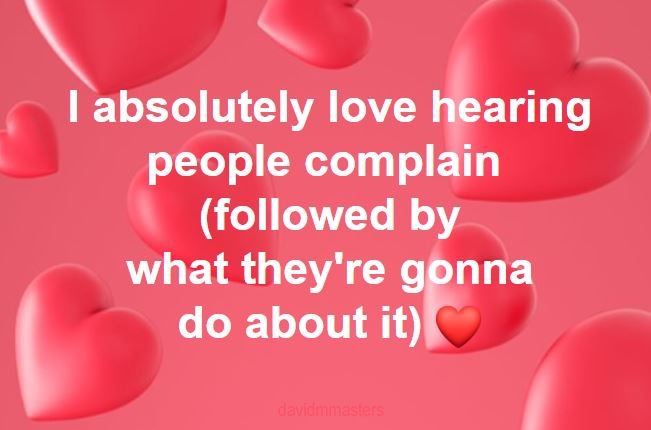
I absolutely love hearing people complain, followed by what they’re gonna do about it.
When you notice some story of an atrocity which rocks your being piercing your soul to your core, you recoil and understandably upset. What happens next determines whether your opposition to this offensive subject will oppose it, or add power to it.
If you complain about it, great. That makes you feel better about it, because you’ve found a way to release the burden of it and pass it on to someone else.
I get excited when I hear someone complaining about something passionately. It instantly attracts my attention as I anticipate what comes next. I listen… if nothing else follows, I am disappointed. Instead of complaining and in a sense, courageously making a stand, by placing themselves in the bullet’s path, this person has just promoted the very thing that made him or her upset.
Instead, I love hearing people complain, followed by what they’re gonna do about it.
Tell me about the thing that upset you, tell me that you researched it to make sure the matter in question is valid (and not simply a false story to distract your attention from the good things in life and to make you fearful), and tell me what you’re doing about it. Even if it’s only donating $5 to an organization that is combating this offense.
If you complain in a venue which is highly public, like social media, then you have exponentially impacted the offending subject, intentionally or unintentionally, either for or against the thing which has upset you.
Do you want to promote this thing that has upset you? Fine, post something offensive in social media, with you acting as it’s PR promoter. Post about how horrible this atrocity is, without offering an opposing solution.
Do you want to be a part of the solution, to quash this thing, to stamp it out forever?
Then, complain. Post to your heart’s content. Put yourself on the line by telling me and the world what you are doing about it, and let your inspired action inspire me and others to join the cause.
Now, I’m excited!
Elizabeth Cady Stanton could have just complained about not having the ability to vote because she was a woman. But she complained and said, “I am drafting a Declaration of Sentiments and Grievances,” which addressed the basic rights which were being denied women at the time.
How crazy it might have seemed, when she, Lucretia Mott and a few friends met in her home to draft her declaration. Anyone looking in from the outside must’ve thought this an impossible task. Really? That one woman would stand against the mightiest political machine ever contrived. Are you kidding me? This dwarfs King David’s youthful account of slaying Goliath by hundreds of times.
She complained, followed by inspired action. She started a movement, complaining, and allowing others to join with her voice to be heard. 72 years later, because Elizabeth Cady Stanton complained and stood in the bullet’s path, the 19th Amendment was passed, granting women the right to vote.
This is only one small example among hundreds of thousands of true stories depicting what people can do to make a difference in a troubled world, and it starts with one.
Will you be the one who adds to the confusion and dysfunction of the world or will you be a part of the solution?
When life seems to be a relentless struggle for survival, it’s so good to have someone in your corner. In this day and age when face-to-face relationships are hard to manage, social media has arrived on the scene to help fill in the gap. Even when we are warned about the dangers of social media as it gets blamed for the deterioration of human interaction, the truth is, it has also saved the lives of many.
For those who need to find someone in their corner with whom they can resonate with, regardless of your social status in the real world, you can find someone empathetic to your situation, cause, or plight.
In this way, social media plays an important part in the social matrix of your life. When you desperately need someone on your side, who can see things from your perspective, can feel what you’re feeling or has walked a mile in your shoes, social media can give you access to the people you need for support, when it would be difficult to do so in the real world.
I know when I have been at my lowest, and it seemed like there was no one there, I was desolate, alone, and felt as though there was no hope, or reason to go on, social media bridged the gap and helped me get through the toughest of times.
People, although virtual, were there to care, understand, love, and support me, when the rest of my life in the real world was crumbling all around me.
With all the negative press that social media gets (much of it warranted), there is another side to it as well. This virtual instant access to others can help build up and support the human condition as well.
Certainly, as with anything with huge positive potential, it can be abused and used with negative intent, but on the other side it can have incredible potential for making the world a better place.
Social media is a powerful medium which can either impact the world for good or for evil, and it appears that in order to keep its effectiveness, it must remain neutral. It’s up to you to decide how you will wield the awesome power of this electronic networking tool.
Social media is a microcosm of the totality of life on our planet. All types of people, philosophies, personality types, and beliefs are represented, and for the most part are able, and encouraged, to share their thoughts and feelings freely.
You may not always agree (and there is no reason why you should be required to) and you always have a choice in how you will represent yourself via social media. You can choose to fight, counter-attack, bless, or love. It’s up to you.
It may serve you well to think about how you are showing up in social media.
Are you representing yourself as the person you would like to be remembered as?
I know when Aaron was killed in Afghanistan, his social media was a worldwide representation of who he was, and it still survives him, even today.
I have many friends who have since passed away and their social media accounts give us all something to look back on to remember, honor, laugh, and reflect on the impact they have had on our lives when they were here.
Someday, after I am long gone, the virtual footprints of my social media interactions may be all that remains.
Just remember, your social media might represent the kind of person you are (or were) when you were here, on your life’s journey.
How would you like to be remembered in your social media?
Just like anything in life, we all do different things for different reasons. How does that apply to how you use Facebook? It depends on what kind of person you are and what you get in return from using Facebook. Here are the Top 20 Types of Facebook Users. Which one are you?
Top 20 Types of Facebook Users Which One Are You?
Top 20 Types of Facebook Users
1. FB TOE DIPPERS
Some Facebook users aren’t really users at all, they’ve simply dipped their toe in the water to see what it’s all about. They may have friend requested you, but are rarely online, or interact with anyone inside the Facebook community. May log-in to look around for a while, but not ready to jump in, yet. Their life is probably consumed with activity in the world which exists outside of Facebook.
2. FACEBOOK NEWBIE
The Facebook Newbie can range in age from four (with parent’s permission) to ninety-four and they want to interact using Facebook but break all the unwritten social networking rules. They innocently offend and interact inappropriately, but it’s all kind of entertaining to watch someone so naïve spreading their wings and learning to Facebook. We laugh, we cry, and we help them along as best we can, so as not to scare them off.
3. CASUAL FACEBOOKER
The Casual Facebooker is a step beyond the FB Toe Dipper in that they do log in periodically to interact with friends and relatives using Facebook. They don’t spend too much time logged in and do not take full advantage of the tools or resources of value to this powerful social media platform.
4. FACEBOOK ANNOUNCER
Some people have to announce everything that’s going on in their life, such as, “I just woke up,” followed by myriad details about what happens throughout their day complete with photo documentation, and commencing with, “Good night.”
5. FB LONELY HEART
Then, there are the lonely hearts, in various stages of amóre who wear their hearts on their sleeves. Either they’re blissfully in the throes of romantic love, or they are heartbroken beyond compare (and may vacillate frequently between these two extremes).
6. OUR FB OF GREAT SORROWS
Our Facebook of great sorrows group is constantly airing the wounds of their depressive pain and discomfort about everything bad that is happening to them, or someone or something else. It’s as if they are determined to make everyone on Facebook feel as awful as they do.
7. FB ATTENTION SEEKER
Attention seekers will use any means to break through the white noise of Facebook’s drone. They will use pain and suffering or success and happiness (augmented by photos of babies and kitties) to get the attention (and likes) they so desperately seek.
8. FACEBOOK GAMER
Lifeless gamers are the folks who have so much free time on their hands they waste it on mindless games which abound on Facebook, and they annoy the non-gamers with relentless requests to join them in a game or to take an action or click on something, so they can get points or advance to the next level.
9. FACEBOOK SELFIE
The selfies are all about themselves, frequently take and post pictures of themselves (selfies), often changing their profile picture, and letting us see them placing themselves in various environments to take and post yet another selfie. They usually see themselves as one of the beautiful people or don’t (and hope that all this selfie-ism will make them feel better about themselves).
10. FB ROCK STAR WANNABE
The I-wanna-be-a-rock-stars are those Facebookers who hope to be recognized for their talent or rock musician bravado by posting pictures of themselves in makeup, attire, and various performance poses (with or without music gear) to be discovered and make the transformation from wannabe to a real rock star.
11. FACEBOOK TAGALONG
Then there are the obsessive taggers who tag hordes of disinterested and/or unassociated Facebook users to various photos and events in the hopes of getting the coveted like(s) thereby validating their efforts and/or life.
12. DON’T YOU WISH YOU WERE ME?
The don’t-you-wish-you-were-me-ers are constantly updating their Facebook timeline with photos of amazing activities, places, and events they are participating in, in real time. It’s not photoshop, there are just bragging on Facebook, while most followers are both impressed and jealous.
13. FACEBOOK CREATOR
The creators actually create, add, and share valuable content with the Facebook community, everything from original artwork, poems, thoughtful stories, wisdom, and memes. They are not self-seeking, only using Facebook as a means to share their creative abilities (and some are quite amazing).
14. FB PHOTOJOURNALIST
Facebook photojournalists are Facebook users who have purchased a nice digital camera and take pictures of everything from bugs and wildlife to still life and landscapes (and everything else imaginable). They assume you’re having access to their Facebook account to peruse their immense photo gallery (galleries) will impress you. If you are at an event they attended, they are likely to post a photo of the event and tag you in it, if they can.
15. FB FAKE NEWS REPORTER
False news reporters abound on Facebook. These folks are waiting for the next unbelievable and shocking news headline/story to flash upon their timeline, then proliferate the information by immediately sharing it with all their friends, insisting they do so in kind to save the world from such an injustice (or whatever the meat of the fake story might be).
16. FACEBOOK INTOLERANT
The Facebook Intolerants are the users who are so immersed in a particular thought pattern or belief system, that they are completely incapable of seeing the other side of any issue and will argue via negative posting, slamming anyone who does not agree with them, to try to start an FB fight online. This is a form of abuse, but one that pays off, when two sides (opposing Facebook Intolerants) of any emotional issue get fired up.
17. FACEBOOK MARKETER
Facebook marketers can be relentless, and Facebook encourages them to market their wares and services to other Facebook users. As annoying as the marketing may be, Zuckerberg is trying to make the advertising experience much less offensive than other types of advertising you might see on the Internet (and the revenue from these “sponsors” is what keeps FB free, and Zuckerberg rich). Other FB marketers are using other types of Facebook interactions to connect (and annoy) their potential customers.
18. FACEBOOK MANIPULATOR
Facebook Manipulators are the sneaky Facebook users who are well-versed in the use of all the Facebook features and filters. They generally have a devious side but are not malicious in nature. You might look at their profile while logged-in from your account and see one thing, and from someone else’s account, it could look very different, for whatever reason.
19. FACEBOOK STALKER
Not to forget the Facebook Stalker (AKA Internet Trolls using Facebook) who possesses and maintains several alternate identities on Facebook just for spying (and commenting on) profiles of Facebook users that might rather be unmonitored (for whatever reason) by the real person in question.
20. FACEBOOK PREDATOR
Facebook Predators are those who may or may not create fake Facebook profile accounts to defraud or otherwise take advantage of Facebook users who may not possess a decent BS-filter, leading to loss; loss of dignity, loss of mental health, loss of finances, time, or life itself. FB-user beware.
Did I miss anyone?
Add a type of Facebook user that may not have made it to the Top 20 Types of Facebook Users below
We all know that things are not always as they appear, yet widely we still tend to base our opinion of another person based on a very small data sample. As much as we know that we don’t like people to judge us, reduce us to a structured personality profile, assume that we are a particular kind of cat or two-dimensional caricatures; still we tend to do this when exposed to another individual whom we might not know very well.
Our first impression of someone will influence and spin everything they say or do from that point forward to support our initial opinion or generalization of the kind of person this person may (or may not) be.
In business, some of the best talent to support your organization comes from the least likely candidates. Often someone who does not interview well may bring the most significant impact to your organization. They might not look the part, dress fashionably or have the best social skills but what they bring to the table can far supersede your more trendy hires or associates.
Of course, we don’t just tend to judge people by their appearance in the sifting and sorting of the hiring process, we judge people based on our own impression of them in all areas of life.
There is the homeless person holding the “Will Work for Food” sign, we don’t think twice before making an immediate evaluation of this person, even though we do not have a clue who they are, what their position in life is, whether they are genuinely broke or not.
When we’re on the prowl for a potential mate, book covers enter the game again. This one’s not handsome/pretty enough, not tall enough, too short, bad taste in fragrance, shoes or jewelry. Then, of course, there’s the number one book cover, “What kind of car does he drive?”
Especially if we’ve been around the relationship venue for some time, we have a whole list of items to disqualify any potential suitor who might come our way, based on our own personal bias and experience.
In a supermarket, you could hear someone in line repeat a particular phrase that sets off all kinds of bells and whistles and you immediately jump to a conclusion about what kind of person this is based on a string of seven or eight words that triggered your psyches.
If you’re on the lookout for demons, you’re likely to find them everywhere you look.
It appears the most judgmental people of all can be found trolling the Internet looking for people to insult, degrade and humiliate.
I know someone who poured their heart out on Facebook (alright, inadvisable, nonetheless) this person was waylaid by an onslaught of vile accusations and ridicule. All from one transparent, honest and open statement, let loose for the world to see; only to be made the subject of further abuse.
In the event that you get hammered by one of these haters, please try not to take it personal. They don’t know you, and they know no other way to make themselves feel better, than to put someone else down. It’s not about you, it’s about their nature, regardless of who you are, haters gonna hate.
Are you a hater?
If we look deep inside ourselves, as much as we would like to deny that we are “haters,” truth be told we are probably more like the haters in the way that we judge or falsely accuse others based on very little information. Some people are falsely accused and sentenced to prison, for being less than desirable.
What can we do about it?
Well, on social media, if you see someone’s post that seems crass or insensitive, maybe check out the individual’s profile to see if he/she is the type of person that you imagined they were based on a few words on a public post. You might be surprised to see a lovely person, who might even be a considered a “friend” if you met him/her face-to-face.
You just cannot rely on your first impression of a person based on a single statement, like or share. You do not know who they are, what’s happening in their life or what caused them to respond in that way. Chances are, if you had walked a mile in that person’s shoes, you would have done the same thing.
And it’s likely that you have liked, commented and posted something questionable, you’d rather not be defined by at some point. Nowadays, it is prudent to think before you post.
You might consider getting used to the idea that there are other people who are a lot more like you than not. These people also have histories, families, hopes, dreams, and beliefs just like you (though dissimilar) and that’s okay. Isn’t it?
If not, not to worry, there’s room for you, too… and we love you anyway.