How and Why to Social Media Advertise Your Program Offer Now

I see people trying to promote their offers on social media without paying, and I often wonder, why even do that? You could just as easily call up your friends and ask them for money. The real idea behind promoting your digital product on social media isn’t about reaching the people you already know. It’s about giving yourself access to people you don’t know yet, inviting them to get to know you, align with you, join your tribe, and, if they resonate, support your mission with their dollars.

These days, social media platforms are more than scrolling feeds. They are the most powerful advertising tools in the world, offering precision targeting at a level small businesses never had access to before. With only a little knowledge and a modest investment, you can put your offer directly in front of the people you’ve already identified as your ideal audience.

The opportunity is spectacular. And here’s the truth: if most people see your ad on social media and it’s not marked as “sponsored” or a paid advertisement, they don’t take you seriously. Unless it’s your mom or your best friend, who already loves you, an unpaid post won’t usually move the needle.

Think about it like this: what if some guy with no business card, no truck, no company logo, just shows up at your door and says he wants to landscape your yard? Does that feel trustworthy? Not really. But if you see a paid advertisement for a landscaping business, you feel more confident—because someone who invests in their visibility shows they are vested in their own credibility. Same thing on social media.

Spend a few dollars. Invest in yourself. That small investment signals to your tribe that you are serious about your mission.

Tips for Effective Social Media Advertising

Here are some techniques you can apply to create trust, build connection, and maximize your reach with paid ads:

    1. Know Your Audience. Use the targeting tools available. Narrow down by age, location, interests, even behaviors. The clearer your customer avatar, the more precise your ad delivery will be.
    2. Lead with Value. Don’t just sell. Offer something useful, an insight, a free guide, a mini-training. This builds trust and gives people a reason to take the first step with you.
    3. Tell Your Story. People don’t buy products; they buy alignment. Use ads to share your mission and why you do what you do. Storytelling creates emotional connection.
    4. Test Small, Scale Big. Start with a small budget, test multiple versions of your ad, and when you find what works, scale up. This prevents wasting money and maximizes ROI.
    5. Use Video Ads. Short, authentic videos outperform text and static images. Your audience wants to see you, your energy, your passion.

Beware the Scams

But let me also wave a caution flag here. The online world is filled with unscrupulous marketers promising the moon: instant traffic, guaranteed sales, or thousands of followers overnight. Don’t fall for it.

Here’s what can happen when you chase too-good-to-be-true offers:

    • Fake Engagement: Some marketers will sell you bots or fake likes. They look impressive at first, but they don’t buy anything. They also damage your credibility.
    • Ad Fraud: Scammers can use shady techniques that drive clicks from fake accounts. You pay for the clicks, but no real human sees your offer.
    • Permanent Bans: Worst of all, if you’re caught using illegitimate methods, your account or project could be banned forever. Imagine relying on your digital product to feed your kids and suddenly losing everything. Not good.

Stay ethical. Build your business on solid ground. The truth is, when you use social media advertising properly, you don’t need shortcuts.

Your digital product represents your calling, your mission, and your value to the world. Social media advertising is one of the most effective and affordable ways to put it into the hands of the people who need it most. But only if you take it seriously.

Invest in yourself. Use the tools wisely. Share your story authentically. Avoid scams and stay ethical. Do this, and you won’t just sell a digital product, you’ll build a tribe that supports you for the long haul.

How to Create Your Digital Product Masterpiece

Platform-Specific Social Media Advertising Guide

When it comes to promoting your digital product, not all platforms are created equal. Each one has its strengths, weaknesses, and its own culture. The good news is, you don’t need to be everywhere. Pick the platform that best aligns with your product, your message, and the audience you’ve defined as your tribe.

Here’s a breakdown:

Facebook

    • Advantages: Still the largest social media platform. Powerful ad targeting tools. Great for community building, longer posts, and sharing your story.
    • Disadvantages: Organic (free) reach is almost non-existent for business pages. Ads can feel crowded with competition.
    • Targeting: Extremely granular, demographics, interests, behaviors, life events, look-alike audiences. You can get laser-focused on your exact people.
    • Affordability: Very affordable to start. You can test ads for just $5–$10 per day. Costs rise if your niche is highly competitive.

Instagram

    • Advantages: Visual storytelling powerhouse. Perfect for younger demographics, lifestyle brands, and digital products that can be shown in action. Great use of reels and stories.
    • Disadvantages: Not ideal if your content isn’t visually engaging. Audiences may scroll fast—harder to hold attention.
    • Targeting: Shares Facebook’s targeting system (Meta owns both), so you get the same precision.
    • Affordability: Similar to Facebook—low barrier to entry, but the most engaging ads (video reels, story ads) usually cost a bit more to optimize.

TikTok

    • Advantages: Explosive reach potential. Short-form videos go viral easily. Younger audience (Gen Z, early Millennials). Great if your product is fun, bold, or entertaining.
    • Disadvantages: Content must be creative and authentic; hard-sell ads flop. Audience skews young, if your product isn’t relevant, skip it.
    • Targeting: Age, location, interests, device type. Not as detailed as Facebook, but strong for broad demographics.
    • Affordability: Ads are relatively cheap right now compared to older platforms, because it’s still growing. Big upside for experimentation.

LinkedIn

    • Advantages: Best platform for B2B (business-to-business) products, coaching, or professional development offers. Credibility is higher when people see sponsored ads here.
    • Disadvantages: More expensive than other platforms. Not great for casual or consumer-focused products.
    • Targeting: Very precise, job title, industry, company size, seniority level. Perfect for professional niches.
    • Affordability: Higher cost per click (CPC often $5–$10+), but if your product is high-ticket or professional, the ROI can be worth it.

YouTube

    • Advantages: Video ads show up before or during other videos. Great for education-based offers or products with a strong story. YouTube has high trust and long watch times.
    • Disadvantages: Requires strong video content. Production quality matters. May feel intimidating for beginners.
    • Targeting: Interests, demographics, search keywords, video topics, even placements on specific channels. Highly customizable.
    • Affordability: Costs vary widely. Skippable in-stream ads can be affordable ($0.10–$0.30 per view), but high-competition niches cost more.

Choosing a Platform

    • If your product is consumer-friendly and you want broad reach, start with Facebook + Instagram.
    • If your product appeals to young trendsetters, experiment with TikTok.
    • If your offer is professional or B2B, LinkedIn is where you want to be.
    • If you’re ready to teach, inspire, and tell longer stories, YouTube ads can be game-changers.

Remember: social media advertising isn’t about shouting into the void. It’s about showing up where your people already are, investing a few dollars to earn their trust, and inviting them into your world.


Email Marketing as a Sacred Bridge to Your Tribe

When you are walking out your higher calling, you are not just building a business or promoting an idea. You are cultivating a sacred relationship with the people who resonate with your message. Email marketing, when practiced with love and integrity, becomes more than a marketing tool, it becomes a bridge of connection, trust, and shared energy between you and your tribe.

Imagine this: someone wakes up, pours their morning coffee, and sees your name waiting in their inbox. In that moment, you have the opportunity to pour encouragement, wisdom, or a spark of inspiration into their day. Your email isn’t just a message, it’s an embrace, a reminder that they are not alone on their journey, and that they belong to a tribe aligned with love and purpose.

Email marketing, when done right, is not about selling. It’s about serving. Each message can be a channel for your higher calling, an echo of your heart’s mission that reminds your tribe of the love, hope, and possibility that brought them to you in the first place.

Building Energy and Enthusiasm

Every message you send carries energy. When your emails are authentic, full of enthusiasm and encouragement, that energy transfers to your tribe. They feel lifted, excited, and motivated to stay connected with you. Over time, this rhythm builds a strong, almost family-like bond.

    • Share your story boldly: Include your highs and lows. Vulnerability breeds trust and deepens the love connection.
    • Celebrate your tribe: Acknowledge milestones, successes, and victories of the people walking with you.
    • Offer encouragement: Short, heartfelt reminders can become anchors of light in difficult seasons.

This is how enthusiastic energy is nurtured, by consistently showing up with love in your words, humility in your tone, and sincerity in your message.

Programs and Products That Support the Journey

To keep this relationship flowing, consider using supportive email platforms designed to make your job easier and more effective:

    • Mailchimp: Great for beginners. Easy to set up and launch simple campaigns.
    • ConvertKit: Wonderful for creators and spiritual entrepreneurs. It makes segmentation and personal touch easier.
    • ActiveCampaign: Powerful for those ready to build deeper funnels and automations without losing authenticity.
    • MailerLite: Affordable, clean, and user-friendly, perfect for starting out with love-centered emails.

Each of these platforms allows you to share your message consistently and with care, while offering tools to segment your audience, personalize messages, and honor the unique energy of each supporter.

Ways to Introduce and Launch Effectively

    1. Welcome Sequences
      When someone joins your email list, don’t just thank them, invite them into your sacred circle. Share your story, your mission, and what they can expect from you. Let them feel your heart right from the first hello.
    2. Love Letters of Value
      Send regular messages filled with inspiration, helpful tips, or resources. Let your tribe know they are receiving value simply by being in connection with you.
    3. Sacred Invitations
      When you offer a product, service, or opportunity to support your mission, present it as an invitation to walk closer with you, not as a sales pitch. Frame it as an opportunity for them to participate in the greater work you are doing together.
    4. Launches with Enthusiasm
      When launching a new product or program, do it with storytelling. Share why you created it, how it aligns with your mission, and how it can transform their lives. Build momentum by sending a series of emails that gradually draw your tribe closer, step by step.
    5. Celebration Emails
      Celebrate holidays, anniversaries, or milestones, not just your own, but those of your community. Let your tribe know they are seen, valued, and celebrated.

Your Email List as a Living Community

Think of your email list not as numbers or data points, but as a circle of souls, each one a living, breathing person who chose to connect with you. The more you honor that sacred trust, the more they will feel the love and energy behind every message.

This is how email marketing supports your higher calling: not by extracting dollars, but by creating connection, by enhancing the love relationship, and by building a thriving, enthusiastic community around your mission.

Your inbox becomes a temple of connection. Your words become prayers of encouragement. And together, you and your tribe walk forward, side by side, creating a better world.

Sample Subject Lines to Spark Love and Connection

Your subject line is the open door to your email. When written with care, it gently invites your tribe into a deeper connection. Here are some examples to inspire you:

    • ✨ “A little reminder: You are loved more than you know”
    • “One small step today that will lift your spirit”
    • “Your higher calling is calling… are you listening?”
    • “This love note is just for you”
    • “We’re building something beautiful together”
    • “What I learned in the valley (that may help you right now)”
    • “A sacred invitation to walk closer with me”
    • “Time to celebrate YOU!”
    • ️ “Peace, purpose, and a story from my heart”
    • “This insight could shift everything for you today”
    • ❤️ “Your tribe is stronger because of you”

A Loving Reminder

Keep your subject lines short, sincere, and full of heart. Avoid gimmicks or pressure. Let your words carry warmth, love, and genuine curiosity. That’s what builds trust, and what keeps your tribe opening, reading, and connecting with you again and again.


The Power of Your Signature Program Digital Product

When you step into your calling, you’re not just stepping into something you do—you’re stepping into something you are. And the best way to share that essence with the world is through your signature product. This isn’t just another ebook, course, or online workshop. No, this is the one product that is you. It represents your heart, your values, your message, and your unique way of making a difference in the world.

We live in a digital age where the most powerful tools of transformation can be shared instantly. Your signature digital product is the bridge between your life’s mission and those who are desperately looking for someone like you to help them along their journey.

A signature program is not just something you create, it’s something you embody.

    • It represents who you are. People aren’t just buying information; they’re buying you, your perspective, your insight, your lived experience.
    • It inspires others. Your product is a reflection of your personal growth, your struggles, and your victories. It shows others what’s possible.
    • It builds your tribe. Those who resonate with your calling now have a way to vote with their dollars. They are saying, “Yes, I see you. Yes, I believe in what you’re doing. Yes, I want to be part of this.”

When someone invests in your signature digital product, they’re not just making a transaction. They’re joining your team. They’re standing shoulder-to-shoulder with you as you make the world a better place.

What Makes It “Signature”?

There are thousands of digital products floating around the internet, but only a few truly carry the weight of authenticity. A signature product has three key qualities:

    1. It’s uniquely yours. No copycatting here. This product has your fingerprint all over it. Your voice. Your stories. Your way of delivering value.
    2. It’s transformational. It doesn’t just give people knowledge, it gives them the ability to change, to grow, to step into a new reality.
    3. It’s scalable. Because it’s digital, your message isn’t limited by geography, time zones, or one-on-one sessions. You can inspire ten people, a thousand people, or a million people with the same effort.

How to Create Your Signature Digital Product

    1. Define Your Core Message.
      What is the one thing you want the world to know about you and what you do? Your product should clearly reflect your mission, your passion, and the transformation you offer.
    2. Choose the Best Format.
      Is your product best expressed as an online course, a video series, a membership site, an audio program, or an ebook? Pick the format that lets your personality shine.
    3. Map the Transformation.
      Don’t just dump information. Walk your people through a journey. Where are they when they start? Where do they want to be when they finish? Build your product to carry them across that bridge.
    4. Infuse Your Story.
      Share your personal experiences, your struggles, and your breakthroughs. This is what makes your product more than just content—it makes it relatable, inspirational, and magnetic.
    5. Make It Accessible.
      Price your product so that it reflects its true value while still being accessible to your audience. Some will start small, others will want the full VIP experience. Give them options, but always have a clear “signature” level that represents the best of what you have to offer.
How to Create Your Digital Product Masterpiece

Here’s the truth: Your signature digital product is more than just a revenue stream. It’s a legacy piece. It’s your message crystallized into something that can live beyond you.

Every time someone downloads your course, reads your book, or listens to your program, they’re not just learning from you, they’re being transformed by you. They’re receiving the very best of who you are, and in that moment, your impact ripples out into the world.

Your calling is sacred. Your message matters. And your signature digital product is the vehicle that allows you to share it with the world.

So, what are you waiting for? Create the product that is you. Pour your passion into it. Make it inspirational, transformational, and unforgettable. Then give your people a way to join you, to stand with you, and to support your mission.

This is how you build not just a business, but a movement.


How to Create Your Irresistible Offer

In every area of life, whether you are leading a ministry, building a business, or sharing your heart through a digital product, the one thing that separates those who reach the people they are called to serve from those who fade quietly into the background is the irresistible offer.

An irresistible offer isn’t just about selling something. It’s about showing up fully as you are, bringing your most authentic self to the table, and wrapping your value in a way that others can immediately see, feel, and say, “Yes, that’s for me.”

Let’s explore how you can create your irresistible offer, no matter your mission or message.

    1. Start with Who You Are

At the core of your offer is you. Not just what you do, but who you are, what you believe, and why you do what you do.

        • In ministry, this might be the way you reflect the love, compassion, and grace that others are hungry for.
        • In business, it’s your story, your journey, your triumphs, and the lessons you’ve learned, that connects you to those who need your solution.
        • In a digital product, it’s the way you weave your voice and experience into every page, video, or audio clip so that the person engaging feels like they’re with you in the room.

People don’t just buy products or services, they buy transformation. They want to know you understand them, and that you can help them move from where they are to where they want to be.

    1. Identify the Transformation

An irresistible offer must clearly answer this question:

“What will my life look like after I say yes?”

This is where many people miss the mark. They describe their features, how many chapters, how many hours, how many modules, when what truly matters is the outcome.

        • Ministry example: “After joining this program, you’ll feel a renewed sense of connection with God and others.”
        • Business example: “After using this system, you’ll have a proven framework to double your income without doubling your hours.”
        • Digital product example: “By completing this course, you’ll finally know how to launch your passion project and attract the people who need it most.”

The transformation is the magnetic force that makes your offer irresistible.

    1. Add Tangible Value

Once you’ve defined the transformation, stack the value so it feels undeniable.

        • What bonuses, guides, or extras can you include that make your offer feel complete?
        • What shortcuts, templates, or frameworks can you provide to save your audience time and frustration?
        • What level of access to you (or your wisdom) can you add to give them confidence?

It’s not about overwhelming them with more. It’s about showing that you’ve thought of everything they need to succeed.

    1. Remove the Barriers

For your offer to be irresistible, you must address the doubts and fears before they ever come up.

        • Affordability: Show how the value far outweighs the price.
        • Trust: Share stories, testimonials, or proof that what you offer really works.
        • Simplicity: Make the next step easy, clear, and doable.

Remember, people are less afraid of investing in you than they are of wasting their time and energy on something that won’t work. Take away that fear.

    1. Infuse Your Calling

The most irresistible offers are not transactional, they are transformational. They carry the weight of your calling.

When your audience senses that you’re not just trying to “make a sale,” but you are answering a higher purpose, whether that’s to serve God, uplift humanity, or empower individuals, they will lean in.

Your offer becomes not just about them buying from you. It becomes about them joining you.

    1. Make It Easy to Say “Yes”

Finally, an irresistible offer is simple, clear, and inviting.

        • Use words that speak directly to the heart of your audience.
        • Show them the path forward step by step.
        • Create urgency, not from pressure, but from the genuine belief that their transformation begins now.

When people feel both the inspiration and the practicality, they will naturally want to take that step.

Creating your irresistible offer is not about manipulation. It’s about alignment. Aligning your story, your passion, your skills, and your mission with the deepest needs of those you’re called to serve.

When you get this right, everything changes. Your ministry reaches more people. Your business grows in abundance. Your digital product becomes more than information, it becomes a beacon of hope, guidance, and transformation.

And the beauty is this: your irresistible offer is already inside you. It’s waiting for you to bring it into the light and share it with the world.


How to Create Your Sales Funnel with Multiple Offers

One of the most common mistakes I see people make when building a sales funnel is thinking in terms of one offer. You’ve seen it before: you land on a page, you’re presented with a single choice, “yes” or “no,” and then the door slams shut. If you buy, the company has your money. If you don’t, they lose you forever.

That kind of funnel leaves you standing at a cliff’s edge with nowhere else to go. But what if there was another way? What if your funnel could become a gentle staircase, with many different steps that let your audience choose the relationship that’s right for them?

That’s how you build a funnel that doesn’t just sell, it serves.

A funnel isn’t just about cash flow. It’s about building a relationship. Every time someone says “no” to one of your offers, it’s not necessarily a rejection. It often means, “Not yet, not at this price, not in this way.”

If you give them nothing else to step into, they’re gone. But if you architect your funnel with multiple doors at every level, they can say “not that” while still saying “yes” to something else.

And here’s the secret: the more ways they can stay in relationship with you, the more likely they’ll move deeper into your world over time.

Building Your Funnel: Step by Step

    1. Start with Your Core Offer

This is the heartbeat of your funnel. It could be a course, a digital product, a membership, or a coaching program. This is the thing you know delivers transformational value.

When you first present it, not everyone will buy. That’s okay. What matters is what you do next.

    1. Always Offer a Downsell

If your customer says no, don’t let the conversation end there. Present them with a downsized version of your core offer:

        • A shorter course
        • A single module instead of the full program
        • An ebook instead of the video library
        • A group session instead of one-on-one

This gives them a way to say “yes” without the same level of risk or cost.

    1. Offer Something Free

If they still say no, give them an option to receive a free resource in exchange for permission to stay connected:

        • A downloadable guide
        • A checklist
        • A quick-start video
        • A mini training

Now you’ve gained the most valuable asset of all, their attention and contact information.

    1. On the Upside, Offer Many Upgrades

If someone says yes to your core offer, don’t stop there. Give them the opportunity to:

        • Add a one-on-one session for deeper results
        • Upgrade to a higher-level coaching package
        • Bundle in a bonus product at a special price
        • Join your mastermind group

This creates natural ways for them to increase their financial support while getting more of what they want.

    1. Always Keep a Door Open

At every stage, whether they are saying yes or no, give them another option. Even while upselling, if they decline the big upgrade, offer a smaller one. If they decline that, offer a supportive product that’s a fit for where they are now.

The message you’re sending is: “No matter where you are in your journey, there’s a place for you here.”

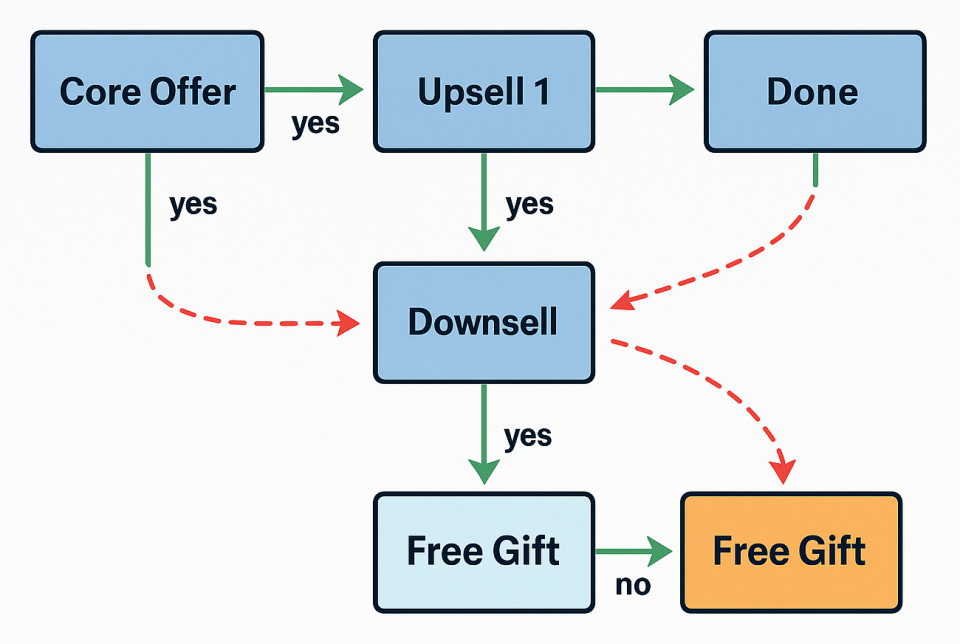
The Funnel Flow at a Glance

Here’s one way to imagine it:

        1. Core Offer → Yes? → Upsell 1 → Yes? → Upsell 2 → Yes? → Done.
          • If “No” at any step → Offer a downsell → Offer a free gift.
        2. Free Gift Entry Point → nurture with valuable content → later reintroduce Core Offer.

Your funnel becomes less of a straight chute and more like a living ecosystem where people can find their level of relationship with you.

When you design your funnel like this, you’re honoring people where they are. You’re not forcing a binary yes/no transaction, you’re creating a spectrum of choices. And that spectrum turns casual browsers into subscribers, subscribers into buyers, buyers into supporters, and supporters into lifelong partners in your mission.

That’s how you create a funnel that doesn’t just convert, it transforms.

How to Create Your Funnel in Practice

    1. Map it out visually. Draw boxes for each offer and arrows for every “yes” and “no” path.
    2. Write the copy. Each page should lead naturally into the next option, always framing the next “yes.”
    3. Set up automation. Use your platform (ClickFunnels, Kartra, Kajabi, WordPress + plugins, etc.) to deliver each step seamlessly.
    4. Test it. Watch where people drop off, and add in new offers or adjustments to keep the relationship alive.
    5. Refine constantly. Your funnel is a living thing. Keep improving it as you learn from your audience.

Here’s a visual funnel diagram showing how your offers connect:

✅ Green arrows = “yes” paths
❌ Red dashed arrows = “no” paths leading to another option

This way, your funnel always keeps the relationship alive, no matter what choice they make.

A true funnel is not a one-way street. It’s a dynamic path that gives your people room to say yes in their own way and at their own pace. When you create many opportunities for connection, you’ll find that “no” doesn’t mean the end of the journey. It often means, “I’ll walk with you another way.”

That’s how you build a funnel that honors who you are, serves those you’re called to serve, and creates sustainable abundance along the way.


Building Trust, Impact, and Sustainable Growth: Value Ladder

If you want to make the world a better place while building a sustainable business, you need more than just a great product or service. You need a pathway. A roadmap that helps your people, your tribe, see the journey you’re inviting them into. That’s where the Value Ladder comes in.

Think of it as a staircase of increasing value. Each step you offer brings your clients closer to transformation, deeper into trust with you, and more invested in the results only you can deliver.

Why the Value Ladder Matters

Many business owners make one of two mistakes:

    1. They throw everything at their customer at once, confusing, overwhelming, and often scaring them away.
    2. Or they offer only one thing, forcing their customer to either say yes or walk away forever.

Both paths lead to frustration.

The Value Ladder solves this by meeting people where they are. You start with something small, sometimes even free, that gives them a taste of what you can do. From there, you invite them into the next step, then the next, and eventually into your highest transformational offer.

Your ladder isn’t just about making sales. It’s about relationship-building. When someone buys from you once, even something small, they are far more likely to buy again. And if what you deliver actually changes their life, even in a small way, they’ll trust you when you present the bigger steps.

What a Value Ladder Looks Like

Picture the journey like this:

    1. Free Offer (Trust Builder): Blog posts, free eBooks, webinars, short videos, or tools that give quick wins. This proves you’re the real deal.
    2. Tripwire (Low Ticket): A small, affordable product or service, something that solves a specific problem quickly. The goal isn’t profit here, it’s relationship.
    3. Core Offer: This is your main product or service, the thing you’re known for. It solves your customer’s biggest pain point.
    4. Premium Offer: A higher-ticket service, program, or experience that goes deeper, delivers more, and provides a bigger result.
    5. High-Ticket Transformation: Your highest-level offer, private coaching, done-for-you services, immersive retreats, or certification programs. This is where your customer experiences their most significant transformation with you.

Each step leads naturally to the next. Each step demonstrates more of your heart, your expertise, and your commitment to their success.

The Benefits of a Value Ladder

    • Trust & Retention: By starting small, you allow hesitant customers to test the waters without risk. Once they’ve had a good experience, they’re far more likely to return.
    • Increased Lifetime Value: A one-time sale is nice. But creating a lifelong relationship with a client? That’s where the real impact and revenue live.
    • Serving More People: Not everyone can afford your highest offer, but almost anyone can step onto the first rung. The ladder allows you to serve people at multiple levels without leaving anyone behind.
    • Clarity for You and Your Team: Your value ladder is more than a sales tool; it’s a business plan. It shows you and your team exactly how people move from curiosity to commitment.

Building Your Value Ladder

Here’s the secret: every step must be valuable on its own. Don’t hold back your best ideas for the top rung. Each level should deliver real results, otherwise you’ll lose people before they ever get to experience your true transformation.

Ask yourself:

    • What’s the smallest, simplest way I can help someone right now?
    • What’s the next logical step they’ll need once they solve that problem?
    • How can I keep creating value at higher and higher levels until I deliver the ultimate transformation I’m here to offer?

The ladder doesn’t have to be complicated. In fact, the simpler it is, the easier it is for your customers to climb.

You Are the Key

At the end of the day, your value ladder isn’t just about strategy. It’s about you.

You are the guide. You are the one building trust. You are the one delivering value.

If the first step feels authentic, generous, and real, people will want to keep climbing. If it feels manipulative or empty, they’ll step off before they ever see the top.

So, build your ladder with heart. Fill it with real solutions, genuine connection, and transformational results. Do this, and not only will your business grow, but you’ll also create lasting impact in the lives of those you serve.

Remember this:
The Value Ladder isn’t just a sales tactic. It’s a journey of trust, transformation, and purpose. It’s how you take someone from curious stranger to lifelong advocate, and in the process, make the world a better place.