One of the most common mistakes I see people make when building a sales funnel is thinking in terms of one offer. You’ve seen it before: you land on a page, you’re presented with a single choice, “yes” or “no,” and then the door slams shut. If you buy, the company has your money. If you don’t, they lose you forever.
That kind of funnel leaves you standing at a cliff’s edge with nowhere else to go. But what if there was another way? What if your funnel could become a gentle staircase, with many different steps that let your audience choose the relationship that’s right for them?
That’s how you build a funnel that doesn’t just sell, it serves.
A funnel isn’t just about cash flow. It’s about building a relationship. Every time someone says “no” to one of your offers, it’s not necessarily a rejection. It often means, “Not yet, not at this price, not in this way.”
If you give them nothing else to step into, they’re gone. But if you architect your funnel with multiple doors at every level, they can say “not that” while still saying “yes” to something else.
And here’s the secret: the more ways they can stay in relationship with you, the more likely they’ll move deeper into your world over time.
Building Your Funnel: Step by Step
-
- Start with Your Core Offer
This is the heartbeat of your funnel. It could be a course, a digital product, a membership, or a coaching program. This is the thing you know delivers transformational value.
When you first present it, not everyone will buy. That’s okay. What matters is what you do next.
-
- Always Offer a Downsell
If your customer says no, don’t let the conversation end there. Present them with a downsized version of your core offer:
-
-
-
- A shorter course
- A single module instead of the full program
- An ebook instead of the video library
- A group session instead of one-on-one
-
-
This gives them a way to say “yes” without the same level of risk or cost.
-
- Offer Something Free
If they still say no, give them an option to receive a free resource in exchange for permission to stay connected:
-
-
-
- A downloadable guide
- A checklist
- A quick-start video
- A mini training
-
-
Now you’ve gained the most valuable asset of all, their attention and contact information.
-
- On the Upside, Offer Many Upgrades
If someone says yes to your core offer, don’t stop there. Give them the opportunity to:
-
-
-
- Add a one-on-one session for deeper results
- Upgrade to a higher-level coaching package
- Bundle in a bonus product at a special price
- Join your mastermind group
-
-
This creates natural ways for them to increase their financial support while getting more of what they want.
-
- Always Keep a Door Open
At every stage, whether they are saying yes or no, give them another option. Even while upselling, if they decline the big upgrade, offer a smaller one. If they decline that, offer a supportive product that’s a fit for where they are now.
The message you’re sending is: “No matter where you are in your journey, there’s a place for you here.”
The Funnel Flow at a Glance
Here’s one way to imagine it:
-
-
-
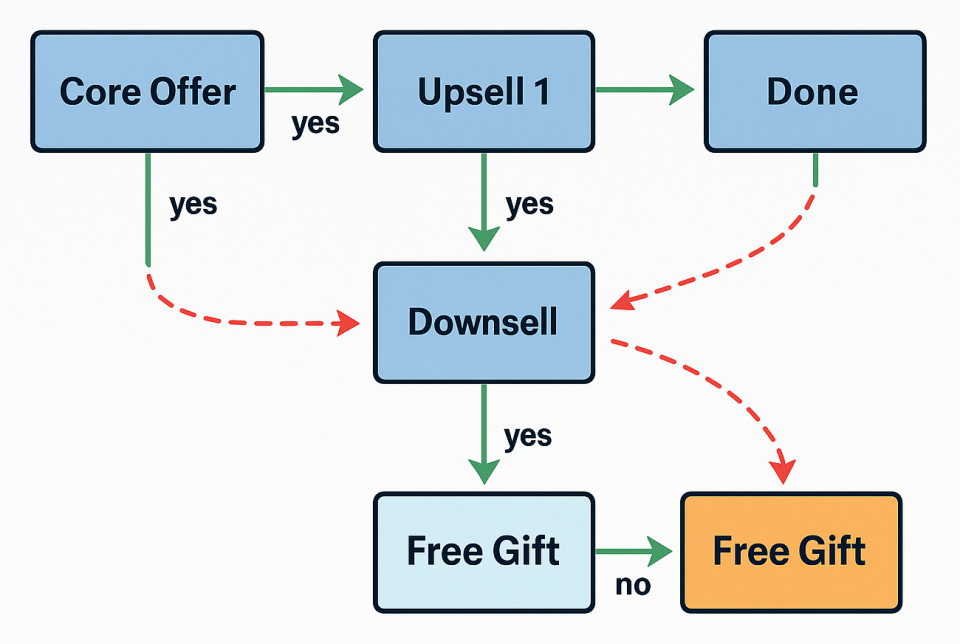
- Core Offer → Yes? → Upsell 1 → Yes? → Upsell 2 → Yes? → Done.
- If “No” at any step → Offer a downsell → Offer a free gift.
- Free Gift Entry Point → nurture with valuable content → later reintroduce Core Offer.
- Core Offer → Yes? → Upsell 1 → Yes? → Upsell 2 → Yes? → Done.
-
-
Your funnel becomes less of a straight chute and more like a living ecosystem where people can find their level of relationship with you.
When you design your funnel like this, you’re honoring people where they are. You’re not forcing a binary yes/no transaction, you’re creating a spectrum of choices. And that spectrum turns casual browsers into subscribers, subscribers into buyers, buyers into supporters, and supporters into lifelong partners in your mission.
That’s how you create a funnel that doesn’t just convert, it transforms.
How to Create Your Funnel in Practice
-
- Map it out visually. Draw boxes for each offer and arrows for every “yes” and “no” path.
- Write the copy. Each page should lead naturally into the next option, always framing the next “yes.”
- Set up automation. Use your platform (ClickFunnels, Kartra, Kajabi, WordPress + plugins, etc.) to deliver each step seamlessly.
- Test it. Watch where people drop off, and add in new offers or adjustments to keep the relationship alive.
- Refine constantly. Your funnel is a living thing. Keep improving it as you learn from your audience.

Here’s a visual funnel diagram showing how your offers connect:
✅ Green arrows = “yes” paths
❌ Red dashed arrows = “no” paths leading to another option
This way, your funnel always keeps the relationship alive, no matter what choice they make.
A true funnel is not a one-way street. It’s a dynamic path that gives your people room to say yes in their own way and at their own pace. When you create many opportunities for connection, you’ll find that “no” doesn’t mean the end of the journey. It often means, “I’ll walk with you another way.”
That’s how you build a funnel that honors who you are, serves those you’re called to serve, and creates sustainable abundance along the way.