I have spent a considerable portion of my life running ahead of people. Not running away from them. Running ahead for them. There’s a difference. Someone would come along who appeared to be headed in roughly the same direction I was going, and I would think, “Wonderful! A traveling companion!” And off I’d go.
I’d invest my time. I’d invest my energy. Sometimes I’d invest my money. I’d make introductions, open doors, solve problems, clear obstacles, and start paving the road ahead because I could see where we were going. Or at least I thought I could.
Eventually, I’d look behind me… and nobody was there.
Apparently, my traveling companion had taken an exit about forty miles back. Ugh.
There I’d be with half a bridge, three miles of freshly paved highway, a depleted bank account, and nobody particularly interested in going where I had worked so hard to make it easier for us to go.
There was camaraderie. There were probably some wonderful memories. But eventually I had to ask myself:
How did I get so far off my own path?
It took me a while, but I finally learned something. Today, I call it:
1 + 1 = 1
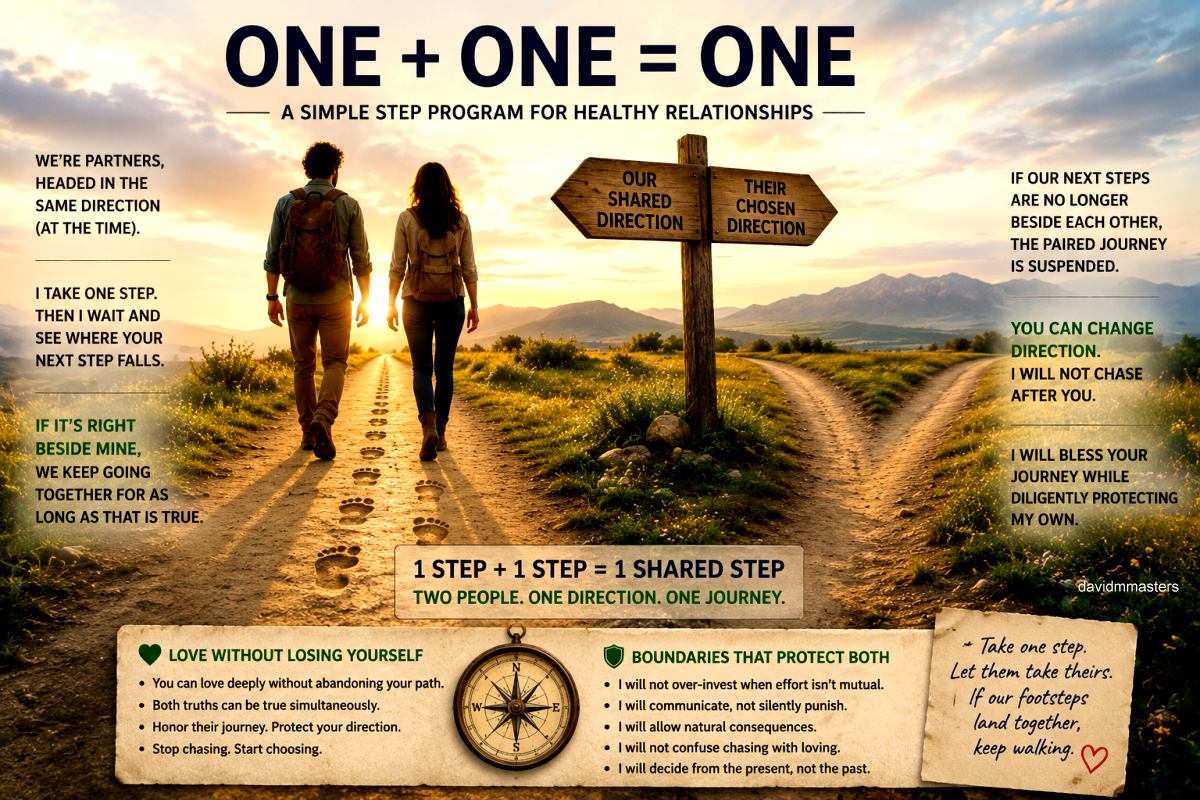
It’s a simple step program. You take one step. I take one step. And together, we’ve taken one step. That’s it.
If we’re business partners, friends, collaborators, lovers, family members, coach and client, or two people attempting almost anything together, we can walk side by side for as long as our footsteps continue landing beside each other.
I take a step. You take a step. I take another. You take another. Look at us go. But if I take my next step and yours doesn’t appear beside it, something changes.
I don’t necessarily get angry. I don’t have to judge you. I don’t have to decide that you’re unreliable, lazy, selfish, afraid, broken, or wrong. And I certainly don’t need to chase you down.
I simply stop advancing our shared journey until there is another shared step.
That’s 1 + 1 = 1.
You Are Allowed to Change Direction
This is where things get interesting. You are absolutely allowed to change direction. So am I.
Maybe something changed. Maybe you learned something. Maybe what seemed important six months ago doesn’t matter anymore. Maybe you’ve discovered another road that belongs to you.
Wonderful. Go explore it.
I can love you while you’re over there. I can cheer for you from here. I can even be curious about what you discover.
What I don’t have to do is abandon my road and run after you merely because we were once walking together. That’s a distinction I wish I’d understood much earlier in life.
For years, I sometimes valued maintaining the relationship more highly than maintaining my own direction.
That can feel like love. Sometimes it even looks like love. But there is a subtle question worth asking:
Am I loving this person, or am I abandoning myself to preserve our proximity?
Ouch. There are questions that don’t need to yell to get your attention.
Love Doesn’t Require Pursuit
This becomes especially interesting when unconditional love enters the conversation. I believe unconditional love represents one of the highest expressions available to us.
Most people would love to receive it. Giving it? Well… that’s where things get interesting.
Unconditional love doesn’t mean unconditional participation.
-
- You can love someone without financing their latest detour.
- You can love someone without cleaning up every mess.
- You can love someone without abandoning your priorities.
- You can love someone without following them somewhere you do not belong.
- You can love someone and say, “It looks like you’re going that way now. I love you. I’m still going this way.” Both things can be true.
That’s one of the great freedoms of emotional maturity.
But They May Feel Abandoned
Here’s the tricky part. When you stop chasing someone, they may believe you’ve abandoned them.
From their perspective, you always followed before.
-
- You always rescued.
- You always caught up.
- You always adjusted your direction.
Then suddenly… you didn’t.
To them, your healthy boundary may initially feel like rejection. That doesn’t make their feelings invalid. Their perspective deserves respect too.
This is where communication becomes important. You might say,
“I’m not abandoning you. I’m honoring the direction you’ve chosen. I’m simply not abandoning my direction in order to follow you.”
That’s a very different message.
There may be angst. There may be misunderstanding. There may even be anger.
People see life from different vantage points.
If we want others to respect ours, it seems reasonable to extend the same courtesy to theirs.
Reframing the Moment
If you’d like to experiment with the 1 + 1 = 1 approach, here are a few reframes that may help.
Instead of: “Why aren’t they doing what they said they would do?”
Try: “Their next step belongs to them.”
Instead of: “I need to get them back on track.”
Try: “I need to remain aware of my own track.”
Instead of: “If I don’t help, everything might fall apart.”
Try: “Maybe reality has something to teach here that doesn’t require my interference.”
Instead of: “They’ve abandoned me.”
Try: “Our paths may have separated for now.”
And this is one of my favorites:
Instead of: “How far am I willing to go for this person?”
Ask: “How far can I go without leaving myself behind?”
That’s a completely different question.
Some 1 + 1 = 1 Boundaries
The step program isn’t a collection of demands imposed upon another person. It’s an agreement you make primarily with yourself.
You might decide:
-
- I will not continually invest more effort in a shared goal than the other participant is willing to invest.
- I will take the next reasonable step without taking someone else’s step for them.
- I will not repeatedly rescue someone from the natural consequences of changing direction.
- I will communicate rather than silently punish.
- I will not use withdrawal as manipulation.
- I will distinguish between patiently waiting and indefinitely putting my own life on hold.
- I will allow another person to change their mind without making their change a judgment about me.
- I will periodically ask whether the journey we’re taking is still genuinely shared.
- I will remain willing to renegotiate our direction when both of us want to.
- I will love people without requiring myself to follow them everywhere they go.
- I will respect their path while protecting mine.
- If our footsteps meet again, I will decide from the present moment—not from obligation to the past—whether walking together still makes sense.
And perhaps the most important:
I will not confuse chasing someone with loving them.
Look Down Occasionally
Relationships can become complicated very quickly.
We make promises. Circumstances change. People change. We change. Nobody needs to become the villain.
Sometimes two people simply stop walking in the same direction. If that happens, you don’t necessarily need a dramatic ending.
You may only need to look down. There’s your footprint. Is theirs beside it? Wonderful. Take another step.
If it isn’t… you don’t have to panic. You don’t have to chase. You don’t have to condemn. You don’t even have to close the door forever.
You can simply stand where you are long enough to notice what is actually happening.
Maybe they’ll return. Maybe you’ll discover a new direction together. Maybe they’ll wave happily from another road. Maybe someone else will eventually come walking alongside you.
You don’t have to know. You can bless another person’s journey without making it your own. You can love someone tremendously without losing yourself in the process.
And when two people really are headed in the same direction?
One step. One step. One shared movement forward.
1 + 1 = 1.
Funny math.
Pretty good traveling.