One + One = One: How to Love Someone Without Losing Yourself

I have spent a considerable portion of my life running ahead of people. Not running away from them. Running ahead for them. There’s a difference. Someone would come along who appeared to be headed in roughly the same direction I was going, and I would think, “Wonderful! A traveling companion!” And off I’d go.
I’d invest my time. I’d invest my energy. Sometimes I’d invest my money. I’d make introductions, open doors, solve problems, clear obstacles, and start paving the road ahead because I could see where we were going. Or at least I thought I could.

Eventually, I’d look behind me… and nobody was there.

Apparently, my traveling companion had taken an exit about forty miles back. Ugh.

There I’d be with half a bridge, three miles of freshly paved highway, a depleted bank account, and nobody particularly interested in going where I had worked so hard to make it easier for us to go.

There was camaraderie. There were probably some wonderful memories. But eventually I had to ask myself:

How did I get so far off my own path?

It took me a while, but I finally learned something. Today, I call it:

1 + 1 = 1

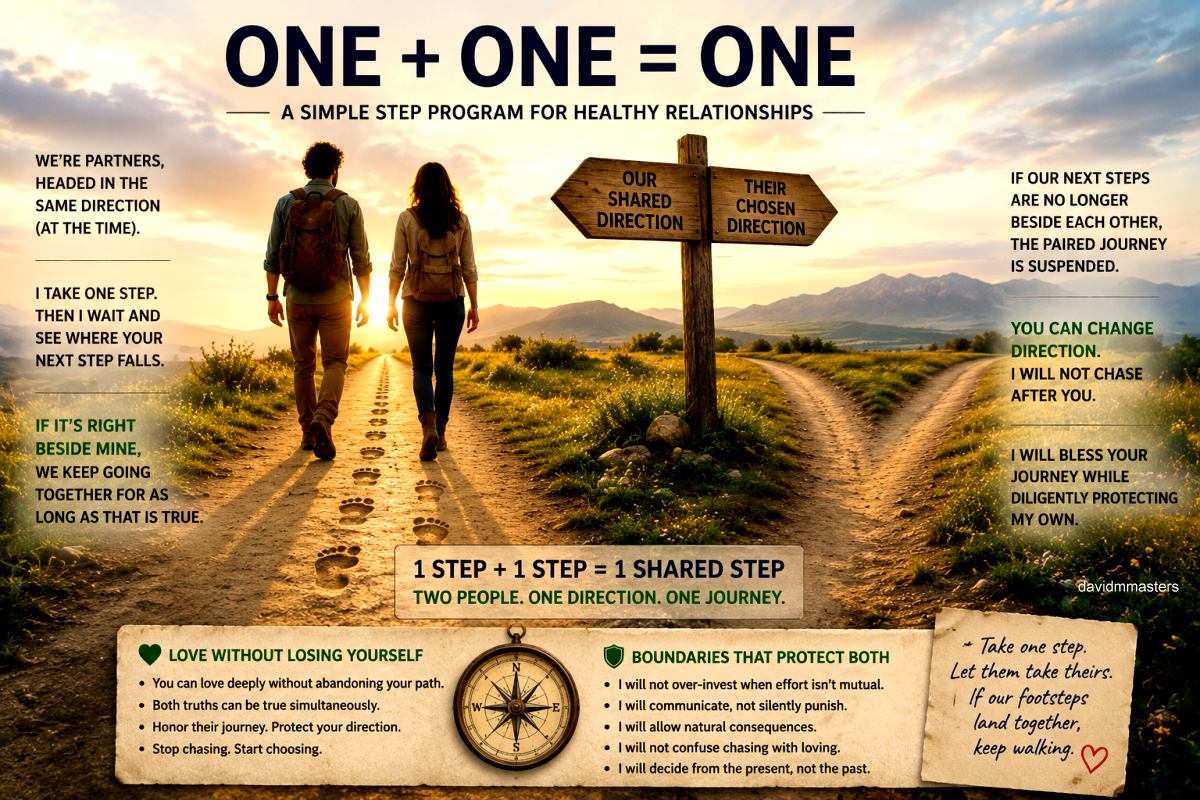
It’s a simple step program. You take one step. I take one step. And together, we’ve taken one step. That’s it.

If we’re business partners, friends, collaborators, lovers, family members, coach and client, or two people attempting almost anything together, we can walk side by side for as long as our footsteps continue landing beside each other.

I take a step. You take a step. I take another. You take another. Look at us go. But if I take my next step and yours doesn’t appear beside it, something changes.

I don’t necessarily get angry. I don’t have to judge you. I don’t have to decide that you’re unreliable, lazy, selfish, afraid, broken, or wrong. And I certainly don’t need to chase you down.

I simply stop advancing our shared journey until there is another shared step.

That’s 1 + 1 = 1.

You Are Allowed to Change Direction

This is where things get interesting. You are absolutely allowed to change direction. So am I.

Maybe something changed. Maybe you learned something. Maybe what seemed important six months ago doesn’t matter anymore. Maybe you’ve discovered another road that belongs to you.

Wonderful. Go explore it.

I can love you while you’re over there. I can cheer for you from here. I can even be curious about what you discover.

What I don’t have to do is abandon my road and run after you merely because we were once walking together. That’s a distinction I wish I’d understood much earlier in life.

For years, I sometimes valued maintaining the relationship more highly than maintaining my own direction.

That can feel like love. Sometimes it even looks like love. But there is a subtle question worth asking:

Am I loving this person, or am I abandoning myself to preserve our proximity?

Ouch. There are questions that don’t need to yell to get your attention.

Love Doesn’t Require Pursuit

This becomes especially interesting when unconditional love enters the conversation. I believe unconditional love represents one of the highest expressions available to us.

Most people would love to receive it. Giving it? Well… that’s where things get interesting.

Unconditional love doesn’t mean unconditional participation.

    • You can love someone without financing their latest detour.
    • You can love someone without cleaning up every mess.
    • You can love someone without abandoning your priorities.
    • You can love someone without following them somewhere you do not belong.
    • You can love someone and say, “It looks like you’re going that way now. I love you. I’m still going this way.” Both things can be true.

That’s one of the great freedoms of emotional maturity.

But They May Feel Abandoned

Here’s the tricky part. When you stop chasing someone, they may believe you’ve abandoned them.

From their perspective, you always followed before.

    • You always rescued.
    • You always caught up.
    • You always adjusted your direction.

Then suddenly… you didn’t.

To them, your healthy boundary may initially feel like rejection. That doesn’t make their feelings invalid. Their perspective deserves respect too.

This is where communication becomes important. You might say,

“I’m not abandoning you. I’m honoring the direction you’ve chosen. I’m simply not abandoning my direction in order to follow you.”

That’s a very different message.

There may be angst. There may be misunderstanding. There may even be anger.

People see life from different vantage points.

If we want others to respect ours, it seems reasonable to extend the same courtesy to theirs.

Reframing the Moment

If you’d like to experiment with the 1 + 1 = 1 approach, here are a few reframes that may help.

Instead of: “Why aren’t they doing what they said they would do?”

Try: “Their next step belongs to them.”

Instead of: “I need to get them back on track.”

Try: “I need to remain aware of my own track.”

Instead of: “If I don’t help, everything might fall apart.”

Try: “Maybe reality has something to teach here that doesn’t require my interference.”

Instead of: “They’ve abandoned me.”

Try: “Our paths may have separated for now.”

And this is one of my favorites:

Instead of: “How far am I willing to go for this person?”

Ask: “How far can I go without leaving myself behind?”

That’s a completely different question.

Some 1 + 1 = 1 Boundaries

The step program isn’t a collection of demands imposed upon another person. It’s an agreement you make primarily with yourself.

You might decide:

    • I will not continually invest more effort in a shared goal than the other participant is willing to invest.
    • I will take the next reasonable step without taking someone else’s step for them.
    • I will not repeatedly rescue someone from the natural consequences of changing direction.
    • I will communicate rather than silently punish.
    • I will not use withdrawal as manipulation.
    • I will distinguish between patiently waiting and indefinitely putting my own life on hold.
    • I will allow another person to change their mind without making their change a judgment about me.
    • I will periodically ask whether the journey we’re taking is still genuinely shared.
    • I will remain willing to renegotiate our direction when both of us want to.
    • I will love people without requiring myself to follow them everywhere they go.
    • I will respect their path while protecting mine.
    • If our footsteps meet again, I will decide from the present moment—not from obligation to the past—whether walking together still makes sense.

And perhaps the most important:

I will not confuse chasing someone with loving them.

Look Down Occasionally

Relationships can become complicated very quickly.

We make promises. Circumstances change. People change. We change. Nobody needs to become the villain.

Sometimes two people simply stop walking in the same direction. If that happens, you don’t necessarily need a dramatic ending.

You may only need to look down. There’s your footprint. Is theirs beside it? Wonderful. Take another step.

If it isn’t… you don’t have to panic. You don’t have to chase. You don’t have to condemn. You don’t even have to close the door forever.

You can simply stand where you are long enough to notice what is actually happening.

Maybe they’ll return. Maybe you’ll discover a new direction together. Maybe they’ll wave happily from another road. Maybe someone else will eventually come walking alongside you.

You don’t have to know. You can bless another person’s journey without making it your own. You can love someone tremendously without losing yourself in the process.

And when two people really are headed in the same direction?

One step. One step. One shared movement forward.

1 + 1 = 1.

Funny math.

Pretty good traveling.


Prison Warden or the Love Warrior Choosing Love Over Control

When someone we love is making destructive choices, something interesting happens inside of us. Part of us wants to rescue. Part of us wants to reason. Part of us wants to fix. And if none of that works, another part quietly begins building a prison. Not always with steel bars. Sometimes with lectures. Sometimes with ultimatums. Sometimes with shame. Sometimes with silence. Sometimes with rules that quietly say, “Become who I think you should be… and then I’ll feel okay.”

I understand. I’ve been there. Watching someone you care about spiral is one of the most painful experiences a human being can endure. When love hurts, control begins looking like compassion. It rarely is.

Two Ends of the Spectrum

Human relationships exist across a wide spectrum. There are moments when immediate protection is necessary. If someone is violent, abusive, or placing others in danger, society has created systems designed to establish boundaries and accountability. Those systems have their place. But most of us aren’t judges. We’re parents. Friends. Spouses. Children. Co-workers. Neighbors. And in those relationships, another option exists. I call it becoming a Love Warrior.

The Love Warrior Leads with Love

A Love Warrior doesn’t pretend destructive behavior is healthy. A Love Warrior doesn’t excuse addiction. Or abuse. Or manipulation. Or dishonesty.

Love doesn’t become blind. It simply refuses to stop seeing the person beneath the behavior. That changes everything.

Instead of asking, “How do I make them stop?”

The Love Warrior begins asking, “What kind of pain could create behavior like this?”

That question changes the atmosphere. Not because it solves the problem. Because it changes the person asking it.

Walking Around in Their Shoes

Here’s an experiment. The next time someone disappoints you… Instead of saying, “I would never do that.” Try asking, “If I were behaving exactly like that… what might be happening inside me?”

Not because you’re right. Because you don’t know. And neither do I.

No one can fully know another person’s internal world.

We see behavior. We rarely see the emotional weather producing it. Fear. Loneliness. Shame. Trauma. Confusion. Exhaustion. Grief. Mental illness. Old wounds. Or perhaps something we’ve never experienced ourselves.

Curiosity opens doors that certainty quietly locks.

The Illusion of Intervention

Many interventions begin with beautiful intentions. “We’re doing this because we love you.” Sometimes they’re necessary. Often they’re not. Too frequently, they create temporary compliance while resentment quietly accumulates beneath the surface.

Pressure can change behavior. It rarely transforms the heart.

The person learns what everyone wants to hear. The performance improves. The relationship doesn’t.

Eventually, the pressure cooker finds a release. Usually with greater damage than before.

You cannot force someone into becoming themselves.

Sacred Space

One of the greatest gifts you can give another human being is sacred space. Not approval. Not agreement. Not enabling. Space.

Space to wrestle. Space to fail. Space to discover. Space to become responsible for their own life.

That can feel unbearable for the people standing nearby. Especially when we desperately want to help. But another person’s journey belongs to them. Not to us.

Boundaries Are Still Love

Choosing love does not mean abandoning wisdom. Love has boundaries.

You may need distance. You may need to protect your family. You may need to protect your finances. You may even need to say, “I love you deeply, but I cannot participate in this.”

Those aren’t contradictions. Those are healthy expressions of love.

Boundaries are not punishment. They are clarity.

A boundary protects both people. Control attempts to own both people.

There is a tremendous difference.

Will You Lose Them?

Maybe. That possibility hurts. Deeply. But remember something important.

You are responsible for your choices. They are responsible for theirs.

Loving someone does not make you responsible for becoming their conscience. Or their jailer. Or their rescuer.

Every one of us arrives carrying a different story. Different wounds. Different fears. Different lessons. Different timing.

We cannot legislate another person’s transformation. Growth is always an inside job.

Choosing Your Uniform

Every difficult relationship quietly asks us a question. Which uniform will you put on today? The Prison Warden? Or the Love Warrior?

One manages behavior. The other protects dignity. One relies primarily on fear. The other invests relentlessly in hope.

One asks, “How do I make them change?” The other wonders, “How can I become a safe place while they discover who they are?”

Not everyone will change. Some won’t. But everyone deserves to be seen as more than their worst day.

Love does not guarantee a happy ending. Neither does control. But love allows us to remain fully human while someone else finds their own path. And sometimes… that is the greatest gift we can possibly give.

Reframing Tools for Becoming a Love Warrior

When you notice your inner Prison Warden taking over, pause and try one of these instead.

    1. Replace Judgment with Curiosity

Instead of: “What’s wrong with them?”

Ask: “What might be hurting inside them?”

    1. Separate the Person from the Behavior

The behavior may be unhealthy.

The person still possesses dignity.

Hold both truths at the same time.

    1. Try On Their Shoes

Ask: “If I were acting exactly like this… what experiences might have brought me here?”

Not to excuse. To understand.

    1. Remember You Cannot Read Minds

Behavior is visible.

Motives rarely are.

Humility creates compassion.

    1. Exchange Control for Influence

You cannot control another adult.

You can become someone whose presence is safe enough to influence them.

    1. Protect Without Punishing

Healthy boundaries say, “This is what I need.”

Punishment says, “Now you’ll suffer.”

There is a world of difference.

    1. Bless Instead of Fix

Sometimes the greatest prayer is, “May you find your own way.”

Not every battle belongs to you.

    1. Let Reality Become the Teacher

Natural consequences often teach more effectively than lectures.

Resist interrupting every lesson life is offering.

    1. Practice Sacred Waiting

Growth is rarely immediate.

Love learns patience.

Control demands schedules.

    1. Ask Better Questions

Instead of, “How do I change them?”

Ask, “Who do I become while walking beside them?”

That question changes everything. Because the Love Warrior’s greatest victory is not controlling another person’s life. It is refusing to lose their own heart while loving someone through theirs.

Tolerance Replacing Love Signals the End of the Relationship

There is something far more dangerous to love than anger. It is not shouting. It is not slammed doors. It is not even betrayal. It is indifference. When a couple says, “I don’t feel anything anymore. I just tolerate them,” that is not a small statement. That is the emotional equivalent of a flatline.

Communication scholar Brian J. Spitzberg has been quoted in research connected with Washington State University, explaining that apathy, not anger, is the earliest and most telling indicator that a relationship is in serious decline. Anger still contains energy. Anger means, “You matter enough to disturb me.”

Apathy says, “You no longer move me.” And that is the beginning of the death spiral.

Relationships rarely explode overnight. They erode. First, emotional withdrawal. Then polite distance. Then parallel lives. Then quiet resignation.

Two people living in the same house. Sleeping in the same bed. Sharing the same last name, but no longer sharing a pulse.

In previous generations, a relationship could survive in this state because survival required it. One partner earned. The other maintained the home. Social, financial, and cultural structures reinforced staying.

That matrix no longer exists in the same way.

Today, either partner can earn income. Single living carries far less stigma. The cost of leaving is often lower than the cost of emotional starvation.

So the real question becomes, How long can two people live as polite roommates before the unraveling completes itself?

Why Anger Is Healthier Than Indifference

Let me say something that may surprise you: Conflict is not the enemy of love. Indifference is.

When two people argue, they are still engaged. They are still attempting, however imperfectly, to matter to one another.

When they stop arguing… When they stop caring… When they no longer even try to be understood… The bond is eroding at its root.

Love requires energy, sustainability requires intention, and rekindling requires two.

One person cannot carry the flame alone.

Many believe, “If I work hard enough, love hard enough, give enough, it will come back.” No. One person can spark awareness, initiate conversation, and model vulnerability, but sustainability requires mutual engagement.

If one partner is willing and the other is unwilling, what you have is not reconciliation; you have delay.

Both must commit, measure progress, and demonstrate change. Otherwise, you are negotiating how long the slow fade will take.

How to Rekindle Before Collapse

If there is still even a flicker of willingness on both sides, there is hope.

Rekindling is not about romance; it is about re-engagement.

Here are practical, measurable strategies that work:

    1. Radical Emotional Honesty (Without Blame)

Set aside a structured time. No phones. No distractions. No defensiveness.

Each partner answers:

          • When did I start pulling away?
          • What did I stop saying?
          • What did I stop asking for?
          • What am I afraid to admit?

This is not about accusations; it is about revelation.

Apathy often hides unspoken resentment or unexpressed hurt.

Bring it to light.

    1. Reintroduce Novelty

The brain bonds through new shared experiences.

Research consistently shows novelty increases dopamine and relational bonding.

Do something neither of you has done before:

          • Take a class together.
          • Travel somewhere unfamiliar.
          • Train for a shared goal.
          • Build something together.

New experience interrupts stale emotional patterns.

    1. Measurable Micro-Commitments

Do not promise “We’ll do better.” That is too vague.

Instead:

          • 15 minutes of undistracted connection daily.
          • One weekly intentional date.
          • One appreciation statement per day.
          • Monthly relationship check-in.

Track it. Not romantically. Strategically.

What gets measured gets improved.

    1. Reignite Physical Proximity

Touch changes chemistry.

Even if passion feels dormant, begin with:

          • Holding hands during conversation.
          • Sitting side-by-side rather than across.
          • Hugging for a full 20 seconds.

Oxytocin rebuilds bonding pathways.

Physical reconnection often precedes emotional reconnection.

    1. Interrupt Parallel Lives

Many apathetic couples are not hostile, they are simply living separate narratives.

Rebuild shared mission:

          • What are we building?
          • What are we solving together?
          • What future excites both of us?

A relationship without shared direction becomes logistical cohabitation.

    1. Stop Protecting Yourself From Each Other

Apathy is often armored self-protection.

“I don’t care” is safer than “I’m hurt.”

Lower the armor.

Say:

“I miss you.”
“I feel distant.”
“I don’t want to lose this.”

Vulnerability reignites energy.

    1. Establish a 90-Day Renewal Contract

If both partners are willing, agree:

“For 90 days, we will fully engage.”

Not halfway. Not cautiously. Fully.

After 90 days, reassess honestly.

If energy returns, continue. If not, part consciously rather than erode unconsciously.

Conscious endings are far healthier than slow decay.

If neither partner is willing to do the work, the unraveling has already begun.

You can extend the timeline. You cannot reverse apathy without engagement.

But if even a spark remains… If even one conversation still feels slightly alive… If both are willing to try… Love can return.

Not the naïve version. Not the fantasy version, but a deeper, earned, intentional version.

Anger says, “You matter.” Apathy says, “You don’t.”

If you find yourself tolerating rather than loving, do not panic.

Ask instead:

      • Am I disengaged?
      • Are we both willing?
      • Do we want to rebuild?

Because love is not sustained by chemistry alone, it is sustained by choice, and choice, when mutual, can resurrect what apathy nearly buried.

The only real question is: Are you both willing to light the match?

If so, begin today.