One + One = One: How to Love Someone Without Losing Yourself

I have spent a considerable portion of my life running ahead of people. Not running away from them. Running ahead for them. There’s a difference. Someone would come along who appeared to be headed in roughly the same direction I was going, and I would think, “Wonderful! A traveling companion!” And off I’d go.
I’d invest my time. I’d invest my energy. Sometimes I’d invest my money. I’d make introductions, open doors, solve problems, clear obstacles, and start paving the road ahead because I could see where we were going. Or at least I thought I could.

Eventually, I’d look behind me… and nobody was there.

Apparently, my traveling companion had taken an exit about forty miles back. Ugh.

There I’d be with half a bridge, three miles of freshly paved highway, a depleted bank account, and nobody particularly interested in going where I had worked so hard to make it easier for us to go.

There was camaraderie. There were probably some wonderful memories. But eventually I had to ask myself:

How did I get so far off my own path?

It took me a while, but I finally learned something. Today, I call it:

1 + 1 = 1

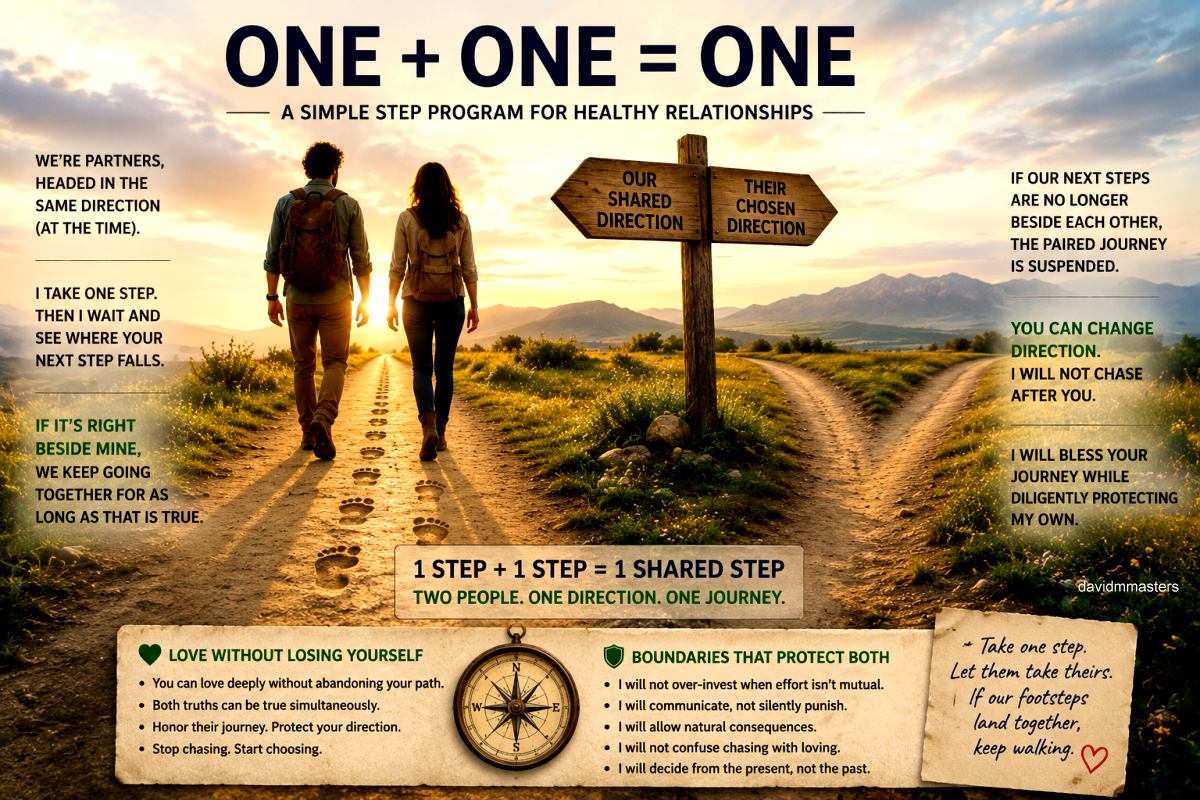
It’s a simple step program. You take one step. I take one step. And together, we’ve taken one step. That’s it.

If we’re business partners, friends, collaborators, lovers, family members, coach and client, or two people attempting almost anything together, we can walk side by side for as long as our footsteps continue landing beside each other.

I take a step. You take a step. I take another. You take another. Look at us go. But if I take my next step and yours doesn’t appear beside it, something changes.

I don’t necessarily get angry. I don’t have to judge you. I don’t have to decide that you’re unreliable, lazy, selfish, afraid, broken, or wrong. And I certainly don’t need to chase you down.

I simply stop advancing our shared journey until there is another shared step.

That’s 1 + 1 = 1.

You Are Allowed to Change Direction

This is where things get interesting. You are absolutely allowed to change direction. So am I.

Maybe something changed. Maybe you learned something. Maybe what seemed important six months ago doesn’t matter anymore. Maybe you’ve discovered another road that belongs to you.

Wonderful. Go explore it.

I can love you while you’re over there. I can cheer for you from here. I can even be curious about what you discover.

What I don’t have to do is abandon my road and run after you merely because we were once walking together. That’s a distinction I wish I’d understood much earlier in life.

For years, I sometimes valued maintaining the relationship more highly than maintaining my own direction.

That can feel like love. Sometimes it even looks like love. But there is a subtle question worth asking:

Am I loving this person, or am I abandoning myself to preserve our proximity?

Ouch. There are questions that don’t need to yell to get your attention.

Love Doesn’t Require Pursuit

This becomes especially interesting when unconditional love enters the conversation. I believe unconditional love represents one of the highest expressions available to us.

Most people would love to receive it. Giving it? Well… that’s where things get interesting.

Unconditional love doesn’t mean unconditional participation.

    • You can love someone without financing their latest detour.
    • You can love someone without cleaning up every mess.
    • You can love someone without abandoning your priorities.
    • You can love someone without following them somewhere you do not belong.
    • You can love someone and say, “It looks like you’re going that way now. I love you. I’m still going this way.” Both things can be true.

That’s one of the great freedoms of emotional maturity.

But They May Feel Abandoned

Here’s the tricky part. When you stop chasing someone, they may believe you’ve abandoned them.

From their perspective, you always followed before.

    • You always rescued.
    • You always caught up.
    • You always adjusted your direction.

Then suddenly… you didn’t.

To them, your healthy boundary may initially feel like rejection. That doesn’t make their feelings invalid. Their perspective deserves respect too.

This is where communication becomes important. You might say,

“I’m not abandoning you. I’m honoring the direction you’ve chosen. I’m simply not abandoning my direction in order to follow you.”

That’s a very different message.

There may be angst. There may be misunderstanding. There may even be anger.

People see life from different vantage points.

If we want others to respect ours, it seems reasonable to extend the same courtesy to theirs.

Reframing the Moment

If you’d like to experiment with the 1 + 1 = 1 approach, here are a few reframes that may help.

Instead of: “Why aren’t they doing what they said they would do?”

Try: “Their next step belongs to them.”

Instead of: “I need to get them back on track.”

Try: “I need to remain aware of my own track.”

Instead of: “If I don’t help, everything might fall apart.”

Try: “Maybe reality has something to teach here that doesn’t require my interference.”

Instead of: “They’ve abandoned me.”

Try: “Our paths may have separated for now.”

And this is one of my favorites:

Instead of: “How far am I willing to go for this person?”

Ask: “How far can I go without leaving myself behind?”

That’s a completely different question.

Some 1 + 1 = 1 Boundaries

The step program isn’t a collection of demands imposed upon another person. It’s an agreement you make primarily with yourself.

You might decide:

    • I will not continually invest more effort in a shared goal than the other participant is willing to invest.
    • I will take the next reasonable step without taking someone else’s step for them.
    • I will not repeatedly rescue someone from the natural consequences of changing direction.
    • I will communicate rather than silently punish.
    • I will not use withdrawal as manipulation.
    • I will distinguish between patiently waiting and indefinitely putting my own life on hold.
    • I will allow another person to change their mind without making their change a judgment about me.
    • I will periodically ask whether the journey we’re taking is still genuinely shared.
    • I will remain willing to renegotiate our direction when both of us want to.
    • I will love people without requiring myself to follow them everywhere they go.
    • I will respect their path while protecting mine.
    • If our footsteps meet again, I will decide from the present moment—not from obligation to the past—whether walking together still makes sense.

And perhaps the most important:

I will not confuse chasing someone with loving them.

Look Down Occasionally

Relationships can become complicated very quickly.

We make promises. Circumstances change. People change. We change. Nobody needs to become the villain.

Sometimes two people simply stop walking in the same direction. If that happens, you don’t necessarily need a dramatic ending.

You may only need to look down. There’s your footprint. Is theirs beside it? Wonderful. Take another step.

If it isn’t… you don’t have to panic. You don’t have to chase. You don’t have to condemn. You don’t even have to close the door forever.

You can simply stand where you are long enough to notice what is actually happening.

Maybe they’ll return. Maybe you’ll discover a new direction together. Maybe they’ll wave happily from another road. Maybe someone else will eventually come walking alongside you.

You don’t have to know. You can bless another person’s journey without making it your own. You can love someone tremendously without losing yourself in the process.

And when two people really are headed in the same direction?

One step. One step. One shared movement forward.

1 + 1 = 1.

Funny math.

Pretty good traveling.

 

Q: What’s the Difference Between Being Nice and Being Loving

There is a great deal of confusion that causes unnecessary pain. Many people believe they are being loving when, in reality, they are being nice, and many people believe love should feel gentle all the time, when in truth, love often feels honest first. Niceness seeks approval, love seeks truth, and understanding the difference can change how you relate to everyone in your life, including yourself.

How Niceness Became the Substitute for Love

Niceness is often learned early. It comes from wanting to belong, from wanting to avoid conflict, and learning that keeping others comfortable feels safer than being honest.

Nice people are polite. They’re agreeable. They try not to upset anyone. They smooth things over. They say “yes” when they mean “no,” and they swallow discomfort to keep the peace, and while niceness isn’t malicious, it’s also not courageous, because niceness is driven by fear, fear of rejection, disapproval, or loss of connection.

Love is not.

“Niceness avoids tension.
Love tells the truth.”

What Niceness Does, and Why It Fails

Niceness avoids tension. Love moves through it. Niceness says what will be accepted. Love says what is needed.

Niceness keeps the surface calm, but often allows deeper harm to continue unchallenged. It tolerates behaviors that quietly erode trust, intimacy, and self-respect, all in the name of being “good.”

Over time, niceness breeds resentment. Not because people are ungrateful, but because truth was never invited into the relationship, and relationships built without truth eventually collapse under the weight of what was never said.

What Love Is Willing to Do That Niceness Is Not

Love is willing to risk discomfort for the sake of integrity. Love tells the truth calmly, without cruelty, it sets boundaries without drama. Love names problems without attacking people, and it allows others their reactions without trying to manage them.

“You can be kind without being dishonest.”

Love understands something niceness does not: You can be kind without being dishonest, and you can be compassionate without being passive.

Why Understanding This Difference Is Critical Now

We are living in a time when many people feel exhausted, misunderstood, and quietly resentful, not because they don’t care, but because they’ve been taught to suppress truth in order to appear loving.

But suppression is not connection, silence is not peace, and self-erasure is not kindness.

Love creates safety not by avoiding truth, but by handling it well.

That’s why love can feel firmer than niceness and why it often brings relief, even when it brings tension.

How to Tell Whether You’re Being Nice or Loving

Here’s a simple reflection.

If you’re being nice, you’re probably asking:
“How do I keep everyone comfortable?”

If you’re being loving, you’re more likely asking:
“What is honest, kind, and necessary right now?”

Niceness protects appearances. Love protects what matters.

Niceness wants to be liked. Love wants to be real.

“Love protects what matters.
Niceness protects appearances.”

What Loving Looks Like in Everyday Life

Love doesn’t shout, but it also doesn’t disappear.

It looks like:

      • Saying no without overexplaining
      • Disagreeing without contempt
      • Allowing disappointment without rescuing
      • Speaking truth without needing to win
      • Letting others feel their feelings without absorbing them

Love trusts that real connection can survive honesty. Niceness is not so sure.

Seek Understanding and Clarity

The world does not need more polite silence, it needs people who can be kind and clear, compassionate and truthful, gentle and grounded.

Being nice may keep things smooth for a while, but being loving builds relationships that last, and once you feel the difference, you won’t want to go back.


Love Is Not Weakness – Why Real Love Requires Strength

Somewhere along the way, love got mislabeled. Not suddenly or maliciously. Just gradually, until love was no longer seen as strong, but soft… no longer intelligent, but sentimental… no longer courageous, but passive. And that misunderstanding has cost us more than we realize.

Love is not weakness, and it never was. What is weak is the version of love many of us were taught to perform, the kind that avoids truth, tolerates harm, and sacrifices self-respect just to keep the peace. That isn’t love. That’s fear, dressed up as virtue.

Why Love Is Often Mistaken for Weakness

For many people, love became confused with being agreeable. Staying quiet, enduring too much, giving endlessly, even when wisdom was already whispering, “This isn’t healthy anymore.” But love has never required self-erasure.

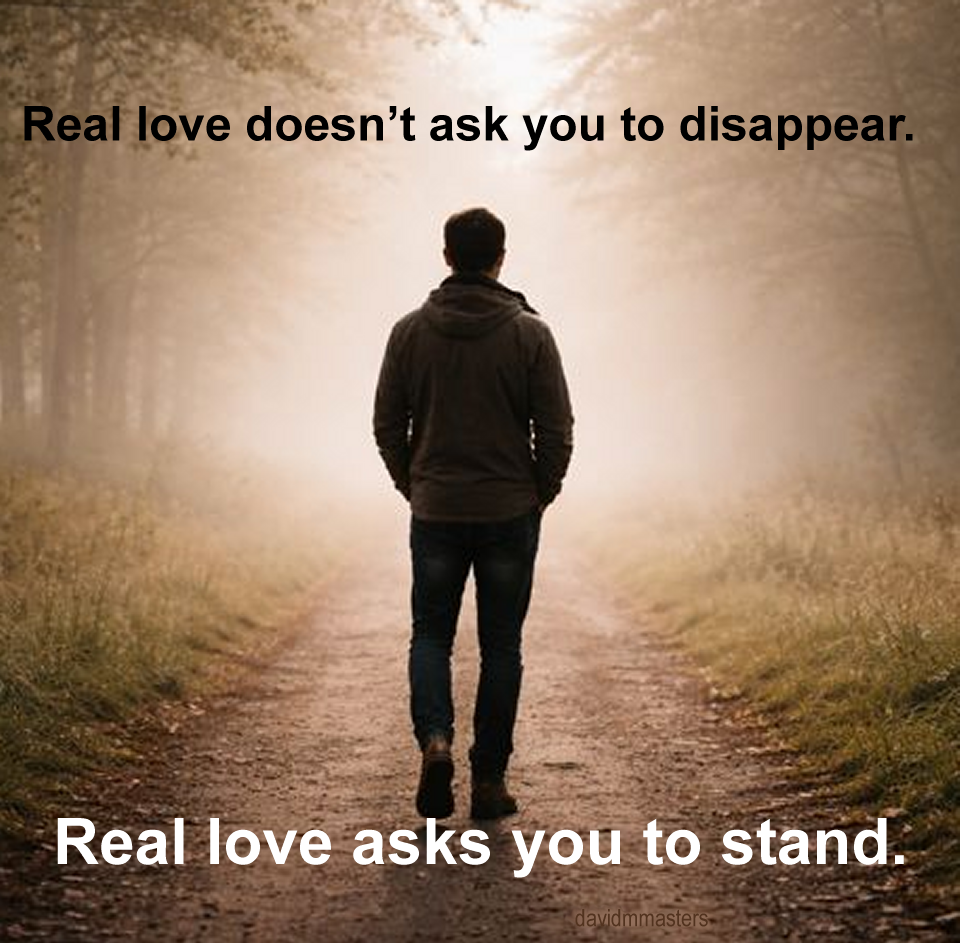
Real love doesn’t ask you to shrink, betray yourself, or abandon your values. It doesn’t demand silence while your spirit erodes. When love looks like disappearance, what’s actually happening is survival; not wisdom. And survival strategies, while understandable, are not the same thing as truth.

Real Love Is Strength Under Control

When you strip away the confusion, something important becomes clear: Love is not fragile. Love is strong. In fact, real love is strength under control.

It takes strength to tell the truth without attacking. Strength to hold a boundary without slamming a door, the strength to walk away without bitterness, and to stay without resentment.

Love doesn’t beg. Love doesn’t manipulate. Love does not guilt or coerce.

Love stands. And because it stands, it can feel threatening to systems built on fear, control, or compliance. That’s one reason love has so often been rebranded as weakness, because calling it weak makes it easier to dismiss, exploit, or override.

Love Requires Courage, Not Avoidance

Avoidance is easy. Numbing is easy. Shutting down is easy. Going along to get along is easy.

Love is not.

Love requires presence, and presence requires courage.

Every meaningful act of love asks something of us. It asks us to stay awake when it would be easier to check out. To remain open without being naive. To forgive without forgetting, and protect what matters without becoming hard.

There is nothing weak about that.

What Happens When Love Loses Its Strength

When love is misunderstood, people learn the wrong lessons.

They learn to:

      • Overgive until they are depleted
      • Confuse endurance with virtue
      • Call self-betrayal kindness
      • Call silence peace

Eventually, they burn out; not because they loved too much, but because they were never taught how to love wisely.

Love without strength collapses. Strength without love hardens. But love with strength? That’s where healing lives.

Love as a Stabilizing Force in a Chaotic World

Strong love doesn’t escalate. Strong love doesn’t need to win, and doesn’t require an audience.

Strong love listens without surrendering discernment. Strong love sees clearly without condemning, and acts deliberately rather than reactively.

This is why love changes rooms. Why it disarms aggression, restores dignity, and endures long after louder forces burn themselves out.

Not because love is soft, but because love is grounded.

What Loving with Strength Looks Like in Real Life

When love is rooted in strength, it shows up practically:

      • You can say no without guilt
      • You can disagree without contempt
      • You can care deeply without carrying what isn’t yours
      • You can leave without hatred
      • You can stay without losing yourself

You stop confusing being liked with being loving, and stop confusing being needed with being valued.

Your love develops a spine.

Why This Love Elevation Can’t Wait

The world doesn’t need weaker people trying harder to be nice. It needs grounded people who can love without fear. People who can hold truth and compassion in the same breath. People who don’t collapse under pressure, or harden under disappointment.

Love is not weakness. Love is not passivity or submission.

Love is clarity. Love is courage and strength—fully awake.

And when you live from that place, you don’t just change your relationships. You change the world around you.

That’s the kind of love this world has always needed.

The World’s Best Kept Secret

You are the world’s best kept secret.

While you navigate and interact with the world as we know it, you do your best to understand other people whom you meet along your journey. You watch, listen and even try to put yourself in their shoes in an effort to understand them, and in some ways we can find ways to perceive or understand them, but you can never truly know them. How do you know? Because you are the world’s best kept secret.

No one knows who you are

When you think about it, no one can ever really know who you are. Even if you try to be totally transparent and open, revealing everything about yourself and going through rigorous efforts to try to get someone to understand who you really are and what you really think or feel, it is impossible to relate the totality of your personage to another person because

No one knows what you think

That part of you which is boundless exists and thrives in the intimate spaces between your words, actions, biochemistry, and other methods of observable communication occupied by you and only you are your thoughts. Nobody knows what goes on inside that head of yours; no one. You are the personification of the idea that, “Still waters run deep.”

No one knows what you feel

Everything that you experience or feel in this life is not simply the observation of life though your five senses. Your feelings, the way you feel about something, or the nearly unlimited array of feelings that only you can feel cannot be authentically understood, felt or known by another person. Not even the world’s most attuned, sensitive, empathetic being can know the breadth of feeling as can only be experienced by you.

You hide behind your disguise

You do, I do, and we all hide behind our respected disguises. We represent ourselves to our communities as we might like to be perceived. We allow different versions of our selves to be revealed (or more correctly “projected on”) to others depending on the level of intimacy we maintain with the recipient of each particular projection.

Still we try to know someone else

Even though each one of us holds our inner most thoughts so dear, never to be fully shared with any other human being, still in our desire to connect with others, we imagine we can see into the life, heart and mind of someone else, even when we know this degree of intimacy is highly improbable. We have impeccable knowledge of the impossibility of anyone else knowing us fully, yet we hold onto the illusion that we can know someone else and act surprised when we witness some unexpected personal revelation. This dichotomy is referred to as asymmetric insight among the mental health community.

And we want to be understood

There is a part of you that wants to be understood, yet no one could possibly know you. And if given half the chance, even if you could allow someone to see everything inside of you, you wouldn’t willingly allow it. But, you do have certain parts of you that you long to share with another person who resonates with your perspective; someone who would agree with you and support your point of view, if it could understood as you understand it without judgment. We all seek this harmonic balance with another being.

Tolerance is the key

So the key to this conundrum is tolerance. The idea that, “I am me and you are he and we are all together,” such as conceived by John Lennon in his cryptic song in which he dons the disguise of the walrus, refers to us. We are all what we are, that is all we can be and we can only do the best we can with what we have. We all suffer from the same human condition and the best we can do is to understand that we are all okay.

If you want to be honored for who you are, the only way to have any hope of being respected by anyone else is to first honor others with the same respect you might like.

No need to make it so complicated.
You are one. And so are we.
We can do this.

Preserving the Servants Heart

I have a servant’s heart, as do many of my clients. There is a downside to being selfless in service to others, and that is neglecting the self-care necessary to maintain a healthy life for the person with a servant’s heart. The result is a decline in emotional health, which is left to deteriorate, will affect the biological system, and add undue mental stress. This could result in a lack of self-respect, angst, premature aging, and a host of other health-related issues.

Preserving the servants heart self respect healthy boundaries

Servant must find ways to preserve themselves to serve their clients, community, and/or the world more effectively. Often, the servant feels as though “the needs of the many outweigh the needs of the few or the one” (Spock, Star Trek: The Wrath of Khan).

There needs to be a healthy balance; even so, one may be called upon to make the ultimate sacrifice for the greater good, albeit rarely. Many have had to answer the call, including my 20-year-old son, who answered this call on a particular 4th of July while serving in the Armed Services in Afghanistan. Although most of us in the service of others will not face paying the ultimate price on their behalf, many have.

That said, to better serve others, we in service must pay sufficient attention to our own needs to maintain a healthy platform from which to work, enabling us to serve our communities more effectively.

Servants need to stop feeling the needs of others are more important than their own. If you have neglected your self-care, it’s time to take back control of your life and increase your effectiveness in service. Your needs are essential, and only you can attend to them. It can be uncomfortable, but taking steps to preserve oneself is paramount to success in effective service over time.

The key is balance

Learn to say, “No.”

For the servant, it may seem counterintuitive, but you were created with an internal sensor to help you monitor when and what serves the highest and best performance in your service. Some call it intuition; at the very least, it is that undaunted feeling of overwhelm, a clear indication the situation at hand is not congruent with your terms of service.

At this moment, it is undoubtedly prudent for you to exercise your ability to say “No.” (I can see that grimace on your face.) Stay with me…) You must start using this word. Uncomfortable as it may be at first, trust me, it will get easier. It’s a small two-letter word that will help you create enough space to establish an essential parameter. It is not your calling to be all things to all men, and besides, saying no doesn’t imply that you don’t respect or like someone; it only means no. That’s all.

You may need a little wiggle room to muster a firm “no.” If so, you could offer a stall tactic, such as, “Let me check my schedule and get back to you.”

If you have a long history of always saying, “Yes” when it was not in your best interest, you could dress it up a bit by saying, “Now is not a good time for me,” or, “That’s not my area of expertise,” and refer them to someone more keenly attuned to that particular circumstance or project.

You can refer them to someone who is better suited or equipped to take on the task or encourage the person approaching you to assess their abilities. Some insightful reviews might lead them to the conclusion that they possess the necessary skills to undertake it independently. Why not use your intuition to allow them to grow?

Suppose you have accepted a particular responsibility and felt uncomfortable or resentful about taking on the challenge. In that case, this is a clear indication that, when approached with a similar offer in the future, declining the assignment is certainly in order.

For those who call on you to serve them and show little respect for all that you do, ask yourself, “Would I let this person treat my son or daughter in the same manner?” If the answer is no, then it’s time to start setting some healthy boundaries.