When Clicks Matter More Than Credibility Becomes Empty Purse

Today I had one of those conversations that stayed with me. Not because it was dramatic. Because it was honest. I was meeting with a client who is active on social media. She had found a story she was about to post. The headline was shocking.

The problem was, it wasn’t actually a news story. It was speculation dressed up as certainty. Designed to provoke. Designed to travel. Designed to make people stop scrolling.

I gently suggested she might not want to post it. “It isn’t really based on fact,” I said. “If people discover that, doesn’t it slowly erode your credibility?”

She didn’t hesitate. “I don’t care.” Then she smiled. “Do you know how much traffic I get on this stuff?”

I appreciated her honesty. Because in that moment she said out loud what much of our culture quietly rewards.

Attention has become a currency. And sometimes it’s worth more than trust. The algorithms don’t ask if something is true. They ask if someone will click.

Outrage performs well. Fear performs well. Suspicion performs well. Half-truths often outperform whole truths. And certainty usually gets more engagement than curiosity.

We’re beginning to live in an economy where integrity doesn’t always pay immediately. That can be discouraging. Especially for people who care about accuracy. But here’s what keeps me thinking.

Traffic isn’t the same thing as trust. Visibility isn’t the same thing as credibility. Influence isn’t the same thing as wisdom.

You can have millions of views and still have very few people who genuinely trust your heart.

Respect grows differently. Respect grows slowly.

    • One honest conversation.
    • One accurate statement.
    • One careful correction.
    • One admission of, “I don’t know.”
    • One decision not to exaggerate.
    • One refusal to pass along something simply because it’s exciting.

Respect is expensive. Clicks are cheap.

The strange thing is that most of us say we want relationships built on trust.

We want leaders with integrity. We want businesses that tell the truth. We want friends who are honest. Yet every day we quietly reward the opposite.

Every click is a tiny vote. Every share says, “Give me more of this.” Whether we realize it or not.

I’m not writing this to criticize my client. I suspect she simply recognized the rules of the current game.

The question is whether those rules deserve to stay. Because every culture eventually becomes what it rewards.

    • If outrage pays better than honesty… we’ll manufacture outrage.
    • If exaggeration pays better than accuracy… we’ll exaggerate.
    • If division pays better than understanding… we’ll divide.

None of that happens overnight. It happens one click at a time.

Jesus once said that where your treasure is, your heart will be also.

I’ve wondered lately if the opposite is equally revealing.

Where our clicks go… our culture follows.

Perhaps integrity has become an empty purse. Or perhaps we’ve simply forgotten how valuable it really is.

The beautiful thing about values is that they don’t need everyone. They begin with one person deciding, “I’d rather be trusted than trending.”

That may not make us famous. But it just might make us someone worth believing.

The Art of Transparent Living: Honesty, Growth, and Authenticity

There is a quiet power in transparency. Not the performative kind or the curated vulnerability designed for applause, but the kind that begins in the mirror, when you are willing to see what is actually there. Transparent living is not about exposing yourself to the world. It is about removing the distortions between who you are and who you present yourself to be. It is about alignment, and alignment is the birthplace of growth.

Transparency Is an Inner Discipline

Most people think of honesty as something outward. “Tell the truth.” “Don’t lie.” “Be authentic.” but transparent living begins much deeper than speech.

It begins with:

  • Emotional honesty
  • Motivational honesty
  • Financial honesty
  • Relational honesty
  • Spiritual honesty

It begins when you ask yourself:

  • Why did I really say that?
  • Why did that comment trigger me?
  • Why am I holding onto this resentment?
  • What am I afraid would happen if people saw the real me?

Growth accelerates the moment you stop negotiating with your own awareness. Transparency is not self-condemnation. It is self-illumination.

The Courage of Vulnerability

Vulnerability is not weakness. It is structural integrity.

When you are willing to admit:

  • “I don’t know.”
  • “I was wrong.”
  • “I’m scared.”
  • “I need help.”

You create psychological spaciousness. Defensiveness contracts growth, and vulnerability expands it.

In my work as a coach and guide, I’ve seen this repeatedly: The breakthrough does not happen when someone becomes stronger. It happens when they become honest.

Radical authenticity removes the friction between your internal world and your external behavior. When that friction dissolves, energy is freed. And that energy fuels transformation, or more precisely, revelation.

Radical Authenticity Is Not Rebellion

There is a misunderstanding about authenticity.

Some believe it means:

  • Saying whatever you think
  • Refusing feedback
  • Rejecting structure
  • Disregarding impact

That is not authenticity.

That is immaturity disguised as courage.

Authenticity is refined awareness. It is knowing who you are, what you value, and how you wish to move through the world, and then living in accordance with that, even when it costs you approval. It is not loud or dramatic; it is steady.

The most powerful people I know are transparent, not because they overshare, but because they have nothing to hide.

Transparency as a Catalyst for Growth

When you live transparently, you learn, repair, and evolve faster. Why? Because you stop wasting energy maintaining illusions.

Consider how much energy is spent:

  • Protecting image
  • Justifying mistakes
  • Blaming others
  • Concealing insecurity
  • Managing impressions

That is energy diverted from growth. Transparent living collapses delay. You see it, own it, and you adjust.

There is no shame in being a work in progress. There is only stagnation in pretending you are not.

Honesty in Relationships

Transparent living reshapes relationships at every level.

In partnership, it looks like:

  • Naming needs before resentment builds
  • Acknowledging attraction without betrayal
  • Discussing fears before they metastasize into distance

In business, it looks like:

  • Clear expectations
  • Clean agreements
  • Financial integrity
  • Direct communication

In leadership, it looks like:

  • Admitting uncertainty
  • Taking responsibility publicly
  • Listening without defensiveness

Transparency builds trust because it reduces ambiguity, and trust is the oxygen of all meaningful human connections.

The Spiritual Dimension of Transparency

Transparency is also spiritual maturity. It is the willingness to allow what is essential within you to become visible. Not performative righteousness or spiritual superiority, just congruence.

In transfiguration work, which is less about changing who you are and more about revealing who you have always been, transparency is foundational. Nothing new is added. Nothing sacred is replaced. What was obscured becomes visible.

And what obscures us most often?

  • Fear
  • Shame
  • Image management
  • Unresolved wounds
  • Cultural conditioning

Transparent living dissolves these layers. Not violently, but steadily.

The Cost — and the Reward

Let’s be honest. Transparency has a cost.

Some people prefer the version of you that is easier to categorize. Some benefit from your silence. Some are threatened by your clarity.

You may lose approval. You may lose alliances built on illusion.

But what you gain is immeasurable:

  • Self-respect
  • Emotional freedom
  • Energetic coherence
  • Deeper relationships
  • Faster growth

And perhaps most importantly: peace.

There is nothing more exhausting than maintaining a persona or more liberating than being internally aligned.

The Practice of Transparent Living

If you want to begin, start here:

  1. Notice where you soften the truth.
  2. Notice where you exaggerate to gain approval.
  3. Notice where you hide discomfort.
  4. Notice where you blame instead of own.
  5. Notice where you say “fine” when you are not fine.

Awareness without judgment.

Transparency is not brutality; it is clarity with compassion.

Transparent living is not about being perfect; it is about being permeable to growth.

When you live honestly, you become teachable. When you become teachable, you evolve. When you evolve, you inspire others to do the same.

Vulnerability is the doorway. Honesty is the path. Authenticity is the lifestyle.

And growth?

Growth is simply what happens when nothing false is left to defend.

Live clearly.
Live honestly.
Live without distortion.

That is the art, and it changes everything.


When Someone Calls You a Liar

What can you do when someone calls you a liar? That’s a tough question and one of the most difficult situations between two people. You have told the truth, whoever you’ve told it to doesn’t believe you, and to make matters worse, you’ve been called a liar.

Few situations are more painful than being called a liar, especially when you know you’ve told the truth. It can feel like an attack on your character, a dismissal of your integrity, and a deeply personal betrayal. But what can you do when someone refuses to believe you? How do you handle such a difficult and emotionally charged encounter?

Stand Firm in Your Truth

The most important thing to remember is this: if you’ve told the truth, you’ve done your part. You are not obligated to defend yourself to someone who doubts your honesty. In fact, trying to prove your truthfulness often makes matters worse.

When someone believes you are lying, no amount of evidence or insistence can change their mind. Their mistrust likely stems from their own experiences, insecurities, or biases—things beyond your control. Arguing or pleading only gives them more reason (in their mind) to doubt you. Sometimes, your attempts to stand up for yourself are twisted into “proof” of dishonesty.

Instead of engaging in a futile battle, speak your truth clearly and calmly, and then let it be. Trust that your integrity speaks for itself, regardless of whether others recognize it.

Their Doubts Are Not About You

It’s vital to understand that someone’s mistrust often says more about them than it does about you. People carry their own histories, fears, and unresolved issues, which can cloud their ability to trust. If someone falsely accuses you of lying, it may be less about your actions and more about their inner struggles.

While their words can hurt—sometimes deeply—you don’t have to internalize their accusations. Their inability to trust is not your responsibility to fix, nor should it dictate your actions.

The Danger of Changing Your Truth

In the face of persistent accusations, you may feel tempted to alter your story just to stop the abuse. After all, what harm could it do to give in? Surely, it’s better than enduring their relentless interrogation. But changing your truth for the sake of appeasement comes at a great cost.

When you bend to someone’s insistence that you are dishonest, you sacrifice a piece of your integrity. Worse, the person will never truly trust you. By confirming their false belief, you reinforce their mistrust, perpetuating a cycle that could haunt your relationship indefinitely.

Stay true to your word. Even when it feels easier to compromise, know that standing firm in your truth protects your integrity and honors your authentic self.

When Accusations Escalate

Unfortunately, some accusations can spiral out of control. Our society, while structured around systems of justice, is far from perfect. Legal systems can be manipulated by those who know how to wield them for personal gain or vengeance. Such individuals may be driven by a sense of self-righteousness, unresolved inner turmoil, or the desire to dominate others.

If you find yourself facing unjust accusations in such circumstances, it’s critical to stay grounded. Speak your truth, but recognize that the battle may not be winnable through force or argument. Sometimes, the best course of action is to step away, protect your energy, and focus on living your truth with dignity.

Choosing Love Over Conflict

When faced with conflict, you always have a choice: to fight or to rise above. Many battles—especially those rooted in personal differences or misunderstandings—aren’t worth the toll they take on your emotional and spiritual well-being.

Interestingly, when you refuse to engage defensively and instead remain in the vibration of love, new paths often reveal themselves. Staying calm, centered, and open to love allows you to see solutions that might otherwise remain hidden in the heat of the moment.

This approach doesn’t mean you condone harmful behavior or accept injustice. It means you prioritize your peace and integrity over the need to prove someone else wrong. You transcend the conflict and move toward a higher state of being—one defined by love, honor, and authenticity.

A Larger Perspective

The pain of being falsely accused is not unique to you; it’s part of the human experience. Wars have been fought, relationships shattered, and lives wasted over differences in belief and perception. But these conflicts only persist when people choose to fight instead of seeking understanding and love.

If we, as individuals, can commit to living in love and truth, we have the power to change the world. Even in its imperfections, this world offers us an opportunity to grow, evolve, and pave the way for future generations. Every act of love, no matter how small, contributes to a better, more compassionate world.

The Power of Love

In the face of doubt, accusations, or conflict, choose love. Love for yourself, love for others—even those who accuse you—and love for the truth that lives within you.

Stay true to your word and your integrity. Let go of the need to be understood or validated by those who doubt you. Trust that your truth will stand on its own, and let love guide your actions.

The world may not be perfect, but love is the most powerful force for good. By choosing love over conflict, you not only honor yourself but also contribute to the healing and evolution of humanity.


Why People Say One Thing but Do Another

As integrous as I try to be, even I may say one thing and do another. For the longest time, I thought the one thing I would like to have etched in my gravestone would be the words, “Here lies a man who kept his words and lived by them.” Yet, even I can see that even I fall short, if I am able to see myself objectively. This leaves you wondering, “Why people say one thing and do another?”

The Human Condition: A Complex Contradiction

People are never exactly as they appear to be. Even if you think you know someone deeply, including their life story, you can never truly understand everything going on in their mind or heart. Each of us is a tangle of contradictions, living, breathing examples of incongruence.

Even with the best intentions, life sometimes prevents us from being perfectly aligned with our words and actions.

Everyday Contradictions

Our Words

We all make promises or commitments that don’t always pan out.

    • “I’ll be there at four,” but you arrive at 4:05 or 3:55.
    • “I’ll pick up everything on the list,” yet you forget the milk.

These small deviations from our words may seem inconsequential, but they reveal how difficult it is to stay perfectly aligned with what we say.

Our Contracts

Contracts and agreements are another area rife with contradictions.

    • You agree to make timely payments on a loan but occasionally miss a due date.
    • You pledge love and fidelity in marriage but end up in divorce court.

Even legal commitments are subject to human fallibility, highlighting how life’s unpredictability often disrupts our intentions.

Our Lives

The contradictions in how we live are perhaps the most glaring.

    • Someone may value health and self-care yet overindulge in junk food and neglect exercise.
    • A person who lives in chaos might maintain an immaculate home.
    • Someone may wear sports apparel but never participate in physical activity.

These contradictions illustrate how our lives often deviate from the ideals we claim to uphold.

The Paradox of Hypocrisy

One of the most confusing contradictions is when people criticize or accuse others of behavior they themselves are guilty of. It’s not uncommon for someone to say, “I would never do that,” while doing exactly what they claim to abhor.

Even more baffling are those who accuse others of actions they are actively engaged in themselves. This form of projection creates confusion and mistrust, leaving us wondering how anyone can reconcile such blatant contradictions.

Why These Contradictions Happen

The truth is, contradictions are an inherent part of being human. Our minds, emotions, and lives are not linear or perfectly aligned. We are influenced by countless internal and external factors, from unconscious triggers to societal pressures and personal insecurities.

For example:

    • You may see yourself as a kind and loving person, yet catch yourself judging others or ignoring those outside your immediate circle.
    • You may value honesty but find yourself telling a white lie to avoid conflict.

Recognizing these incongruencies can help you uncover the triggers that lead to contradictions in your life.

The Path to Coherence

Once you become aware of your own contradictions, you face a choice:

    1. Make Changes: Take steps to align your words, actions, and beliefs more closely.
    2. Redefine Yourself: Adjust your self-perception to include the variations and inconsistencies that make you human.

This decision is what separates those who seek to live a life of alignment from those who remain content with their contradictions.

People who pursue coherence regularly self-evaluate and make adjustments to minimize incongruencies. They strive to live harmoniously, knowing that while perfection is impossible, progress is achievable.

Are You One of Them?

Do you know people who say one thing but do another? Are you one of them? If you’re honest, you’ll likely find that you are. We all are, to some degree.

Recognizing this truth isn’t about self-judgment—it’s about self-awareness. By acknowledging our inconsistencies, we gain the power to grow, adapt, and become more aligned with our values.

What’s a Good Example?

Think of the friend who preaches the importance of a healthy lifestyle but skips the gym and orders fast food. Or the colleague who talks about teamwork but hoards credit for success. These everyday examples remind us how common and natural contradictions are.

That said,

Understanding why people say one thing but do another helps us see the humanity in ourselves and others. Life is messy, and perfection is an illusion. Instead of judging, let’s strive to recognize our contradictions, learn from them, and move closer to the coherence we desire.

By doing so, we not only live more authentically but also inspire others to do the same. Let’s embrace our flaws and contradictions as part of the journey toward a more aligned, harmonious life.

What’s a good example of people say one thing and do another?


Who are You Insurmountable Odds?

What you do every day defines you, exponentially overshadowed by who you are and what you do when facing insurmountable odds. Who are you insurmountable odds?

When all hope is lost and you feel like you just can’t go on… There is hope. It may only a glimmer of the slightest otherwise failing ember, but it is there, waiting for you to reignite the flame.

Who you are and what you do in the face of insurmountable odds further defines you influencing your capacity to be an inspiration for others in their most challenging moments, possibly raising your status to legendary.

Though who you are and what you do when facing those critical, pivotal moments in life are not about others, it’s about you. Even so, when it seems like there is no energy to draw from left within you, thinking about how your actions might affect the community at large, people you know, your family, or your children may be the catalyst to afford you a second wind.

Somewhere from within, you are able to find the strength to take a deep cleansing breath, you re-center yourself yes, you utter, “It’s all I can stands, and I can’t stands no more.”

This can be the turning point in your story. If you think about the greatest stories, don’t they feature the main character facing insurmountable odds? Just as when you’re reading a book or watching a film, this is often the most exciting part of the story, right?

Well, this is your story. You are writing your story from moment to moment every day. You make 35,000 decisions every day. That’s 35,000 times you can influence the direction your story takes.

You are living your story right now, and you are the star, of what very well could be The Best Story Ever! It’s up to you. How will you decide to write your story?

What do you do when you face the most difficult circumstances, when it appears that all hope is lost?

You can be miles ahead in the game of facing challenges and obstacles which may appear to be overwhelming if you have a strong sense of who you are, your Purpose, Message, Passion, and Mission (PMPM).

By reviewing your most meaningful personal motivators with love, strength, and honor, it will help dictate what the next steps should be in accordance with your purpose, message, passion, and mission. You will be able to ascertain what your character (you) should do in those moments when facing insurmountable odds.

To support you in those times when you feel you just can’t go on, you should be able to draw upon a wealth of experience where you have been faithful and true in the little things. This is the character-building actions you take every day that strengthens your resolve and stores up for you hidden treasures of integrous and powerful resources which you can call upon when the going gets tough.

Your diligence and commitment to follow through in small things regularly builds your discipline and determination. It is the faithfulness to do the small things, even when you don’t feel like it, or you’re unable to recognize a particular value in what you’re doing, that builds your resilience and strength of character; your ability to do the right thing. These are invaluable resources when facing the life’s biggest challenges.

When you are exercising diligence, you are working through the discomfort, and developing a vibratory state which you can work within which enables you to continue to do the right thing, regardless of the extraneous circumstances. It may not seem like much when you’re practicing this every day, but when it matters most, you will find yourself courageously and powerfully prepared to deal with the most difficult issues when they arise, all do to your developed skill of entering a state of productivity which cannot be shaken by external circumstances.

Your integrity will help in being true to your word. You said it, so it is. If you’ve made a commitment, you said you will do something, you will do it, come hell or high water, and you expect nothing less from those who are on your team. If you have a team, you hold each other accountable with the highest levels of integrity.

If all things are possible, then the real question is, “Who are you in surmountable odds?”

This is your story.

You are the hero.

So hero up.

Truth and Integrity

What is integrity? What is it? How does it work and what does it mean to different people in their quest for truth?

Integrity and what it means can look very different, depending on who you are. Integrity is remaining congruent with that greater part of you while maintaining an authentic representation of your self with respect to your journey.

There are very few (possibly no) universal truths on which we as the human race can all agree. Nevertheless, you and I maintain truths that are apparent to each of us, and even these are subject to change as we grow and change. Even two people can view the same incident and report what they’ve seen very differently, based on their perspective and their own life’s experience and language patterns. Unless they have some nefarious motivation their differences are not considered untrue. Just because you’re interpretation of something is different from someone else’s does not mean either one of you, or anyone else is a liar.

It’s highly unlikely that two people could possibly write the same report word for word regarding any incident witnessed due to the fact that we are different people and we all see things differently based on who we are. Our lives, experiences and what is meaningful to us varies immensely among our population, The onus is on you to determine what is truth to you. Certainly there are people who have researched and specialized in different disciplines, but it is up to you what to adopt as truth to you at any given time, remembering that this is always subject to change due to access to new information. Therefore, what was true for you yesterday may not be true for you today.

Being true and congruent with what you currently believe while honoring the right of others to have a contrasting belief is the integrous approach to evaluating truth. You are not responsible for what another person believes. There is no need to change what they believe, as it is up to each person to make their own way and discover their own truths along their own individual journeys.

Your personal vibration and your intuitive heart-mind connection will help you to determine what truth means to you in any given moment, understanding that truth is ever-evolving, there may be moments of uncertainty during the reevaluation process. The more in tune you are with your heart’s frequency vibration, the faster the evolvement of your truth. As your personal vibration continues to raise, so will your perception of higher truths. Temper this personal growth with tolerance, allowing others to do the best they can with what they have without judgment.

An integral portion of your life’s purpose is to observe, nurture and maintain your expanding vision of truth, utilizing your heart’s connection to source to help you discern advancements and their validity to your consciousness.

As you adopt new revelations you may be compelled to share your new insights with others. By all means do so. But do not insist that anyone else see things from your perspective. Let others take what they resonate with as they plant and care for it in their garden of truth. Allow others to let your other seeds of truth which they are not ready for to fall on the ground. You never know which seeds left unattended on the surface will germinate and grow on their own.

Our world and our connection to it is changing. The archaic institutions and systems of control (including our imposed belief systems) are losing their effectiveness and validity. New, expanding and evolutionary thought is the key to the sustainability of our future. You are an active part of this evolution which is taking place at this moment.

Your contribution to help in making the world a better place is discerning your own truth as it emerges and becomes refined in your heart and mind. Being congruent to this process of revelation in integrity is imperative to your ability to contribute.

None of us holds the entirety of all the truth. Each of us maintain our own specialty and only together can we achieve a better understanding of emerging truths, and when we unite in love, together we can achieve a higher vibration and evolutionary expansion affecting the whole world.

Where’s the Integrity?

Wait-a-minute, if I have integrity and I give someone my word (like I will do something at some point in the future), well, that’s then and this is now. If I’ve told someone I was going to do something in the past, that was so then and it doesn’t matter now. So, if I make a promise to you, it doesn’t matter? What about someone else’s promise to me? Where’s the integrity in that?

Want the truth? Nothing really matters.

You just have to realize that life on planet earth is a lot of some-will-some-won’t-next. If you can wrap your head around this, you will be okay, but it’s hard, because we’re not programmed to allow what is to be.

I am a product of my programming and I have a huge Integrity component. I feel like, if I tell someone something, it must be true and it’s up to me to make it true no matter what the cost because I want to be remembered as an intengrous person, one who has always kept his word. For the longest time, I thought, if my tombstone had anything on it, it should read, “Here lies an honest man. If nothing else, he was good to his word.” Which sounds good on the surface, but if you look at it, there it is: Lies and Honest in the same reference, as if it was to be something good.

And what does it mean to be good to your word?

Is it really any good to suffer through pain, turmoil, tragedy, confusion and angst, just because you uttered certain words in the heat of the moment? How good is that? Wouldn’t it be more good to say, “Sorry, something came up. I just can’t make it.”?

I can hear all the Eckhart Tolle fans starting to murmur in the background about my finally starting to get a clue.

I mean, what kind of a prison have I committed myself to?

Actually, I do maintain a high level of integrity, although I must admit, I am less happy than the folks who are actively more apt to be less integrous and live in the now.

Take a look at someone you know who has no idea about what it means to keep their word – no concept of it – because they’re so blissfully living in the now. What do you see? Happiness. They truly have found a way to be content and joyful, by disregarding anything that isn’t and only seeing what is.

As I move away from selfishness and more toward allowing what is to be, I find myself less judgmental against someone whom I might have considered a liar in the past. Why? Because this is the unrealistic expectation I had of myself. This was my standard. I militantly adhered to the ridiculous concept that if I were to utter a certain sequence of words at any time, and if they were not manifest as I had uttered them, then I would be a liar and deserving of severe punishment (at least personal berating). So, it was not unreasonable for me to hold others to the same standard.

Say something. If it does not manifest as you said, you were a liar. (Oh, silly Masters.)

I have to credit business principles for introducing me to concepts, like, some-will-some-won’t-next. It is a reference commonly used to put salespeople at ease in their dealing with rejection. When you pitch your spiel, then there are only two possible outcomes, followed by your best course of action: Next; keep it moving.

That’s all well and good in business but to apply it to life was well beyond my ability to comprehend. What about integrity?

Really? What about it?

Where is the integrity in life?

“Life is the least integrous system ever conceived.”

If anything, life (as we know it) is the least integrous system ever conceived. It is full of chaos, dysfunction, unexpected twists and turns and for god’s sake, even such random acts as to be referred to as acts of god!

And through all this confusion, if you’re listening, you start to hear the gentle flow of isness in the background; that soothing vibration of allowing things to be as they are. It doesn’t mean you don’t get your feelings hurt, suffer pain or loss along the way. By all means, do. Cry, scream, rant, rave – whatever your fancy – then be done with it.

Next. Keep it moving…

In life,
some things will work out the way you wanted
Some won’t.
Next.

Thank god for the many nexts we are afforded in this life.

Amen.

What Does Integrity Mean?

I talk a lot about integrity when I am working with people, and you’d be surprised to find that while people will agree about integrity’s importance, they may perceive its definition differently.

While the official definition of integrity might be:

“The quality of being honest and having strong moral principles; moral uprightness.”

There is a deeper meaning among those who are on a path to enlightenment; a more accurate integrity definition would be something, like this:

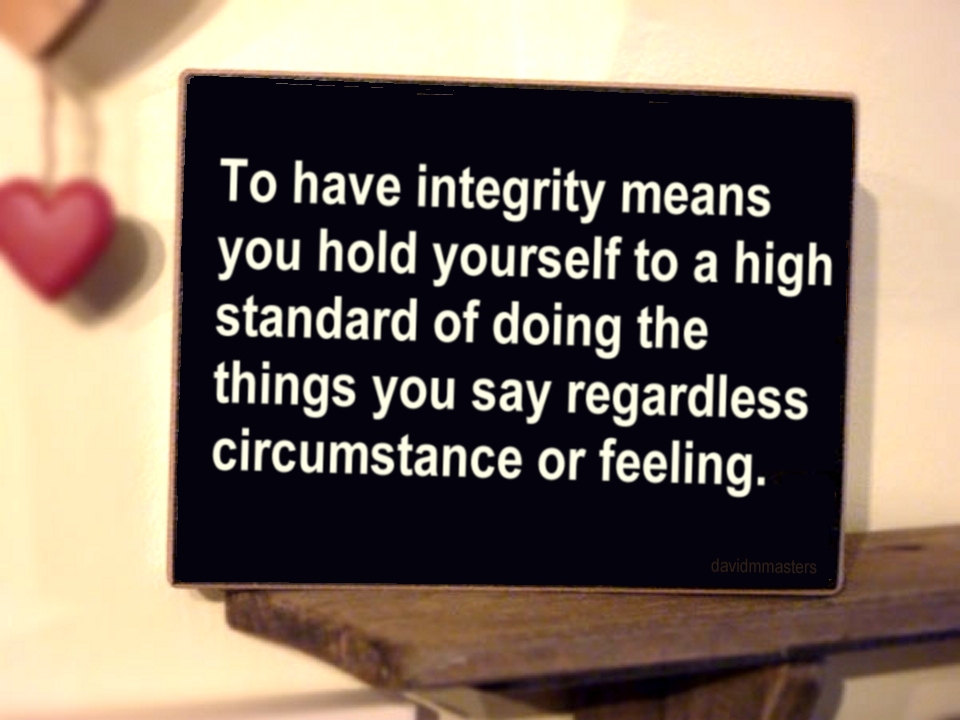
“To have integrity means you hold yourself to a high standard of doing the things you say regardless circumstance or feeling.”

to-have-integrity-means-you-hold-yourself-to-a-standard-of-doing-the-things-you-say-regardless-circumstance-or-feeling

In other words, you keep your word, elsewise no one could truly put their trust in you. An old adage referring to integrity was, “A man’s word is his bond.” This translates to

“If I tell you something, you can count on it coming to pass.”

Back in the day, this standard of integrity only applied to the masculine sex due to their ability to make a thing so was far more likely due to the feminine’s lack of resources; this does not apply today, as women too have the ability to manifest a result just as equally (or more so) than their male counterparts.

The first objection to come to mind for anyone contemplating the heaviness of possessing a high degree of integrity and the meaning of integrity in general might be

“What if I change my mind?”

Change is a matter to be weighed any time anyone makes a commitment, gives their word or generally agrees to anything. It is a constant throughout time that things will happen, circumstances may change or additional knowledge may have been withheld at the time the affirmation was agreed to.

“So, what do I do, if I gave my word and now find myself in a quandary?”

Integrity also allows for the integrous individual to alter his or her word, without much loss of one’s value of integrity if it is handled with integrity.

An integrous person who is unable to keep their word must approach the active party/parties with humility and honesty, explaining their inability to keep his or her word due to whatever circumstances apply, then ask for feedback, solutions or alternatives to make things right.

The highest level of integrity would be to keep your word and follow through regardless of feelings, circumstances of even due to lack of integrity of other parities who may have been involved. The next best thing would be to enter a negotiation to see if all parties can agree on a compromise that they all can live with. It might not be ideal or completely integrous, but it is honorable to

Do the right thing

Which may mean considering changes in circumstances and renegotiation; though it can be problematic if after much deliberation no compromise can be found.

If no compromise can be agreed to there may be an inevitable loss of integrity as well as trust that may have been associated with it.

If you find yourself often unable to keep your word, you may find that you agree to things too quickly, without practicing due diligence or reviewing the ramifications of your commitment prior to agreement. In this case, consider enforcing your own hesitation to allow time for thoughtful consideration before agreeing to anything. This can help to preserve your integrity.

Recovery of a high level of integrity may be established after a time of demonstrating one’s level of integrity over time.

A small number of people within our population actually adhere to any level of integrity, as the majority focus completely on how they feel at any given moment, and this lack of integrity has led our society to where it is today.

On the other hand, there are people, like us, who choose to hold ourselves to a higher standard.

If nothing else, people know us by our ability to follow through and be counted on, regardless of circumstance or how we feel.

This is the definition of integrity.