Deflection is Better than Defense

Fighting back or direct resistance only leads to more harm, using love, deflection is better than resistance because it decreases the damage to you while your opponent continues to fight in force until they become disinterested in the battle or have exhausted their resources.

In a battle, you can never have enough weapons to combat a formidable foe. A fight between two individuals fighting against each other always results in a great deal of pain and suffering, which may include broken bones and spilled blood. So, the smart thing to do is not to fight back in defense of yourself.

This applies to physical confrontation, as well as psychological confrontation, or response to any attack from any type or style of attacker.

In the olden days, an actor was cast in a TV show based on a Shaolin monk facing all kinds of attacks responding in Kung Fu fashion, which is primarily deflection of physical attack, using the opponent’s power of force against themselves. The actor was David Carradine, who didn’t know anything about Kung Fu at the time but playing the part in the Kung Fu TV show so inspired him that he did become an avid student and teacher of Tai Chi and Qigong.

Having been exposed to this television show did influence me and my response to fighting of any kind. Therefore, I have little respect for an all-out fistfight, am inclined to avoid a brute force battle, and prefer to be the one who walks away from any confrontation in as pristine condition as possible.

I have not been able to avoid physical confrontation, but I have survived these encounters with as little damage to myself by following these principles.

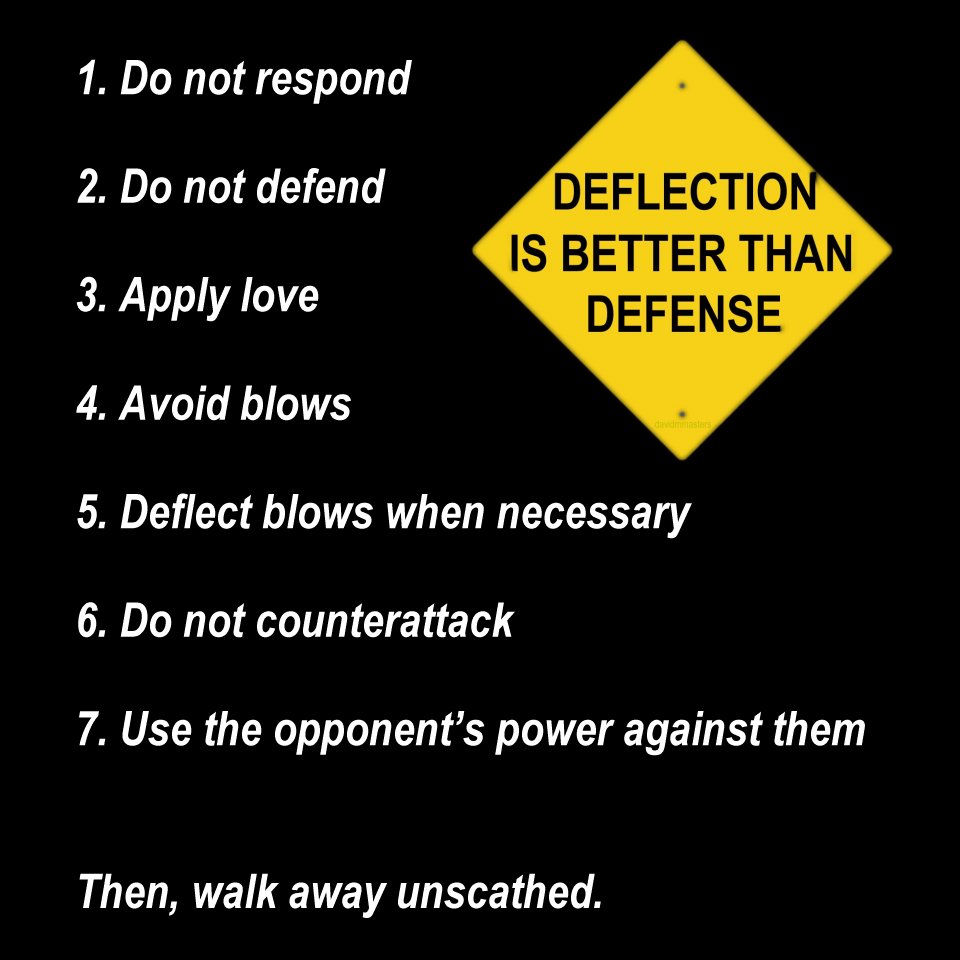
1. Do not respond
2. Do not defend
3. Apply love
4. Avoid blows
5. Deflect blows when necessary
6. Do not counterattack
7. Use the opponent’s power against them

Then, walk away unscathed.
I am not trying to convince anyone to follow these principles, I am just expressing that this is what I do, whether it is a physical altercation or any other type of potential battle.

When I was attacked by a prolific psychopath, I documented everything and applied these principles.

I remained steadfast and simply ignored everything the psychopath tried to say about me or do to me, and applied love’s perspective to the man who was attacking me. I wondered why someone might end up being like that? What kind of a life must he have lived? What must he have suffered as a young child? I tried to imagine what it must be like to walk a mile in his shoes. I sent him love, hoping he might be able to find a way to a better life.

Most would have lost interest and found some other mark to pursue, but this one made a lifetime vow with the commitment of all his resources, and those of others, to destroy me.

In this particular circumstance, the psychopath (because he could not be satisfied by my response), took the battle to the media and my circle of influence.

Still not wanting to fight back, I had no choice but to engage, because the psycho had started attacking my friends, and family. Attack me, fine, but to go after my children (who are sacred to me) requires my protection of them.

Attempting to keep my wits about me, I did respond to the psychopath with deflection and using the psycho’s own power of force against himself.

Fortunately for me, the psychopath left threatening messages on my answering machine. I posted them on YouTube. Now, he had a venue where he could spin all his efforts against me, and I empowered him to do so.

Did I care? No. I am impenetrable. Anything he says about me is not true, and I don’t care, nor do I respond to any ridiculous accusations.

Now, I did get a flood of attention from friends and family who feared for me, especially those who the psycho was able to make fearful in his attacks on them because of my not responding. I just told them not to worry, and apologized for any overflow which had affected their lives, but told them that I was attempting to protect them by placing his focus back on me.

Without directly engaging or defending, I just posted everything he threw at me online, and let it be.

In the process, I was able to help countless other potential victims see the psychopath (a lifetime criminal con man) for who he was prior to losing their life’s savings and suffering continued abuse by the psychopath by finding some of this information online.

He was forced to change his identity and possibly even fake his own death in order to continue his life of crimes in the exploitation of others.

I apply this to any confrontation by anyone, even if someone were to say in an interview (in this fictitious example), “According to,” (some source that was leaked by the psychopath), “you kill babies and bury them in your backyard. What do you have to say about that?”

My only response would be, “It is my personal policy not to respond to any false accusation. Next?”

When what I wanted to do is to counter-attack, like ask the interviewer, “What about your collection of clown noses and pickled small toes of circus performers who have mysteriously disappeared? What about those?”

It is your sacred right not to respond to a false accusation, not to even dignify it with any response. Regardless of your good intentions, and the inclination to defend yourself and your good name, any response can be used as a weapon against you, or to fuel the fire of further attack.
In this way, deflection is better than defense.

Next.

Twisting Your Words to Make You Look Bad

Don’t you just hate it when someone twists your words, gets all heated up, and attacks you – using your own words – to put you on the defensive or make you upset. What’s happening? What can you do when someone’s twisting your words to make you look bad?

Few things are as frustrating as having your words twisted and weaponized against you. Whether it’s to make you look bad, provoke an emotional reaction, or put you on the defensive, this tactic can leave you feeling angry, hurt, or disoriented. So, why do people do this, and how can you respond effectively?

Why People Twist Your Words

In the Media: It’s About Spin

In public venues like news programs, social media, or memes, twisting words is often referred to as “spin.” It’s a calculated strategy designed to create drama and soundbites that grab attention. This tactic generates clicks, views, and engagement, making it an accepted practice under the guise of free speech and parody.

While it’s a common practice in media, the misuse of someone’s words can still cause significant harm. It can tarnish reputations, derail good intentions, and turn powerful messages into weapons.

In Personal Relationships: A Coping Mechanism

In personal and social circles, twisting your words is less about spin and more about projection. People who lack self-confidence, have been deeply hurt, or live under constant stress may twist your words as a defense mechanism.

By projecting their unresolved emotional wounds onto you, they temporarily release their inner pain. When they twist your words to make you look bad, it allows them to transfer their suffering onto you, offering them a fleeting sense of relief.

Unfortunately, this behavior is often subconscious. The person twisting your words is unlikely to recognize or admit that they’re projecting. If they’re looking for demons, they’ll find them everywhere—until they’re willing to address their own unresolved pain.

The Emotional Impact on You

When someone twists your words, it can feel deeply personal. You may feel compelled to defend yourself, which is a natural response. However, reacting defensively often exacerbates the situation, adding fuel to the fire. Your attempts to explain or justify yourself may even give the other person more material to twist against you.

Understanding the motivation behind this behavior can help you take a step back and avoid being drawn into the cycle.

How to Respond When Someone Twists Your Words

    1. Stay Calm and Neutral
      Responding with calmness and neutrality can prevent the situation from escalating. A simple statement like,

      • “That’s not what I meant, but you’re entitled to your opinion,”
        can defuse tension without adding more energy to the conflict.
    2. Avoid Defensiveness
      Defensiveness often backfires. By defending yourself, you validate the other person’s tactic and give them more opportunities to twist your words.
    3. Don’t Take It Personally
      Recognize that their behavior is likely a reflection of their own unresolved issues. This doesn’t excuse their actions, but understanding this can help you detach emotionally.
    4. Offer Clarification Thoughtfully
      If there’s a misunderstanding worth addressing, you can offer clarification. However, consider the potential consequences carefully. Your clarification could be twisted further, so weigh the risks before speaking.
    5. Use Empathy Without Condescension
      Try to have compassion for the person without feeling sorry for them. Remember, if you had lived their life and experienced their pain, you might behave similarly.
    6. Walk Away if Necessary
      If the situation becomes too volatile, disengage. Walking away isn’t a sign of weakness—it’s a way to protect your peace and avoid unnecessary conflict.

Advanced Strategies for Emotional Resilience

If you’re highly self-aware and emotionally resilient, you might choose to act as a “shock absorber” for someone who is twisting your words. This means allowing them to release their frustrations onto you without becoming emotionally engaged.

This approach requires significant emotional detachment and is not for everyone. Unless this aligns with your life’s purpose or personal calling, it’s best to protect yourself rather than absorb someone else’s pain.

When the Motivation Is Malicious

Sometimes, twisting your words isn’t about projection or unresolved pain—it’s a calculated move by someone with a darker agenda.

Psychopaths and Sociopaths

Those on the predatory end of the anti-social personality spectrum may twist your words to undermine or destroy your credibility altogether. Their goal is to damage you, not to heal themselves.

The response to this is the same:

    • Avoid defending yourself.
    • Disengage and remove yourself from the situation.
    • Seek safety and distance from the manipulative individual.

In such cases, protecting yourself is paramount.

The Power Is in Your Hands

No one can make you look or feel bad without your permission. When someone twists your words, they’re trying to draw you into their emotional chaos. By refusing to engage defensively, you take away their power.

Remember, your response—or lack thereof—determines whether the situation escalates or fizzles out. With patience, self-awareness, and compassion, you can rise above the manipulation and protect your peace.

Ultimately, the best way to disarm someone who twists your words is to maintain your integrity and choose your battles wisely. Some conflicts are not worth your energy, and the most powerful statement you can make is to simply walk away.


How to Deal With the Emotional Outbursts of Others

Are there people in your life who are a constant source of frustration? People who rub you the wrong way, make you a little crazy, find that single raw nerve, tweaking your otherwise sound sense of calm, then wreck your whole outlook on life, with a single word or gesture?

Consider, if you are willing, to seek out what is hiding beneath the surface.

People will interrupt your state of being for a wide variety of reasons including personality quirks, lack of self-esteem, current or past trauma, inability to handle stressors of life, jealousy, awkward expression or communication styles, mental or physical health concerns, or narcissism are among the most common.

Not possessing the necessary awareness, emotional/communication tools, they may only be able to strike out in an abrasive manner which may be disrespectful, putting others down, making false accusations, demonstrating abrupt, unrestrained angst, anger, or other destructive behavior, including stonewalling (the silent treatment).

When they strike out at you, it’s perfectly understandable and normal for you to think it’s about you because that’s representative of the words they are using when they are pointing their finger at you and addressing “you,” accusing you of being the cause of their emotional outburst.

Even though they are blaming you for their state of mind, this negative energy is sourced and expressed from something deeply disconcerting from deep within themselves. They need to release some of the pressure from these deep, dark secrets and/or unresolved inner conflicts, or else they might explode.

Not understanding how much pain this out-of-control person is, could let you take their emotional display personally. It can actually transfer some of their pain to you, and you get upset or defensive, launching your own emotional overwhelm or outburst.

Losing sight of what’s really happening behind the scenes can cause you to forfeit your power and cause your otherwise high vibrational state of mind to sink to their level, as you do battle in those primal vibratory states of mind.

Following the seduction of your compromised vibration, you might play the event over and over again in your mind, possibly further prolonging your angst about the event, and you might even be distracted by trying to figure out how you could fix things, do or say just the right thing to potentially change the person you shared this experience with.

You may forget that you cannot change anyone, and neither should you even try.

The only thing you can change is you.

How to Deal With the Emotional Outbursts of Others

The next time someone strikes out at you reclaim your power by trying to understand what is happening deep inside the heart and soul of the person who is acting up. Realize, no matter how hard they try to blame or insist that you are the cause for their upset, you are not.

Also, consider that even though you know you are not the cause of their present emotional state, keep in mind that there may be a hidden treasure or truth inside their out of control expression that is a sacred message meant especially for you.

You might uncover something about yourself, where you could grow or change if you can filter out all the upset of the delivery method and find something deep within yourself which could be an opportunity for you to look deep inside from a different perspective.

There will be people whose negative outbursts are just their way of releasing pressure and have little or no prolonged consequence. Try to humbly accept the therapeutic position, possibly even feeling blessed to be the vehicle this person has selected to release this emotional pressure. Some of us are better shock absorbers than others.

It is unnecessary to defend yourself or fight with someone in such a destructive behavioral pattern. Find that safe place within and allow them to release without allowing their upset to compromise your vibration.

You are never expected to remain in an abusive situation. Do not let someone else threaten or terrorize you. Remove yourself from any potentially dangerous circumstances. Don’t let them get to you, retain your power and walk away in love.

You are all-powerful and have full authority to protect your sacred emotional space while allowing life to go on all around you.

You can choose to be unaffected by the dysfunction of others while looking after your own safety and security in peace and harmony.

When Someone Calls You a Liar

What can you do when someone calls you a liar? That’s a tough question and one of the most difficult situations between two people. You have told the truth, whoever you’ve told it to doesn’t believe you, and to make matters worse, you’ve been called a liar.

Few situations are more painful than being called a liar, especially when you know you’ve told the truth. It can feel like an attack on your character, a dismissal of your integrity, and a deeply personal betrayal. But what can you do when someone refuses to believe you? How do you handle such a difficult and emotionally charged encounter?

Stand Firm in Your Truth

The most important thing to remember is this: if you’ve told the truth, you’ve done your part. You are not obligated to defend yourself to someone who doubts your honesty. In fact, trying to prove your truthfulness often makes matters worse.

When someone believes you are lying, no amount of evidence or insistence can change their mind. Their mistrust likely stems from their own experiences, insecurities, or biases—things beyond your control. Arguing or pleading only gives them more reason (in their mind) to doubt you. Sometimes, your attempts to stand up for yourself are twisted into “proof” of dishonesty.

Instead of engaging in a futile battle, speak your truth clearly and calmly, and then let it be. Trust that your integrity speaks for itself, regardless of whether others recognize it.

Their Doubts Are Not About You

It’s vital to understand that someone’s mistrust often says more about them than it does about you. People carry their own histories, fears, and unresolved issues, which can cloud their ability to trust. If someone falsely accuses you of lying, it may be less about your actions and more about their inner struggles.

While their words can hurt—sometimes deeply—you don’t have to internalize their accusations. Their inability to trust is not your responsibility to fix, nor should it dictate your actions.

The Danger of Changing Your Truth

In the face of persistent accusations, you may feel tempted to alter your story just to stop the abuse. After all, what harm could it do to give in? Surely, it’s better than enduring their relentless interrogation. But changing your truth for the sake of appeasement comes at a great cost.

When you bend to someone’s insistence that you are dishonest, you sacrifice a piece of your integrity. Worse, the person will never truly trust you. By confirming their false belief, you reinforce their mistrust, perpetuating a cycle that could haunt your relationship indefinitely.

Stay true to your word. Even when it feels easier to compromise, know that standing firm in your truth protects your integrity and honors your authentic self.

When Accusations Escalate

Unfortunately, some accusations can spiral out of control. Our society, while structured around systems of justice, is far from perfect. Legal systems can be manipulated by those who know how to wield them for personal gain or vengeance. Such individuals may be driven by a sense of self-righteousness, unresolved inner turmoil, or the desire to dominate others.

If you find yourself facing unjust accusations in such circumstances, it’s critical to stay grounded. Speak your truth, but recognize that the battle may not be winnable through force or argument. Sometimes, the best course of action is to step away, protect your energy, and focus on living your truth with dignity.

Choosing Love Over Conflict

When faced with conflict, you always have a choice: to fight or to rise above. Many battles—especially those rooted in personal differences or misunderstandings—aren’t worth the toll they take on your emotional and spiritual well-being.

Interestingly, when you refuse to engage defensively and instead remain in the vibration of love, new paths often reveal themselves. Staying calm, centered, and open to love allows you to see solutions that might otherwise remain hidden in the heat of the moment.

This approach doesn’t mean you condone harmful behavior or accept injustice. It means you prioritize your peace and integrity over the need to prove someone else wrong. You transcend the conflict and move toward a higher state of being—one defined by love, honor, and authenticity.

A Larger Perspective

The pain of being falsely accused is not unique to you; it’s part of the human experience. Wars have been fought, relationships shattered, and lives wasted over differences in belief and perception. But these conflicts only persist when people choose to fight instead of seeking understanding and love.

If we, as individuals, can commit to living in love and truth, we have the power to change the world. Even in its imperfections, this world offers us an opportunity to grow, evolve, and pave the way for future generations. Every act of love, no matter how small, contributes to a better, more compassionate world.

The Power of Love

In the face of doubt, accusations, or conflict, choose love. Love for yourself, love for others—even those who accuse you—and love for the truth that lives within you.

Stay true to your word and your integrity. Let go of the need to be understood or validated by those who doubt you. Trust that your truth will stand on its own, and let love guide your actions.

The world may not be perfect, but love is the most powerful force for good. By choosing love over conflict, you not only honor yourself but also contribute to the healing and evolution of humanity.


Make Someone Love You

As much as you love someone, you can never love them enough to make them love you. Someone will either love you or they won’t. You will be able to trust them, or you won’t. They will either stay, or they will leave and no matter how much you love them, you cannot make someone love you back.

Since people have been exchanging love one to another, unrequited love has been an issue. It’s nothing new, and it’s not likely to change any day soon.

The False Accusation Breakup

There is a growing trend of demonization that is becoming more commonplace in the breakup process. When someone is secretly planning a breakup, they start collecting words and phrases uttered by you dating back to the origination of your relationship.

Data will likely include decisions you made or actions you’ve taken, which all can be spun into wild false accusations which would make others, possibly even yourself, question your capacity for love or sanity, which could be considered as abusive.

The false accusation breakup model is designed to hurt you and make you feel better about this person’s departure.

Until recently, this was a psychological tool utilized by psychopaths, sociopaths, and narcissists. Today, this is more common in our contemporary culture. When something invades popular culture, like this, there is little you can do about it, so until this method runs its course, try not to take it personally (though nothing could be more personal than a personal attack focused on you and your integrity).

Your attacker (the person breaking it off with you) has had plenty of time to prepare, and there is no way for you to compete or respond appropriately to each and every accusation, which will be voluminous.

If you find yourself on the receiving end of such an attack, your best move is just to listen, try not to let yourself be offended by all the accusations, and just let him or her air all their issues. Try to listen and interject with the, “Oh, I’m sorry,” or, “I didn’t realize that.”

The key is not to become offended or defensive about these exaggerated charges against you. This whole process is far less about you than it is meant to appear.

Your accuser has already left and has likely already made plans that do not include you. He or she has already left, and this particular act of demonizing you is his or her way of justifying their recent actions and final disconnection.

Any attempt to reason with someone who is unjustly rapid-firing a long list of false accusations will only delay the false accusation breakup performance and its ultimate outcome. So, just let them do what they have to do, and let them go.

Will it be painful? Yes, it will because you’ve been blindsided. You didn’t see this coming and it’s shocking when it happens. And because this break-up method is becoming more and more popular, you’re likely to encounter it more than once.

Remember that when someone is done with you, they are done. When they’ve initiated your crucifixion on their own, acting as accuser, judge, and jury. There is nothing you can do about it but delay the inevitable.

You cannot make someone love you, who has already left and disconnected from you. He or she may return later after they have put you through this and accomplished whatever it was that motivated them to do this to you.

If he or she returns, you have to seriously ask yourself if this is the kind of person you want to align yourself with. There is the likelihood that you will have to suffer this again in the future, and it will be worse the next time.

No one can make this decision for you. This is something you have to work out for yourself and whatever you decide will be right for you, because all things work out for good, even if it looks unlikely at the time.

So, see it for what it is, and let him or her say whatever is necessary to justify him-or-her-self. Let them go and remember,

You cannot make someone love you.

See you at the Soulmate Wizardry event.