Twisting Your Words to Make You Look Bad

Don’t you just hate it when someone twists your words, gets all heated up, and attacks you – using your own words – to put you on the defensive or make you upset. What’s happening? What can you do when someone’s twisting your words to make you look bad?

Few things are as frustrating as having your words twisted and weaponized against you. Whether it’s to make you look bad, provoke an emotional reaction, or put you on the defensive, this tactic can leave you feeling angry, hurt, or disoriented. So, why do people do this, and how can you respond effectively?

Why People Twist Your Words

In the Media: It’s About Spin

In public venues like news programs, social media, or memes, twisting words is often referred to as “spin.” It’s a calculated strategy designed to create drama and soundbites that grab attention. This tactic generates clicks, views, and engagement, making it an accepted practice under the guise of free speech and parody.

While it’s a common practice in media, the misuse of someone’s words can still cause significant harm. It can tarnish reputations, derail good intentions, and turn powerful messages into weapons.

In Personal Relationships: A Coping Mechanism

In personal and social circles, twisting your words is less about spin and more about projection. People who lack self-confidence, have been deeply hurt, or live under constant stress may twist your words as a defense mechanism.

By projecting their unresolved emotional wounds onto you, they temporarily release their inner pain. When they twist your words to make you look bad, it allows them to transfer their suffering onto you, offering them a fleeting sense of relief.

Unfortunately, this behavior is often subconscious. The person twisting your words is unlikely to recognize or admit that they’re projecting. If they’re looking for demons, they’ll find them everywhere—until they’re willing to address their own unresolved pain.

The Emotional Impact on You

When someone twists your words, it can feel deeply personal. You may feel compelled to defend yourself, which is a natural response. However, reacting defensively often exacerbates the situation, adding fuel to the fire. Your attempts to explain or justify yourself may even give the other person more material to twist against you.

Understanding the motivation behind this behavior can help you take a step back and avoid being drawn into the cycle.

How to Respond When Someone Twists Your Words

    1. Stay Calm and Neutral
      Responding with calmness and neutrality can prevent the situation from escalating. A simple statement like,

      • “That’s not what I meant, but you’re entitled to your opinion,”
        can defuse tension without adding more energy to the conflict.
    2. Avoid Defensiveness
      Defensiveness often backfires. By defending yourself, you validate the other person’s tactic and give them more opportunities to twist your words.
    3. Don’t Take It Personally
      Recognize that their behavior is likely a reflection of their own unresolved issues. This doesn’t excuse their actions, but understanding this can help you detach emotionally.
    4. Offer Clarification Thoughtfully
      If there’s a misunderstanding worth addressing, you can offer clarification. However, consider the potential consequences carefully. Your clarification could be twisted further, so weigh the risks before speaking.
    5. Use Empathy Without Condescension
      Try to have compassion for the person without feeling sorry for them. Remember, if you had lived their life and experienced their pain, you might behave similarly.
    6. Walk Away if Necessary
      If the situation becomes too volatile, disengage. Walking away isn’t a sign of weakness—it’s a way to protect your peace and avoid unnecessary conflict.

Advanced Strategies for Emotional Resilience

If you’re highly self-aware and emotionally resilient, you might choose to act as a “shock absorber” for someone who is twisting your words. This means allowing them to release their frustrations onto you without becoming emotionally engaged.

This approach requires significant emotional detachment and is not for everyone. Unless this aligns with your life’s purpose or personal calling, it’s best to protect yourself rather than absorb someone else’s pain.

When the Motivation Is Malicious

Sometimes, twisting your words isn’t about projection or unresolved pain—it’s a calculated move by someone with a darker agenda.

Psychopaths and Sociopaths

Those on the predatory end of the anti-social personality spectrum may twist your words to undermine or destroy your credibility altogether. Their goal is to damage you, not to heal themselves.

The response to this is the same:

    • Avoid defending yourself.
    • Disengage and remove yourself from the situation.
    • Seek safety and distance from the manipulative individual.

In such cases, protecting yourself is paramount.

The Power Is in Your Hands

No one can make you look or feel bad without your permission. When someone twists your words, they’re trying to draw you into their emotional chaos. By refusing to engage defensively, you take away their power.

Remember, your response—or lack thereof—determines whether the situation escalates or fizzles out. With patience, self-awareness, and compassion, you can rise above the manipulation and protect your peace.

Ultimately, the best way to disarm someone who twists your words is to maintain your integrity and choose your battles wisely. Some conflicts are not worth your energy, and the most powerful statement you can make is to simply walk away.

 

I Didn’t Mean to Be Mean

Have you ever been accused of disrespecting, treating someone poorly, of being mean? Your natural response was, “But I didn’t mean to be mean.” And it’s true you didn’t mean to be mean.

You had no intention of being mean, but you are, being accused of being mean when it was never your intention to be disrespectful or to make anyone feel bad.

First of all, you do not have to accept responsibility for something you never intended to do. Know it is far more likely that the responsibility for the conflict in a situation where you’ve been accused of wrongdoing, like this, has to do with the person who is accusing you of the transgression.

Communication between any two people has the potential for misinterpretation from the get-go. Just because two different people are not unlike aliens from different planets trying to communicate with each other.

Our lives, pasts, and entire world concepts are vastly different, even if we feel like we are like-minded. It’s surprising that any two people can communicate and connect deeply at all.

Some people are just socially inept and hurt other people’s feelings out of ignorance. They have no clue they are saying things that hurt other people’s feelings. They’re just blurting out whatever comes into their mind with no thought of how their delivery might be received.

People who lack the social skills to communicate effectively may be unintentionally offensive, even when they are in the process of learning better social skills, which is awkward at best, as they continue to hurt people’s feelings while they are exercising their communications skill set.

Today, it’s really easy to hurt someone’s feelings unintentionally because we have common methods of communication which do not deliver 70% of the message correctly. You can text someone on your phone, but because the recipient does not have the ability to see your body language, expression on your face, or hear the tone in your voice, can be offended by something you communicated with the best of intentions, or were just being cute or funny.

Sarcasm is potentially hurtful, even face-to-face with full view of the total delivery process. It’s far more potentially misinterpreted via limited communication methods like texting, email, or other social messaging formats.

Then, there are those who have the best intentions. They just want to reach out and help someone in trouble, pain, or struggling.

Sometimes, people just want to share how they are feeling, only needing someone to listen to their expression of their conflict because it helps them release pressure and helps them figure things out for themselves. But you, because you are sensitive, empathetic, or really want to help this person, may try to give advice which is offensive to the person who was just looking for a compassionate ear. Now, you’ve hurt someone’s feelings when you were just trying to help, and you’ve made things worse.

Realizing this can help you to understand what’s going on when your feelings have been hurt by someone who didn’t have any intentions of being mean at all.

Then there are those who are on the path of self-growth. They are learning to hold up their hand and say, “no,” in an effort to set healthy boundaries and protect their sacred space. This can be awkward at first, and it could unintentionally hurt other people’s feelings. Hopefully, they continue to build their communication skills so that it doesn’t seem offensive.

In all honesty, though, there are those who will hurt people on purpose and use the same phrase, “I didn’t mean to be mean,” to cover up the fact that they actually had the full intention of delivering a message they knew would hurt your feelings.

For them, using the “I didn’t mean to be mean,” is a cop-out used as a method to sidestep any responsibility for hurting your feelings when inside they are secretly feeling better or even pleasure from causing you emotional trauma.

Why would someone intentionally want to hurt your feelings?

Meet Miss Interpretation

I’m a communicator; it’s what I do.

How can something so simple, like stacking words in a certain order to convey one’s thoughts, be so complicated?

I can assemble a little 140-character text (laughing and giggling about how innovative, clever and humorous I’ve been in my word assembly) and press SEND.

Within moments, I receive a barrage of complaints, accusations and abbreviations, like OMG, WTF and/or blocked, unfriended, deleted or reported as spam.

Now, I feel bad because SHE reared her pretty head and stuck that cute little nose right in the middle of my attempt to reach out and communicate with others.

With a name like, “Interpretation,” you’d think she’d exert all her efforts in helping people understand what message I was trying to convey… BUT NO-o-o-o, she’s got to stretch, twist and garble it all so as to have the worst possible outcome.

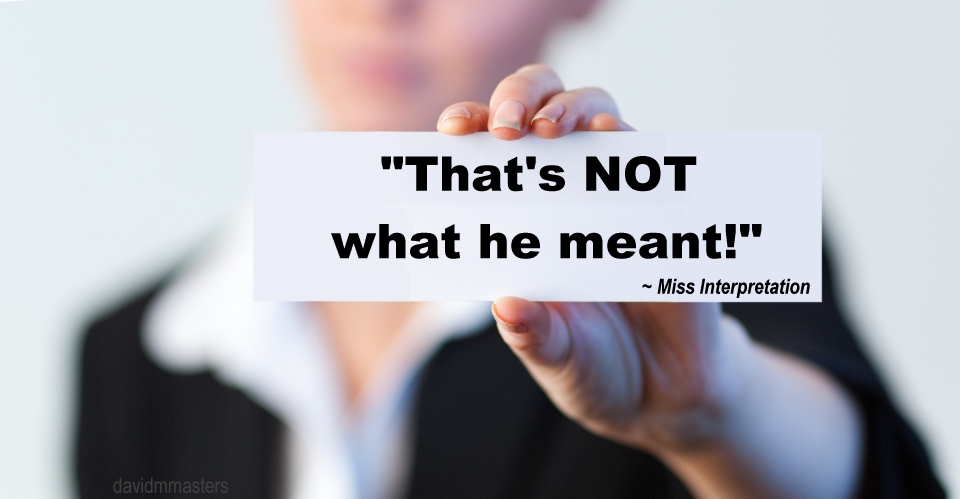
Thats not what he meant to say Miss Interpretation misinterpretation

Little Miss Interpretation has been at this as long as I can remember. As a kid, I’d try to express myself to my parents and get sent to my room or punched in the face. I’ve said things (and been fairly adequately quoted) from the pulpit, stage, conference room, boardroom, classroom or office with the best intentions, only to have MI mess things up for me.

There I was, fully intent on effectively communicating when she walks in and gets everyone all riled up, offended, objecting and ranting about something that wasn’t even intended to be included in what I was talking about. How does she do it?

“That’s not what he meant to say.”

~ Miss Interpretation

She gets inside people’s head and rifles through all their personal belongings and grabs words, ideas and thoughts that still hold emotional charge from the past and waves it in front of their face:

“See this! Look at that! Remember this? What about that?”

A relentless barrage of old information that is highly charged with negative emotion, causing the individual to think that danger may be ahead.

A person can’t help but recoil in self-preservation and protect themselves from such a vicious attack, and…

Forget everything I’ve ever said before this moment.

Now, all attention is on this word – or phrase – that harkens to a time that may have been dangerous (or at the very least unpleasant) and now I (the messenger who used the word or phrase with the best of intentions) am an assailant.

How does she wield so much power over us? And I’m the first to admit, that even though I work hard on kicking her to the curb every time she tries to interrupt someone else’s monologue, I too, have fallen victim to her manipulative influence and subject to mounting up to do battle or cut-and-run.

She does seem to have access to all my personal baggage accumulated since birth, and she’ll use anything she can get her hands on to derail (initiating fight or flight response) an otherwise potentially meaningful exchange of information between two people.

Why does she do it?

I don’t know… I think it’s because she hangs out with that little child inside us and that’s how she gets her kicks. Or maybe her intentions are good; it’s just that in an effort to protect us from harm’s way, she sees everything as a potential threat… even when it may not be a threat at all.

Just words

Exchanged between two people

Looking for a home

in our hearts and minds