Breaking Free from Endless Rumination Over Past Abuse Trauma

Many people struggle with rumination, replaying painful past events over and over in their minds. You can’t rewrite what happened, but you can stop rereading the worst parts over and over again. If you’ve experienced trauma, this cycle can feel endless—like being trapped in a movie that never stops playing. While it’s normal to reflect on past pain, excessive rumination can prevent healing and steal your peace.

The good news is that you can break free from this cycle. Below are practical steps to help you stop ruminating and start moving forward with greater peace and clarity.

    1. Recognize the Cycle

Rumination often feels productive, like you’re searching for answers or justice, but in reality, it just deepens the pain. Signs of unhealthy rumination include:

        • Replaying events without resolution
        • Feeling stuck in anger, guilt, or regret
        • Asking “What if?” or “Why me?” repeatedly
        • Struggling to focus on the present

The first step is to notice when you’re ruminating and remind yourself that reliving the past won’t change it.

    1. Reframe Your Thinking

Instead of seeing the past as a wound that won’t heal, try shifting your perspective:

        • This happened to me, but it does not define me.”
        • I can learn from this experience and grow.”
        • I will not give my past power over my future.”

A simple mantra like I release this memory with love and choose peace can help redirect your thoughts.

    1. Limit “Thinking Time”

If your mind keeps returning to the past, schedule a specific time for reflection. Give yourself 10–15 minutes to process your thoughts, then move on with an activity. Over time, this conditions your brain to spend less time dwelling.

    1. Focus on Your Body

Trauma isn’t just in the mind—it’s stored in the body. Instead of overthinking, try:

        • Deep breathing (4-7-8 method)
        • Yoga or stretching
        • Tapping (EFT – Emotional Freedom Technique)
        • Cold water exposure (splashing face, cold shower)

These methods calm your nervous system and help release emotional tension.

    1. Rewrite the Story

Your trauma is real, but your interpretation of it can evolve. Write a new version of the story where:

        • You acknowledge your strength
        • You recognize what you’ve learned
        • You find meaning, even in hardship

For example, instead of “I was betrayed and abandoned,” you might say, “I survived, I grew stronger, and I know my worth.”

    1. Engage in Something Absorbing

The best way to stop dwelling is to engage your brain elsewhere:

        • Read a book
        • Try a new hobby
        • Volunteer or help someone in need
        • Work on a creative project

When you’re fully present in an activity, your mind has less space to ruminate.

    1. Connect With the Right People

Isolation fuels rumination, while connection brings healing. Seek out:

        • Support groups (online or in-person)
        • A trusted friend or therapist
        • Spiritual or faith-based support

Talking things through with the right people helps you process and move forward.

    1. Practice Radical Acceptance

Sometimes, we ruminate because we resist what happened. Acceptance doesn’t mean you approve of the trauma—it means you stop fighting reality and choose peace. Try saying:

        • “This happened, but it no longer controls me.”
        • “I accept the past, and I choose to heal.”

Acceptance is not weakness—it’s the key to freedom.

    1. Release Stored Pain with Movement

If trauma feels stuck in your body, consider:

        • Walking or running
        • Dancing to music that uplifts you
        • Shaking therapy (letting your body tremble to release tension)

Moving helps your brain process and release stuck emotions.

    1. Seek Professional Help When Needed

If rumination is severely affecting your life, you don’t have to face it alone. Therapy options like:

        • Cognitive Behavioral Therapy (CBT) (rewires thought patterns)
        • EMDR (Eye Movement Desensitization and Reprocessing) (helps process trauma)
        • Somatic Therapy (releases trauma stored in the body)

can be life-changing. There is no shame in seeking help.

You Are Not Your Thoughts

Breaking free from rumination takes time, but every small step moves you forward. The past does not define you—you have the power to heal, grow, and create a beautiful future.

You deserve peace. Choose it today.

Breaking the Cycle of Abuse: Reclaiming Your Self-Worth

Surviving abuse is an incredibly challenging ordeal that can lead to the development of unhealthy coping mechanisms as a means of self-preservation. While these coping strategies may have initially helped you survive the abuse, they can become counterproductive in the long run, ultimately granting power to the abuser. In this article, we will explore the concept of unhealthy coping skills developed as a result of abuse, why it’s essential to break this cycle, and how to self-diagnose and treat these patterns.

Understanding Unhealthy Coping Mechanisms

Abuse, whether physical, emotional, or psychological, can leave deep scars on a person’s mental and emotional well-being. Victims of abuse often develop coping mechanisms as a way to endure their traumatic experiences. These coping mechanisms can include denial, self-isolation, emotional numbing, or even mirroring the behavior of the abuser to avoid further harm.

Unhealthy coping mechanisms can become ingrained over time, and while they may offer short-term relief from the pain and fear of the abuse, they ultimately become harmful. These mechanisms often include addictive or destructive behaviors that ultimately perpetuate a sense of powerlessness and dependence on the abuser, effectively granting them more control over the victim’s life.

Every time the victim initiates the unhealthy coping mechanism, the abuser is granted superiority and wins in the game of abusing others, prolonging their abuse. Victims can stop the lingering abuse, reclaim control of their lives and reestablish an empowered healthy life by firstly,

Self-Diagnosing Unhealthy Coping Mechanisms

Recognizing and understanding your unhealthy coping mechanisms is a crucial step toward breaking free from the cycle of abuse. Here are some signs to help you self-diagnose these behaviors:

  1. Escapism: You may find yourself resorting to substance abuse, excessive television or social media consumption, or other distractions to avoid facing your emotions or reality.
  2. Self-Isolation: A common response to abuse is withdrawing from friends and family. You may have isolated yourself from loved ones to avoid confrontation or judgment.
  3. Self-Doubt: Continuously doubting your own abilities and self-worth, which the abuser may have undermined during the abuse.
  4. Imitating the Abuser: Mirroring the behavior of your abuser, either consciously or unconsciously, as a way to deflect harm or gain their approval.
  5. Inability to Trust: Difficulty in trusting others, forming healthy relationships, and setting boundaries as a result of past experiences.

Breaking the Cycle

Breaking the cycle of abuse and unhealthy coping mechanisms is a challenging but vital journey towards reclaiming your self-worth and independence. Here are some steps to help you on this path:

  1. Seek Professional Help: Reach out to a therapist or counselor who specializes in trauma and abuse. They can provide guidance and support as you work through your experiences and develop healthier coping strategies.
  2. Self-Reflection: Take the time to reflect on your past and identify the coping mechanisms that you have adopted. Recognize that these strategies were survival tools and not a reflection of your character.
  3. Build a Support Network: Reconnect with friends and family or seek out support groups where you can share your experiences and receive validation and empathy.
  4. Set Boundaries: Learn to establish healthy boundaries in your relationships to protect yourself from further abuse and manipulation.
  5. Cultivate Self-Compassion: Practice self-compassion and self-care. Treat yourself with kindness and patience as you navigate the healing process.
  6. Educate Yourself: Learn about the effects of abuse and the psychology behind it to gain a deeper understanding of your experiences.
  7. Reclaim Your Power: Acknowledge that the abuser no longer has control over your life. Take steps towards your own healing and personal growth.

Survivors of abuse who have developed unhealthy coping mechanisms should recognize that these strategies, while once necessary for survival, no longer serve their well-being. By breaking the cycle of abuse and developing healthier coping mechanisms, victims can reclaim their self-worth and regain control over their lives. Remember that seeking professional help and building a strong support network are essential steps on the path to healing and empowerment. You have the strength to overcome the destructive cycle of abuse and emerge as a victor, not a victim.


Strong Not Broken

I had a client with whom I was working who had intimated to me her traumatic past relationships with men which led her to the conclusion that she no longer desired to expose her heart to another man, and she made a vow never to do so again.

I assumed this might put her at a disadvantage when it came to having love in her life, and I suggested that she might reconsider her position because this might be blocking other areas of her life as well, especially because we’re talking about “love,” which she agreed was the most powerful force in (and/or beyond) the universe. It is the key which unlocks all doors which stand between us and the desires of our heart.

She was quick to correct me. She had filled her life with so much love, loving deeply family, her community, others who had little or no love in their lives, animals, nature, all living things, and those beyond. Her life was not one of brokenness but one of love, an enthusiastic abundance of love.

She admitted she had been broken by the men she had allowed herself to be victimized by, those who disrespected her, abused, and terrorized her, but when she decided to deny them access to that most vulnerable organ inside her, it was not out of fear, or fueled by pain from the past.

It was the most powerful decision she had ever made in strength and honor which enabled her to freely open herself in unconditional love in all other areas of her life. Since making this decision, she has been able to interact and work with men in her field, and throughout all other areas of life, without the threat of being vulnerable, hurt, disrespected, or loved by them.

She could powerfully interact with them intimately, for a limited amount of time, without risk of developing a deeper connection, for she did enjoy having them in and around her life, but not allowing them access to her heart.

She had built a stronghold, a mighty fortress, not around her heart, but only around that area which focused only on men, and who could blame her if you’d had the opportunity to learn the depths of darkness, she had endured while her heart was held captive by a succession of abusive monsters.

This fortress was not built in weakness or fear. This fortress was built in love. Pure love, which enabled her to freely love everything that is, protecting her and allowing her to live other days, one after the other, in love.

It has been many years of her living this life of love, without a thought of exposing herself to the idea of romance and she continues to live a happy life, full of love, without regret. She never has the thought of what it might be to have romantic love in her life.

And when she sees someone, a couple who appears to be enthusiastically in the throes of love, she blesses them, wishing for them all the love which they seek to find in each other, without imposing her views upon them. She loves them, the idea of love, and sends them some of her love in hopes that it will help them have all the best things in life together, and that their love will overflow to others.

There is no doubt, this woman is living a life of love. “Romantic love” in her life is not her ministry (by “ministry,” I mean, “her passionate area of specialization”). She declines participation in this arena and blesses others who do specialize in this type of work.

She does not judge others for seeking their individual paths, leading to their own unique journeys, fully supports them on their way, and does not impose her personal stance on romantic love on anyone else.

This is a deeply personal work she has accomplished on her own which has led to a full life or happiness, abundance, and unconditional love.

So, I stand corrected.

In my attempt to understand her from her own perspective, I mistakenly applied a general filter based on my experience in working with singles and couples who are struggling with the idea of love in their lives. And I was wrong.

This extraordinary woman took massive action to protect herself from abuse, which any one of us would have encouraged her to do, to stop the abuse, to find a safe place to do the deep work, and heal traumatic wounds of the past.

She has done the work, the hard work, and continues to do the deep work, in a safe environment filled with love. There is no lack of love here.

She remains a light in the darkness for so many.

Maybe she is an angel, for angels are love and have no need or inclination for romantic love.

God bless her for all she brings to this world.

Because of her, so many of us are blessed.

What Are You Going to Do?

Alright, no doubt. You’ve been disrespected, even abused. That was a terrible injustice, but what are you going to do about it? The answer makes all the difference.

You can feed into the cycle of abuse, it’s the natural response.

Your boss says something which cuts you to the quick, and you resist lashing back, but when you get home, you say something biting to your spouse, who doesn’t want to rock the boat, and one of the kids gets inadvertently put down. The child goes to school and barks at another child, who disrespects a teacher, who disrespects a coworker, who gets upset at a cashier at the supermarket. The cashier strikes out at the person who is rounding up the shopping carts, who comes home and kicks the cat. The mom who sees this outburst expresses her frustration and the pet abuse, gets the dad upset, the family has an outburst but the father tries to settle the dispute, and he’s your boss, who it short with you, yet again, and the cycle readies for another round.

While, admittedly, over-simplified, this is the pattern of abuse, which can only be interrupted by nonother than (you guessed it), you.

The buck stops here, with you. You are the only one who can stop this abuse from running, like wildfire, throughout the world.

I like the way don Miguel Ruiz refers to this as “emotional poison.” When someone is the recipient of emotional poison, they know of no other way to ease the pain than to put it on someone else. So, he or she strikes out at you, now you’ve been infected. What are you going to do?

The next time someone disrespects you, infects you with their emotional poison, you could instead make the conscious decision to break the cycle. You can affirm, “This stops, here and now, with me.”

What you do next changes everything.

You can disable, the emotional poison by applying empathy, forgiveness, and love. You seek to understand that your boss was infected and have empathy for his or her condition, forgiving the transgression because you know what’s happening. After all, your boss is only doing the best he or she can do with what they have.

Your boss doesn’t know what’s going on, but you do.

But you’re still infected. You can’t just push it down, cover it up, and ignore it, because that will cause the wound to fester and build up more poison inside you, ‘til… well, you know what happens. Either it finds a way to come out in an explosive event, or it will cause your immune system to deteriorate, making you more susceptible to illness, accelerated aging, and possibly premature death.

That’s why you need to apply the most powerful healing energy of love to the wound. And when you do, something amazing happens. The wound heals enabling you to powerfully chose the love response. So, now…

What are you going to do?

When someone judges you, you can have the wherewithal to understand what’s going on behind the scenes and not take it personally.

When you are rejected, you can find acceptance that things are what they are, nothing more than that. Search your self and see if there is any value or hidden (meaningful) message in the rejection, otherwise, let it flow right past you, as if it were no thing. And it was, because it really had nothing to do with you, and far more to do with your rejector trying to release their own poison in that moment.

If someone tries to shame you for something that is just the way it is, there is no reason to defend yourself and you can have compassion for that person who tried to disempower you.

You have the ability to break the cycle of abuse.

You can be the person you needed to reach out to when you were hurting, instead of falling into the trap of becoming someone who perpetuates the spreading of emotional pain.

You are better than this.

You are the interceptor breaking the flow of abuse.

And when you respond empowered by love, people notice. While emotional poison is highly contagious, so is love.

Love is the sacred virus which uncreates and transmutes fear and all its trappings.

Choose love and with powerful intention help infect the world with it for freedom from emotional disease.

Love is most powerful.

Apply generously, rinse and repeat.

Twisting Your Words to Make You Look Bad

Don’t you just hate it when someone twists your words, gets all heated up, and attacks you – using your own words – to put you on the defensive or make you upset. What’s happening? What can you do when someone’s twisting your words to make you look bad?

Few things are as frustrating as having your words twisted and weaponized against you. Whether it’s to make you look bad, provoke an emotional reaction, or put you on the defensive, this tactic can leave you feeling angry, hurt, or disoriented. So, why do people do this, and how can you respond effectively?

Why People Twist Your Words

In the Media: It’s About Spin

In public venues like news programs, social media, or memes, twisting words is often referred to as “spin.” It’s a calculated strategy designed to create drama and soundbites that grab attention. This tactic generates clicks, views, and engagement, making it an accepted practice under the guise of free speech and parody.

While it’s a common practice in media, the misuse of someone’s words can still cause significant harm. It can tarnish reputations, derail good intentions, and turn powerful messages into weapons.

In Personal Relationships: A Coping Mechanism

In personal and social circles, twisting your words is less about spin and more about projection. People who lack self-confidence, have been deeply hurt, or live under constant stress may twist your words as a defense mechanism.

By projecting their unresolved emotional wounds onto you, they temporarily release their inner pain. When they twist your words to make you look bad, it allows them to transfer their suffering onto you, offering them a fleeting sense of relief.

Unfortunately, this behavior is often subconscious. The person twisting your words is unlikely to recognize or admit that they’re projecting. If they’re looking for demons, they’ll find them everywhere—until they’re willing to address their own unresolved pain.

The Emotional Impact on You

When someone twists your words, it can feel deeply personal. You may feel compelled to defend yourself, which is a natural response. However, reacting defensively often exacerbates the situation, adding fuel to the fire. Your attempts to explain or justify yourself may even give the other person more material to twist against you.

Understanding the motivation behind this behavior can help you take a step back and avoid being drawn into the cycle.

How to Respond When Someone Twists Your Words

    1. Stay Calm and Neutral
      Responding with calmness and neutrality can prevent the situation from escalating. A simple statement like,

      • “That’s not what I meant, but you’re entitled to your opinion,”
        can defuse tension without adding more energy to the conflict.
    2. Avoid Defensiveness
      Defensiveness often backfires. By defending yourself, you validate the other person’s tactic and give them more opportunities to twist your words.
    3. Don’t Take It Personally
      Recognize that their behavior is likely a reflection of their own unresolved issues. This doesn’t excuse their actions, but understanding this can help you detach emotionally.
    4. Offer Clarification Thoughtfully
      If there’s a misunderstanding worth addressing, you can offer clarification. However, consider the potential consequences carefully. Your clarification could be twisted further, so weigh the risks before speaking.
    5. Use Empathy Without Condescension
      Try to have compassion for the person without feeling sorry for them. Remember, if you had lived their life and experienced their pain, you might behave similarly.
    6. Walk Away if Necessary
      If the situation becomes too volatile, disengage. Walking away isn’t a sign of weakness—it’s a way to protect your peace and avoid unnecessary conflict.

Advanced Strategies for Emotional Resilience

If you’re highly self-aware and emotionally resilient, you might choose to act as a “shock absorber” for someone who is twisting your words. This means allowing them to release their frustrations onto you without becoming emotionally engaged.

This approach requires significant emotional detachment and is not for everyone. Unless this aligns with your life’s purpose or personal calling, it’s best to protect yourself rather than absorb someone else’s pain.

When the Motivation Is Malicious

Sometimes, twisting your words isn’t about projection or unresolved pain—it’s a calculated move by someone with a darker agenda.

Psychopaths and Sociopaths

Those on the predatory end of the anti-social personality spectrum may twist your words to undermine or destroy your credibility altogether. Their goal is to damage you, not to heal themselves.

The response to this is the same:

    • Avoid defending yourself.
    • Disengage and remove yourself from the situation.
    • Seek safety and distance from the manipulative individual.

In such cases, protecting yourself is paramount.

The Power Is in Your Hands

No one can make you look or feel bad without your permission. When someone twists your words, they’re trying to draw you into their emotional chaos. By refusing to engage defensively, you take away their power.

Remember, your response—or lack thereof—determines whether the situation escalates or fizzles out. With patience, self-awareness, and compassion, you can rise above the manipulation and protect your peace.

Ultimately, the best way to disarm someone who twists your words is to maintain your integrity and choose your battles wisely. Some conflicts are not worth your energy, and the most powerful statement you can make is to simply walk away.


What If Nobody Could Hurt You?

What if nobody could ever hurt you, ever again?

If you’ve ever been in a knock down drag out fight you know what it feels like to be hit by someone. Adrenaline and other hormones cascade overwhelming your state of being as you as immediately find yourself in fight or flight. Being part of a brutal smackdown is no fun and the trauma, pain, and suffering that comes from the physical abuse can endure and cause even more suffering as you try to heal from the event over time.

How curious is it when we are similarly affected by the spoken words of someone?

When you feel as though someone has disrespected, insulted, ignored, judged, or rejected you, BAM! Just as though you’d been kicked in the guts, all the pain, emotional and physical with all the feelings and hormone overload.

When this happens to you, those words, which cut like a knife, were likely spoken by someone you love, trust, or highly regard. They could be your partner, a family member, a child, a neighbor, someone you work with or for. Because you are more connected to these people than others in your life, their words cut the deepest, can crush you, and leave your heart bleeding in pain and sorrow.

Those you care about the most hurt you the most

The concept, “those you care about the most hurt you the most” rings true.

Interestingly enough, this concept was programmed into your psyche since the day you were born. Based on your life experience, you learned to love and depend on others. Early on, you realized that if you disappointed the people you loved and trusted to take care of you, they would turn on you, leaving you in a state of fear and suffering.

That’s where it starts, and it grows as you trust and are betrayed by those who you love and care for along the way, when all you really wanted was to be accepted, respected, and loved for no other reason than you love others. Family, friends, lovers, fellow students, teachers, and others in your circle of influence. Why can’t they just love you back?

We have been programmed to value the opinion of others so highly that the slightest threat of potentially not being highly regarded by someone we care about can threaten our very sense of existence. Our feelings are hurt. We can either strike back and start an all-out war of words (or worse), and if we’re unable to strike back (for fear of being hurt even worse), we find someone else who we are stronger than to strike out at to release the angst inside. Or we can find ourselves sinking to the depths of depression, even contemplating suicide as a way out of the pain.

You were socially programmed to want what others want, to desire to do the things that others do with them as a part of the crowd. Giving you a sense of belonging, in the belief there is safety and security by being accepted by others, for to be alone would be potentially dangerous, or too much to bear.

This social programming has been a disservice to your highest and best because you were meant for so much more than just being just another sheep in the herd.

Blessed are those who were raised in an empowered sense of individuality and personal awareness. They possess the power of seeing themselves as separate, and in the best-case scenarios, also see themselves as part of the greater whole of community and humanity, though these days this represents a very small percentage of us.

To expect someone to know and appreciate you for all that you are sets you up for disappointment and failure, and your feelings will always be hurt because no one can ever know and appreciate you as much as you do.

Likewise, no matter how hard you try, you can’t fully “get” anyone else. So much goes on inside the heart and mind of everyone that you will never know. Just like when you are silent, your mind keeps working and think thoughts you might never convert to spoken word.

What’s the answer?

There is great personal power in realizing that what anyone thinks or says about you has nothing to do with you at all. It’s about them.

You know that you are always intentionally authentic, open, honest, and want the best for everyone in your life. You know you are always worthy of the best things in this life, and you would never do anything intentionally to hurt anyone you cared about. You don’t need anyone else’s validation of these things because you know them to be true. Your knowledge of and confidence in you is unshakeable.

From this vantage point, if someone barks something that might have hurt your feelings in the past, you can feel compassion for the person who felt like he or she had to react in such a say. And instead of being threatened or hurt by what they said or did, you can just look at them lost in their own life-struggle and think (or say, if appropriate), “That’s interesting.”

You know you can respond with love and compassion because you know that you were like that too.

You are emotionally resilient and bulletproof.

You are no longer a victim of anyone else’s disrespect or abuse.

You don’t have to defend yourself or strike back because they didn’t actually do or say anything that could hurt you. You can bless them because you know they are just doing the best they can with what they have.


Invisible Ties that Bind

The invisible ties that bind us together are unseen shackles which keep us tethered together. These energetic cords are like umbilical cords through which the person or people that to whom we are connected draws energy, our very life force, from us.

You become connected to so many people throughout your course of life, and if you continue through life without doing a bit of spiritual and emotional cord-cutting, you remain deeply connected to the people whom you’d be better off freeing yourself from.

The first cords you establish are those that connect you to your parents, good or bad, loving or hateful, these cords connect you to your parents for life, unless you can go through the process of freeing yourself from their energy drain.

You are also energetically corded to people you admired, loved, cared for, people who have befriended you, done a favor for you, have had sex with you, or abused you. You can feel the connection when you think about any of these people. That energetic charge is very active because you are still connected to these people, and they are draining your energy, not unlike energy vampires, even though they may not be currently actively participating in your life today.

Whenever you make a promise, vow, or are indebted to someone, an energetic cord is connected. The connection remains, even long after the situation is rectified, expired, or the debt has been paid, unless you go about the work of disconnecting this invisible energetic connection.

You may have gone about the work of severing your relationship with a person from your past, yet, the invisible ties that bind remain keeping you connected to a person whose energy you would be better off without. As long as you are still connected to this person (these people) you will be unable to focus your energies and abilities to achieve your highest and best.

You will still be able to maintain a better life, but while these cords remain and persist in draining your precious energy, you may be prevented from realizing your best life.

Especially in past relationships, when you have pledged your love to someone, even long after that relationship has run its course, the connection and the energy drain persists as you continue to be haunted by the person you promised to love.

Traumatic energy connections also keep you connected to individuals and incidents which you would much rather be free from, holding you back and restraining your full potential in the present moment. These negative energetic cords are a leading contributor to Post Traumatic Stress Disorder (PTSD).

While you remain connected, you will continue to attract these people to whom you are connected or other people who share a similar vibration, life, lifestyle, negative energy, or psychological profile.

When this energy remains connected to you, it clouds your vision and will project itself onto those new people, relationships, situations, and circumstances, triggering false cues or suspicions as the energy of the connection is projected onto your viewscreen of the present.

As unfair as it might seem, it remains a matter of fact, that unless these cords are cut, and you are free from these energetic drains from the past, it will hinder your potential to live your best life, free from these shadows and connections, and it may lead to physiological decline in health, wellness, and may promote a sensitivity to disease.

Psychotherapy might suggest a violent attempt to dig down into the recesses of your mind, having to drag you through each detail of the past, which is a traumatic process in itself, and though it may be effective, can take months or years of therapy (which works incredibly well for the therapists bottom-line).

For this reason, I prefer more modern (or ancient) methods of cutting cords from the past which are far less invasive, instantaneous, and have lasting results.

Think about how you know this to be true and ask yourself if you think now is a good time to sever the invisible ties that bind you to the past, so you can live a better life, your best life, and make the world a better place.

Hit me up, if you need a referral.

Reduce Conflict at Home

Isn’t it time to reduce conflict at home? Sometimes people just can’t seem to get along and this leads to a lot of conflict at home, work, school, among friends, and even while driving. When you get upset at something that someone else does, says, or communicates in some other way, you are likely to experience some degree of stress.

The greatest stressors will be initiated by those whom you know the best, the people within your family. While the family unit is no stranger to stress, if there are little witnesses to these active familial stressors, they will be affected the most. This is how children learn to interact with others, and this follows them into adulthood, even if they cannot consciously recall these events.

Even if the conflict does not engage the children directly, they are still being affected by these stressful situations. If you don’t believe me, just think back to familial conflicts which you witnessed when you were a child. How does that affect the way you handle stress and conflict today?

If you have children around watching your interactions with your family, you might consider taking a break or a timeout, the next time you feel tensions building. Maybe you can reason with the person you’re experiencing the conflict with and pick up the discussion at a different place and time. You might be surprised that delaying the discussion will allow you both to revisit the topic when emotions are not running as high.

This works for adults, adults interacting children, and among children as well.

This can have a tremendous effect on reducing the familial stress in relationships, also, it gives whoever might be inclined to do some deep inner work time to reflect on his or her own past to see if there are any hidden anchors from the past triggering the feelings which are being experienced in the moment.

If you are in a relationship with someone and are not able to manage taking a break or timeout, then you might consider seeking a relationship coach, counselor, consultant, or a member of the clergy, whatever appeals to you and seek assistance from a qualified third party, someone you can trust.

There are many techniques which can be applied to any type of relationship which will reduce both conflict and stress, and it’s up to you to check it out and take the appropriate steps to change your life. No one else is going to do it for you.

This is your life, and those whom you care about deserve not to be impaired by your lack of control, and left to itself unhindered by someone’s drawing explicit boundaries, not seeing eye to eye, or having different points of view, could turn into an abusive situation.

If ever, any relationship is visited by abuse, you have the right and the responsibility to stop the abuse. You are never required to fight back if there is abuse. Just take the steps necessary to isolate yourself from any further abuse.

This takes a great deal of courage and determination, but you can do it.

You have zero tolerance for abuse.

Unconditional Love Makes You Angry

You’re not alone if the idea of unconditional love makes you angry.

You’ve been trained to desire unconditional love. You want to be loved for who you are, everything, the good, the bad, your adorable traits and the mistakes you have made and may make from this day forward. To feel as though you could be accepted and loved no matter what is what you long for.

You can look back on decisions and actions you’ve initiated in your past didn’t turn out the way you planned and may have turned out badly, possibly making you look and feel stupid. You know you could have done better if given a second chance. After all, your intentions were pure when you did it or allowed it to happen.

To be loved, regardless of the stupid things you’ve done in the past, not judged for those things you could have done better and understood as if anyone in the same situation might have done the same thing seems reasonable. And this is what you long for.

While this kind of unconditional love is what you desire, to imagine the offering of such a love to another feels like a preposterous proposition. This is when the idea of unconditional love makes you angry.

What? Love someone no matter what? Do you think I’ve learned nothing from all the pain I’ve endured throughout the course of my life? Have you lost your mind?

If I’ve learned anything, I know you can’t trust anyone, particularly someone you care about, and the more you care about them, the more they will hurt you, and the less you can trust them.

You have surrounded yourself with a protective forcefield in an effort to keep yourself safe from disappointment or risk of being hurt.

Congratulations. You’ve built for yourself and voluntarily checked-in to your hospital fortress where you can find the love you seek from within and heal, because life has been hard, and you need this time to focus on you, isolated from potential harm.

No one would blame you for feeling bad, sad, or mad while suffering from your wounds in your love hospital for recovery. While recovering from these wounds, of course, the idea of unconditional love makes you angry, anyone else in the same situation would feel the same way.

You are suffering from a form of Post-Traumatic Stress Disorder (PTSD), not unlike any other form of PTSD.

If it weren’t for the support of others in their own various stages of love wound recovery, you would be totally alone and isolated in your fortress hospital, and with others who have are also suffering from love’s wounds you develop a supportive camaraderie. This kind of support can prolong your healing as you feel more comfortable in treatment than taking the risk of re-engaging in life outside the walls.

Isn’t the idea of checking one’s self into an isolated healing environment to become well enough to leave the facility and start to live your life again? To not do so transforms your hospital into a prison of your own making to serve out our own self-imposed life sentence. You needn’t suffer the extreme self-abuse of exercising your own love death penalty.

You’re better than that.

You can heal. In fact, you may be far more healed than you believe yourself to be. How many completely healthy people are in hospitals or recovery programs far past their healing because it’s safer to be in the hospital than to face your fears outside in the real world?

It’s time to get up and ambulate. Get outside and exercise your ability to love.

You can still exercise love when the idea of unconditional love makes you angry. No need to push through to unconditional love, but to start loving a little at a time would be highly beneficial.

You might find it helpful to see others as just like you.

You understand yourself so well and you would never intentionally do anything to hurt anyone else, unless in that moment, you felt like you had no other choice, as you were in fully engulfed in the fight-or-flight response. You felt like you had no other option(s).

You don’t have to love what someone else does, but you can still love the person.

Isn’t that what you want?

That is not to say that you allow anyone to abuse you. You have the right and obligation to separate yourself from dangerous situations, but let those situations be an authentic potential risk to you, your body, your mind, or your spirit. Don’t let your fear-inspired imagination to override your ability to find potential danger everywhere you look.

Instead, look to understand and realize that the person with whom you are feeling conflict is looking back at you in the mirror. If you were that person, having lived the same life, you would have done the same thing.

You can feel compassion for that person (not feeling “sorry” for them because that insinuates your superiority), trying to understand what it might like to be like to have to feel as though you might feel like you have to live life, like that. It could make you sad, and even react in a less defensive manner.

Even if the idea of unconditional love makes you angry, don’t let it stop you. Find ways to exercise your love. Start with letting friends in a little deeper. Find a child to love. Make occasions for you to engage in activities that you love, and allow your activities to grow to include more people to participate in those things that you love in public.

Get up. Get out of your love hospital, even if only briefly at first, and one day you will find you no longer rely on your self-restraint and self-imposed love prison sentence.

You have complete control of your release date. You get to leave early based on your healing and good behavior if you want to.

Maybe today is the day.

Write down today’s date, mark it on the calendar, and walk out on your own accord.

Set yourself free.

The greatest love is waiting for you.

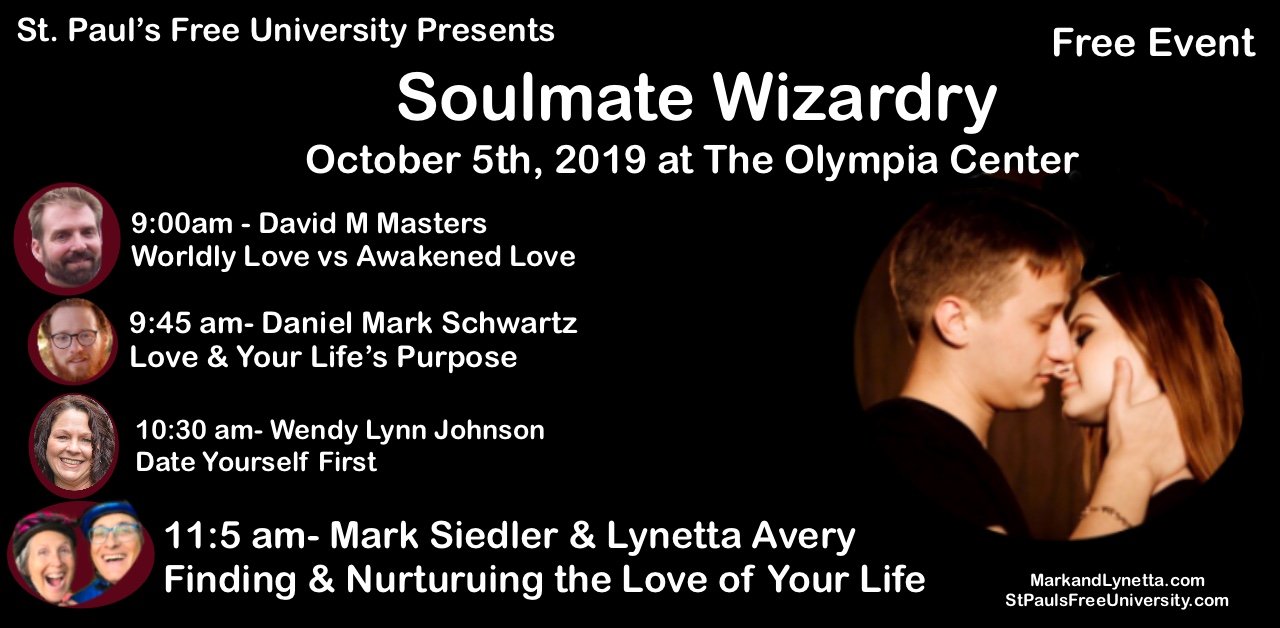
See you at the Soulmate Wizardry event.

Shock Absorbers

Victims of abuse are the superheroes who have come to this planet to experience and absorb the impact of abuse for the benefit of the world at large. Your experience exposes, educates and changes the world, and you are the conduit of the transformative change.

Shock absorbers - victims of abuse
Shock absorbers – victims of abuse

I am so grateful for the victims of the most abhorrent abuses in our modern society. While I would never wish any of the atrocities which have been suffered by these individuals, they have often (if not always and unbeknownst to them) pledged their service to the greater good, and their participation in this special calling is nothing less than heroic.

Sometimes, the act of submitting yourself to suffer abuse on the behalf of others is conscious, like in a hostage situation and the captor(s) are going to torture or kill one of the hostages, and you volunteer to be the first victim. How courageous is that? To sacrifice yourself for the sake of sparing the others. Even if you end up paying the price of your benevolent act of service requires paying the ultimate sacrifice and you give your life for the benefit of others.

In that hostage scenario, you absorbed the shock which faced the entire world in that moment. It was the worst of circumstances which involved and affected the whole world, not just you and the other hostages. It is also a tragic event for the captors, negotiators, law enforcement, reporters, witnesses, healthcare and mental health professionals. Not to mention friends and relatives of active and passive participants, and anyone else who may become aware of the abusive event.

An abusive event ripples through the local community and the world at large.

What about silent victims of abuse?

Placing yourself in harm’s way to absorb any abuse that might otherwise visit someone less equipped to take the abuse is also heroic, even if it takes place in secret and no one ever knows that you’re taking the abuse spared anyone else from having to suffer.

Until the world shifts from barbarianism to enlightenment there will be abuse and someone will have to suffer. And there are those who being a sufferer of abuse is a part of their journey. They actually decided or knew before they were born, that their journey would include this suffering to help make a difference, to change the world, and play an integral part in stopping the patterns of abuse our society turns a blind eye to or tolerates.

Sometimes, someone who has suffered abuse becomes a key component in exposing, reducing, or eliminating that particular type of abuse, while others take it upon themselves to reach out in support of other victims.

Often, a victim of abuse cannot imagine that anyone else could have suffered a similar type of abuse, so a survivor of abuse can be priceless in the rehabilitation process of any abuse victim.

Then, there are others who insist on silently hiding the abuse(s) they’ve suffered never letting anyone know and doing their very best to deal with it without saying a word to anyone or doing anything about it.

I would never advise anyone to subject themselves to abuse. If you have been a victim of abuse, you should see to the cessation of the abuse as soon and effectively as possible.

If you are one of those who has decided to take the abuse and remain in silence, you must do whatever you need to do any way you need to do it. There is no judgment for you here. You are a blessed shock absorber, any way you decide to do it, and you are a blessing.

We feel bad, because we want to help you. We don’t want to see you suffering, like this. Some of us are empathetic and can feel some of the feelings that you are going through or know how we would feel if what you were going through was happening to us, and we would do anything we could to help you.

There are others who know your pain. They have walked in your shoes. They have remained in silence while they were being abused, and they did find a way out. They are here, too, hoping you will reach out to someone. We are all here to support your choice, whether you choose to reach out or not.

No one is doing it wrong.

After all, we’re all doing the best we can with what we have.

May the shock absorbers of the world be blessed for all that you do and endure.

You are loved, the shock absorbers of the world, today.