Accused of Love, Growth, and Toxic Positivity

As an Olympian Life Coach, I’ve been called a lot of things; some kind, some not so much. I’ve been labeled “The Love Guru,” accused of spreading “toxic positivity,” and even scolded by well-meaning Christians who say I’ve gone off the rails because I devote my life and abilities to anyone, people from every walk of life, from every belief system, every background. “You’re co-mingling with the lost,” they say. Honestly? That kind of cracks me up. Because if I’m being attacked from every possible angle, it tells me I’m doing something right, I’m not choosing sides, I’m choosing love.

When I scroll through social media, I see brave souls who dare to lead with their hearts, to be open, vulnerable, and authentic, and they’re attacked for it. Trolls and wounded people come out swinging, desperate to find some sense of control or purpose. For a fleeting moment, tearing someone else down gives them a spark of significance.

And as strange as it sounds, I say, good for them.

If criticizing someone is the only way they can feel a little better about themselves today, I hope it helps. Because there’s so much despair in the world, and sometimes even the smallest relief from pain is the best a person can find.

Unless you walk in my world, the world of coaching, healing, transformation, you might never see how close to the edge some people live every single day. For some, just waking up is a victory. Just breathing is a miracle. To attack someone who’s hanging on by a thread? That’s more than unkind, it’s inhuman.

Inhumanity isn’t about cruelty on a battlefield or evil in a headline, it’s the quiet, everyday lack of compassion. It’s the refusal to let another person have their dignity, their struggle, their own process of becoming.

And this modern state of extreme polarity, “If you don’t think like me, I hate you,” only feeds that inhumanity. I see it every day.

When I work with someone breaking free from a toxic relationship, I know what’s coming; I’ll be attacked. Not by the one who’s healing, but by the abuser who feels their control slipping away. People on the antisocial spectrum, narcissists, sociopaths, and psychopaths, are masters of manipulation. They rally others to shame, ridicule, or destroy anyone who threatens their grip on another soul. They’re skilled at turning healing into heresy.

People often see my clients in a moment of transformation, not the beginning, not the end, but a single snapshot of their becoming. They might look overly enthusiastic, radiant, hopeful, even too positive. And someone will whisper, “That’s toxic positivity.”

What they don’t realize is that they’re witnessing the messy middle, the moment where the light first breaks through the storm clouds. Granted, they have not progressed to a state of balance, and who could blame them for being a little over-excited about a significant life-change. (I know, I’ve done it.)

Should we judge a butterfly by the awkwardness of its chrysalis?

Growth is never linear. It’s a constant metamorphosis. You’ll see glimpses of both darkness and light in people as they evolve. Some are learning how to hold joy for the first time without guilt. Some are just discovering what hope feels like again. And yes, it might look too bright, but I’d rather see too much light than none at all.

“Toxic positivity” is when optimism becomes denial, when we force a smile to avoid pain, suppress our emotions, or shame others for feeling sad, angry, or broken. It’s the refusal to acknowledge the full human experience, pretending everything’s fine when it’s not.

But real positivity isn’t toxic. It’s compassionate. It says, “Yes, this hurts, but we can still find meaning, growth, and love here.”

Toxic positivity dismisses pain. True positivity integrates it.

Toxic spirituality is similar, it’s when people use spiritual language to bypass reality. “Everything happens for a reason,” “You manifested this,” “Just raise your vibration,” all valid ideas in the right context, but when used to dismiss real suffering, they become weapons instead of wisdom.

Real spirituality walks with the broken, not around them.

So maybe, before we judge someone for being “too positive,” “too spiritual,” or “too open,” we can pause and remember that everyone is doing the best they can with what they have, in the moment they’re in.

If you catch someone in the act of transformation, celebrate them. Don’t tear them down. Because love isn’t toxic. Growth isn’t fake. And the heart that dares to feel deeply is not weak, it’s divine.

I love you, and I believe that growth and change are waiting for you just around the corner.

Toxic vs. Authentic Growth

Aspect Toxic Positivity Authentic Positivity Toxic Spirituality Authentic Spirituality
Core Belief “Good vibes only.” Denies negative emotions. “All emotions are valid.” Seeks balance and growth. “Pain is illusion.” Avoids responsibility for suffering. “Pain is a teacher.” Embraces healing through awareness.
Emotional Response Suppresses sadness, anger, fear. Acknowledges and processes all emotions. Dismisses pain as “low vibration.” Holds space for suffering with compassion.
Effect on Others Shames people for not being happy. Encourages honesty and emotional expression. Judges others for being “unenlightened.” Accepts each soul’s unique path.
Relationship to Reality Pretends everything is fine. Faces reality with faith and courage. Escapes reality through spiritual clichés. Transforms reality through mindful presence.
Spiritual Focus Image-based: appearing “positive.” Heart-based: being real and kind. Ego-based: superiority or avoidance. Unity-based: connection and humility.
Outcome Emotional repression, burnout, inauthenticity. Emotional freedom, resilience, growth. Detachment, judgment, hypocrisy. Compassion, authenticity, spiritual maturity.


Deflection is Better than Defense

Fighting back or direct resistance only leads to more harm, using love, deflection is better than resistance because it decreases the damage to you while your opponent continues to fight in force until they become disinterested in the battle or have exhausted their resources.

In a battle, you can never have enough weapons to combat a formidable foe. A fight between two individuals fighting against each other always results in a great deal of pain and suffering, which may include broken bones and spilled blood. So, the smart thing to do is not to fight back in defense of yourself.

This applies to physical confrontation, as well as psychological confrontation, or response to any attack from any type or style of attacker.

In the olden days, an actor was cast in a TV show based on a Shaolin monk facing all kinds of attacks responding in Kung Fu fashion, which is primarily deflection of physical attack, using the opponent’s power of force against themselves. The actor was David Carradine, who didn’t know anything about Kung Fu at the time but playing the part in the Kung Fu TV show so inspired him that he did become an avid student and teacher of Tai Chi and Qigong.

Having been exposed to this television show did influence me and my response to fighting of any kind. Therefore, I have little respect for an all-out fistfight, am inclined to avoid a brute force battle, and prefer to be the one who walks away from any confrontation in as pristine condition as possible.

I have not been able to avoid physical confrontation, but I have survived these encounters with as little damage to myself by following these principles.

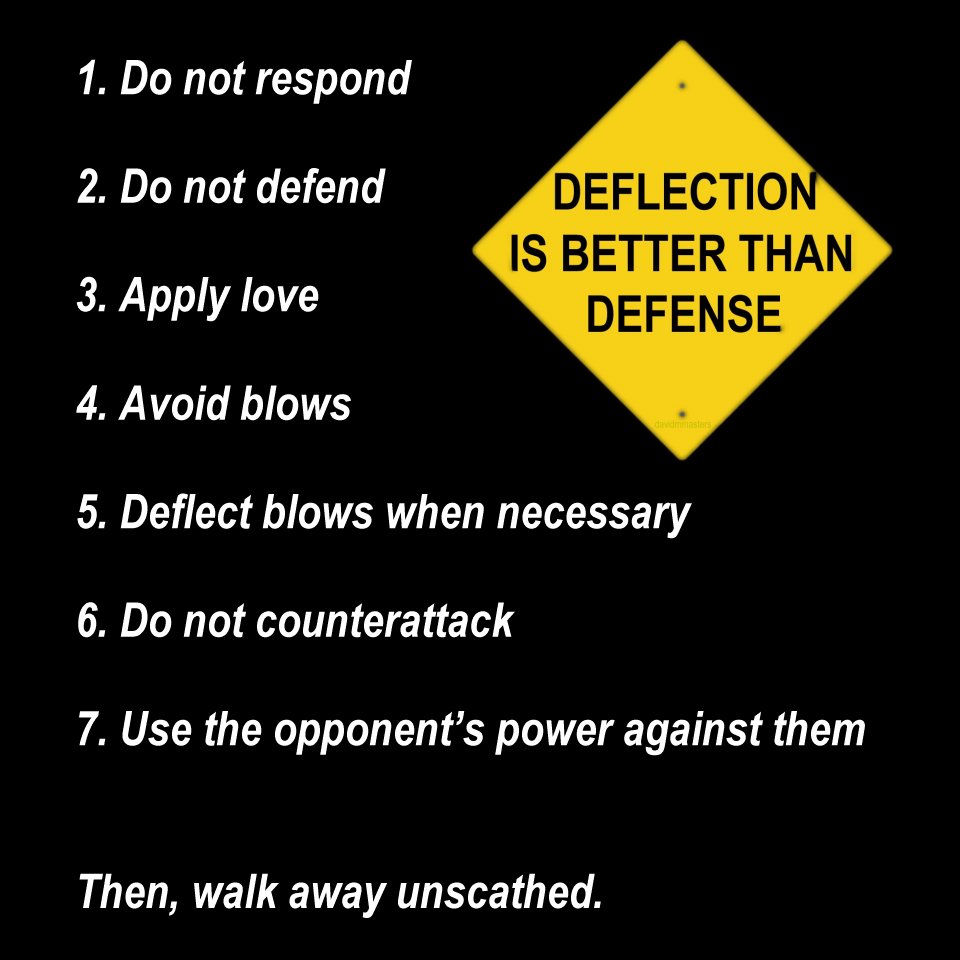
1. Do not respond
2. Do not defend
3. Apply love
4. Avoid blows
5. Deflect blows when necessary
6. Do not counterattack
7. Use the opponent’s power against them

Then, walk away unscathed.

I am not trying to convince anyone to follow these principles, I am just expressing that this is what I do, whether it is a physical altercation or any other type of potential battle.

When I was attacked by a prolific psychopath, I documented everything and applied these principles.

I remained steadfast and simply ignored everything the psychopath tried to say about me or do to me, and applied love’s perspective to the man who was attacking me. I wondered why someone might end up being like that? What kind of a life must he have lived? What must he have suffered as a young child? I tried to imagine what it must be like to walk a mile in his shoes. I sent him love, hoping he might be able to find a way to a better life.

Most would have lost interest and found some other mark to pursue, but this one made a lifetime vow with the commitment of all his resources, and those of others, to destroy me.

In this particular circumstance, the psychopath (because he could not be satisfied by my response), took the battle to the media and my circle of influence.

Still not wanting to fight back, I had no choice but to engage, because the psycho had started attacking my friends, and family. Attack me, fine, but to go after my children (who are sacred to me) requires my protection of them.

Attempting to keep my wits about me, I did respond to the psychopath with deflection and using the psycho’s own power of force against himself.

Fortunately for me, the psychopath left threatening messages on my answering machine. I posted them on YouTube. Now, he had a venue where he could spin all his efforts against me, and I empowered him to do so.

Did I care? No. I am impenetrable. Anything he says about me is not true, and I don’t care, nor do I respond to any ridiculous accusations.

Now, I did get a flood of attention from friends and family who feared for me, especially those who the psycho was able to make fearful in his attacks on them because of my not responding. I just told them not to worry, and apologized for any overflow which had affected their lives, but told them that I was attempting to protect them by placing his focus back on me.

Without directly engaging or defending, I just posted everything he threw at me online, and let it be.

In the process, I was able to help countless other potential victims see the psychopath (a lifetime criminal con man) for who he was prior to losing their life’s savings and suffering continued abuse by the psychopath by finding some of this information online.

He was forced to change his identity and possibly even fake his own death in order to continue his life of crimes in the exploitation of others.

I apply this to any confrontation by anyone, even if someone were to say in an interview (in this fictitious example), “According to,” (some source that was leaked by the psychopath), “you kill babies and bury them in your backyard. What do you have to say about that?”

My only response would be, “It is my personal policy not to respond to any false accusation. Next?”

When what I wanted to do is to counter-attack, like ask the interviewer, “What about your collection of clown noses and pickled small toes of circus performers who have mysteriously disappeared? What about those?”

It is your sacred right not to respond to a false accusation, not to even dignify it with any response. Regardless of your good intentions, and the inclination to defend yourself and your good name, any response can be used as a weapon against you, or to fuel the fire of further attack.

In this way, deflection is better than defense.

Next.

You Might Be a Toxic Person

Have you ever hurt someone you loved? Made a choice that led to unintended consequences? Blurted out something you immediately regretted? If so, you might have wondered if you’re a toxic person.

It’s a brave question to ask yourself. Reflecting on your actions can lead to powerful growth. But before jumping to conclusions, let’s explore the signs of toxic behavior and what they might mean for you—or someone you know.

A Compassionate Look at Self-Reflection and Behavior

Recognizing Toxic Traits

Here are some behaviors that might indicate toxic tendencies:

    1. Controlling Behavior
      If you dictate your partner’s clothing, activities, friendships, or choices, you could be exhibiting toxic control.
    2. Taking Without Giving
      Constantly receiving attention or resources without reciprocating can point to an imbalance in your relationships.
    3. Avoiding Connection
      Ignoring calls, texts, or attempts to connect—unless it suits your needs—might be a sign of disregarding others’ efforts.
    4. Spinning the Truth
      Exaggerating or lying to make yourself look better—or to make others look worse—can erode trust and foster negativity.
    5. Weaponizing Words
      Using someone’s exact words or actions against them, especially to harm their reputation or well-being, is a hallmark of toxicity.
    6. Betraying Confidence
      Sharing sensitive information entrusted to you—or using it to elevate yourself or diminish others—is a serious breach of trust.
    7. Twisting Context
      Taking someone’s words out of context to create conflict or assert your superiority shows a lack of integrity.
    8. Bullying the Gentle
      Picking on kind, empathetic individuals to “toughen them up” or challenge their sensitivities is both unkind and unnecessary.
    9. Boasting and Dismissing Others
      Constantly bragging about your accomplishments, while disregarding others’ achievements, reveals an inflated sense of self-importance.
    10. Avoiding Accountability
      Blaming others for your failures or making excuses for unmet commitments suggests a reluctance to take responsibility.
    11. Lacking Integrity
      Struggling to keep promises or aligning actions with words often signals a deeper disconnect.
    12. Manipulating with Guilt
      Using guilt, pity, or self-deprecation to sway someone’s decisions shows a tendency to manipulate rather than collaborate.
    13. Judging Others
      If you consistently feel others don’t meet your standards and try to change them, it might be time to reassess your expectations.
    14. Abusive Tendencies
      Intimidating, belittling, or threatening others to get your way reflects unhealthy behavior that can harm relationships.
    15. Jealousy and Rage
      Reacting with jealousy or rage when your partner is out of sight—or assuming infidelity without evidence—points to insecurity.
    16. Distrusting Everyone
      Believing that no one can be trusted, often because you struggle to trust yourself, can create a toxic outlook on life.

What It Means If These Traits Resonate with You

Before you spiral into guilt or shame, take a deep breath. Simply asking, “Could I be toxic?” is a sign that you’re likely not. Toxic people rarely reflect on their behavior or consider its impact on others.

We’re all human, and we all make mistakes. Life is full of moments when we fall short, but those moments don’t define us. What matters is our willingness to recognize, learn from, and improve upon them.

Understanding True Toxicity

Truly toxic people often move through life leaving emotional destruction in their wake without concern for how their actions affect others. For them, manipulation, control, and disregard for others’ feelings are habitual.

This doesn’t make them “evil” or “bad” people—it makes them individuals who are deeply wounded or disconnected from empathy.

Responding to Toxic People

If you encounter someone displaying toxic behavior:

    • Practice Compassion: You don’t know their full story or the pain that might have shaped them.
    • Set Boundaries: Protect your own emotional space. You’re not obligated to suffer for someone else’s actions.
    • Don’t Judge: Instead, focus on creating distance while maintaining your peace.

How to Move Forward If You See Toxic Traits in Yourself

If you recognize some of these behaviors in your own life, congratulations—you’ve taken the first step toward growth. Here’s how to continue:

    1. Acknowledge the Behavior
      Identify specific instances where you may have acted in a toxic way. Reflect on the reasons behind those actions.
    2. Seek Understanding
      Ask yourself: What was I feeling? What unmet need or fear might have driven this behavior?
    3. Apologize Where Necessary
      If you’ve hurt someone, a sincere apology can be a powerful step toward healing.
    4. Commit to Change
      Identify healthier ways to communicate, connect, and navigate relationships. Consider seeking support from a counselor or coach if needed.
    5. Be Patient with Yourself
      Change takes time. Celebrate small victories as you work to align your actions with your values.

The Journey of Growth

We’re all navigating life the best we can, learning as we go. Recognizing toxic tendencies doesn’t make you a bad person—it makes you human.

What sets you apart is your willingness to grow, to reflect on your behavior, and to make choices that align with kindness, respect, and empathy.

So, if you’re asking yourself, “Am I a toxic person?” take heart. You’re likely not toxic—you’re simply on the path of becoming the best version of yourself.

Keep going. Keep growing. And keep making the world a better place, one choice at a time.

They Don’t Love You

They might say they love you or have your best interests at heart. If that’s true, then why doesn’t it feel like love? Because they don’t love you. There’s something more sinister going on behind the scenes. What can you do about it?

You have people, family, friends, and coworkers in your life with whom you share an obligatory relationship. No matter how much these people profess to have your back, when you’re in their presence, you don’t feel good. In fact, you feel quite the opposite.

They drain your energy, don’t respect you, your point of view, won’t let you get a word in edgewise, because they are more in need of an audience or support, and your presence is necessary for them to feel good.

It’s really not about you. It’s about them. Needing support is not a bad thing, but it’s so much better when it goes both ways. We all need support and in a reciprocal relationship, there is a sacred give-and-take when it comes to being loving and supportive.

Not all your friends are toxic vampires, but you know there are some that you would probably feel better if they did not have as much access to you during the course of your life.

There are your friends who have always been there, and you have let them have access to you anytime they needed for a long time, possibly since childhood. There are friends who are just around you as you go through life, they are your neighbors, coworkers, and casual acquaintances who are just there, taking advantage of you’re being there.

Then there are the closest of all relationships which you maintain, and it’s up to you to take an active role in the management of these relationships. There are certain types of energetically draining persons whom you would be better off without by limiting their access to you.

Of course, there are the toxic friends and energy vampires, you would be better off without, but there are others also. It’s up to you to decide which ones need to be trimmed-back for your higher good.

There are those who are all about themselves, expect you to support them but offer nothing in return. Those who want to control you and everything you do (and think, if they could). Those who refuse to have an empathetic response when you bear your soul, and often argue and debate with you about your beliefs in an order to save or convert you to their beliefs. The overbearing asserters who make you feel like they’re demanding a “My way or the highway” approach to you and yours.

The continual fearful pessimists, who always look at the negativity and potentiality of failure in all areas of your life, who would dissuade or prevent you from moving forward, growing, expanding, or reaching out to achieve your highest and best. They the perpetual complainers who rarely, if ever, have anything good to say.

You should probably consider discharging the drama kings and queens from your life who tend to let their trauma overflow into yours. Helping someone out in their hour of need, and potentially suffering consequences yourself in the process is admirable, but for those who are continually in dramatic turmoil, that is another issue altogether.

There are those who have little or no self-esteem who masquerade as self-righteous and pompous to overcompensate for their lack of feeling good about themselves. They may be entertaining, cute, or funny, but are prone to jealousy, putting others down, insulting and criticizing everything and everyone else.

The gossipmongers who are always talking behind everyone else’s back (realizing that they are also talking behind your back, too, does not require a Ph.D. in psychology).

There are two types of liars which you might think about dealing with, pathological and fanciful. Pathological liars are often predatory, will misrepresent everything, exaggerating the details, and presenting you with overwhelming amounts of false data, while the fanciful liars will offer up endless non-fact-based stories without ill intent. Pathological liars are harmful and destructive. Fanciful liars mean no harm, but they can be as much a drain on your energetic resources.

Keep in mind, while it seems as though they don’t love you, they might actually love you in their own way. After all, they’re only doing the best they can with what they have, so there’s no need to be unkind as you’re going about the business of limiting their access to you.

If you want to live a better life, your best life, and make the world a better place, a little social maintenance in your circle of influence can go a long way.

The preservation of your sacred space is up to you, and you are the only one who can control it.

Surround yourself with those who love and support you and hold them dear.

See you at the Soulmate Wizardry event.

Toxic Friend Much?

What about when a friend is verbally or emotionally abusive to you? It’s easy for a friend to laugh it off as a joke or accuse you of being too sensitive. There is a sort of locker-room camaraderie which is a good cover for bullying using such methods as put-downs, name-calling, or teasing.

Even if it is all in good fun, piercing jabs can still cut like a knife, even if you try to convince yourself that you might be misinterpreting their snide remarks. They couldn’t possibly have mean to cut you to the quick, like that.

Nonetheless, you deserve the respect to which you are entitled. Your life is not a joke to be laughed at or made fun of. No one has the right to take you or your life for granted. You never need to heed anyone’s disrespect or other toxic abuse.

Toxic friend much?

If you’re disrespected by someone in your inner circle of friends, you might have to do a bit of emotional housecleaning. Disrespect has many faces, like not valuing your goals or intentions. They take cheap jabs at your appearance, clothing choices, job, what kind of car you drive, or home you live in. They may not value your time, skills, or special abilities, and may ask you to help them but never have an inclination to honor the value of such or offer to pay for your services.

They make fun of you, making you the but of their jokes, condescend in public, in an effort to make themselves look better at your expense. If they don’t stick up for you, support you, express an interest in your life, recognize your value, or understand who you are or how important living the way you do is to you, it might be time to cut them loose.

If you find yourself unable to share intimate details about your because they’ll be disregarded or made fun of, or worse yet, tell wild stories about your shared personal data behind your back, this person is not a friend. If a friend cannot take you seriously, or see from your point of view, at least trying to understand what it might be like to be in your shoes, he or she might not be as good a friend as you may have thought.

If your friend discounts what you have to say doesn’t want to listen to you or feels as though anything you might have to say doesn’t matter. They might even ask you for your opinion about something but disregard your input as invaluable, they may see themselves as superior to you and your input as worthless.

You can trust a true friend with your most intimate details. A friend that cannot be trusted isn’t much of a friend. If he or she makes a promise, and you cannot depend on it, or take them at their word, there is not much of a friendship foundation of trust on which to build.

What if you know that your friend is untrustworthy or has a dark side? You know he or she tells half-truths, withholds information, or right-out lies. It’s only a matter of time, ‘til you find yourself on the wrong side of this person, as he or she talks behind your back, tells lies about you, betrays you, or sets you up to take the fall for something you didn’t have anything to do with.

Friends who are constantly using you, draining you or valuable resources, they are counted among the energy vampires and have little or no respect for you and your needs.

Toxic friendships can be hard to let go of because you are attached to this person, you care about and may even love him or her, but this person is not good for you. The toxicity may ebb and flow, sometimes being tolerable or fine, but at other times, tragic. This kind of back and forth, up and down, kind of relationship is crazymaking.

You have every right to be you, and it’s up to you to protect the sacred space which surrounds you.

Your sacred space is your holy of holies and it’s up to you to keep it sacred. Surround yourself with people you can trust to value you, your love, support you, lift you up, inspire you, and to keep an honorable give-and-take relationship.

Infectious Toxicity in Relationships

Some people will drain the life out of you, like energy vampires. Others will introduce infectious toxicity in relationships in and about your life. Every so often you need to do a bit of social housecleaning to preserve your personal sacred space.

You never have to subject yourself to the toxicity of others, and their toxicity can take many subtle forms. Sometimes you just have to let them go. It’s all part of your personal growth process.

Keep in mind that some of the toxic people in your life are not maliciously toxic. Often people are not intentionally toxic, it is merely their unconscious state of being, and they are unable to help themselves as they are infected with the poison of toxicity.

This is common among victims of abuse. In an effort to protect themselves from being abused, they more often than not take on the very thing which they fear, and this cannot help but be felt by others who are within their proximity.

They will unintentionally subtly victimize others unbeknownst to their conscious mind as a twisted form of self-preservation.

If they’ve trusted and been betrayed, and have been infected, they will be unable to trust you. They will harden their heart, and you will find yourself having to jump through hoops to prove your trustworthiness. If the infection by their abuser was severe, they may not be able to be trusted themselves as the poison courses through their veins.

Forget about helping someone in this condition, you will never be able to love them through this phase of life. Without trust, there is no love. It will take a profound epiphany and awakening for this person to break free from the disease and it is a mission that only he or she can take on en solo. All you can do is to walk away and let them find their own way, or not. Their mission is not yours.

You cannot love anyone enough to make someone love you. Love without trust leads to toxic false accusations and abuse. They cannot love in this condition, only maintain high levels of suspicion and manipulation. Their distrust can be so pervasive you can even start to question your own trustworthiness. You are never obligated to compromise your own psychological well-being for the benefit of someone else’s dysfunction.

As much as they pressure and attack you, know this, is not about you at all. It’s about them, and the trauma they’ve endured in their past. Their fear will project that which they fear onto you as they continue to morph into that which they despise.

You may honestly and truly love this person, but they will only drag you down as you are infected with their disease, until you are just as broken and vile as he or she is, if you tarry for very long.

Their fear will filter and twist your words and deeds to use them as weapons against you. No matter how hard you try to help them, show them compassion, or accommodate them, their needs, wants, and desires, you will never be good enough for them.

They will control any attempt to conduct a conversation, over-talking and not letting you get a word in edgewise. It’s all about them, and you are merely a distraction, except for any supply you can provide to this borderline narcissist.

Your attempts to reason with them will only run round-and-round in circles with you wondering what the hell is happening. The more you talk, the more words he or she will have to use against you.

They will assert how good a person they are, while they continue to put others down, and they’re likely not to hold up to their part of the bargain when you agree upon a reasonable compromise. When they insult you or put you down, it makes them feel better about themselves and creates an air of superiority.

Even if they are a genuine empathetic human being, while they are jacked-up on distrust and suspicion while infected with this disease, they cannot muster empathy when upset and they will only see despicable flaws and danger in you. And if you dare misstep or make a mistake, do not expect to be forgiven, even if he or she utters the words, as your faux pas will just be more fuel for their vile dysfunction.

If you act trustworthy, you deserve to be treated in a trustworthy manner. If not, it is on you to change your circumstance. If they cannot have faith in you, find a way to preserve your sacred space and free yourself from their toxicity less you be infected by the disease yourself.

Do not despise, allow yourself to feel angry, become defensive, or hate this person for being infected with this disease, they cannot help it. If you cannot contain yourself and look upon their condition with compassion, then you may have already been infected with the disease.

Finding a safe place to be, free from the influence of this person is the best thing you can do for yourself, and for the victim of the infection. Only in solitude will this person be able to see their poison and find the wherewithal to heal themselves from what ails them.

You are love. You need to preserve and nurture your love yourself. You deserve to have your love reflected back to you from others who are able to do so.

Continue to love and bless others and allow them to find their own way, or not.

Toxic or Angelic?

“I don’t know what it is, but every time this person comes around, I get upset.” If you’re in a relationship, especially a close or intimate relationship with someone that drives you crazy and you just can’t seem to see eye to eye, you’re likely to think this is a toxic person in your life. Is this person toxic or angelic?

If you’re in the stage of personal growth where you need to extricate those people in your life who have a negative effect on your life, then setting boundaries to avoid exposure to others who tend to irritate you is definitely warranted.

But what if some of these people who irritate you are angels or brought into your life to awaken your conscious mind to something which is hidden deep within your self that can be the key to unlocking a brighter future for you releasing the flow for peace, joy, and abundance to envelop your life.

This person could be toxic or angelic

Life can be hard, and we can get accustomed to working very hard to have a better life. While this is effective and generally accepted as a good method of creating a better life for yourself by exercising your brute strength to make a change or evoke something better for yourself, consider there might be a better way.

A better way might be allowing yourself to go with the flow of the life you were destined to live, full of all the best things in life. Believe it or not, this is your natural state.

The moment you were born, you were perfect in every way, and all the best things in life were perfectly attuned to you. Yet, not long after you were born, you were subjected to the social programming of those around you which robbed you of your divine destiny. This continued throughout your life and you became acclimated to life’s struggle for survival. Yet, struggle is not your destiny.

If you look at the body chemistry of those who struggle through life, you can see high levels of Cortisol, the reward for fighting for a better life. For those who allow all the best things in life to come to them, they are rewarded with Dopamine and have very low levels of Cortisol in their bodies.

Don’t believe me. Google it. Cortisol makes you feel stressed and causes deterioration of the body system, while Dopamine makes you feel good, and increases the body’s immune system.

How you approach life makes a difference

The sooner you can start to change your thinking process, looking for precious learnings or gifts when your emotional triggers are firing, the happier and longer life you will have.

You can apply this approach to those who make you upset. While these people may seem toxic on the surface, they may have been attracted to your life at just the right time, when you were ready to consider talking some deep inner work which may be hindering your personal growth or potential.

This is common in romantic relationships, where we are magically divine mirrors, one to the other, reflecting back those areas of our lives where we can find deep work waiting to be brought to the surface, so they can be dealt with.

Remembering that we all get upset when we are triggered is a normal human condition. No need to berate yourself for feeling this way. It happens to everyone, especially the more we expose our true selves to someone who is close to us. You are not broken or in need of fixing. There is nothing wrong with you.

If you are a highly sensitive person, you will find you are more sensitive to the things people say or do, and even those things that are not said or done, as you rightly (or wrongly) interpret the meanings behind or underneath that which is obvious to the naked eye or attentive ear.

The basic function of triggers is to protect you from potential danger which may or may not be present but projected onto the screen of life. This is rooted in fear, and while this method is instilled in you to protect you, the fear of it all does hinder your progress.

Often, if you are in the process of excluding others from your life who do not make you feel good (though this may be necessary for a time, while you define and get acclimated to who you really are, it is limiting your becoming aware of those things which block you from the best things in life.

The next time someone triggers you, think about it. Ask yourself if there’s any shadow experience of belief hiding inside? There might be something lurking to be exposed and expelled when you feel like you’re getting upset, especially if your reaction seems to be more than the present circumstance requires.

Love is waiting for you.

Your greatest love adventure of all

Your greatest love will require vulnerability, trust, and welcoming all the good things of life, which long to be found in all things, even those which appear to be bad at first glance.

Try,

Looking through the eyes of love

Toxic Relationship Much?

Unless you’re called to live the single life (as some people are), you are genetically designed and physically manifested as an individual who thrives as one-half of a romantic coupling with another. The benefits of this coupling are enhanced by joining together in the sacred bond of marriage.

Notably, there is a huge difference between the benefits of taking wedding vows for a good marriage between two people and the tragic toxicity of trying to manage a bad marriage.

In the best relationships, marriage is good medicine. There are at least 12 health benefits you can enjoy from being in a healthy love relationship with your spouse. It doesn’t have to be perfect by any means, just moderately meaningful, manageable, and positive for the most part.

On the other hand, even though you may enter a relationship with the best intentions, and pledged to be bonded for life, marriage can be very toxic, and thank God, if it is abusive or unmanageable, there is a way out.

If you’re in a toxic or abusive relationship this is a call to arms. You should look for insights within yourself, seek refuge, get out and be safe. No marriage or commitment to a relationship requires your being abused, ever. It only signifies your need to leave, learn, and move on.

For those of you who predisposed to looking for red flags in relationships, some early warning signs of relationships which could potentially go sideways on you might include keeping secrets or withholding (which is tantamount to lying).

Being dishonest, deceptive, sneaking around, and hiding things are signs of something deeper and darker which will show its hidden identity one day.

As you enter into a relationship, if you’re witnessing assertions of “this is yours” and “this is mine” attitude about a variety of things, be aware that this kind of division is counter-intuitive for genuine coupling where the focus should be on the “sharing” of most things.

While the yours-and-mine attitude is generally accepted as a healthy perspective, often supported by relationship professionals and the legal community, it fosters separateness and can be extremely problematic when fighting over what rightly belongs to whom in the process of dissolution which can be extremely traumatic and expensive.

If your mate is likely to spend time pointing out all your faults (or often accusing you of possessing his or her faults) it is highly unlikely that you will ever be good enough for this person, expect it only to get worse.

Conflict in a good relationship leads to resolution, while conflict in an unhealthy relationship demands compliance or sacrifice and often leads to chaos and abuse.

A mate who is unsupportive and selfish will not put forth the effort to put the work into making the relationship better, unless he or she is able to manipulate a relationship therapist or coach to support his or her agendas, as a method to manipulate and mold you for his or her benefit.

If you’re not the most important person in your partner’s life, his or her priorities are not in alignment with the goals of a healthy and happy relationship between two people. This is not to say that your partner should have a healthy independence and positive friends and social connections, only that you should be the most highly regarded person in their circle of influence.

A toxic partner will emphasize your missteps and hold grudges against you ad infinitum when forgiveness and creating a new normal is the order of the day in dealing with relationship shortfalls, loving through our imperfections, leading to a better healing day, moving positively into the future together.

Marriage is a celebration of the life of two people. It is a joining of two people co-creating a positive future together and upholds the sacred potential which surpasses the potential of either party without the other.

Toxic or abusive relationships indicate your need to look within to find why you might have attracted this life circumstance. Please look inside and find what lurks in the dark recesses of your soul because if you don’t, your next relationship will present you with the same problematic circumstances.

Only you have the power to stop this negative relationship cycle by doing the deep inner work and embracing all the love which resides inside of you. Only then, will you be able to move on in unconditional love, which is desperately waiting for you,

Walk Away Let It Go

When involved in any kind of relationship with another person, whether in a friendship, romantic, familial, work or business relationship, you may find yourself wondering if it’s time for

Letting go of someone you love

let it go walk away tough love letting go of someone you love stupid things know when to walk away

You may find yourself unequally yoked with someone who is not a positive influence on your life. Their lives may be filled with drama and they may be somewhat self-destructive. Because you love and care for this person, you may find yourself expending a great deal of your personal resources redirected to this person more often than not.

Once you realize that someone is draining you, as you have a decreasing volume of inner strength and/or other resources (or even nothing left, if it’s already gone on far too long) for yourself, you begin to wonder if it’s time to walk away from this person, enough for you to garner some strength of your own without accusation, judgment or ridicule – because you know everyone is doing the best they can with what they have – in an effort to just let it go.

Care Too Much

The more emotionally tethered you are to this individual; the harder it may be to sever the cords that bind you so rigidly. Why? Because you care. It’s why you’re in this situation, now, and while it’s good to care, it may be self-destructive of you to care too much. What is caring too much? When

You care about the other person more than they care about themselves

We All Do Stupid Things

Understanding we all are emotional beings, we all realize that we all occasionally find ourselves saying something stupid (inappropriate or at the wrong time and/or place) or doing stupid things when we’re not fully our most conscious. This allows us to engage our empathy when we see someone else struggling and feel sorry for them or want to help them get back on their feet. At what cost?

You can help someone, but you cannot help someone who does not respect your assistance, and will not pick up the ball, accept responsibility for their own life, and live their life in a better way on their own. You cannot be expected to be someone else’s everything. You must love them enough to let them find their own way, even if it means letting them stumble, fall, self-destruct and hit rock bottom, if that’s what it takes.

Know when to walk away

Take a personal power inventory. Rate yourself from 1-to-10 on your personal balance of these:

Happiness, Joy, Contentment, Personal satisfaction, Exercising good judgment, Enjoying activities and/or hobbies, Spending time with others whose company makes you feel good or better, Feeling good about yourself and Enjoying good health.

If your relationship with this person is responsible for depleting your personal accounts in these areas, you know it’s time to walk away.

It’s time to distance yourself from this person if you have more emotional pain resulting from

Depression, fear, despair, rage, guilt, worrying, bitterness, lack of energy, helplessness, unhappiness and frustrations with feeling responsibility for covering up for this person’s actions and life choices.

Other signs you might be better off without this particular person would include their propensity to engage in dishonesty, lack of integrity, making promises they never keep, never compromising, self-sabotage, not following through on commitments, inconsiderate of others (especially you), attract drama and continue to deplete your resources (emotional and/or financial).

It’s time to take the time to let it go and focus on your own emotional well-being.

Tough Love

It’s not that you love them any less. In fact, it takes a much greater love to allow someone to find their own way, even if it means walking through the valley of the shadow of death. It’s not easy to watch someone you care about experience the trauma and repercussions of their own decision-making and having to suffer the consequences without being compelled to help relieve some of their discomfort.

Tough love means I love you enough to care, even share in your emotional pain, and enough to let you go through this on your own. I love you. I believe in you and that you have everything you need to have everything you want, to make all your dreams come true, if you choose to embrace your dreams and to whatever is necessary for you to get to where you want to be.

And they call it tough love because it not easy to do. It may be the hardest thing you’ve ever done. But it’s the best thing you could ever do for you and that person for whom you care so dearly. And the people whom you’ve empowered to take responsibility for their own lives, they won’t like it either. They have become dependent on you, but now it’s their time to shine and make their own way. It will be difficult but it will be worth it.

God bless you in all that you do

See also: Toxic Relationships

Toxic Relationships How to Deal With Toxic People

Invariably, there will come times in your life when you find people within your inner circle of friends and family who do not have your best interests at heart. They come in all shapes and sizes, can have a variety of social disorders or none at all, but this one thing they have in common:

They Do Not Support Your Continued Growth or Success

Often times, not only are they non-supportive, contact and their continued influence may actually be detrimental to your personal growth and success. These individuals are referred to as “Toxic people.”

To say the least having a toxic relationship can prevent you from achieving your highest and best. Toxic people have a tendency to drag down your emotional state, leaving you feeling drained. Toxic people may be destructive, showering you with admiration to earn your respect and trust only to betray you or stab you in the back.

When you are on a path of personal growth or increasing your performance, it may be necessary to minimize the negative affects of nay Sayers and toxic people in your life.

Toxic relationships toxic people just say no

How to Deal with Toxic People

In most cases, you can decrease the negative influence of toxic people by creating a buffer of space between you and the person with whom you have a toxic relationship. Most toxic people have varying degrees of toxicity and may not be so toxic as to be dangerous.

Simply backing away and being a little more “busy” to avoid spending too much time in close proximity with the toxic person may be enough to mitigate the damages of this particular toxic relationship.

This enables you to maintain a relationship with the toxic individual that is less toxic in nature. Simply by limiting your exposure, you can maintain a healthier version of a previously toxic relationship, which is the best way to approach how to deal with toxic people, especially family, friends, co-workers and/or clients who are somewhat toxic.

Dangerous Toxic Relationships

Dangerously toxic people, on the other hand, are a different breed and must be approached in a different manner.

Dangerous toxic people are destructive. They seek out ways to not only undermine your personal growth or success, but they will extend a great deal of effort to make you feel bad, put you down, impose their beliefs on you, demand your attention and resources (including emotional and financial).

Establishing firm and clear boundaries may be an effective way to deal with a toxic person. If you do this, do not renegotiate your established boundaries, because toxic people – especially dangerously toxic people – will have little regard for your setting boundaries. It is likely that they will persist in an attempt to breach your parameters at every opportunity.

If necessary, limit your exposure to the toxic people in your life to public places. This may decrease the negative affects of the toxic relationship.

In the event that these more considerable options are not effective in eliminating the social toxicity from your life, you may need to severe the toxic relationship altogether.

Stop contacting the toxic person, do not take their calls, block their number, un-friend them from social media, block them if you have to.

With enough lack of access to you, the toxic people will eventually move on to someone else.

The Most Important Thing

The most important thing, fo you, is to maintain healthy relationships and deal with people who support you and make you feel good consistently.

The better you feel, the closer you are to achieving your highest and best.

Wishing you the best and that all your relationships are with people who

Love, Support and Respect You
Increasing Your Happiness