Tomorrow Doesn’t Need Your Permission Amidst Uncertain Times

There are seasons of life when tomorrow feels exciting. A new job. A new relationship. A long-awaited vacation. A dream finally beginning to take shape. And then there are seasons when tomorrow feels like something to survive. Loss has a way of doing that.
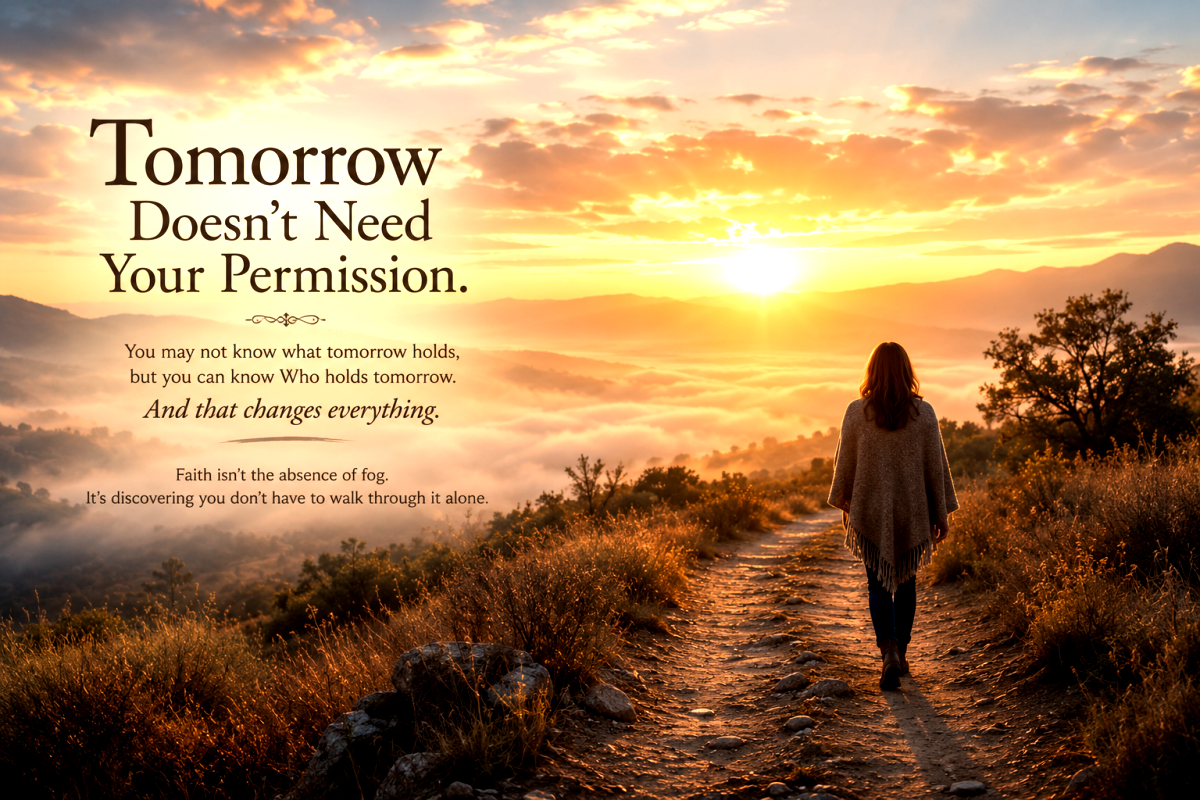
Grief rearranges the furniture inside the soul. What once felt familiar suddenly feels foreign. Ordinary routines require extraordinary effort. Even getting dressed, making coffee, or answering a text message can feel surprisingly heavy.

People on the outside may not notice. But inside, everything has changed. Perhaps that’s why so many people quietly wonder if something is wrong with their faith.

“I know what I believe,” they tell themselves. “So why does everything still feel so uncertain?”

The truth is, uncertainty has never been a sign that faith has disappeared. Sometimes it is simply evidence that life has become larger than the answers we currently possess.

We often imagine faith as standing confidently on a mountaintop with both hands lifted toward heaven. But much of real faith doesn’t look like that at all.

    • It looks like making breakfast after you’ve cried yourself to sleep.
    • It looks like driving to work with an empty seat beside you.
    • It looks like paying bills you never expected to face alone.
    • It looks like praying without eloquence because all the polished words have worn out.

Sometimes faith is simply taking one more step when the road ahead disappears into fog. Not because the fog has lifted. Because Love hasn’t.

There is something deeply human about wanting tomorrow explained. \

    • We want details.
    • We want guarantees.
    • We want a map with every twist highlighted before we take the first step.
    • We want to know how long the pain will last.
    • We want to know that the people we love will be okay.
    • We want to know that we will be okay.

Life smiles kindly at those questions… and answers very few of them. Instead, something quieter is offered.

Presence. Not explanations. Presence. Not certainty. Presence.

The older I get, the more I notice that God often gives us enough light for today while keeping tomorrow folded safely in His own hands.

At first, that can feel frustrating. We would rather receive an itinerary. Instead, we receive companionship. Perhaps certainty was never the greater gift. Perhaps companionship always was.

That realization doesn’t erase grief. It doesn’t suddenly refill the empty chair at the dinner table. It doesn’t silence the ache that catches you off guard when you hear a familiar song, smell someone’s cologne, or walk past the grocery shelf where they always reached for the same brand of coffee.

Love remembers. And remembrance can be both beautiful and painful.

Yet somewhere in that sacred tension, another realization quietly begins to emerge.

The Father has not abandoned you simply because the road became difficult. He has not stepped away because your prayers have become shorter. He has not become disappointed because your confidence occasionally gives way to tears.

Some of the strongest faith you’ll ever discover doesn’t look strong at all.

    • It looks like whispering, “Father… please stay close.”
    • It looks like choosing kindness when your heart is tired.
    • It looks like getting out of bed one more morning.
    • It looks like believing that even if you cannot see beyond today, the One who loves you already can.

Perhaps faith isn’t the absence of fog. Perhaps faith is discovering you don’t have to walk through it by yourself.

If today feels uncertain, you’re in good company.

Throughout history, countless men and women of deep faith have stood where you are standing now. They didn’t always understand what God was doing. They didn’t always receive immediate answers. They didn’t always feel courageous. But they discovered something that certainty could never have taught them.

God is often most deeply experienced in the places where we finally run out of our own ability to see.

Maybe that’s where you are today.

If so, be gentle with yourself.

    • You are allowed to miss someone.
    • You are allowed to feel overwhelmed.
    • You are allowed to have questions that remain unanswered for a while.
    • You are allowed to rest.

God has never required perfect emotional weather before walking with His children. He has always been willing to meet them in storms.

If all you can manage today is one small step… take one.

If all you can pray is, Fatherstay close.”  That is enough.

If all you can do is breathe deeply and trust that Love has not forgotten your address… that is enough too.

Tomorrow will arrive when it arrives. And when it does, you may discover something beautiful. The strength you needed wasn’t waiting for you yesterday. It will arrive with tomorrow’s grace. Because the Father has always been faithful that way.

You may not be able to see tomorrow. Neither can anyone else. But perhaps the goal was never to see farther. Perhaps it was simply to discover that Love can see farther than you can…

and has been quietly walking beside you the entire time.
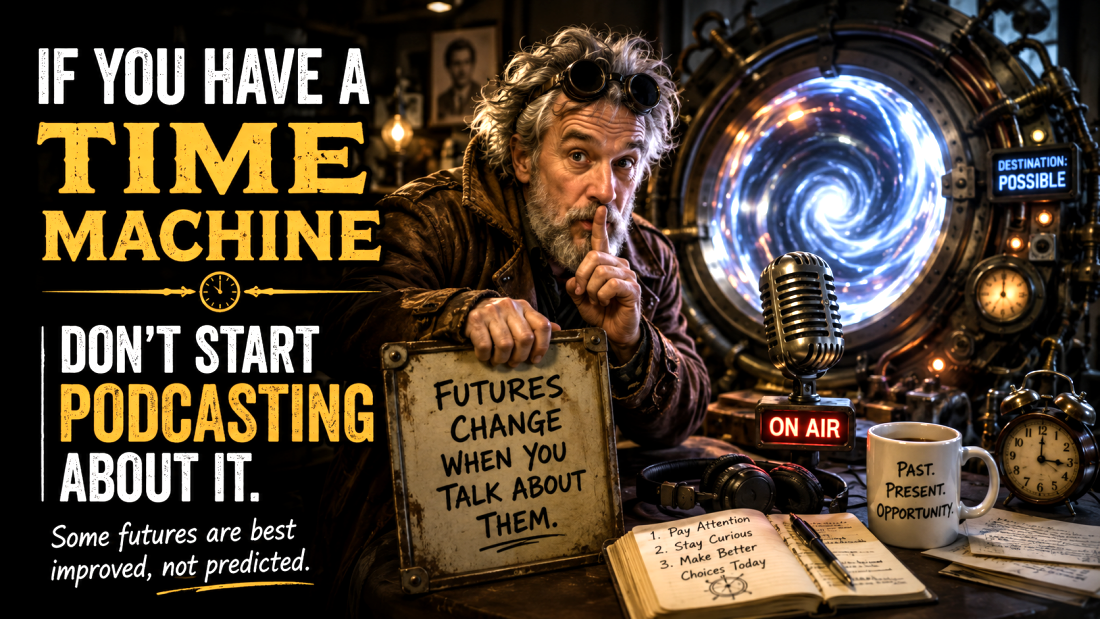
If You Have a Time Machine | Don’t Start Podcasting About It

I’ve been thinking about time travel lately. No, not because I built a flux capacitor in my garage. And no, this isn’t one of those moments when I try to convince you that Elvis is living on Mars with three government accountants and someone’s pet iguana. Relax. This is just one of those little thought experiments that wandered into my head, sat down, and refused to leave.

Let’s suppose, for the sake of conversation, that someone actually could see the future.

    • Maybe they have a crystal ball.
    • Maybe they have a sophisticated quantum machine.
    • Maybe they simply had one incredibly vivid glimpse of tomorrow.

Here’s my question. The moment they tell you what they saw… haven’t they already started changing it?

Imagine someone says, “On October 17th, the bridge will collapse.” Well… now what?

    • Do people stay home?
    • Does the city inspect the bridge?
    • Does someone reinforce it?
    • Does traffic reroute?
    • Does a construction crew accidentally discover an unrelated problem that saves thousands of lives?

In other words, the prediction itself just entered history.

    • It became another variable.
    • It didn’t merely describe the future.
    • It participated in creating it.

That’s why I’ve always been a little cautious around people who confidently announce, “This is exactly what’s going to happen.”

Maybe. Maybe not.

If the future is alive, then every decision, every conversation, every warning, every prayer, every act of courage, and every unexpected kindness becomes another pebble thrown into the pond. The ripples keep changing.

Even Charles Dickens understood this. Ebenezer Scrooge wasn’t shown the future so he could panic. He was shown one possible future so he could change the present. That’s a very different lesson.

Now, before someone writes me a strongly worded email… No, I’m not dismissing prophecy.

If God intends for certain events to unfold exactly as He has declared, I have absolutely no interest in debating His ability to accomplish His own purposes. I suspect He is entirely capable of protecting His plans without my assistance. This article isn’t about arguing with God. It’s about remembering that most of us aren’t Him.

Most predictions we hear, from experts, influencers, anonymous internet accounts, neighbors, or the guy at the coffee shop who always seems to know somebody who knows somebody, should probably be held with open hands. Take the insight. Leave the certainty.

Use the information to become wiser today instead of becoming obsessed with tomorrow.

There’s another reason I like this approach. Fear spreads quickly. Certainty spreads even faster. Curiosity slows us down just enough to ask better questions.

    • “What if?”
    • “How do we know?”
    • “What could I do today that would make tomorrow better, regardless?”

Those questions have improved far more lives than panic ever has.

If someone really did invent a working time machine, the smartest thing they could do would be to keep their mouth shut. Because the instant they announced what they saw, millions of people would begin reacting to it.

      • Politicians.
      • Investors.
      • Scientists.
      • Criminals.
      • Journalists.
      • Neighbors.
      • Entire governments.

Suddenly the future they reported wouldn’t be the future anymore. It would become history’s first draft. Maybe that’s one of life’s lessons.

The future isn’t simply something we discover.
It’s also something we participate in.

So, if tomorrow offers you a glimpse of itself, through wisdom, experience, prayer, intuition, good counsel, or even one of those wonderfully strange conversations that makes you think, you don’t have to cling to it.

Receive what is useful. Become a little wiser. Make one better decision today. Then let tomorrow continue being wonderfully alive.

After all, the best way to improve the future has never been arguing about it. It’s living well today.

Everybody Lies | Now What Are You Going to Do About It?

Everybody lies. Some lies are tiny. Some are catastrophic. Some are told to protect others. Some are told to protect ourselves. Some are told because we are afraid of losing love, losing status, losing control, losing security, or losing the carefully constructed image we want the world to believe about us. And every once in a while, someone lies to you that you never expected would.

That one lands differently. Not because the lie itself was necessarily devastating, but because it woke you up. It shook your assumptions. It cracked open your illusion that certain people are somehow above human weakness.

Recently, someone I had known and respected for years lied to me. Not a stranger. Not someone I expected it from. Someone I trusted. And for a brief moment, it threw me for a loop. Not because I do not understand human behavior. I have worked in counseling, coaching, consulting, and personal transformation for a very long time. I know people lie. I know it intellectually. I know it professionally. But sometimes we forget emotionally.

We create little islands of certainty around people we love, admire, or trust. We quietly place them into categories where we no longer expect ordinary human behavior from them. Then one lie reminds us that every single person on this earth is still wrestling with fear, identity, survival, insecurity, shame, ego, and the desperate need to feel safe. Including us. That realization can harden you. Or it can deepen you. That is the crossroads.

Every Lie Is an Opportunity

One of the most valuable tools I have ever developed in my work with people is the willingness to allow space for dishonesty without immediately punishing it. That surprises some people. They expect confrontation. Exposure. Correction. Consequences. But I learned something a long time ago: People often lie before they feel safe enough to tell the truth. Especially in the beginning of a coaching or counseling relationship.

If something does not feel right, sound right, or line up with the facts, I simply make note of it. I do not necessarily attack it immediately. I observe it. I hold awareness around it. I allow the story to breathe. Then something interesting happens.

Over time, the fabricated version becomes exhausting to maintain. The contradictions begin stacking up. The emotional energy required to maintain the false identity becomes heavier and heavier. People start tangling themselves in the barbed wire of their own stories. One lie requires another. Then another. Then another. And eventually, if enough trust and safety exist, many people come clean on their own. Not because they were forced into submission. But because they became exhausted from carrying the weight of separation between who they are and who they pretend to be.

That moment is sacred. Not humiliating. Sacred. Because when a human being finally feels safe enough to be honest, something profound happens inside them. Relief enters the room. Their nervous system softens. Their breathing changes. The armor begins to fall away. And for many people, that may be one of the first moments in their lives they have ever truly felt accepted while being fully seen.

That changes people.

We live in a culture obsessed with justice, exposure, consequences, outrage, and public destruction. Catch the liar. Expose the liar. Punish the liar. Destroy the liar. But very little attention is given to understanding why people lie in the first place.

Fear. Shame. Trauma. Survival. Rejection. Embarrassment. Insecurity. Childhood conditioning. Loss of identity. Fear of abandonment.

Most people do not wake up in the morning plotting evil. Most people are simply terrified of losing something they believe they need in order to survive emotionally. Now, that does not mean accountability disappears. Far from it. Truth matters. Boundaries matter. Integrity matters. But accountability without love often creates better liars instead of transformed people.

Fear-based correction teaches concealment. Love-based awareness teaches integration. That is a very different path.

I was fortunate to grow up around ideas like: “I’m okay, you’re okay.” “Do unto others as you would have them do unto you.” “We are all doing the best we can with what we have.” Those ideas grounded me. Not because they excuse destructive behavior, but because they remind us that human beings are unfinished creatures trying to find their way through life while carrying invisible burdens.

When you approach people with compassion instead of immediate condemnation, something extraordinary becomes possible. Growth. Real growth. Not performative compliance. Not fear-driven obedience. Not temporary behavioral suppression. Actual transformation. And transformation almost never happens through humiliation. It happens through awareness. It happens when people discover truth inside themselves.

That is why I have never been overly interested in controlling clients through rigid systems, punishments, or demands. Yes, structure matters. Yes, accountability matters. But lasting change usually occurs when people arrive at their own realization.

When the light bulb turns on inside them. When they see themselves clearly for the first time. When they finally become tired of running from themselves. That moment cannot be forced. It can only be invited.

People sometimes ask me why I continue doing this work after all these years. The answer is simple. I live for the moment of epiphany. The moment a client suddenly sees the truth about themselves with complete clarity.

The moment the masks fall away. The moment they stop defending their pain and begin understanding it. The moment self-awareness replaces self-deception. That is the payoff for me. To sit in the room while another human being reconnects with themselves is one of the most sacred experiences I know. Not because I “fixed” them. I did not. They found themselves. I simply created enough safety, enough love, enough accountability, enough space, and enough patience for truth to emerge naturally. That is very different from forcing compliance.

So What Are You Going to Do About It?

When someone lies to you, you stand at a fork in the road. You can become cynical. Suspicious. Closed off. Controlling. Punitive. Emotionally armored. Or…

      • You can become wiser without becoming harder.
      • You can develop discernment without losing compassion.
      • You can learn to see human weakness without abandoning human love.

That is the challenge. Not to become naive. But not to become cold either. Because the truth is this:

Every single one of us has lied.
Every single one of us has hidden.
Every single one of us has protected an image.
Every single one of us has feared rejection.

And every single one of us longs to be loved beyond our imperfections. That realization changes the way you see people. Including yourself.

A Practical Guide:

Moving from Strict Accountability to Love-Based Growth

This does not mean becoming weak, passive, or enabling destructive behavior. It means learning how to create environments where transformation becomes possible.

    1. Separate the Person from the Behavior

A lie is behavior.
It is not the entirety of the person.

When you attack identity instead of addressing behavior, people become defensive instead of reflective.

Say:
“That story doesn’t seem consistent.”

Instead of:
“You’re a liar.”

One invites awareness.
The other invites war.

    1. Stay Calm When You Discover Dishonesty

Most people expect emotional punishment.

When you remain calm, observant, and grounded, it creates psychological space for truth to emerge later.

Overreaction often drives dishonesty deeper underground.

    1. Observe Patterns Instead of Isolated Incidents

One contradiction may be confusion.
Repeated contradictions reveal deeper issues.

Notice:

        • Emotional inconsistencies
        • Changing narratives
        • Avoidance patterns
        • Sudden defensiveness
        • Over-explaining
        • Excessive justifications

Observe without becoming consumed by suspicion.

    1. Build Safety Before Demanding Vulnerability

People rarely tell the truth where they feel emotionally unsafe.

If someone believes honesty will lead only to shame, rejection, ridicule, or abandonment, concealment becomes survival.

Safety does not eliminate accountability.
It makes accountability productive.

    1. Ask Questions Instead of Making Accusations

Questions open doors.

Accusations slam them shut.

Try:
“Help me understand something.”

Instead of:
“You’re obviously lying.”

Questions invite self-reflection.

    1. Allow Natural Consequences Without Cruelty

Compassion does not mean removing all consequences.

Trust may need rebuilding.
Boundaries may need strengthening.
Access may need limitation.

But consequences delivered without hatred create opportunity for maturity instead of retaliation.

    1. Recognize Your Own Capacity for Self-Deception

Humility changes everything.

When you understand your own imperfections, you stop approaching others from a throne of moral superiority.

That softens your delivery without weakening your standards.

    1. Leave Room for Redemption

Many people become trapped inside the identity others assign to them.

When you leave room for people to evolve, they sometimes rise into that opportunity.

Not always.

But far more often than cynicism would have you believe.

    1. Focus on Awakening, Not Winning

Winning arguments is easy.

Awakening consciousness is rare.

Ask yourself:
“Do I want revenge, or do I want healing?”

That question changes the entire interaction.

    1. Become the Kind of Person Safe Enough for Truth

This may be the most important step of all.

People tell the truth around people who can handle truth.

Can you?

Can you hear difficult things without collapsing, exploding, condemning, or retaliating?

Can you remain loving while still remaining discerning?

That is emotional maturity.

And that level of love changes lives.

Including your own.


We Make Plans. God Laughs: Finding Peace in Life’s Turns

You might have heard me say, We make plans. God laughs. I must admit the origin of my saying is credited to an old Yiddish saying: “Der mentsh trakht un Got lakht.” Man plans… and God laughs. This concept has a way of finding you at just the right moment. God’s laugh is not a cruel or mocking laugh, but something far more mysterious. A laugh that seems to say, “Oh, my dear one… you see only the next step. I see the whole path.”

We are planners by nature. We map out our lives like architects of certainty:

    • Where we will go
    • Who we will become
    • What we will build
    • Who will be there with us when we arrive

We call it responsibility, vision, or purpose, and to be fair… there is nothing wrong with any of that, but somewhere along the way, many of us quietly cross an invisible line. We move from participating in life… to believing we are in charge of it. That’s usually when life smiles… and gently rearranges everything.

We make plans. God laughs.

I’ve noticed something over the years. The moments that shape us most… rarely come from our plans. They come from interruptions. Unexpected conversations. Unplanned opportunities. Uninvited endings.

    • A job you thought was secure disappears overnight… only to redirect you toward work that actually fits your soul.
    • A relationship you were certain would last forever… ends without warning… and somehow opens you to a deeper understanding of love than you had before.
    • A move you never intended to make… places you exactly where your life begins to expand.

We would not have chosen these things, and yet… looking back… many of us would not undo them because something greater was at work.

We make plans. God laughs.

Then there are the moments that are not just inconvenient, they are sacred in a way that stops time.

Just last Wednesday, I stopped by to visit a friend of nearly fifty years. Three months shy of that milestone. He didn’t answer the door. It was unlocked, so I stepped inside… and found him shortly after he had passed from an unexpected fall.

He and I had plans.
He and his new bride had plans.

And in a moment… all of those plans became something else. Unfinished sentences. Unwalked paths. Unlived tomorrows.

He had so many friends—from different walks of life—who loved him deeply. And now, that love is meeting this moment in its own way… in shock… in sorrow… in reflection.

His wife… his friends… all of us who knew him… are feeling the weight of this loss in ways that are still hard to put into words. It is still so fresh.

In the quiet that follows something like that… you don’t hear laughter.

You hear silence.

You feel the weight of how fragile all of this really is.

Even here… there is something quietly undeniable: life did not consult our plans.

We make plans. God laughs.

There are times when that phrase can feel almost too simple… too light… because when you’re standing in the middle of loss… or shock… or heartbreak… It doesn’t feel like laughter.

It feels like the ground has shifted beneath your feet.

Dreams pause. Time bends. Certainty dissolves.

That’s where we misunderstand the phrase because perhaps it isn’t about humor at all. Perhaps it is about perspective. The distance between what we can see… and what we cannot.

What if that “laugh” is the echo of a greater intelligence at play?

Not dismissing us… but holding a view so vast that our carefully crafted plans look like sketches in sand. We draw lines. Life brings the tide.

The promotion that didn’t happen… the meeting that got canceled… the flight that was missed… and later you discover that the “delay” was protection.

The closed door was direction. The interruption was alignment.

How many times have we said, “At the time, I didn’t understand… but now I see”?

How many times has life rerouted us… only to land us exactly where we needed to be?

We make plans. God laughs.

So what do we do with this? Do we stop planning? Do we abandon vision? Do we give up on building anything meaningful? Not at all. We still plan. But we plan differently. Not with clenched fists… but with open hands.  Not with rigid expectations… but with flexible awareness. Not “this must happen”… but “I am willing to meet what comes.” Because there is a quiet strength in holding your plans lightly. It allows life to move. It allows grace to enter. It allows something better—something unseen—to emerge.

Shift from Control to Trust

At some point, the most powerful shift we can make is this:

From control… to trust.

From certainty… to curiosity.

From “my way”… to “show me the way.”

Because control says, “I know how this should go.”

Trust says, “I am willing to discover how this unfolds.”

And strangely enough, when we release our grip… we often find ourselves more aligned than ever before. Not because we forced it… but because we allowed it.

We make plans. God laughs.

A Different Kind of Planning

What if planning was never about predicting the future… but about preparing your presence for whatever arrives?

    • Can you remain open when things change?
    • Can you stay grounded when the unexpected comes?
    • Can you love fully, even knowing nothing is guaranteed?

That kind of planning… God doesn’t laugh at. That kind of planning… He meets you in.

If there is anything this life continually invites us into, it is this:

To participate fully… without assuming control.

To love deeply… without demanding permanence.

To build boldly… without believing we own the outcome.

Because in the end… We do make plans. Beautiful ones. Meaningful ones. Heartfelt ones.

We make them with the people we love… with friends who become family… with those whose presence quietly weaves meaning into our days.

And sometimes… without warning… those shared plans are left in our hands… while the one we made them with is no longer there to carry them forward.

And yet, even then… The love remains. The impact remains. The connection does not disappear—it transforms. And often, it is carried not by one… but by many. By every life they touched. By every heart now holding a piece of what was shared.

But often… Life unfolds into something else entirely. And in that unfolding… if we are willing… We may just hear it.

Not a laugh at us… But a gentle, knowing whisper carried through every unexpected turn: “We make plans. God laughs.”

And somehow… that becomes not a statement of defeat… but an invitation into something far greater than anything we could have planned.


The Art of Transparent Living: Honesty, Growth, and Authenticity

There is a quiet power in transparency. Not the performative kind or the curated vulnerability designed for applause, but the kind that begins in the mirror, when you are willing to see what is actually there. Transparent living is not about exposing yourself to the world. It is about removing the distortions between who you are and who you present yourself to be. It is about alignment, and alignment is the birthplace of growth.

Transparency Is an Inner Discipline

Most people think of honesty as something outward. “Tell the truth.” “Don’t lie.” “Be authentic.” but transparent living begins much deeper than speech.

It begins with:

  • Emotional honesty
  • Motivational honesty
  • Financial honesty
  • Relational honesty
  • Spiritual honesty

It begins when you ask yourself:

  • Why did I really say that?
  • Why did that comment trigger me?
  • Why am I holding onto this resentment?
  • What am I afraid would happen if people saw the real me?

Growth accelerates the moment you stop negotiating with your own awareness. Transparency is not self-condemnation. It is self-illumination.

The Courage of Vulnerability

Vulnerability is not weakness. It is structural integrity.

When you are willing to admit:

  • “I don’t know.”
  • “I was wrong.”
  • “I’m scared.”
  • “I need help.”

You create psychological spaciousness. Defensiveness contracts growth, and vulnerability expands it.

In my work as a coach and guide, I’ve seen this repeatedly: The breakthrough does not happen when someone becomes stronger. It happens when they become honest.

Radical authenticity removes the friction between your internal world and your external behavior. When that friction dissolves, energy is freed. And that energy fuels transformation, or more precisely, revelation.

Radical Authenticity Is Not Rebellion

There is a misunderstanding about authenticity.

Some believe it means:

  • Saying whatever you think
  • Refusing feedback
  • Rejecting structure
  • Disregarding impact

That is not authenticity.

That is immaturity disguised as courage.

Authenticity is refined awareness. It is knowing who you are, what you value, and how you wish to move through the world, and then living in accordance with that, even when it costs you approval. It is not loud or dramatic; it is steady.

The most powerful people I know are transparent, not because they overshare, but because they have nothing to hide.

Transparency as a Catalyst for Growth

When you live transparently, you learn, repair, and evolve faster. Why? Because you stop wasting energy maintaining illusions.

Consider how much energy is spent:

  • Protecting image
  • Justifying mistakes
  • Blaming others
  • Concealing insecurity
  • Managing impressions

That is energy diverted from growth. Transparent living collapses delay. You see it, own it, and you adjust.

There is no shame in being a work in progress. There is only stagnation in pretending you are not.

Honesty in Relationships

Transparent living reshapes relationships at every level.

In partnership, it looks like:

  • Naming needs before resentment builds
  • Acknowledging attraction without betrayal
  • Discussing fears before they metastasize into distance

In business, it looks like:

  • Clear expectations
  • Clean agreements
  • Financial integrity
  • Direct communication

In leadership, it looks like:

  • Admitting uncertainty
  • Taking responsibility publicly
  • Listening without defensiveness

Transparency builds trust because it reduces ambiguity, and trust is the oxygen of all meaningful human connections.

The Spiritual Dimension of Transparency

Transparency is also spiritual maturity. It is the willingness to allow what is essential within you to become visible. Not performative righteousness or spiritual superiority, just congruence.

In transfiguration work, which is less about changing who you are and more about revealing who you have always been, transparency is foundational. Nothing new is added. Nothing sacred is replaced. What was obscured becomes visible.

And what obscures us most often?

  • Fear
  • Shame
  • Image management
  • Unresolved wounds
  • Cultural conditioning

Transparent living dissolves these layers. Not violently, but steadily.

The Cost — and the Reward

Let’s be honest. Transparency has a cost.

Some people prefer the version of you that is easier to categorize. Some benefit from your silence. Some are threatened by your clarity.

You may lose approval. You may lose alliances built on illusion.

But what you gain is immeasurable:

  • Self-respect
  • Emotional freedom
  • Energetic coherence
  • Deeper relationships
  • Faster growth

And perhaps most importantly: peace.

There is nothing more exhausting than maintaining a persona or more liberating than being internally aligned.

The Practice of Transparent Living

If you want to begin, start here:

  1. Notice where you soften the truth.
  2. Notice where you exaggerate to gain approval.
  3. Notice where you hide discomfort.
  4. Notice where you blame instead of own.
  5. Notice where you say “fine” when you are not fine.

Awareness without judgment.

Transparency is not brutality; it is clarity with compassion.

Transparent living is not about being perfect; it is about being permeable to growth.

When you live honestly, you become teachable. When you become teachable, you evolve. When you evolve, you inspire others to do the same.

Vulnerability is the doorway. Honesty is the path. Authenticity is the lifestyle.

And growth?

Growth is simply what happens when nothing false is left to defend.

Live clearly.
Live honestly.
Live without distortion.

That is the art, and it changes everything.


Loving Unconditionally the Doorway to Evolutionary Expansion

In the world we live in, there lies a profound truth: unconditional love is the doorway to evolutionary expansion. This truth is not hidden; it is present in every moment, offering us a choice—to act from fear or to act from love. This choice, simple yet powerful, defines the trajectory of our lives. When we choose fear, we tether ourselves to lower vibrations, cycles of pain, doubt, and limitation. But when we choose love, we liberate ourselves, rising above these constraints to embody the truth of who we truly are.

Fear vs. Love: A Daily Choice

Life’s challenges often tempt us to act out of fear. Fear whispers that we are not enough, that we lack something vital, or that we must control, resist, or fight to survive. These fear-based patterns keep us stuck, replaying old narratives that limit our growth and potential.

Yet, in every present moment, there exists an alternative: love. Love is expansive, freeing, and inherently aligned with our highest self. When we choose love, we shift our frequency, aligning with higher vibrations that invite miracles, synchronicities, and profound healing. Love opens doors to realities where possibilities are boundless, where we thrive, and where life unfolds with clarity, joy, and abundance.

The Power of Choosing Love

Choosing love is not merely an emotional act; it is a step in our evolutionary expansion. Each moment of choosing love over fear is a step closer to our highest potential. In love, we align with higher timelines, pathways that resonate with our soul’s purpose. These pathways are rich with opportunities for growth, understanding, and fulfillment.

Love invites us to:

    • Embrace Healing: Through love, we release old wounds and limiting beliefs, allowing our hearts to heal.
    • Experience Miracles: Love fosters alignment with the divine, creating a fertile ground for miracles and synchronicities.
    • Expand Possibilities: Love dissolves boundaries and limitations, revealing a world abundant with opportunities and connections.
    • Thrive in Joy and Abundance: Love shifts our perspective, enabling us to see life’s inherent beauty and abundance.

The Courage to Love

The path of love is not always easy. It demands courage, trust, and a willingness to let go of fear-based patterns. It calls for forgiveness—of ourselves and others. To choose love is to see the divine in every experience, to embrace the lessons hidden in life’s challenges, and to remember that love is our natural state.

This journey requires us to release judgments, attachments, and the illusion of separation. In love, there is no division, no lack. Instead, there is infinite connection and possibility. Love reminds us that we are part of a greater whole, interconnected with all beings and all things.

Shifting from Fear to Love

Evolutionary expansion begins with a single breath. In moments of doubt or fear, pause. Breathe deeply and ask yourself, “What would love do?” This simple question has the power to redirect your thoughts, actions, and energy.

    • Pause and Reflect: When fear arises, take a moment to pause and become aware of its presence.
    • Choose a Loving Perspective: Reframe the situation through the lens of love. What opportunities for growth or connection can you find?
    • Act with Intention: Let love guide your actions, even if it requires vulnerability or courage.

With each loving choice, your world transforms, moment by moment. You ascend to higher frequencies, creating a life that reflects your highest truth and potential.

Embracing Infinite Possibility

The beauty of love lies in its infinite nature. In love, there is no limit to what you can achieve, create, or experience. By choosing unconditional love, you align with the flow of the universe, where abundance, joy, and clarity naturally reside. You step into a reality where every moment is an opportunity for growth, connection, and fulfillment.

Loving unconditionally is not just an ideal; it is a practice, a choice to be made over and over again. It is the doorway to evolutionary expansion, the bridge between the ordinary and the extraordinary. As you walk this path, remember: in every breath, you hold the power to choose love. Let it guide you, and watch as your life becomes a masterpiece of transformation, one loving moment at a time.


Your Highest and Best is Ever Changing, and You Are As Well!

My calling as a coach is to help people achieve their highest and best potential. Despite my stellar reputation for guiding individuals toward their goals, it’s essential to recognize that personal growth is an ongoing, ever-changing process. We are all engaged in this continuous journey of evolution, each on our unique paths yet united in our quest for growth and enlightenment.

Understanding the Phases of Growth

Seven distinct phases can be understood for personal and spiritual growth. As a coach, I am adept at assisting individuals regardless of their current phase, helping them transition to the next stage, even if their growth level surpasses mine. The fundamental process remains consistent, though tailored to each individual’s specific circumstances and needs.

7 Phases of Personal and Spiritual Growth

Personal Growth Spiritual Growth
Phase 1 Survival Awakening
Phase 2 Relationship Leader
Phase 3 Self-esteem Master
Phase 4 Transformation Cosmic Consciousness
Phase 5 Internal Cohesion God Consciousness
Phase 6 Making a Difference Unity Consciousness
Phase 7 Service Ascension

See: 7 Phases of Personal Growth and 7 Phases of Spiritual Growth for more information.

The Fluidity of Growth

Growth is not linear but fluid and dynamic. For instance, I may find myself predominantly in Spiritual Growth Phase Two (Leader) yet oscillate between phases such as Spiritual Growth Phase One (Awakening) and Phase Three (Master). Simultaneously, I might navigate through Personal Growth Phases One (Survival) and Three (Self-esteem) as I manage life’s complexities on my journey.

The Necessity of Flexibility

Our paths to enlightenment are perpetually in flux, necessitating flexibility and adaptability. Rigidity in our thinking and actions can impede our progress, trapping us in a stagnant state. Viewing the world or desiring to assert things as

    • Black-and-white
    • This is good, that is bad
    • Do this, don’t do that
    • Be like me, not like them
    • This is right, and that is wrong
    • You must go this way, not that way
    • This is the way I did it; this is the way you should do it

These limiting ideals create barriers to growth. Insisting others follow our exact path because it worked for us only stifles their unique journey.

The Power of Inclusiveness

True growth requires an open mind, tolerance, and inclusiveness. Intolerance and exclusivity widen the gap between different ideas and people, hindering our collective progress. A vast consciousness surrounds us, and it is up to us to decide whether to share our understanding selectively or to embrace the limitless resources available to all who are open to this expansive consciousness.

Compassionate Coaching

The success of my coaching practice is grounded in one primary principle: the ability to be compassionate about someone else’s circumstances. I approach each client without judgment, understanding that their current position in life is a culmination of all their experiences, choices, and challenges. Instead of offering correction or imposing my own views, I empathetically imagine what it would be like to walk in their shoes, considering their unique life journey. This deep empathy allows me to see them not just as they are now but as people shaped by every episodic moment they have encountered.

By embracing this compassionate perspective, I help clients navigate their own paths to growth and transformation. Recognizing that each individual’s journey is distinct, I provide support that respects their personal history and current reality. My role is to assist them in finding their own way to the next level of their life, offering guidance tailored to their unique needs and experiences. This empathetic approach fosters a trusting and supportive environment, enabling clients to explore their potential and achieve their highest and best selves. Through compassion, I facilitate a process of self-discovery and empowerment, helping them move forward in their journey with confidence and clarity.

Overcoming Barriers to Growth

While exercising flexibility, inclusiveness, and compassion are valid approaches for those who progress and contribute positively to the world, we are doing our best with what we have. However, another significant barrier to expansive growth is our “state of mine.”

You recognize your state of mine from youth. When you were young, you were exposed to the idea of egocentric ownership, the idea that you could possess a thing, that you held the complete title and control of it and claimed it as your own. How often have we seen children struggling with a toy, each one asserting that it is “Mine!” Aren’t we just big children in that way?

The Illusion of Ownership

As adults, we continue this behavior, amassing possessions and engaging in disputes over ownership. Our society upholds this view and amasses fortunes in arguing over who belongs to whom in the present day and age, celebrating the winners, and pitying the losers. Yet none of us, not any one of us, could possibly own anything. You can possess a thing while you hold it in your hands, yes, but you can never truly control or own a thing, not even a thought.

Absolute control or ownership is an illusion.

That said,

The journey to achieving our highest and best is an ever-changing, fluid process. Embracing flexibility, inclusiveness, and a broader consciousness allows true transformation and growth. By overcoming the barriers of rigidity and the illusion of ownership, we can progress more freely and help others do the same. Together, we can navigate our unique paths toward enlightenment, sharing our insights and resources for the collective good.

The Journey of Recapitulation | for Your Continued Expansion

Recapitulation is a profound journey of introspection and liberation, guiding individuals through the labyrinth of past experiences, choices, and relationships. It’s a process that transcends mere reminiscence; it’s a deliberate act of digesting, neutralizing, and redefining our emotional landscape, freeing ourselves from the shackles of lingering attachments. At its core, recapitulation invites us to confront our past with ruthless honesty and extend the hand of forgiveness to ourselves and others.

Reflecting on decades of traversing this transformative path, I recall its inception during my early embrace of Christianity, evolving into a rich tapestry of spiritual growth and self-discovery. From those humble beginnings, it became clear that recapitulation wasn’t merely a practice; it was a way of life—a continuous dance with the Divine, navigating the expansive depths of our innermost selves.

The journey commences with forging a deep connection with the Divine—an ever-present force that flows within and around us. This sacred alliance provides the foundation upon which the process unfolds, guiding us to listen intently to the whispers of intuition and apply its wisdom in the tapestry of our daily existence.

Yet, the path of recapitulation is not for the faint of heart. It demands courage—a willingness to embark on a fearless moral inventory, confronting the shadows within our souls. It’s a journey of accountability, where we acknowledge the harm we’ve caused, both inadvertently and intentionally, and take proactive steps toward reconciliation and healing. This arduous task may span years, requiring unwavering commitment and resilience.

Moreover, recapitulation isn’t a solitary endeavor but a sacred collaboration between the self and the Divine. Together, we unravel the threads of deep-seated beliefs, fears, and behaviors, tracing them back to their origins, often nestled in the tender tendrils of infancy. It’s a process of excavation, unearthing buried truths, and confronting them with unwavering honesty.

In my work with clients, I’ve witnessed the profound transformations that unfold when we dare to journey into the depths of our being. Together, we navigate the tumultuous seas of emotion, engaging in honest dialogues and employing energy-healing modalities to facilitate release and renewal. As the dust settles, we stand in a space of neutrality—a sanctuary free from the chains of reactivity and expectation.

In this sacred space, clarity emerges—a crystalline clarity that illuminates the path forward, untethered from the burdens of the past. Though the specifics of my clients’ experiences remain confidential, I celebrate each individual’s triumphs as they traverse the labyrinth of recapitulation, emerging victorious on the other side.

For those embarking on this sacred journey, I offer words of encouragement. Know that you are not alone. The Divine walks beside you, guiding your steps and illuminating your path. And for those still navigating the twists and turns of recapitulation, take heart. Liberation awaits on the other side of adversity—a liberation born of courage, compassion, and unwavering faith in the transformative power of the human spirit.

Recapitulation in 7 Steps

Step 1: Prepare Your Space and Mind

    • Create Sacred Space: Set aside a quiet, comfortable place to conduct these exercises privately and without disturbances. Set a calming atmosphere with candles, music, or essential oils.
    • Connect with the Divine: Ground yourself and invite Divine guidance through prayer, meditation, or setting an intention.

Step 2: Reflect on Past Experiences

    • Recall Significant Events: Without judgment, bring to mind important experiences, choices, actions, and relationships from your past. Allow these memories to surface naturally.

Step 3: Conduct a Fearless Moral Inventory

    • Examine in Detail: Write down your reflections on what happened, how you felt, the choices you made, and the impacts on yourself and others. This requires honesty and courage.

Step 4: Identify and Release Emotional Attachments

    • Notice Emotional Charges: Identify any lingering emotions such as guilt, shame, anger, or nostalgia.
    • Release Techniques: Use deep breathing, visualization, or affirmations to release these emotional burdens.

Step 5: Practice Forgiveness

    • Forgive Yourself and Others: Reflect on what and whom you must forgive. Write letters of forgiveness to yourself and others (these don’t need to be sent).

Step 6: Integrate and Achieve Neutrality

    • Combine and Neutralize: Integrate these experiences into your self-awareness. Aim to acknowledge past events without being emotionally triggered, finding a neutral perspective.

Step 7: Maintain and Seek Support

    • Daily Practice: Make recapitulation part of your daily routine through meditation or journaling to maintain emotional balance.
    • Seek Help if Needed: If the process is challenging, reach out to a coach, therapist, or spiritual advisor for support.

Following these seven steps, you can effectively engage in the recapitulation process, which can help you release past emotional attachments, achieve inner neutrality, and foster ongoing personal growth.

Your Personal Transfiguration Process

A Transfiguration Specialist helps you achieve your highest potential, ensuring you receive respect and recognition as the undeniable expert in your field. This process involves transforming your life to align with your innate gifts, turning them into powerful revenue streams, and embracing your unique purpose.

Here’s a detailed guide to initiate and strategize your personal transfiguration process:

1. Determine Your Innate Gifts and Talents

Self-Reflection

Begin by setting aside quiet time to reflect on your life. Consider moments when you felt most alive, engaged, and fulfilled. What activities were you doing? What skills were you using?

Seek Feedback

Ask friends, family, and colleagues for their observations about your strengths and talents. Sometimes, others see our gifts more clearly than we do ourselves.

Personality and Aptitude Tests

Utilize tools like the Myers-Briggs Type Indicator (MBTI), StrengthsFinder, or the Enneagram to gain insights into your natural inclinations and talents.

Journaling

Keep a journal to document your thoughts, feelings, and experiences as you explore your gifts. Writing can help clarify your strengths and passions.

Professional Guidance

Consider working with a coach or mentor who can provide objective insights and help you identify and develop your talents.

2. Turn Them Into Powerful Revenue Streams

Identify Market Needs

Research current market trends and demands. Identify areas where your talents can meet a need or solve a problem.

Create a Business Plan

Outline how you can offer your skills and talents as services or products. Consider the logistics, target audience, pricing, and marketing strategies.

Develop Your Brand

Establish a personal brand that reflects your unique talents and values. This includes creating a professional website and social media presence and networking with relevant industry professionals.

Monetize Your Skills

Offer your talents through various channels such as freelancing, consulting, workshops, online courses, or creating digital products. Explore multiple income streams to diversify your earnings.

Continuous Learning

Stay updated with industry trends and continuously improve your skills through courses, certifications, and workshops.

3. Discover and Embrace Your Unique and Individual Purpose, Message, Passion, and Mission (PMPM) in Life

Purpose Exploration

Reflect on what drives you and what you want to contribute to the world. Consider your passions, values, and the impact you wish to have.

Message Clarity

Define the core message you want to convey through your work. What do you want others to learn, feel, or do due to your contributions?

Passion Pursuit

Engage in activities that ignite your passion. Surround yourself with like-minded individuals who inspire and support your journey.

Mission Statement

Craft a mission statement that encapsulates your purpose, message, and passion. Use this as a guiding principle for your personal and professional decisions.

Align Actions with PMPM

Ensure that your daily actions and long-term goals align with your PMPM. This alignment brings coherence and fulfillment to your life and career.

4. Establish Yourself as the Undeniable Expert in Your Field

Build Credibility

Share your knowledge through writing articles, blogs, and books. Speak at conferences, webinars, and workshops to showcase your expertise.

Network

Connect with industry leaders, join professional associations, and participate in networking events. Building relationships with other experts enhances your credibility.

Offer Value

Provide exceptional value through your services or products. Consistently exceed expectations and build a reputation for excellence.

Visibility

Leverage social media, podcasts, and videos to increase your visibility. Engage with your audience by sharing insights, answering questions, and providing valuable content.

Certifications and Awards

Obtain relevant certifications and pursue awards in your field. These accolades enhance your credibility and recognition as an expert.

5. Ever Continue to Grow and Expand

Continuous Learning

Commit to lifelong learning. Stay curious, read widely, and take courses to keep your knowledge and skills up-to-date.

Seek Feedback

Regularly seek feedback from clients, peers, and mentors to identify areas for improvement and growth.

Innovate

Stay open to new ideas and approaches. Experiment with innovative solutions and adapt to changing market needs.

Set New Goals

Periodically review and set new personal and professional goals. Aim to stretch your limits and explore new opportunities.

Balance and Well-being

Maintain a healthy work-life balance. Prioritize self-care, relationships, and activities that nourish your well-being.

Following this comprehensive process, you can initiate and sustain your personal transfiguration journey, achieving your highest potential while enjoying a fulfilling and prosperous life.

Quantum Spiritual Growth and Transformation

Exploring the interconnectedness of consciousness, energy, and the universe becomes a catalyst for spiritual growth and personal transformation. As we deepen our understanding of these interconnections, we gain insights into our own nature and purpose. We become aware of the profound impact our thoughts, emotions, and actions have on ourselves and the world. This awareness opens pathways for spiritual expansion, self-realization, and the unlocking of our superhuman potential.

Within each of us lies a profound potential for spiritual growth and transformation. It is an innate longing to understand the deeper aspects of our existence, to connect with something greater than ourselves. This journey invites us to explore the realms beyond the physical, to delve into the depths of our consciousness and awaken the dormant power within.

Spiritual growth is a process of expanding our awareness and connection to the divine essence that permeates all existence. It is a journey of self-discovery and self-transcendence, where we uncover the layers of conditioning, limitations, and illusions that veil our true nature. As we peel away these layers, we begin to align with our authentic selves and cultivate a deeper sense of purpose, meaning, and fulfillment.

Transformation on a spiritual level requires a willingness to explore the profound impact our thoughts, emotions, and actions have on ourselves and the world around us. It is an invitation to become conscious co-creators of our reality, recognizing that our inner landscape shapes the outer manifestations of our lives. Through this awareness, we gain the power to transcend limitations and create positive change.

To embark on the path of spiritual growth and transformation, we must first cultivate a sense of inner stillness and presence. Practices such as meditation, mindfulness, and contemplation enable us to quiet the mind, dissolve the noise of external distractions, and attune to the whispers of our soul. In these moments of inner silence, we connect with a deeper wisdom that transcends the limitations of the egoic mind.

As we deepen our spiritual practice, we begin to recognize the interconnectedness of all beings and the divine intelligence that orchestrates the symphony of life. We develop compassion and empathy, seeing beyond the surface-level differences and embracing the unity of our shared humanity. This shift in perception opens our hearts and fosters a sense of interconnectedness with all living beings.

Spiritual growth and transformation are not confined to any particular religious or spiritual tradition. It is a universal journey that transcends boundaries and invites us to explore diverse paths. Each person’s journey is unique, shaped by their individual experiences, beliefs, and desires. It is a personal exploration that unfolds in its own time and pace.

To cultivate spiritual growth and transformation, it is essential to nurture a sense of curiosity and openness. Explore different spiritual teachings, philosophies, and practices to find what resonates with your heart and aligns with your soul’s longing. Engage in self-reflection, journaling, and seeking guidance from wise mentors or spiritual communities.

The journey of spiritual growth and transformation is not always smooth or linear. It encompasses moments of profound joy and connection, as well as challenges and moments of inner turmoil. However, through these experiences, we learn, grow, and expand our consciousness.

As we embark on this sacred journey, we are called to embody the qualities of love, compassion, gratitude, and forgiveness. These virtues become the guiding lights that illuminate our path and inspire us to serve the highest good of ourselves and humanity.

So, I invite you to embrace the profound potential for spiritual growth and transformation within you. Open your heart and mind to the mysteries of the universe. Seek the truth that resonates with your soul and walk the path of self-discovery and self-transcendence. In doing so, you will embark on a transformative journey that awakens the essence of your being and brings profound meaning and fulfillment to your life.