If You Have a Time Machine | Don’t Start Podcasting About It

I’ve been thinking about time travel lately. No, not because I built a flux capacitor in my garage. And no, this isn’t one of those moments when I try to convince you that Elvis is living on Mars with three government accountants and someone’s pet iguana. Relax. This is just one of those little thought experiments that wandered into my head, sat down, and refused to leave.
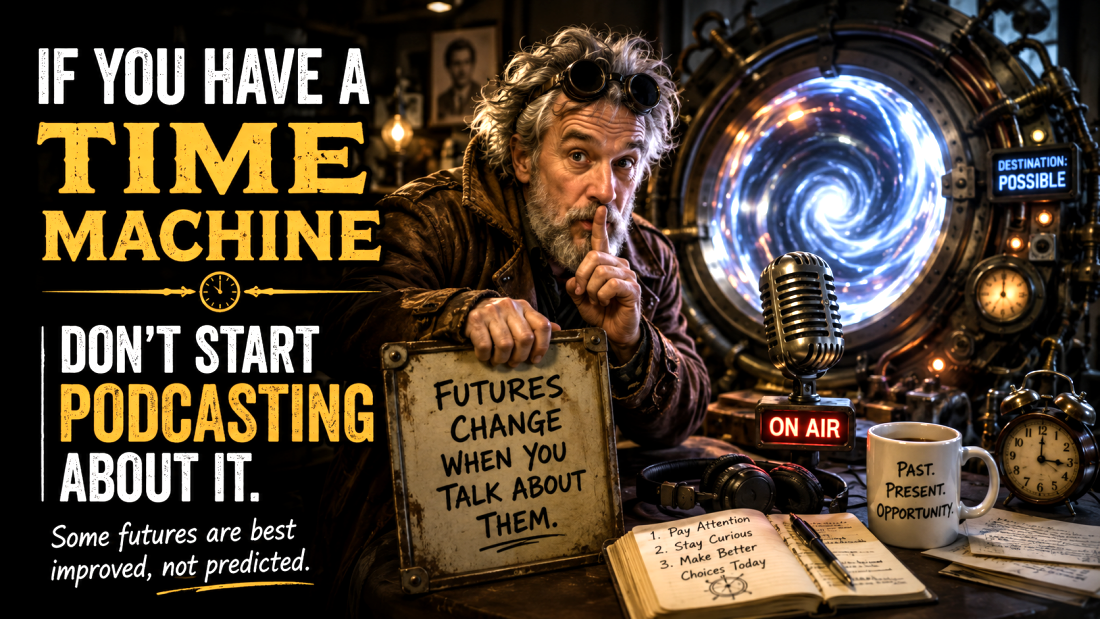
Let’s suppose, for the sake of conversation, that someone actually could see the future.

    • Maybe they have a crystal ball.
    • Maybe they have a sophisticated quantum machine.
    • Maybe they simply had one incredibly vivid glimpse of tomorrow.

Here’s my question. The moment they tell you what they saw… haven’t they already started changing it?

Imagine someone says, “On October 17th, the bridge will collapse.” Well… now what?

    • Do people stay home?
    • Does the city inspect the bridge?
    • Does someone reinforce it?
    • Does traffic reroute?
    • Does a construction crew accidentally discover an unrelated problem that saves thousands of lives?

In other words, the prediction itself just entered history.

    • It became another variable.
    • It didn’t merely describe the future.
    • It participated in creating it.

That’s why I’ve always been a little cautious around people who confidently announce, “This is exactly what’s going to happen.”

Maybe. Maybe not.

If the future is alive, then every decision, every conversation, every warning, every prayer, every act of courage, and every unexpected kindness becomes another pebble thrown into the pond. The ripples keep changing.

Even Charles Dickens understood this. Ebenezer Scrooge wasn’t shown the future so he could panic. He was shown one possible future so he could change the present. That’s a very different lesson.

Now, before someone writes me a strongly worded email… No, I’m not dismissing prophecy.

If God intends for certain events to unfold exactly as He has declared, I have absolutely no interest in debating His ability to accomplish His own purposes. I suspect He is entirely capable of protecting His plans without my assistance. This article isn’t about arguing with God. It’s about remembering that most of us aren’t Him.

Most predictions we hear, from experts, influencers, anonymous internet accounts, neighbors, or the guy at the coffee shop who always seems to know somebody who knows somebody, should probably be held with open hands. Take the insight. Leave the certainty.

Use the information to become wiser today instead of becoming obsessed with tomorrow.

There’s another reason I like this approach. Fear spreads quickly. Certainty spreads even faster. Curiosity slows us down just enough to ask better questions.

    • “What if?”
    • “How do we know?”
    • “What could I do today that would make tomorrow better, regardless?”

Those questions have improved far more lives than panic ever has.

If someone really did invent a working time machine, the smartest thing they could do would be to keep their mouth shut. Because the instant they announced what they saw, millions of people would begin reacting to it.

      • Politicians.
      • Investors.
      • Scientists.
      • Criminals.
      • Journalists.
      • Neighbors.
      • Entire governments.

Suddenly the future they reported wouldn’t be the future anymore. It would become history’s first draft. Maybe that’s one of life’s lessons.

The future isn’t simply something we discover.
It’s also something we participate in.

So, if tomorrow offers you a glimpse of itself, through wisdom, experience, prayer, intuition, good counsel, or even one of those wonderfully strange conversations that makes you think, you don’t have to cling to it.

Receive what is useful. Become a little wiser. Make one better decision today. Then let tomorrow continue being wonderfully alive.

After all, the best way to improve the future has never been arguing about it. It’s living well today.
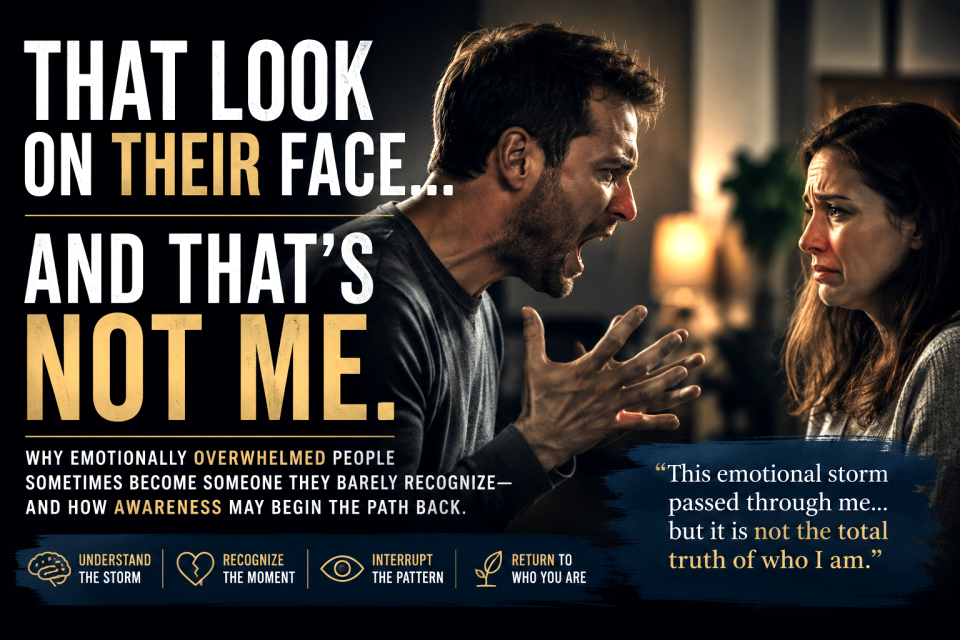
That Look on Their Face… And That’s Not Me

A strange thing happens to people when emotion overwhelms rationality. For a few moments, sometimes longer, they become someone they do not fully recognize. Not permanently. Not completely. But enough to frighten themselves afterward. It usually does not happen the way people imagine.

Most emotional derailments do not begin with evil intentions or conscious decisions to become destructive. More often, they begin quietly, beneath the surface, while someone is carrying more emotional pressure than they realize.

Stress. Exhaustion. Resentment. Fear. Humiliation. Burnout. Years of trying to hold everything together while slowly coming apart internally.

Then one day, something relatively small happens.

A tone of voice. A dismissive comment. A criticism. A disrespectful glance. A delayed text message. A disagreement over something that, under calmer circumstances, probably would not have mattered very much at all. But this time is different.

This time something inside the person accelerates. Their chest tightens. Their thoughts narrow. Their emotional intensity rises faster than their rational mind can regulate it. Their voice changes. Their posture changes. The nervous system floods with urgency, adrenaline, and emotional momentum. And for a few moments, everything they are saying feels completely justified.

Until suddenly… they see the look on the other person’s face.

Not anger exactly. Not even fear. Something worse. A look of emotional withdrawal.

A look that says: “I don’t recognize you right now.”

And for one painful instant, the emotional storm briefly breaks. The person hears themselves. Really hears themselves. The volume. The tone. The hostility. The emotional force that had taken control of the room.

And somewhere underneath the adrenaline and emotional static, another realization quietly appears:

“…And that’s not me.”

I think many people have experienced moments like this. Maybe not with yelling. Maybe not in dramatic ways. But most people have had moments where emotion temporarily outran perspective.

A father hears himself speaking to his son in the exact same tone his own father once used on him, and it shakes him to the core.

A woman in the middle of a jealous argument suddenly realizes she no longer even believes half the accusations she is making, but cannot seem to stop herself from escalating.

An exhausted executive walks out of a meeting replaying his own voice in his head, disturbed by how arrogant, defensive, or intimidating he sounded over something so minor.

A mother locks herself in the bathroom after screaming at her children and quietly cries because she never wanted to become this version of herself.

A person lying awake at night after another emotional collapse whispers into the darkness:

“What is happening to me?”

These moments frighten people because they feel revealing.

People begin wondering:

    • “Maybe this is who I really am.”
    • “Maybe I’m becoming someone terrible.”
    • “Maybe I’m broken.”
    • “Maybe the emotional storm is the real me.”

But I no longer believe that is necessarily true. I think emotionally overloaded people often become temporarily consumed by states that are not the total truth of who they are. And modern life is producing emotionally overloaded people everywhere.

People carrying:

    • unresolved grief,
    • financial pressure,
    • relationship disappointment,
    • chronic stress,
    • loneliness,
    • emotional suppression,
    • burnout,
    • nervous-system exhaustion,
    • and years of accumulated emotional compression.

Most people keep functioning anyway. They go to work. Answer emails. Pay bills. Smile in public. Try to appear normal.

Meanwhile, internally, the pressure continues building beneath the surface. Until eventually, something breaks through. And when it does, many people react in ways that leave them sitting quietly afterward wondering:

“How did I get here?”

I have become increasingly fascinated by that moment. Not the outburst itself. Not the emotional collapse. The interruption. The moment awareness returns. The moment someone sees the look on another person’s face and suddenly realizes: “Something just took over me.”

That moment matters more than most people realize. Because the moment we become capable of observing the emotional storm, we are no longer completely possessed by it.

A small separation appears between:

ourselves,
and
the emotional state moving through us.

That separation may feel fragile at first. But inside it lives something extraordinarily important: awareness.

And awareness changes everything. Not overnight. Not instantly. But awareness is often the first moment a person begins finding their way back to themselves. Not through shame. Not through denial. Not through pretending difficult emotions do not exist. But through the quiet realization that:

“This emotional storm passed through me…
…but it is not the total truth of who I am.”

Maybe more people need permission to talk honestly about moments like these. Not to justify destructive behavior. Not to avoid responsibility. But because emotionally flooded human beings often feel deeply alone in experiences that are far more universal than most people realize.

And perhaps emotional healing begins the moment someone finally becomes able to say:

“That reaction happened…
…and that’s not me.”


What Actually Becomes Your Legacy, (If It’s Not Your Stuff)?

After you come to terms with the idea that your belongings eventually become cash or trash, something deeper begins to surface. A more important question surfaces. If it’s not your stuff… then what actually remains? Because something does. It has to. Otherwise, what are we doing here?

Most people spend their lives building a collection. Fewer people spend their lives building a legacy. And at first, those two things can feel like the same thing. You work hard. You acquire things. You create a life that looks meaningful from the outside. But when you strip away the objects… when you remove the physical layer… you begin to see what was actually being built underneath it all. Or in some cases… what wasn’t.

Your legacy is not something that sits on a shelf. It doesn’t gather dust. It doesn’t need to be sorted, sold, or thrown away.

Your legacy lives in places that don’t require storage:

    • In the way someone hears your voice in their mind when making a hard decision
    • In the confidence you helped someone discover in themselves
    • In the moment someone chose differently because of something you once said
    • In the feeling people carry when they think of you

That’s where it lives. And unlike your stuff… it doesn’t depreciate.

If you look closely, you’ll start to recognize the real assets you’ve been building all along. Not the ones in your house… The ones in people.

Things like:

    1. Emotional Imprints

How did people feel around you?

        • Safe?
        • Judged?
        • Seen?
        • Dismissed?

Those impressions don’t get packed into boxes. They stay.

    1. Perspective Shifts

Did you help people see life differently?

Sometimes a single conversation becomes a turning point in someone’s life.

You may not even remember it. They will.

    1. Encouragement Given at the Right Time

Most people can point to one moment… When someone believed in them before they believed in themselves.

If you’ve ever been that person for someone else… that’s part of your legacy.

    1. Standards You Lived By

Not what you said. What you consistently demonstrated.

Integrity, kindness, discipline, presence…

People remember patterns more than moments.

    1. The Way You Handled Difficulty

Your response to challenge becomes a reference point for others. Whether you intended it or not.

Why Is It Time to Consider Your Legacy?

Because legacy is not something you leave behind. It’s something you are building… in real time. Every interaction. Every response. Every decision. You are either reinforcing something… or weakening it. And most people don’t realize this until much later, if ever.

Once you see this clearly, something begins to change. You don’t have to give up your stuff. You don’t have to become extreme or detached.

But you start to ask different questions:

    • “What will this moment mean later?”
    • “What am I leaving with this interaction?”
    • “Is this building something that continues… or something that ends with me?”

That shift alone begins to recalibrate everything.

What’s the Deal?

At the end of it all… People don’t gather to talk about what you owned.

They gather to talk about:

      • Who you were
      • How you showed up
      • What you stood for
      • What it felt like to be around you

That’s the conversation. That’s the continuation.

If your stuff doesn’t define your legacy… then your legacy becomes something far more powerful.

Something that

      • doesn’t rely on preservation.
      • doesn’t need protection.
      • can’t be taken, sold, or discarded.

It becomes…

the part of you that continues in others.

And the moment you recognize that… You stop trying to hold onto everything. And you start becoming someone worth remembering.


Why Are the Same Problems Showing Up in My Life Relentlessly

There comes a moment that creeps up on you, and you don’t see it coming; all of a sudden, you find yourself noticing something that doesn’t seem right. Cycles involving different people, circumstances, and seasons of life, yet the outcome remains the same. The same frustration, conflict, and feeling that somehow… you’ve been here before.

At first, it feels like bad luck. Then it feels like coincidence. Eventually, if you’re honest enough to sit with it, a deeper question begins to surface:

Why does this keep happening to me?

Most people spend their lives trying to solve problems without ever identifying patterns. They treat each experience as isolated. A difficult relationship becomes about that person. A business setback becomes about that situation. A disappointment becomes about that moment. But life is not as random as we might like to believe, it is patterned. Those patterns are not there to punish you, they are there to reveal you.

What feels like repetition is growth, refinement, and the evolutionary process trying to engage you.

These similar experiences return again and again, not because you are stuck, but because something in you has not yet fully seen, understood, or integrated what these experiences are trying to teach you. Until it is integrated, the pattern returns. Not more harsh or loud, but as that familiar irritation or challenge.

Life does not move in circles; it moves in a spiral. At the beginning, the spiral is wide. Experiences feel spread out. Time feels expansive. Lessons feel disconnected. But as life progresses, the spiral narrows. Experiences begin to feel closer together. Patterns become more noticeable. Repetition becomes harder to ignore.

If growth has been minimal, those repeating experiences frustrate you, and you’re likely to express, “Why does this keep happening to me?”

On the other hand, if you have learned from the experience and grown in your understanding of it, something shifts, and you say, “Ah, I’ve seen this before.”

Same experience. Different awareness. That is the difference between repetition and recognition.

The shift does not happen in the midst of the event. It happens in your awareness.

Two people can go through nearly identical experiences. One becomes reactive, defensive, and discouraged. The other becomes reflective, grounded, and aware. The difference is not intelligence. It is not talent. It is not even opportunity. It is growth.

Patterns become visible the moment you stop asking, “What is happening to me?” And start asking, “What is this revealing about me?”

That question changes everything.

This intentional subtle shift gives you a higher perspective. Now the experience is no longer something to escape. It becomes something to understand.

I remember a season in my own life when I began to notice a pattern I could no longer ignore. Different people. Different environments. Still, the same dynamic.

I found myself carrying more than my share. Stabilizing situations. Holding things together.

At first, I believed it was strength, and in some ways, it was, but over time, I realized it was also constant repetition. Not because others were demanding it, because I kept stepping into the field of these experiences unconsciously.

That realization was not condemning. It was clarifying.

The moment you see the pattern for what it is, you are no longer trapped inside it. You are standing above it.

This is where most people misunderstand love. They think love is emotional support, encouragement, or affection. But real love, mature love, does something far more powerful. It tells the truth. Not harshly or reactively, but clearly.

Love says:

“This is the pattern.”
“This is where you are participating.”
“This is where growth is available.”

Without that kind of love, whether from others or from within, you remain in the loop. Why? Because avoidance feels easier than awareness.

If patterns are ignored, they don’t disappear; they compress. The spiral tightens, and these experiences come closer together. Frustration increases, and eventually, life begins to feel like pressure rather than progress. But that pressure is not punishment, it is invitation.

You are not being asked to fix everything at once. You are being invited to notice. To slow down just enough to see what has always been there. To recognize that the repetition is not failure. It is feedback.

Here is a line that belongs in the book—and is worth carrying with you:

Life does not repeat to punish you. It repeats to reveal what you are ready to outgrow.

If the same problems keep showing up in your life, it is not because you are unlucky. It is because something important is trying to become visible, and once it becomes visible, it becomes optional.

You can continue unconsciously stepping into these revisiting cycles or you can begin to live deliberately.

The goal is not to eliminate challenge. The goal is to increase awareness.

When awareness increases, something remarkable happens, the same experience no longer produces the same result. Not because life changed; because you did.

These ideas are explored more deeply in Love Like It’s the Only Thing That Matters, where we look at how life moves in cycles, and how love, when practiced with awareness and structure, becomes the force that breaks repetition and builds something that endures.