For years, I’ve told people some version of: Don’t bury your symphony in the graveyard. You’ve probably heard the sentiment before. The graveyard is filled with unwritten books, unsung songs, unbuilt businesses, unspoken words, and magnificent ideas that never made it out of someone’s head.
As a coach, I’ve spent a good portion of my life trying to prevent that. Write the book. Create the course. Record the message. Build the thing. Get as much of what is inside you outside of you while you’re still on the right side of the grass.
Good advice.
Then there’s me. LOL.
I Thought I’d Done a Pretty Good Job
For the most part, I have. I’ve built businesses, launched ministries, written books, created courses, recorded ideas, developed programs, etc. And I’ve learned to recognize which creations have sustainability.
Some things are created for a moment. They do their job and disappear.
Others have what I call evergreen potential. They’re almost like little money-market bonds of creativity. You invest in them, preserve them, occasionally dust them off, update them, and bring them back into circulation. They continue accruing value.
I’ve become pretty good at recognizing those.
Good job, David.
Except… there was this one rather large part of my life that I let disappear almost completely.
My Awkward Career as a Singer/Songwriter
Once upon a time, I wrote songs. Lots of them. I performed them. Recorded them. Produced them. And I did it under the name Dave-Michael Valentine.
I was never particularly confident about my career as a singer/songwriter. It served its purpose at the time, and eventually it stopped being financially practical. So I let it go. Completely.
I had done the same thing with other businesses. Video stores disappeared. Photo labs disappeared. Industries change. Technology changes. Markets change. You move on.
That’s life.
So I moved on from the music too. I didn’t preserve it particularly well. I didn’t maintain the catalog. I didn’t periodically pull out the old recordings and reminisce. I simply went forward.
And for decades, that was fine.
Then Some People Came Looking for the Music
Recently, a few people who remembered and supported that old music started asking about bringing it back. My first reaction was something like: Really? Why?
I’m no stranger to music production. Mary and I had a recording studio. My best friend, bandmate, and supporter Norman joined us at Eternalight Studios in Centralia.
I know what went into producing music. It was expensive. It was labor-intensive.
And, frankly, many of those old recordings were never pushed all the way to the level of commercial production I would have wanted.
So what would be the point of resurrecting them now?
Then these guys showed me something. Technology had changed. Dramatically.
They had access to contemporary production tools, including AI-assisted tools, that could do things we couldn’t have dreamed of doing economically when those recordings were made.
I was skeptical.
Then I listened to some of the work they had restored and recreated.
Okay. You have my attention.
Unprofitable Is Not the Same as Worthless
That may be the larger lesson I’ve stumbled into.
When something stops generating money, we have a tendency to measure its remaining value by its commercial viability. Sometimes that’s appropriate.
A business has to make economic sense. But commercial value and human value are not the same measurement.
-
- An old photograph may be commercially worthless and priceless to your granddaughter.
- A letter may have no market value whatsoever and become one of the most treasured possessions in a family.
- A book that sold poorly may contain one idea that changes someone’s life twenty years later.
And apparently… an old song that never became a hit can still matter to somebody.
I hadn’t really thought about that.
My Life Used to Have a Soundtrack
There’s another part of this resurrection that caught me by surprise. I realized what I actually missed. It wasn’t performing. It wasn’t trying to become famous. It wasn’t chasing record sales.
I miss writing songs.
For many years, my life had a soundtrack. Something would happen… and eventually there would be a song.
-
- A relationship.
- A heartbreak.
- A spiritual experience.
- Something ridiculous.
- Something beautiful.
- Something I couldn’t quite explain in ordinary conversation.
It could become music.
Looking back, it’s almost as though I lived inside one enormous music video. There was always another lyric wandering around somewhere. Another melody. Another story looking for three minutes and forty seconds in which to become something else.
I miss that. I hadn’t realized how much.
Maybe Nothing Creative Is Ever Completely Wasted
This has made me wonder about the things we leave behind. Not everything needs to be resurrected. Good heavens.
Some things served their purpose and deserve a peaceful retirement.
Please don’t interpret this as instructions to retrieve everything you’ve ever created from the attic. LOL.
But perhaps occasionally it’s worth looking back and asking:
Did I abandon this because it had no value… or because its season appeared to be over?
Those are not necessarily the same thing. Technology changes. You change. The world changes.
Something that was impossible twenty years ago may be ridiculously easy today. Something that couldn’t find an audience then may find one now. And something that will never earn a nickel might still deserve to exist.
Get It Out of You
That’s where this circles back to the advice I’ve given other people for years.
Don’t bury your symphony. Maybe yours isn’t music.
Maybe it’s
-
- The book you’ve been talking about writing.
- The photographs nobody has organized.
- The family stories only you know.
- The invention scribbled on paper in your desk.
- The course you’ve never finished.
- The paintings stacked against the garage wall.
- The business idea.
- The research.
- The poems.
- The recipes.
- The ridiculous little project nobody else understands.
I’m not saying everything inside you needs an audience. I’m saying give the things that matter a chance to exist outside of you.
-
- Preserve them.
- Finish some of them.
- Share some.
- Leave others for the people who will eventually discover them.
Before Somebody Shovels Dirt on It
Maybe that’s the invitation hiding inside all of this. Take another look. Not only at your music. Look at whatever you created during another season of your life and eventually left behind.
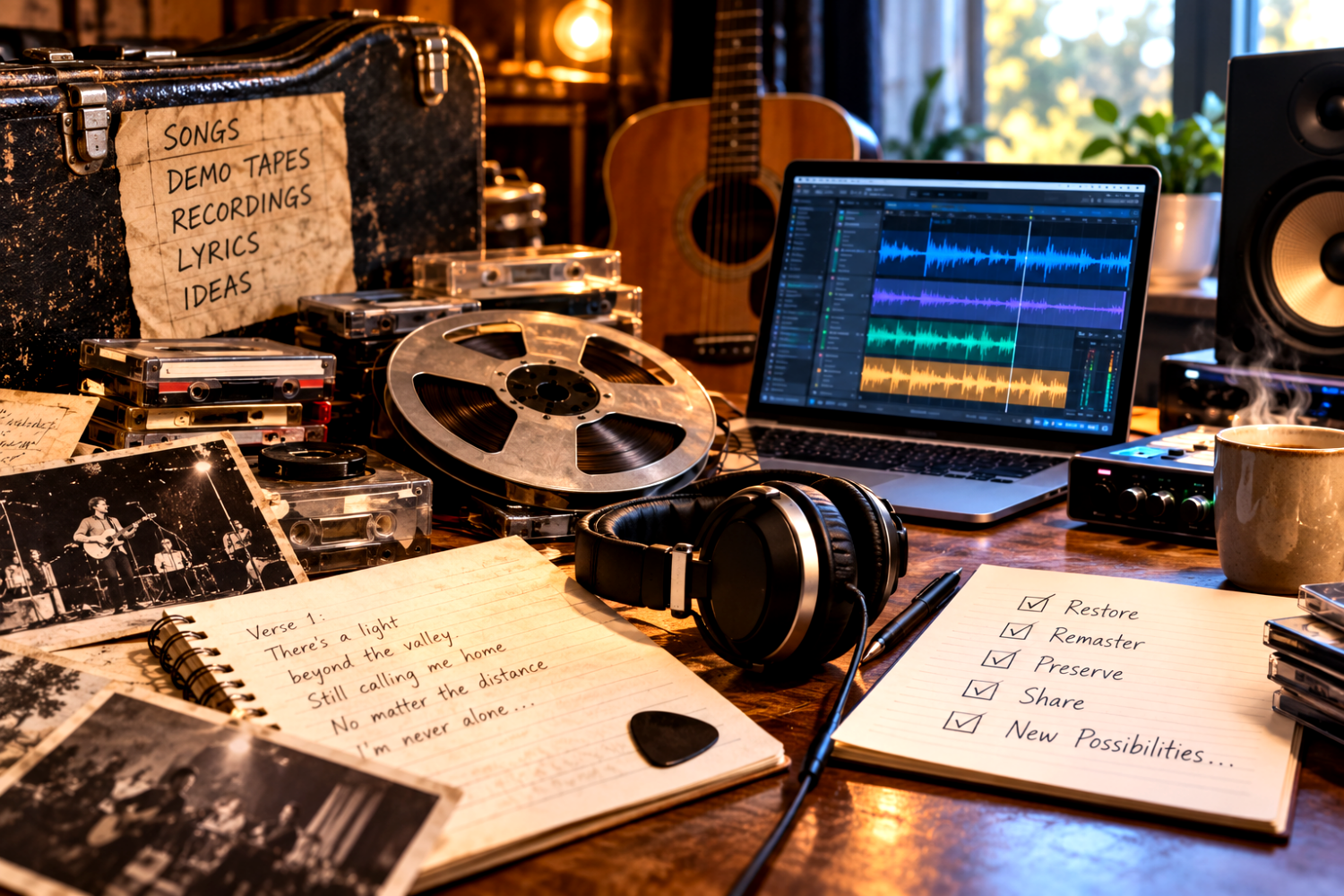
Maybe you’re one of my old musician cronies with boxes of tapes somewhere. Maybe there are songs you haven’t heard in forty years.
Maybe you have photographs, manuscripts, poems, sermons, recordings, inventions, research, artwork, family histories, or ideas created with technologies that became obsolete before the work itself did.
Pull something out. Look at it again. Not nostalgically, necessarily. Curiously.
Ask: What could I do with this today that I couldn’t do then?
That’s an entirely different question than asking whether something from your past is still commercially viable.
-
- Technology has changed.
- Distribution has changed.
- Production has changed.
- The cost of doing things has changed.
- And now AI is changing the equation again.
Things that once required a recording studio, production crew, publishing company, substantial financing, or access to specialized equipment may suddenly have possibilities that simply didn’t exist when we packed them away.
That doesn’t mean everything needs resurrecting. Some things really are finished. God bless them. LOL.
But maybe some aren’t.
-
- Maybe there is something sitting in your garage right now that deserves another afternoon of your attention.
- Maybe your children have never heard the songs you wrote.
- Maybe your grandchildren don’t even know you wrote songs.
- Maybe somebody who loved your work thirty or forty years ago would smile enormously just hearing it again.
- And maybe—just maybe—the person who needs to hear it hasn’t even been born yet.
That’s worth thinking about.
So, to all my fellow old fogies, musicians, writers, artists, dreamers, garage-band survivors, four-track veterans, cassette collectors, reel-to-reel warriors, and people who once made something that mattered to them: Go look.
See what’s still there. See what’s salvageable. See what today’s tools can do with yesterday’s creativity.
I’m hoping I’m not the only one doing this.
In fact, I’d love to see a small army of my old cronies digging through closets, garages, storage units, and forgotten boxes, finding those old recordings and saying, “Well, lookie there…”
-
- Maybe that song isn’t dead after all.
- Maybe the old soundtrack still has a little life in it.
- And maybe bringing the old songs back reminds some of us that we’re not quite finished making new ones.
As for the Dave-Michael Valentine catalog, we’re going to see where this goes.
Maybe something happens. Maybe nothing happens. I’m becoming less concerned about that. The songs will exist. Someone will be able to hear them.
And someday, when somebody finally does shovel dirt onto me… at least they won’t be shoveling it onto the songs.

