A strange thing happens to people when emotion overwhelms rationality. For a few moments, sometimes longer, they become someone they do not fully recognize. Not permanently. Not completely. But enough to frighten themselves afterward. It usually does not happen the way people imagine.
Most emotional derailments do not begin with evil intentions or conscious decisions to become destructive. More often, they begin quietly, beneath the surface, while someone is carrying more emotional pressure than they realize.
Stress. Exhaustion. Resentment. Fear. Humiliation. Burnout. Years of trying to hold everything together while slowly coming apart internally.
Then one day, something relatively small happens.
A tone of voice. A dismissive comment. A criticism. A disrespectful glance. A delayed text message. A disagreement over something that, under calmer circumstances, probably would not have mattered very much at all. But this time is different.
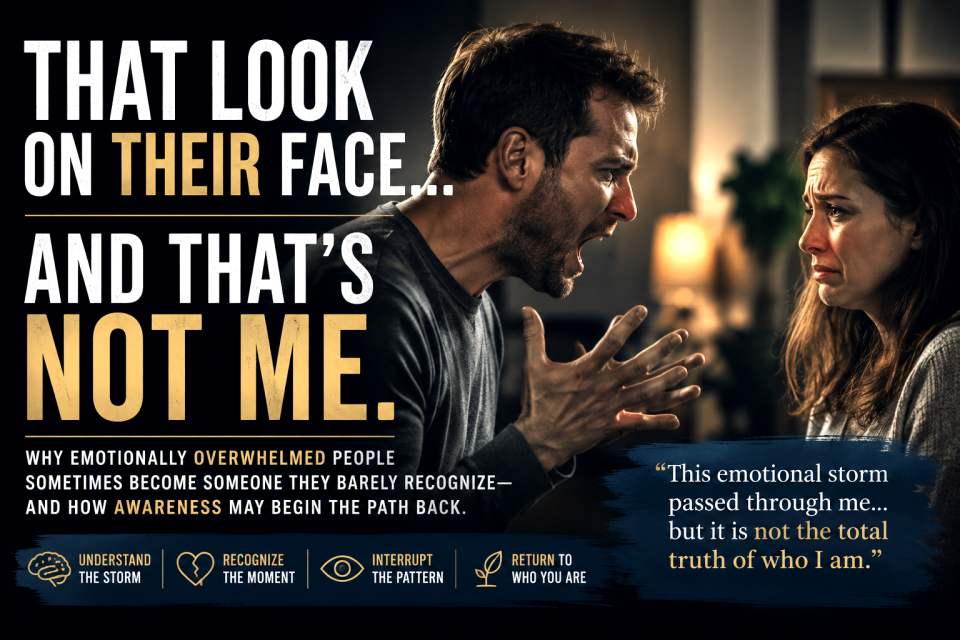
This time something inside the person accelerates. Their chest tightens. Their thoughts narrow. Their emotional intensity rises faster than their rational mind can regulate it. Their voice changes. Their posture changes. The nervous system floods with urgency, adrenaline, and emotional momentum. And for a few moments, everything they are saying feels completely justified.
Until suddenly… they see the look on the other person’s face.
Not anger exactly. Not even fear. Something worse. A look of emotional withdrawal.
A look that says: “I don’t recognize you right now.”
And for one painful instant, the emotional storm briefly breaks. The person hears themselves. Really hears themselves. The volume. The tone. The hostility. The emotional force that had taken control of the room.
And somewhere underneath the adrenaline and emotional static, another realization quietly appears:
“…And that’s not me.”
I think many people have experienced moments like this. Maybe not with yelling. Maybe not in dramatic ways. But most people have had moments where emotion temporarily outran perspective.
A father hears himself speaking to his son in the exact same tone his own father once used on him, and it shakes him to the core.
A woman in the middle of a jealous argument suddenly realizes she no longer even believes half the accusations she is making, but cannot seem to stop herself from escalating.
An exhausted executive walks out of a meeting replaying his own voice in his head, disturbed by how arrogant, defensive, or intimidating he sounded over something so minor.
A mother locks herself in the bathroom after screaming at her children and quietly cries because she never wanted to become this version of herself.
A person lying awake at night after another emotional collapse whispers into the darkness:
“What is happening to me?”
These moments frighten people because they feel revealing.
People begin wondering:
-
- “Maybe this is who I really am.”
- “Maybe I’m becoming someone terrible.”
- “Maybe I’m broken.”
- “Maybe the emotional storm is the real me.”
But I no longer believe that is necessarily true. I think emotionally overloaded people often become temporarily consumed by states that are not the total truth of who they are. And modern life is producing emotionally overloaded people everywhere.
People carrying:
-
- unresolved grief,
- financial pressure,
- relationship disappointment,
- chronic stress,
- loneliness,
- emotional suppression,
- burnout,
- nervous-system exhaustion,
- and years of accumulated emotional compression.
Most people keep functioning anyway. They go to work. Answer emails. Pay bills. Smile in public. Try to appear normal.
Meanwhile, internally, the pressure continues building beneath the surface. Until eventually, something breaks through. And when it does, many people react in ways that leave them sitting quietly afterward wondering:
“How did I get here?”
I have become increasingly fascinated by that moment. Not the outburst itself. Not the emotional collapse. The interruption. The moment awareness returns. The moment someone sees the look on another person’s face and suddenly realizes: “Something just took over me.”
That moment matters more than most people realize. Because the moment we become capable of observing the emotional storm, we are no longer completely possessed by it.
A small separation appears between:
ourselves,
and
the emotional state moving through us.
That separation may feel fragile at first. But inside it lives something extraordinarily important: awareness.
And awareness changes everything. Not overnight. Not instantly. But awareness is often the first moment a person begins finding their way back to themselves. Not through shame. Not through denial. Not through pretending difficult emotions do not exist. But through the quiet realization that:
“This emotional storm passed through me…
…but it is not the total truth of who I am.”
Maybe more people need permission to talk honestly about moments like these. Not to justify destructive behavior. Not to avoid responsibility. But because emotionally flooded human beings often feel deeply alone in experiences that are far more universal than most people realize.
And perhaps emotional healing begins the moment someone finally becomes able to say:
“That reaction happened…
…and that’s not me.”
