KER-CHUNK! Somebody Said the Word

I’ve discovered a peculiar form of entertainment. I probably shouldn’t admit this. But lately, when I notice someone has a particularly reliable trigger word, I’m occasionally tempted to work it innocently into a conversation just to watch what happens.
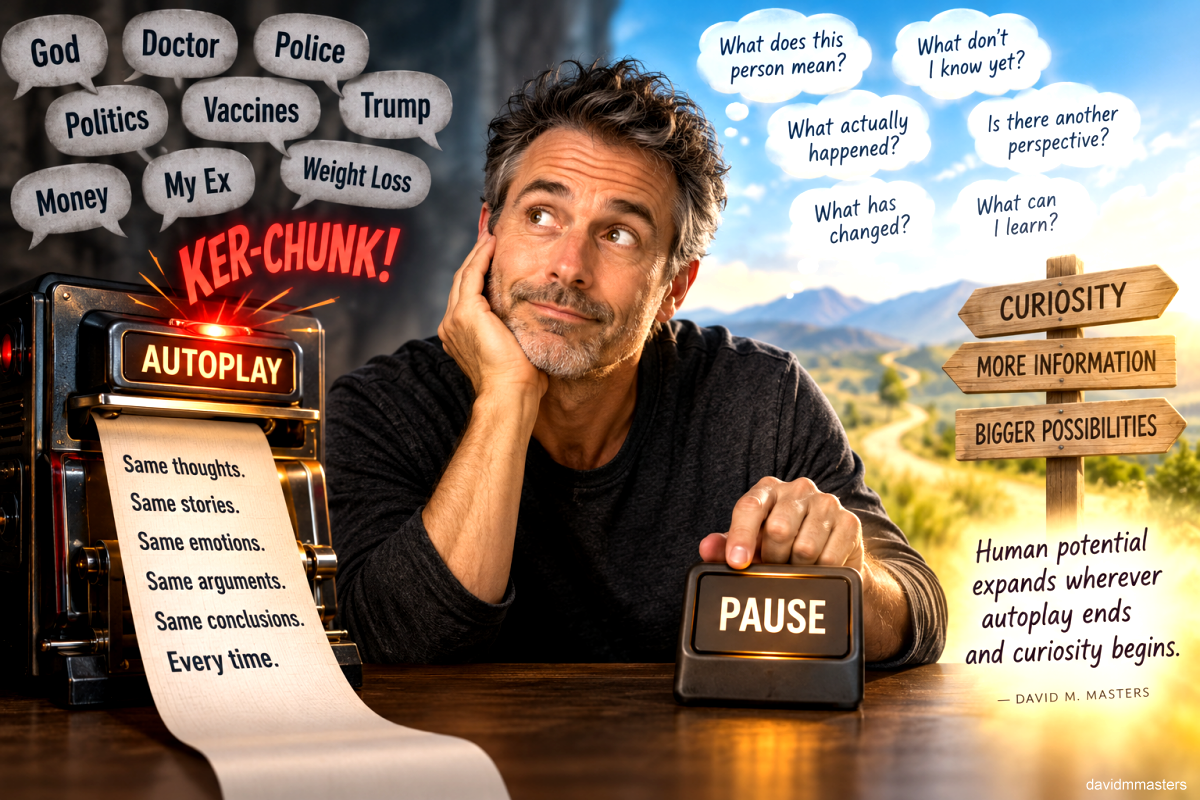
Someone says: God.

KER-CHUNK.

Autoplay engaged. And we’re off.

The six-minute God presentation has begun.

Someone else casually mentions going to their: Doctor. KER-CHUNK. “Well, let me tell you about doctors…”

Nobody asked. But apparently the program was already loaded.

    • Police.
    • Attorney.
    • Military.
    • Weight loss.
    • Immigration.
    • Gender.
    • Vaccines.
    • Guns.
    • Republican.
    • Democrat.

And God forbid somebody says: Trump. KER-CHUNK. Cancel your dinner reservations. We may be here a while.

The Human Autoplay Feature

I’m having some fun with this, but I think something rather important is happening. Human beings automate things. We have to. Imagine waking up every morning and having to rediscover how doorknobs work.

Automation is enormously useful. But we don’t automate only physical tasks. We automate associations. Interpretations. Emotional responses. Conclusions. Stories. Sometimes we even automate entire speeches.

Someone says the magic word and – before we’ve really considered what this particular person is saying in this particular moment – the familiar recording begins.

KER-CHUNK. Autoplay.

And this has nothing to do with whether your position is liberal, conservative, religious, atheist, conventional, alternative, mainstream, rebellious, or somewhere out beyond Pluto. Autoplay doesn’t care.

A six-minute glowing tribute is just as automatic as a six-minute tirade.

I Don’t Want to Be a Jukebox

Personally, I don’t want to be reduced to a jukebox with a limited playlist.

Push B-7 and get my God speech. C-12 plays my doctor recording. D-4 launches politics. Same record. Same scratches. Same chorus. Every time.

Because if somebody knows which button to push and can predict what I’m going to say for the next six minutes, they don’t need mind control.

I’ve automated the job for them. LOL.

That’s what I playfully think of as the mind-control grid. Not some sinister organization operating from an underground bunker. Our grids are much more ordinary.

Family. Culture. Education. Pain. Religion. Politics. Media.Tribal belonging. People we’ve trusted. People who hurt us. Things we’ve experienced repeatedly.

Over time, we build an internal model of reality. And that model is useful. Until we forget it’s a model.

Your Recording May Be Right

This is important. I’m not suggesting that your beliefs are wrong.

    • Maybe you have very good reasons for distrusting doctors.
    • Maybe doctors saved your life.
    • Maybe religion wounded you.
    • Maybe faith transformed you.
    • Maybe your experience with law enforcement was terrible.
    • Maybe a police officer once stood between you and disaster.

Keep your experiences. Keep your conclusions if they still make sense to you.

The question isn’t: “Is my opinion wrong?” The more interesting question is: “Did I choose this response just now?”

Because your beliefs aren’t necessarily the prison. Your inability to stop them from going on autoplay might be.

Curiosity Interrupts Autoplay

This is where it gets interesting to me. Someone says one of my words.

KER-CHUNK. I can feel the familiar program loading. But before it gets very far: Pause.

    • What does this particular person mean?
    • What actually happened?
    • What don’t I know yet?
    • Is there information here that doesn’t fit my existing model?
    • What has changed since I formed this opinion?
    • What might I notice if I weren’t trying to prove anything?

Now I’m not merely reacting. I’m accumulating data. I’m expanding. And after listening, investigating, and considering the new information, I may arrive at exactly the same conclusion I had before. Fine. Except this time, I chose it.

The Three-Second Experiment

Try it sometime. You don’t have to change your beliefs. You don’t have to become neutral. You don’t have to hug anyone. Just notice when one of your programs starts.

KER-CHUNK.

Then give yourself three seconds.

Instead of immediately asking, “What do I already know about this?”

Try: “What is actually happening here?”

That’s a very different question.

Certainty says: “I already have the answer.” Curiosity says: “Let’s see what else reality has brought us.”

I prefer the second one. Not because certainty is always wrong. But because reality has not finished introducing itself. And I don’t want to spend the rest of my life playing the same twelve records simply because somebody keeps pushing the buttons.

There are more songs. More information. More observations. More possibilities. More surprises. More life.

Maybe escaping the so-called mind-control grid isn’t discovering the correct collection of opinions. That could just become another jukebox. Maybe freedom is becoming increasingly difficult to reduce to predictable output.

Someone pushes the button.

KER-CHUNK.

Oh, lookie there. One of mine. And then, instead of automatically pressing PLAY…

I get curious.

Because human potential expands wherever autoplay ends and curiosity begins.


That Look on Their Face… And That’s Not Me

A strange thing happens to people when emotion overwhelms rationality. For a few moments, sometimes longer, they become someone they do not fully recognize. Not permanently. Not completely. But enough to frighten themselves afterward. It usually does not happen the way people imagine.

Most emotional derailments do not begin with evil intentions or conscious decisions to become destructive. More often, they begin quietly, beneath the surface, while someone is carrying more emotional pressure than they realize.

Stress. Exhaustion. Resentment. Fear. Humiliation. Burnout. Years of trying to hold everything together while slowly coming apart internally.

Then one day, something relatively small happens.

A tone of voice. A dismissive comment. A criticism. A disrespectful glance. A delayed text message. A disagreement over something that, under calmer circumstances, probably would not have mattered very much at all. But this time is different.

This time something inside the person accelerates. Their chest tightens. Their thoughts narrow. Their emotional intensity rises faster than their rational mind can regulate it. Their voice changes. Their posture changes. The nervous system floods with urgency, adrenaline, and emotional momentum. And for a few moments, everything they are saying feels completely justified.

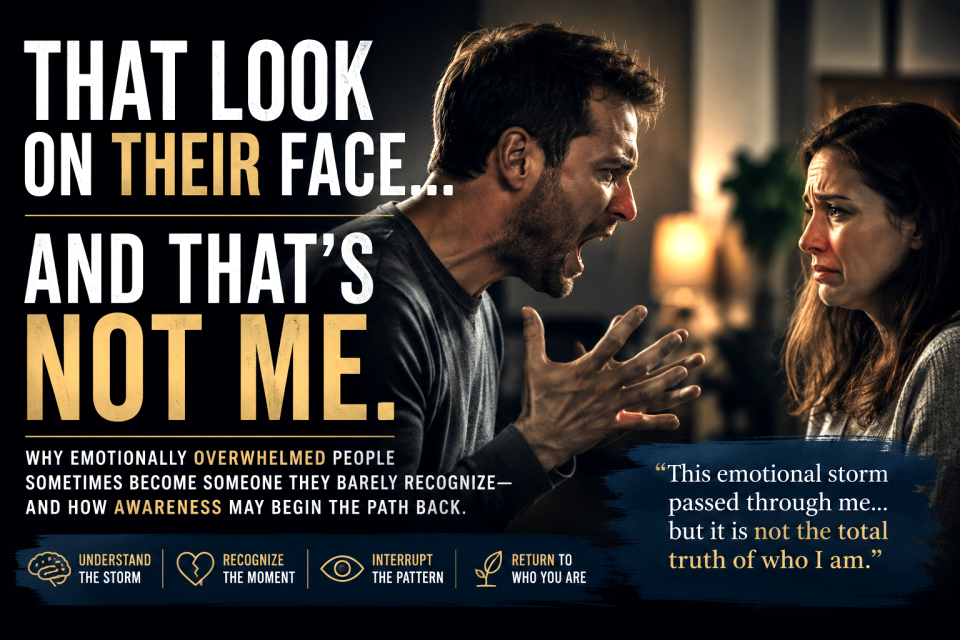
Until suddenly… they see the look on the other person’s face.

Not anger exactly. Not even fear. Something worse. A look of emotional withdrawal.

A look that says: “I don’t recognize you right now.”

And for one painful instant, the emotional storm briefly breaks. The person hears themselves. Really hears themselves. The volume. The tone. The hostility. The emotional force that had taken control of the room.

And somewhere underneath the adrenaline and emotional static, another realization quietly appears:

“…And that’s not me.”

I think many people have experienced moments like this. Maybe not with yelling. Maybe not in dramatic ways. But most people have had moments where emotion temporarily outran perspective.

A father hears himself speaking to his son in the exact same tone his own father once used on him, and it shakes him to the core.

A woman in the middle of a jealous argument suddenly realizes she no longer even believes half the accusations she is making, but cannot seem to stop herself from escalating.

An exhausted executive walks out of a meeting replaying his own voice in his head, disturbed by how arrogant, defensive, or intimidating he sounded over something so minor.

A mother locks herself in the bathroom after screaming at her children and quietly cries because she never wanted to become this version of herself.

A person lying awake at night after another emotional collapse whispers into the darkness:

“What is happening to me?”

These moments frighten people because they feel revealing.

People begin wondering:

    • “Maybe this is who I really am.”
    • “Maybe I’m becoming someone terrible.”
    • “Maybe I’m broken.”
    • “Maybe the emotional storm is the real me.”

But I no longer believe that is necessarily true. I think emotionally overloaded people often become temporarily consumed by states that are not the total truth of who they are. And modern life is producing emotionally overloaded people everywhere.

People carrying:

    • unresolved grief,
    • financial pressure,
    • relationship disappointment,
    • chronic stress,
    • loneliness,
    • emotional suppression,
    • burnout,
    • nervous-system exhaustion,
    • and years of accumulated emotional compression.

Most people keep functioning anyway. They go to work. Answer emails. Pay bills. Smile in public. Try to appear normal.

Meanwhile, internally, the pressure continues building beneath the surface. Until eventually, something breaks through. And when it does, many people react in ways that leave them sitting quietly afterward wondering:

“How did I get here?”

I have become increasingly fascinated by that moment. Not the outburst itself. Not the emotional collapse. The interruption. The moment awareness returns. The moment someone sees the look on another person’s face and suddenly realizes: “Something just took over me.”

That moment matters more than most people realize. Because the moment we become capable of observing the emotional storm, we are no longer completely possessed by it.

A small separation appears between:

ourselves,
and
the emotional state moving through us.

That separation may feel fragile at first. But inside it lives something extraordinarily important: awareness.

And awareness changes everything. Not overnight. Not instantly. But awareness is often the first moment a person begins finding their way back to themselves. Not through shame. Not through denial. Not through pretending difficult emotions do not exist. But through the quiet realization that:

“This emotional storm passed through me…
…but it is not the total truth of who I am.”

Maybe more people need permission to talk honestly about moments like these. Not to justify destructive behavior. Not to avoid responsibility. But because emotionally flooded human beings often feel deeply alone in experiences that are far more universal than most people realize.

And perhaps emotional healing begins the moment someone finally becomes able to say:

“That reaction happened…
…and that’s not me.”