KER-CHUNK! Somebody Said the Word

I’ve discovered a peculiar form of entertainment. I probably shouldn’t admit this. But lately, when I notice someone has a particularly reliable trigger word, I’m occasionally tempted to work it innocently into a conversation just to watch what happens.

Someone says: God.

KER-CHUNK.

Autoplay engaged. And we’re off.

The six-minute God presentation has begun.

Someone else casually mentions going to their: Doctor. KER-CHUNK. “Well, let me tell you about doctors…”

Nobody asked. But apparently the program was already loaded.

    • Police.
    • Attorney.
    • Military.
    • Weight loss.
    • Immigration.
    • Gender.
    • Vaccines.
    • Guns.
    • Republican.
    • Democrat.

And God forbid somebody says: Trump. KER-CHUNK. Cancel your dinner reservations. We may be here a while.

The Human Autoplay Feature

I’m having some fun with this, but I think something rather important is happening. Human beings automate things. We have to. Imagine waking up every morning and having to rediscover how doorknobs work.

Automation is enormously useful. But we don’t automate only physical tasks. We automate associations. Interpretations. Emotional responses. Conclusions. Stories. Sometimes we even automate entire speeches.

Someone says the magic word and – before we’ve really considered what this particular person is saying in this particular moment – the familiar recording begins.

KER-CHUNK. Autoplay.

And this has nothing to do with whether your position is liberal, conservative, religious, atheist, conventional, alternative, mainstream, rebellious, or somewhere out beyond Pluto. Autoplay doesn’t care.

A six-minute glowing tribute is just as automatic as a six-minute tirade.

I Don’t Want to Be a Jukebox

Personally, I don’t want to be reduced to a jukebox with a limited playlist.

Push B-7 and get my God speech. C-12 plays my doctor recording. D-4 launches politics. Same record. Same scratches. Same chorus. Every time.

Because if somebody knows which button to push and can predict what I’m going to say for the next six minutes, they don’t need mind control.

I’ve automated the job for them. LOL.

That’s what I playfully think of as the mind-control grid. Not some sinister organization operating from an underground bunker. Our grids are much more ordinary.

Family. Culture. Education. Pain. Religion. Politics. Media.Tribal belonging. People we’ve trusted. People who hurt us. Things we’ve experienced repeatedly.

Over time, we build an internal model of reality. And that model is useful. Until we forget it’s a model.

Your Recording May Be Right

This is important. I’m not suggesting that your beliefs are wrong.

    • Maybe you have very good reasons for distrusting doctors.
    • Maybe doctors saved your life.
    • Maybe religion wounded you.
    • Maybe faith transformed you.
    • Maybe your experience with law enforcement was terrible.
    • Maybe a police officer once stood between you and disaster.

Keep your experiences. Keep your conclusions if they still make sense to you.

The question isn’t: “Is my opinion wrong?” The more interesting question is: “Did I choose this response just now?”

Because your beliefs aren’t necessarily the prison. Your inability to stop them from going on autoplay might be.

Curiosity Interrupts Autoplay

This is where it gets interesting to me. Someone says one of my words.

KER-CHUNK. I can feel the familiar program loading. But before it gets very far: Pause.

    • What does this particular person mean?
    • What actually happened?
    • What don’t I know yet?
    • Is there information here that doesn’t fit my existing model?
    • What has changed since I formed this opinion?
    • What might I notice if I weren’t trying to prove anything?

Now I’m not merely reacting. I’m accumulating data. I’m expanding. And after listening, investigating, and considering the new information, I may arrive at exactly the same conclusion I had before. Fine. Except this time, I chose it.

The Three-Second Experiment

Try it sometime. You don’t have to change your beliefs. You don’t have to become neutral. You don’t have to hug anyone. Just notice when one of your programs starts.

KER-CHUNK.

Then give yourself three seconds.

Instead of immediately asking, “What do I already know about this?”

Try: “What is actually happening here?”

That’s a very different question.

Certainty says: “I already have the answer.” Curiosity says: “Let’s see what else reality has brought us.”

I prefer the second one. Not because certainty is always wrong. But because reality has not finished introducing itself. And I don’t want to spend the rest of my life playing the same twelve records simply because somebody keeps pushing the buttons.

There are more songs. More information. More observations. More possibilities. More surprises. More life.

Maybe escaping the so-called mind-control grid isn’t discovering the correct collection of opinions. That could just become another jukebox. Maybe freedom is becoming increasingly difficult to reduce to predictable output.

Someone pushes the button.

KER-CHUNK.

Oh, lookie there. One of mine. And then, instead of automatically pressing PLAY…

I get curious.

Because human potential expands wherever autoplay ends and curiosity begins.


Strange Lights in the Sky I Don’t Know What I Saw and That’s Okay

Last night I went outside and looked up. This may have been a mistake.  There was a light moving across the night sky, and I assumed I was looking at an airplane. Nothing unusual about that. Then it moved sideways. Not turned sideways. Moved sideways.

It continued traveling in one direction and then suddenly jumped rapidly on a diagonal before continuing again.

Okay. That got my attention. Then it did it again.

At one point, there was a flash, and the light appeared to jump a considerable distance backward from the direction it had been traveling.

I stood there watching it.

I don’t do drugs. I wasn’t drinking. And unless weather balloons have received a rather impressive technological upgrade, I’m reasonably confident I wasn’t watching one of those.

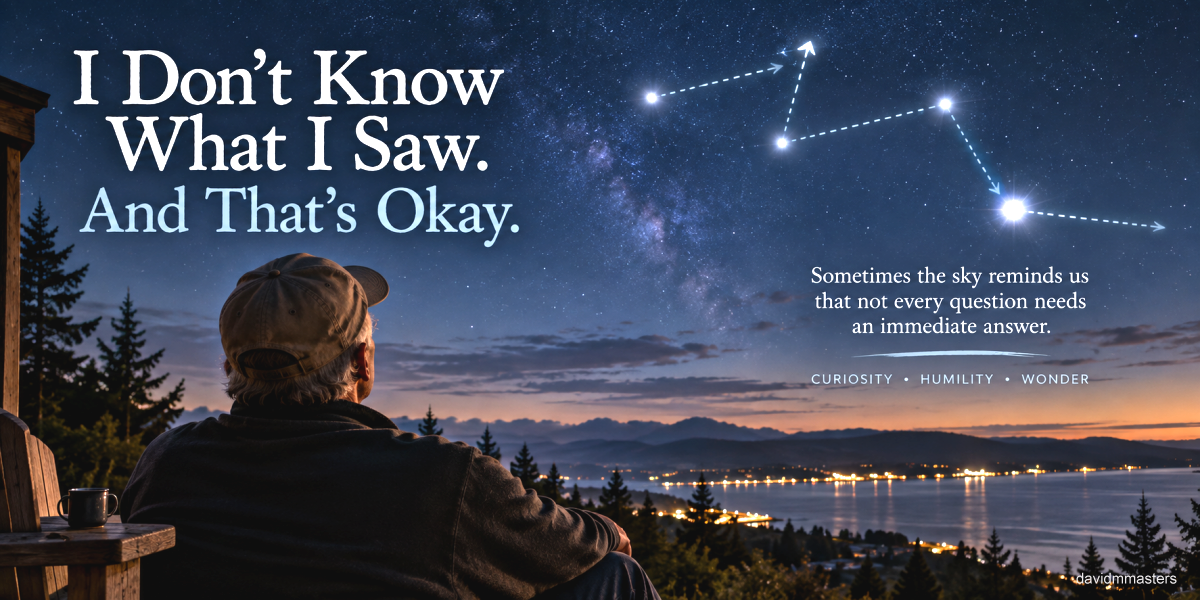
I don’t know what I saw. There. I said it.

Interestingly, those five words seem extraordinarily difficult for human beings.

I don’t know what I saw.

Not: “It was aliens.”
Not: “It was a secret government spacecraft.”
Not: “It was an airplane and your eyes were playing tricks on you.”
Not even: “David has finally lost it.”

Although you’re certainly entitled to that one. I simply don’t know. And I’ve discovered that not knowing is actually a wonderful place to stand.

I’ve Been Here Before

The strange thing is, this wasn’t my first experience with something behaving oddly in the sky. The last time was more than fifty years ago. I was a youngster living in Astoria, Oregon.

Sometime around 1970, the local radio station DJ, KAST, began talking about reports of strange lights in the sky. Naturally, I went outside.

Then I ran next door because one of the kids had a telescope. The telescope wasn’t much help.

But before long, we didn’t need one. As I remember that night, people started coming out of their houses. Neighbors stood in their yards looking upward. More and more people joined them.

Eventually, it seemed as though everybody was outside watching the show.

And these weren’t simply lights traveling neatly from one horizon to another. They appeared to make abrupt changes in direction.

Things weren’t behaving the way things in the sky were supposed to behave. My recollection is that military aircraft were eventually sent up in response.

I couldn’t wait for the newspaper the next morning. Surely this was going to be front-page news.

At the crack of dawn, the newspaper landed on our porch. Nothing.

I went to school. Some kids laughed when I talked about it. Others had seen it too.

Later, I called KAST. As I remember it, suddenly nobody knew what I was talking about.

That was a peculiar experience for a kid.

And apparently I filed it away somewhere in the cabinet marked:

THINGS I CANNOT EXPLAIN.

I didn’t spend the next fifty years obsessing about it. Life had plenty of other material.

Then Last Night Happened

More than half a century later, I’m standing beneath another night sky watching something I cannot explain.

So, naturally, I did what any modern human being does when confronted by one of life’s mysteries.

I asked a machine. That didn’t go particularly well. I was given several perfectly reasonable explanations for why human perception can be unreliable.

And that’s true. Our eyes can fool us. Our brains fill gaps. Distance is difficult to judge against a dark sky. Lights can appear to move strangely. Atmospheric conditions can create peculiar effects.

All true.

But there’s a funny thing about explanations. An explanation can be possible without being the explanation.

Sometimes we’re so uncomfortable saying “I don’t know” that we’ll grab the nearest plausible answer and promote it immediately to certainty.

That works in both directions.

“Obviously aliens!” Really? How do you know?
“Obviously an optical illusion!” Really? How do you know?

What if we simply left one chair empty for mystery?

Reality Doesn’t Owe Us an Explanation

I think this reaches considerably farther than strange lights in the night sky. We do this everywhere.

Something happens in a relationship. We decide why.
Someone doesn’t return our call. We know what they’re thinking.
A business opportunity collapses. We immediately construct the story explaining what happened.
Someone behaves strangely. Within minutes, we’ve diagnosed their motives, childhood, attachment style, and probably their mother.

Maybe we know. Maybe we don’t.

Reality is an excellent collaborator. It just refuses to rehearse.

There are things we experience that won’t immediately fit inside the filing system we’ve built for the world.

That’s okay.

We don’t have to force them in.

You Don’t Have to Choose a Camp

This may be the most freeing part.

I don’t have to become a UFO guy because I saw something I can’t explain.
I don’t have to buy a telescope.
I don’t have to start a podcast.
I don’t have to build a bunker.
And I don’t have to convince you.

Likewise, I don’t have to pretend I didn’t see what I saw simply because somebody else has a more comfortable explanation for it. I can remain curious. That’s enough.

Maybe somebody reading this knows exactly what I witnessed. Maybe there is a wonderfully ordinary explanation. I’d actually enjoy hearing it. Or maybe I’ll wait another fifty years.

Although at this stage of the game, that particular research strategy may be overly optimistic.

Leave Room for Wonder

I went looking online for the Astoria event I remember from childhood. Years ago, I did find it documented. No such luck today.

Interestingly, there are documented reports of unusual aerial sightings around Astoria from other years. So apparently that little corner of Oregon has had its share of people looking upward and scratching their heads.

Does that prove anything about what I saw? Nope.

And I rather like it that way. Because maybe every unexplained thing doesn’t need to become a belief. Maybe some things can simply become a question.

We can observe carefully. We can investigate. We can consider conventional explanations. We can change our minds when better information arrives. And after we’ve done all that, occasionally we may still be left with three magnificent words: I don’t know.

There is humility there. There is curiosity there. And if we resist filling that empty space too quickly… there might even be wonder.

So, yes. I’ll probably go outside and look at the night sky again. Eventually.

But if anything up there starts jumping backward again… I’m going inside. I’ve got work to do.

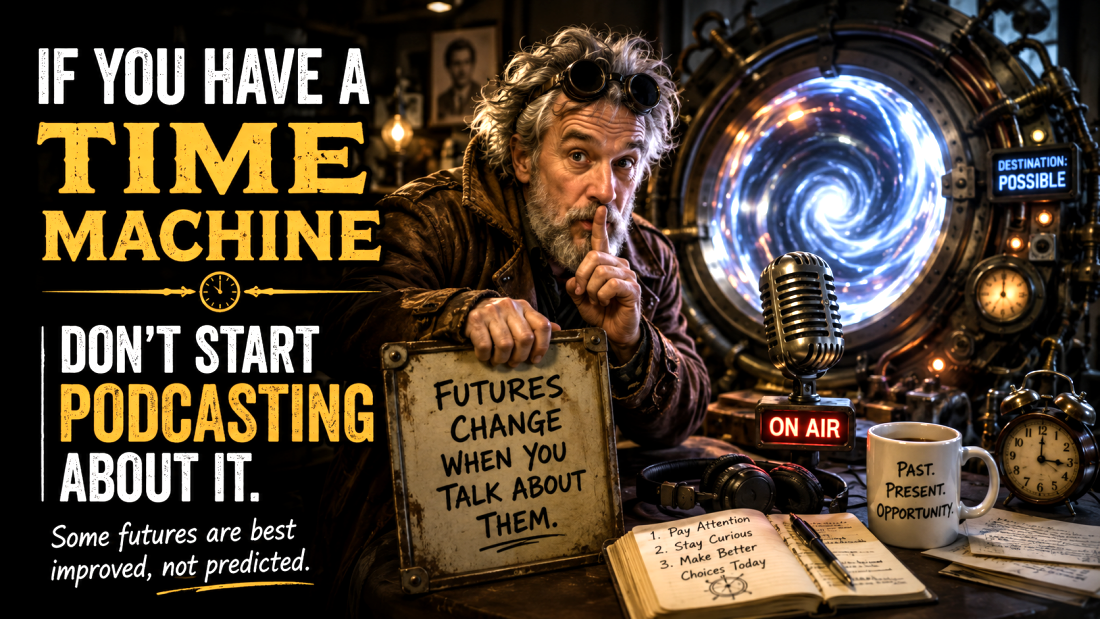
If You Have a Time Machine | Don’t Start Podcasting About It

I’ve been thinking about time travel lately. No, not because I built a flux capacitor in my garage. And no, this isn’t one of those moments when I try to convince you that Elvis is living on Mars with three government accountants and someone’s pet iguana. Relax. This is just one of those little thought experiments that wandered into my head, sat down, and refused to leave.

Let’s suppose, for the sake of conversation, that someone actually could see the future.

    • Maybe they have a crystal ball.
    • Maybe they have a sophisticated quantum machine.
    • Maybe they simply had one incredibly vivid glimpse of tomorrow.

Here’s my question. The moment they tell you what they saw… haven’t they already started changing it?

Imagine someone says, “On October 17th, the bridge will collapse.” Well… now what?

    • Do people stay home?
    • Does the city inspect the bridge?
    • Does someone reinforce it?
    • Does traffic reroute?
    • Does a construction crew accidentally discover an unrelated problem that saves thousands of lives?

In other words, the prediction itself just entered history.

    • It became another variable.
    • It didn’t merely describe the future.
    • It participated in creating it.

That’s why I’ve always been a little cautious around people who confidently announce, “This is exactly what’s going to happen.”

Maybe. Maybe not.

If the future is alive, then every decision, every conversation, every warning, every prayer, every act of courage, and every unexpected kindness becomes another pebble thrown into the pond. The ripples keep changing.

Even Charles Dickens understood this. Ebenezer Scrooge wasn’t shown the future so he could panic. He was shown one possible future so he could change the present. That’s a very different lesson.

Now, before someone writes me a strongly worded email… No, I’m not dismissing prophecy.

If God intends for certain events to unfold exactly as He has declared, I have absolutely no interest in debating His ability to accomplish His own purposes. I suspect He is entirely capable of protecting His plans without my assistance. This article isn’t about arguing with God. It’s about remembering that most of us aren’t Him.

Most predictions we hear, from experts, influencers, anonymous internet accounts, neighbors, or the guy at the coffee shop who always seems to know somebody who knows somebody, should probably be held with open hands. Take the insight. Leave the certainty.

Use the information to become wiser today instead of becoming obsessed with tomorrow.

There’s another reason I like this approach. Fear spreads quickly. Certainty spreads even faster. Curiosity slows us down just enough to ask better questions.

    • “What if?”
    • “How do we know?”
    • “What could I do today that would make tomorrow better, regardless?”

Those questions have improved far more lives than panic ever has.

If someone really did invent a working time machine, the smartest thing they could do would be to keep their mouth shut. Because the instant they announced what they saw, millions of people would begin reacting to it.

      • Politicians.
      • Investors.
      • Scientists.
      • Criminals.
      • Journalists.
      • Neighbors.
      • Entire governments.

Suddenly the future they reported wouldn’t be the future anymore. It would become history’s first draft. Maybe that’s one of life’s lessons.

The future isn’t simply something we discover.
It’s also something we participate in.

So, if tomorrow offers you a glimpse of itself, through wisdom, experience, prayer, intuition, good counsel, or even one of those wonderfully strange conversations that makes you think, you don’t have to cling to it.

Receive what is useful. Become a little wiser. Make one better decision today. Then let tomorrow continue being wonderfully alive.

After all, the best way to improve the future has never been arguing about it. It’s living well today.