KER-CHUNK! Somebody Said the Word

I’ve discovered a peculiar form of entertainment. I probably shouldn’t admit this. But lately, when I notice someone has a particularly reliable trigger word, I’m occasionally tempted to work it innocently into a conversation just to watch what happens.

Someone says: God.

KER-CHUNK.

Autoplay engaged. And we’re off.

The six-minute God presentation has begun.

Someone else casually mentions going to their: Doctor. KER-CHUNK. “Well, let me tell you about doctors…”

Nobody asked. But apparently the program was already loaded.

    • Police.
    • Attorney.
    • Military.
    • Weight loss.
    • Immigration.
    • Gender.
    • Vaccines.
    • Guns.
    • Republican.
    • Democrat.

And God forbid somebody says: Trump. KER-CHUNK. Cancel your dinner reservations. We may be here a while.

The Human Autoplay Feature

I’m having some fun with this, but I think something rather important is happening. Human beings automate things. We have to. Imagine waking up every morning and having to rediscover how doorknobs work.

Automation is enormously useful. But we don’t automate only physical tasks. We automate associations. Interpretations. Emotional responses. Conclusions. Stories. Sometimes we even automate entire speeches.

Someone says the magic word and – before we’ve really considered what this particular person is saying in this particular moment – the familiar recording begins.

KER-CHUNK. Autoplay.

And this has nothing to do with whether your position is liberal, conservative, religious, atheist, conventional, alternative, mainstream, rebellious, or somewhere out beyond Pluto. Autoplay doesn’t care.

A six-minute glowing tribute is just as automatic as a six-minute tirade.

I Don’t Want to Be a Jukebox

Personally, I don’t want to be reduced to a jukebox with a limited playlist.

Push B-7 and get my God speech. C-12 plays my doctor recording. D-4 launches politics. Same record. Same scratches. Same chorus. Every time.

Because if somebody knows which button to push and can predict what I’m going to say for the next six minutes, they don’t need mind control.

I’ve automated the job for them. LOL.

That’s what I playfully think of as the mind-control grid. Not some sinister organization operating from an underground bunker. Our grids are much more ordinary.

Family. Culture. Education. Pain. Religion. Politics. Media.Tribal belonging. People we’ve trusted. People who hurt us. Things we’ve experienced repeatedly.

Over time, we build an internal model of reality. And that model is useful. Until we forget it’s a model.

Your Recording May Be Right

This is important. I’m not suggesting that your beliefs are wrong.

    • Maybe you have very good reasons for distrusting doctors.
    • Maybe doctors saved your life.
    • Maybe religion wounded you.
    • Maybe faith transformed you.
    • Maybe your experience with law enforcement was terrible.
    • Maybe a police officer once stood between you and disaster.

Keep your experiences. Keep your conclusions if they still make sense to you.

The question isn’t: “Is my opinion wrong?” The more interesting question is: “Did I choose this response just now?”

Because your beliefs aren’t necessarily the prison. Your inability to stop them from going on autoplay might be.

Curiosity Interrupts Autoplay

This is where it gets interesting to me. Someone says one of my words.

KER-CHUNK. I can feel the familiar program loading. But before it gets very far: Pause.

    • What does this particular person mean?
    • What actually happened?
    • What don’t I know yet?
    • Is there information here that doesn’t fit my existing model?
    • What has changed since I formed this opinion?
    • What might I notice if I weren’t trying to prove anything?

Now I’m not merely reacting. I’m accumulating data. I’m expanding. And after listening, investigating, and considering the new information, I may arrive at exactly the same conclusion I had before. Fine. Except this time, I chose it.

The Three-Second Experiment

Try it sometime. You don’t have to change your beliefs. You don’t have to become neutral. You don’t have to hug anyone. Just notice when one of your programs starts.

KER-CHUNK.

Then give yourself three seconds.

Instead of immediately asking, “What do I already know about this?”

Try: “What is actually happening here?”

That’s a very different question.

Certainty says: “I already have the answer.” Curiosity says: “Let’s see what else reality has brought us.”

I prefer the second one. Not because certainty is always wrong. But because reality has not finished introducing itself. And I don’t want to spend the rest of my life playing the same twelve records simply because somebody keeps pushing the buttons.

There are more songs. More information. More observations. More possibilities. More surprises. More life.

Maybe escaping the so-called mind-control grid isn’t discovering the correct collection of opinions. That could just become another jukebox. Maybe freedom is becoming increasingly difficult to reduce to predictable output.

Someone pushes the button.

KER-CHUNK.

Oh, lookie there. One of mine. And then, instead of automatically pressing PLAY…

I get curious.

Because human potential expands wherever autoplay ends and curiosity begins.


The Seven Transitions of Human Change

Over the years, I began noticing something interesting about people who genuinely changed their lives. Not temporary motivation, self-help excitement, or a three-day breakthrough that faded by next Tuesday. I mean real change. The kind that changes the atmosphere around a person, where old patterns stop feeling natural, and someone who once reacted one way now responds entirely differently without even trying.

The more I worked with people through relationships, trauma, business struggles, identity crises, spiritual searching, emotional collapse, reinvention, and recovery, the more I noticed that transformation seemed to move through recognizable stages. Not as a perfectly reproducible framework but often enough that I started paying attention.

Curiously, many of these stages naturally fell under “trans” language. Which makes sense, because the word “trans” simply means: to move across, to move beyond, to move through. And maybe that’s what growth really is. Not becoming someone else. But moving through the layers that were never fully you to begin with.

    1. Transaction

Every change begins with some form of transaction.

Something happens.

You say something you regret.
You tolerate something you shouldn’t.
You abandon yourself to keep someone else comfortable.
You repeat a destructive habit.
You betray your values.
You overreact.
You shut down emotionally.
You give away your power for approval, attention, safety, or temporary relief.

Sometimes the transaction is obvious. Sometimes it’s subtle.

A child learning that love must be earned is a transaction.
A teenager discovering that hiding emotions prevents conflict is a transaction.
An adult realizing they built their entire personality around survival is a transaction.

Most people live inside repeated transactions for years without realizing they are repeating them.

The same emotional exchanges, wounds, or outcomes… just with different faces and different scenery. But eventually, something begins to wake up.

    1. Transcription

This is where honesty enters. Transcription means writing it down. Speaking it aloud. Admitting what actually happened.

Not the polished version or the version designed to protect your ego, and not the version that makes everybody else the villain. Just the truth.

This is one reason journaling can become life-changing. Not because writing itself is magical, but because clarity begins forming when experience is translated into language.

A surprising number of people never fully heal because they never honestly describe the event.

They explain around it.
Defend it.
Minimize it.
Intellectualize it.
Or bury it under spirituality, positivity, productivity, or distraction.

But once you can calmly say, “This is what happened,” something begins changing. Because truth has structure. And structure begins stabilizing chaos.

    1. Translation

After the event is honestly observed, the deeper question naturally follows: What does this mean?

Why did that affect me so deeply?
Why do I keep repeating this pattern?
Why do certain situations trigger reactions that feel larger than the moment itself?
What belief is hiding underneath the behavior?

This is where many people begin uncovering the deeper architecture beneath their lives.

The anger may actually be fear.
The perfectionism may be an attempt to avoid rejection.
The constant rescuing of others may be connected to a childhood need to feel valuable.
The attraction to emotionally unavailable people may reflect familiar emotional terrain from early life.

Translation is where patterns begin revealing themselves. And once patterns become visible, they become harder to unconsciously obey.

    1. Transgression

This stage is deeply personal. Not religious necessarily, moralistic, or performative.

It is the moment where something inside you quietly says: “I don’t want to continue this anymore.”

Not because somebody threatened you, you got caught, or society disapproved, but because the behavior itself no longer feels aligned.

You begin noticing the cost.

The emotional cost.
The relational cost.
The spiritual cost.
The physical cost.
The nervous-system cost.

And eventually you reach a point where continuing the old pattern starts feeling heavier than changing it.

This is where many people first begin separating from an identity they previously thought was permanent.

    1. Transformation

Now the real work begins. Transformation is not usually dramatic. Most often, it is repetitive.

This is where someone begins consciously redirecting the old pattern into something healthier.

The person who

used to explode learns to pause.
used to numb out learns to feel.
chased validation learns to self-regulate.
constantly abandoned themselves begins setting boundaries.

At first, it feels unnatural. That’s because the nervous system tends to prefer familiar suffering over unfamiliar peace.

People underestimate how physical emotional patterns become.

The body memorizes reactions.
The mind rehearses identity.
The nervous system automates survival strategies.

Which means transformation often requires repetition long before it feels natural. And honestly, this phase can feel discouraging at times. Because you may intellectually understand the change long before your body fully trusts it. But if someone continues practicing the new pattern with enough compassion and consistency, something remarkable eventually begins happening.

The new response slowly becomes the natural one.

    1. Transmission

This is where change stops being private.

At some point, transformed people begin affecting the emotional atmosphere around them. Not because they are trying to, not because they are preaching, and not because they became perfect. But because regulated people regulate people.

Grounded people calm rooms.
Authentic people create safety.
Honest people give others permission to become honest.

Without realizing it, people begin transmitting what they embody.

A healed parent transmits stability to children.
A centered leader transmits steadiness into a business.
A compassionate partner transmits emotional safety into a relationship.

And the opposite is true as well.

Fear transmits.
Bitterness transmits.
Chaos transmits.
Resentment transmits.

We are constantly affecting one another more than we realize. This is why personal healing matters far beyond the individual. Because eventually, who you become enters every room before you say a word.

    1. Transfiguration

There is a stage beyond effort. A stage where someone is no longer trying to become different because, in many ways, they already are.

The old reactions no longer fit naturally.
The old identities feel too small.
The old emotional addictions lose their grip.

This does not mean life becomes perfect. It does not mean someone becomes enlightened or superior. It simply means something fundamental has changed. The transformation became integrated.

And people who reach this stage often become softer, not harder.

Less reactive.
Less performative.
Less obsessed with proving themselves.
Less desperate for approval.

Because once someone truly changes internally, much of the external performance begins falling away on its own. They stop trying so hard to become someone. And begin feeling more comfortable simply being.

Maybe that is the deeper purpose behind all of this.

Not self-improvement for the sake of image.

But becoming increasingly honest,
increasingly conscious,
and increasingly aligned with the person underneath all the conditioning, fear, coping, performance, and survival.

Transaction.
Transcription.
Translation.
Transgression.
Transformation.
Transmission.
Transfiguration.

Seven movements of human change.

Seven ways we move through ourselves.


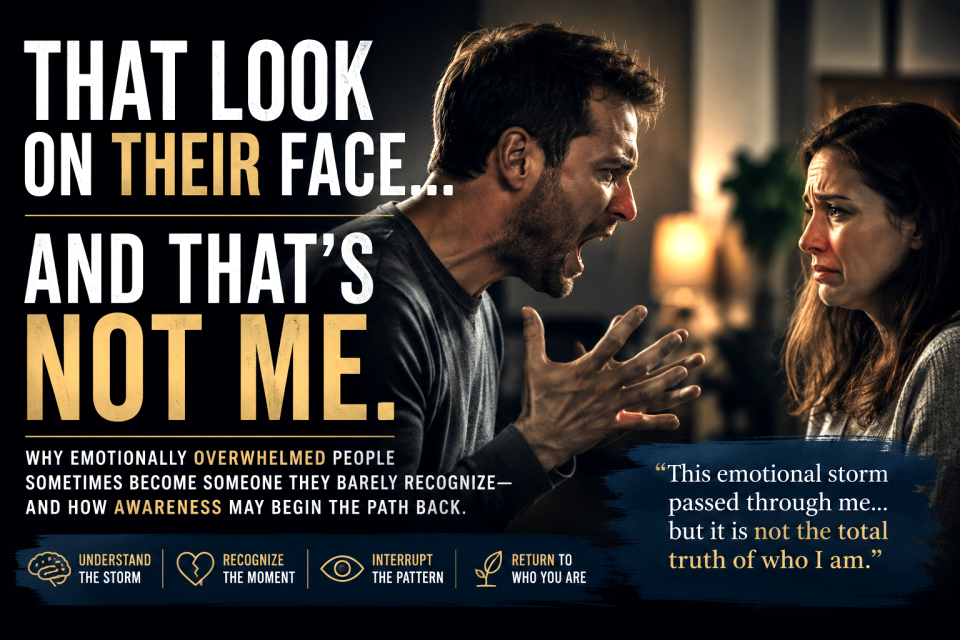
That Look on Their Face… And That’s Not Me

A strange thing happens to people when emotion overwhelms rationality. For a few moments, sometimes longer, they become someone they do not fully recognize. Not permanently. Not completely. But enough to frighten themselves afterward. It usually does not happen the way people imagine.

Most emotional derailments do not begin with evil intentions or conscious decisions to become destructive. More often, they begin quietly, beneath the surface, while someone is carrying more emotional pressure than they realize.

Stress. Exhaustion. Resentment. Fear. Humiliation. Burnout. Years of trying to hold everything together while slowly coming apart internally.

Then one day, something relatively small happens.

A tone of voice. A dismissive comment. A criticism. A disrespectful glance. A delayed text message. A disagreement over something that, under calmer circumstances, probably would not have mattered very much at all. But this time is different.

This time something inside the person accelerates. Their chest tightens. Their thoughts narrow. Their emotional intensity rises faster than their rational mind can regulate it. Their voice changes. Their posture changes. The nervous system floods with urgency, adrenaline, and emotional momentum. And for a few moments, everything they are saying feels completely justified.

Until suddenly… they see the look on the other person’s face.

Not anger exactly. Not even fear. Something worse. A look of emotional withdrawal.

A look that says: “I don’t recognize you right now.”

And for one painful instant, the emotional storm briefly breaks. The person hears themselves. Really hears themselves. The volume. The tone. The hostility. The emotional force that had taken control of the room.

And somewhere underneath the adrenaline and emotional static, another realization quietly appears:

“…And that’s not me.”

I think many people have experienced moments like this. Maybe not with yelling. Maybe not in dramatic ways. But most people have had moments where emotion temporarily outran perspective.

A father hears himself speaking to his son in the exact same tone his own father once used on him, and it shakes him to the core.

A woman in the middle of a jealous argument suddenly realizes she no longer even believes half the accusations she is making, but cannot seem to stop herself from escalating.

An exhausted executive walks out of a meeting replaying his own voice in his head, disturbed by how arrogant, defensive, or intimidating he sounded over something so minor.

A mother locks herself in the bathroom after screaming at her children and quietly cries because she never wanted to become this version of herself.

A person lying awake at night after another emotional collapse whispers into the darkness:

“What is happening to me?”

These moments frighten people because they feel revealing.

People begin wondering:

    • “Maybe this is who I really am.”
    • “Maybe I’m becoming someone terrible.”
    • “Maybe I’m broken.”
    • “Maybe the emotional storm is the real me.”

But I no longer believe that is necessarily true. I think emotionally overloaded people often become temporarily consumed by states that are not the total truth of who they are. And modern life is producing emotionally overloaded people everywhere.

People carrying:

    • unresolved grief,
    • financial pressure,
    • relationship disappointment,
    • chronic stress,
    • loneliness,
    • emotional suppression,
    • burnout,
    • nervous-system exhaustion,
    • and years of accumulated emotional compression.

Most people keep functioning anyway. They go to work. Answer emails. Pay bills. Smile in public. Try to appear normal.

Meanwhile, internally, the pressure continues building beneath the surface. Until eventually, something breaks through. And when it does, many people react in ways that leave them sitting quietly afterward wondering:

“How did I get here?”

I have become increasingly fascinated by that moment. Not the outburst itself. Not the emotional collapse. The interruption. The moment awareness returns. The moment someone sees the look on another person’s face and suddenly realizes: “Something just took over me.”

That moment matters more than most people realize. Because the moment we become capable of observing the emotional storm, we are no longer completely possessed by it.

A small separation appears between:

ourselves,
and
the emotional state moving through us.

That separation may feel fragile at first. But inside it lives something extraordinarily important: awareness.

And awareness changes everything. Not overnight. Not instantly. But awareness is often the first moment a person begins finding their way back to themselves. Not through shame. Not through denial. Not through pretending difficult emotions do not exist. But through the quiet realization that:

“This emotional storm passed through me…
…but it is not the total truth of who I am.”

Maybe more people need permission to talk honestly about moments like these. Not to justify destructive behavior. Not to avoid responsibility. But because emotionally flooded human beings often feel deeply alone in experiences that are far more universal than most people realize.

And perhaps emotional healing begins the moment someone finally becomes able to say:

“That reaction happened…
…and that’s not me.”


Everybody Lies | Now What Are You Going to Do About It?

Everybody lies. Some lies are tiny. Some are catastrophic. Some are told to protect others. Some are told to protect ourselves. Some are told because we are afraid of losing love, losing status, losing control, losing security, or losing the carefully constructed image we want the world to believe about us. And every once in a while, someone lies to you that you never expected would.

That one lands differently. Not because the lie itself was necessarily devastating, but because it woke you up. It shook your assumptions. It cracked open your illusion that certain people are somehow above human weakness.

Recently, someone I had known and respected for years lied to me. Not a stranger. Not someone I expected it from. Someone I trusted. And for a brief moment, it threw me for a loop. Not because I do not understand human behavior. I have worked in counseling, coaching, consulting, and personal transformation for a very long time. I know people lie. I know it intellectually. I know it professionally. But sometimes we forget emotionally.

We create little islands of certainty around people we love, admire, or trust. We quietly place them into categories where we no longer expect ordinary human behavior from them. Then one lie reminds us that every single person on this earth is still wrestling with fear, identity, survival, insecurity, shame, ego, and the desperate need to feel safe. Including us. That realization can harden you. Or it can deepen you. That is the crossroads.

Every Lie Is an Opportunity

One of the most valuable tools I have ever developed in my work with people is the willingness to allow space for dishonesty without immediately punishing it. That surprises some people. They expect confrontation. Exposure. Correction. Consequences. But I learned something a long time ago: People often lie before they feel safe enough to tell the truth. Especially in the beginning of a coaching or counseling relationship.

If something does not feel right, sound right, or line up with the facts, I simply make note of it. I do not necessarily attack it immediately. I observe it. I hold awareness around it. I allow the story to breathe. Then something interesting happens.

Over time, the fabricated version becomes exhausting to maintain. The contradictions begin stacking up. The emotional energy required to maintain the false identity becomes heavier and heavier. People start tangling themselves in the barbed wire of their own stories. One lie requires another. Then another. Then another. And eventually, if enough trust and safety exist, many people come clean on their own. Not because they were forced into submission. But because they became exhausted from carrying the weight of separation between who they are and who they pretend to be.

That moment is sacred. Not humiliating. Sacred. Because when a human being finally feels safe enough to be honest, something profound happens inside them. Relief enters the room. Their nervous system softens. Their breathing changes. The armor begins to fall away. And for many people, that may be one of the first moments in their lives they have ever truly felt accepted while being fully seen.

That changes people.

We live in a culture obsessed with justice, exposure, consequences, outrage, and public destruction. Catch the liar. Expose the liar. Punish the liar. Destroy the liar. But very little attention is given to understanding why people lie in the first place.

Fear. Shame. Trauma. Survival. Rejection. Embarrassment. Insecurity. Childhood conditioning. Loss of identity. Fear of abandonment.

Most people do not wake up in the morning plotting evil. Most people are simply terrified of losing something they believe they need in order to survive emotionally. Now, that does not mean accountability disappears. Far from it. Truth matters. Boundaries matter. Integrity matters. But accountability without love often creates better liars instead of transformed people.

Fear-based correction teaches concealment. Love-based awareness teaches integration. That is a very different path.

I was fortunate to grow up around ideas like: “I’m okay, you’re okay.” “Do unto others as you would have them do unto you.” “We are all doing the best we can with what we have.” Those ideas grounded me. Not because they excuse destructive behavior, but because they remind us that human beings are unfinished creatures trying to find their way through life while carrying invisible burdens.

When you approach people with compassion instead of immediate condemnation, something extraordinary becomes possible. Growth. Real growth. Not performative compliance. Not fear-driven obedience. Not temporary behavioral suppression. Actual transformation. And transformation almost never happens through humiliation. It happens through awareness. It happens when people discover truth inside themselves.

That is why I have never been overly interested in controlling clients through rigid systems, punishments, or demands. Yes, structure matters. Yes, accountability matters. But lasting change usually occurs when people arrive at their own realization.

When the light bulb turns on inside them. When they see themselves clearly for the first time. When they finally become tired of running from themselves. That moment cannot be forced. It can only be invited.

People sometimes ask me why I continue doing this work after all these years. The answer is simple. I live for the moment of epiphany. The moment a client suddenly sees the truth about themselves with complete clarity.

The moment the masks fall away. The moment they stop defending their pain and begin understanding it. The moment self-awareness replaces self-deception. That is the payoff for me. To sit in the room while another human being reconnects with themselves is one of the most sacred experiences I know. Not because I “fixed” them. I did not. They found themselves. I simply created enough safety, enough love, enough accountability, enough space, and enough patience for truth to emerge naturally. That is very different from forcing compliance.

So What Are You Going to Do About It?

When someone lies to you, you stand at a fork in the road. You can become cynical. Suspicious. Closed off. Controlling. Punitive. Emotionally armored. Or…

      • You can become wiser without becoming harder.
      • You can develop discernment without losing compassion.
      • You can learn to see human weakness without abandoning human love.

That is the challenge. Not to become naive. But not to become cold either. Because the truth is this:

Every single one of us has lied.
Every single one of us has hidden.
Every single one of us has protected an image.
Every single one of us has feared rejection.

And every single one of us longs to be loved beyond our imperfections. That realization changes the way you see people. Including yourself.

A Practical Guide:

Moving from Strict Accountability to Love-Based Growth

This does not mean becoming weak, passive, or enabling destructive behavior. It means learning how to create environments where transformation becomes possible.

    1. Separate the Person from the Behavior

A lie is behavior.
It is not the entirety of the person.

When you attack identity instead of addressing behavior, people become defensive instead of reflective.

Say:
“That story doesn’t seem consistent.”

Instead of:
“You’re a liar.”

One invites awareness.
The other invites war.

    1. Stay Calm When You Discover Dishonesty

Most people expect emotional punishment.

When you remain calm, observant, and grounded, it creates psychological space for truth to emerge later.

Overreaction often drives dishonesty deeper underground.

    1. Observe Patterns Instead of Isolated Incidents

One contradiction may be confusion.
Repeated contradictions reveal deeper issues.

Notice:

        • Emotional inconsistencies
        • Changing narratives
        • Avoidance patterns
        • Sudden defensiveness
        • Over-explaining
        • Excessive justifications

Observe without becoming consumed by suspicion.

    1. Build Safety Before Demanding Vulnerability

People rarely tell the truth where they feel emotionally unsafe.

If someone believes honesty will lead only to shame, rejection, ridicule, or abandonment, concealment becomes survival.

Safety does not eliminate accountability.
It makes accountability productive.

    1. Ask Questions Instead of Making Accusations

Questions open doors.

Accusations slam them shut.

Try:
“Help me understand something.”

Instead of:
“You’re obviously lying.”

Questions invite self-reflection.

    1. Allow Natural Consequences Without Cruelty

Compassion does not mean removing all consequences.

Trust may need rebuilding.
Boundaries may need strengthening.
Access may need limitation.

But consequences delivered without hatred create opportunity for maturity instead of retaliation.

    1. Recognize Your Own Capacity for Self-Deception

Humility changes everything.

When you understand your own imperfections, you stop approaching others from a throne of moral superiority.

That softens your delivery without weakening your standards.

    1. Leave Room for Redemption

Many people become trapped inside the identity others assign to them.

When you leave room for people to evolve, they sometimes rise into that opportunity.

Not always.

But far more often than cynicism would have you believe.

    1. Focus on Awakening, Not Winning

Winning arguments is easy.

Awakening consciousness is rare.

Ask yourself:
“Do I want revenge, or do I want healing?”

That question changes the entire interaction.

    1. Become the Kind of Person Safe Enough for Truth

This may be the most important step of all.

People tell the truth around people who can handle truth.

Can you?

Can you hear difficult things without collapsing, exploding, condemning, or retaliating?

Can you remain loving while still remaining discerning?

That is emotional maturity.

And that level of love changes lives.

Including your own.


Everyone Wants Unconditional Love Until It Costs Them Something

There’s a moment I’ve seen happen more times than I can count. It taps on your shoulder in a conversation or a relationship, sometimes in the middle of an ordinary day, and if you’re paying attention, you can feel it. Someone says they want to be loved unconditionally. I believe them. They’re not being manipulative or trying to take advantage of anything. They really mean it. They want to be known… and not rejected. They want to be seen clearly… and not reduced to their worst moment. They want to feel safe enough to be human without constantly feeling evaluated. That desire is real and honest. It runs deeper than most people are willing to admit.

Here’s what I’ve also seen: The moment unconditional love stops being an idea… and starts becoming an experience… something shifts. Not outside of them; inside.

I remember sitting with a couple, not in crisis, not on the edge of collapse, but in that quiet place where something had started to feel… off.

Nothing explosive happened. No betrayal or major event. Just tension that didn’t quite make sense. The kind that lingers in the room even when no one is speaking.

At one point, she said, “I just want to feel loved without having to earn it all the time.” And he nodded. Not defensively, no eyeroll; he actually agreed.

Then something subtle happened over the next few weeks. He started changing, not in personality, but in posture. He became… steadier, less reactive. Less pulled into every emotional shift and less likely to defend himself or escalate when tension rose.

Instead of creating peace right away, it created confusion.

She said to me, “I don’t know what’s happening. He’s not reacting the way he used to.”

And I asked her, “Do you feel less loved… or less able to control the rhythm of the interaction?”

She paused. Not because she didn’t understand the question. Because she did.

Unconditional love sounds beautiful until it removes the patterns we’ve learned how to navigate. Because most relationships, whether we realize it or not, run on some form of emotional exchange.

If I lean in, you respond. If I pull back, you pursue. If I get upset, something shifts. There’s a rhythm to it. A predictability, and over time, people learn how to move inside that rhythm. Not always consciously, but effectively.

Then unconditional love enters the room, and it doesn’t follow that rhythm.

Unconditional love doesn’t withdraw when pressure rises, it doesn’t escalate when challenged, nor does it perform to stabilize the moment. It stays. Calm. Clear. Unmoved in the ways people expect, and that’s when things get interesting.

I have seen spouses grow uneasy when their partner remained steady instead of reactive, not because something was wrong, but because something familiar was missing.

I have seen leaders become suspicious when they were corrected without being diminished. No edge or humiliation; just clarity, and strangely, that made them more cautious, not less.

I have seen children push harder against calm, consistent boundaries than they ever did against explosive ones. Why? Because reaction is something you can work with, but calm, anchored presence? You have to adjust yourself to meet that. You can’t move it.

This is where most people begin to feel the cost.

Unconditional love is going to cost you. Not like you might think.

Unconditional love won’t cost you your voice, your boundaries, or your ability to walk away when something is not right. It will cost you something more subtle than that.

Unconditional love will cost you your ability to rely on reaction as a form of control. It costs you the small, almost invisible ways we try to stabilize relationships by influencing how others feel, and for many people, that’s disorienting, because they don’t realize how much of their relational security has been built on that exchange.

Some people hear “unconditional love” and assume it means: Stay no matter what. Accept everything. Endure without question.

I don’t see it that way. Not at all.

Unconditional love, as I’ve come to understand it, and as I’ve watched it actually work in people’s lives, has nothing to do with removing standards. It has everything to do with removing reactivity.

It’s the ability to say, “I care about you. And I’m not going to participate in something that damages either of us.”

No anger or performance, without needing the other person to agree in order for you to stay grounded.

That’s not weakness. That’s strength most people haven’t practiced yet.

There’s a turning point.

You don’t arrive there through theory. You arrive there in a moment where things could go the way they always have… but don’t.

Where you could react… but choose not to.

Where you could try to shape the outcome… but instead stay clear, present, and steady.

Afterward, something feels different. Not necessarily easier. But cleaner. More aligned. More… true.

If I were to reduce this into something simple enough to carry, it would be this:

Unconditional love does not remove boundaries. It removes the need to control.

Maybe even more honestly:

Most people want unconditional love, until it asks them to grow beyond the patterns they rely on.

If you’ve ever found yourself saying, “I just want to be loved for who I am…” That’s not wrong or naive. But there is a second part to that truth that doesn’t get talked about as often. To receive that kind of love… you have to become someone who can stand inside it.

Without needing to shape it. Without needing to test it. Without needing it to behave the way you’re used to.

That’s where this becomes less about what you receive… and more about who you become.

Love Like It’s the Only Thing That Matters

These ideas are explored more deeply in Love Like It’s the Only Thing That Matters, where unconditional love is not treated as a feeling, but as a disciplined, steady way of being that reshapes relationships over time.


The Art of Transparent Living: Honesty, Growth, and Authenticity

There is a quiet power in transparency. Not the performative kind or the curated vulnerability designed for applause, but the kind that begins in the mirror, when you are willing to see what is actually there. Transparent living is not about exposing yourself to the world. It is about removing the distortions between who you are and who you present yourself to be. It is about alignment, and alignment is the birthplace of growth.

Transparency Is an Inner Discipline

Most people think of honesty as something outward. “Tell the truth.” “Don’t lie.” “Be authentic.” but transparent living begins much deeper than speech.

It begins with:

  • Emotional honesty
  • Motivational honesty
  • Financial honesty
  • Relational honesty
  • Spiritual honesty

It begins when you ask yourself:

  • Why did I really say that?
  • Why did that comment trigger me?
  • Why am I holding onto this resentment?
  • What am I afraid would happen if people saw the real me?

Growth accelerates the moment you stop negotiating with your own awareness. Transparency is not self-condemnation. It is self-illumination.

The Courage of Vulnerability

Vulnerability is not weakness. It is structural integrity.

When you are willing to admit:

  • “I don’t know.”
  • “I was wrong.”
  • “I’m scared.”
  • “I need help.”

You create psychological spaciousness. Defensiveness contracts growth, and vulnerability expands it.

In my work as a coach and guide, I’ve seen this repeatedly: The breakthrough does not happen when someone becomes stronger. It happens when they become honest.

Radical authenticity removes the friction between your internal world and your external behavior. When that friction dissolves, energy is freed. And that energy fuels transformation, or more precisely, revelation.

Radical Authenticity Is Not Rebellion

There is a misunderstanding about authenticity.

Some believe it means:

  • Saying whatever you think
  • Refusing feedback
  • Rejecting structure
  • Disregarding impact

That is not authenticity.

That is immaturity disguised as courage.

Authenticity is refined awareness. It is knowing who you are, what you value, and how you wish to move through the world, and then living in accordance with that, even when it costs you approval. It is not loud or dramatic; it is steady.

The most powerful people I know are transparent, not because they overshare, but because they have nothing to hide.

Transparency as a Catalyst for Growth

When you live transparently, you learn, repair, and evolve faster. Why? Because you stop wasting energy maintaining illusions.

Consider how much energy is spent:

  • Protecting image
  • Justifying mistakes
  • Blaming others
  • Concealing insecurity
  • Managing impressions

That is energy diverted from growth. Transparent living collapses delay. You see it, own it, and you adjust.

There is no shame in being a work in progress. There is only stagnation in pretending you are not.

Honesty in Relationships

Transparent living reshapes relationships at every level.

In partnership, it looks like:

  • Naming needs before resentment builds
  • Acknowledging attraction without betrayal
  • Discussing fears before they metastasize into distance

In business, it looks like:

  • Clear expectations
  • Clean agreements
  • Financial integrity
  • Direct communication

In leadership, it looks like:

  • Admitting uncertainty
  • Taking responsibility publicly
  • Listening without defensiveness

Transparency builds trust because it reduces ambiguity, and trust is the oxygen of all meaningful human connections.

The Spiritual Dimension of Transparency

Transparency is also spiritual maturity. It is the willingness to allow what is essential within you to become visible. Not performative righteousness or spiritual superiority, just congruence.

In transfiguration work, which is less about changing who you are and more about revealing who you have always been, transparency is foundational. Nothing new is added. Nothing sacred is replaced. What was obscured becomes visible.

And what obscures us most often?

  • Fear
  • Shame
  • Image management
  • Unresolved wounds
  • Cultural conditioning

Transparent living dissolves these layers. Not violently, but steadily.

The Cost — and the Reward

Let’s be honest. Transparency has a cost.

Some people prefer the version of you that is easier to categorize. Some benefit from your silence. Some are threatened by your clarity.

You may lose approval. You may lose alliances built on illusion.

But what you gain is immeasurable:

  • Self-respect
  • Emotional freedom
  • Energetic coherence
  • Deeper relationships
  • Faster growth

And perhaps most importantly: peace.

There is nothing more exhausting than maintaining a persona or more liberating than being internally aligned.

The Practice of Transparent Living

If you want to begin, start here:

  1. Notice where you soften the truth.
  2. Notice where you exaggerate to gain approval.
  3. Notice where you hide discomfort.
  4. Notice where you blame instead of own.
  5. Notice where you say “fine” when you are not fine.

Awareness without judgment.

Transparency is not brutality; it is clarity with compassion.

Transparent living is not about being perfect; it is about being permeable to growth.

When you live honestly, you become teachable. When you become teachable, you evolve. When you evolve, you inspire others to do the same.

Vulnerability is the doorway. Honesty is the path. Authenticity is the lifestyle.

And growth?

Growth is simply what happens when nothing false is left to defend.

Live clearly.
Live honestly.
Live without distortion.

That is the art, and it changes everything.


The Quiet Loneliness of Strong People, Whom No One Checks On

There is a kind of loneliness that doesn’t look like loneliness. It doesn’t announce itself, ask for help, or break down in obvious ways. It shows up in the lives of strong people. Those who are capable, the ones who handle things, and whom others lean on without hesitation. They are often admired, respected, and even relied upon, yet rarely checked on.

Why Strong People Are Often Overlooked

Strong people give off a certain signal. They seem steady, composed, and seem like they’ve got it handled, so others assume they’re fine. Not because they don’t care, but because strength is often misread as invulnerability. Capability gets mistaken for capacity. Reliability gets mistaken for endless reserves, and slowly, quietly, the strong ones become invisible in their own struggles.

Strength is often mistaken for invulnerability.

Most strong people didn’t choose strength as a personality trait; they learned it. They learned it because someone had to be steady. Because chaos didn’t leave room for collapse, and showing emotion felt unsafe, inconvenient, or unhelpful, so they adapted.

They became the listener, the fixer, the calm presence in the room, and over time, they learned an unspoken rule:

Don’t burden others. Don’t make it about you.

That rule may have kept things functioning, but it often came at a cost.

What Loneliness Looks Like When You’re the Strong One

This kind of loneliness isn’t loud. It looks like being surrounded by people, yet rarely asked how you’re really doing. It feels like always being the one others turn to, while having no one to turn to yourself, and shows up as exhaustion that rest doesn’t quite fix.

Strong people often feel grateful, and tired at the same time. Grateful to be trusted, tired of always being the container, and because they’re good at holding things together, their quiet need for care often goes unnoticed.

Strength Doesn’t Eliminate the Need for Support

Strength does not cancel the human need for connection. Being capable doesn’t mean being self-sustaining. Being resilient doesn’t mean being unaffected, and being dependable doesn’t mean being unbreakable.

Capability is not the same as capacity.

Strong people still need to be seen, need to be asked, and need space where they don’t have to perform competence. And when that space is missing, loneliness settles in… quietly, patiently, without drama.

Why Strong People Rarely Ask for Help

Not because they don’t need it, but because they don’t want to disappoint expectations. They don’t want to reverse roles. They’ve learned that asking feels like weakness, even when it isn’t.

Many strong people worry that if they stop being strong, everything will fall apart. So they keep going, keep showing up, carrying more than anyone realizes, and the loneliness deepens… not from lack of people, but from lack of reciprocity.

Strong people don’t need rescuing.
They need to be seen.

What Changes When Strong People Are Finally Seen

Something remarkable happens when a strong person is genuinely checked on; not casually or politely, but sincerely.

When someone asks (and actually means it) the armor can soften. The load can shift and the nervous system can finally exhale.

Strong people don’t need to be rescued; they need permission to be human.

A Quiet Invitation

If you are the strong one, this is not a call to harden. It’s an invitation to let yourself be known, even a little, by someone safe. To allow support without explaining or justifying it. To remember that strength includes discernment, not self-denial.

And if you know a strong person, check on them. Not because they’re failing, but because they matter.

The strongest people in the room are often the loneliest, not because they are distant, but because they are dependable, and in that moment when someone finally sees them, not for what they do but for who they are, something essential begins to heal.

Strength doesn’t mean standing alone.

Sometimes, it means letting someone stand with you.


When Effort Becomes Escape and Trying Harder Isnt the Answer

There is a kind of effort that looks noble on the surface but quietly drains the life out of us. It’s the effort of chasing one more solution, one more possibility, one more breakthrough, especially when we feel powerless, afraid, or cornered by circumstances we don’t want to accept. We tell ourselves we’re being proactive. We tell ourselves we’re not giving up. Deep down, something else is happening. We’re avoiding stillness. We’re avoiding the grief of acknowledging what is.

I know this terrain well. I’ve walked it. I’ve burned enormous amounts of energy trying to fix situations that were already slipping beyond my control, believing that if I just tried harder, learned more, searched wider, or found the right thing, I could bend reality back into a shape I could live with.

What I didn’t realize at the time was that all that effort wasn’t moving me forward. It was keeping me suspended, while I desperately continued to dig the hole deeper.

The Trap of Endless Searching

When someone is overwhelmed by illness, fear, loss, or uncertainty, the mind goes hunting. It searches the internet. It searches AI. It searches obscure technologies, foreign treatments, miracle devices, secret knowledge, hidden cures.

And the more desperate the situation feels, the more exotic the solutions become. This isn’t stupidity. This isn’t weakness. It’s a nervous system looking for control when it feels it has none.

The problem is that this kind of searching creates the illusion of progress without the substance of it. It feels like movement, but it’s motion without direction. Wheel-spinning disguised as hope.

And the cruel irony is this: the simpler, gentler, more grounded solutions—the ones that actually support healing, often feel too small, too ordinary, too slow to someone who is in panic mode. So they’re dismissed.

When Hope Becomes Exhaustion

There comes a point where “not giving up” turns into self-harm. When every waking moment is spent trying to hold things together. When every ounce of energy is poured into preventing loss. When rest feels irresponsible and acceptance feels like betrayal.

That’s not hope anymore. That’s exhaustion wearing a hopeful mask.

I’ve lived that state, trying to save relationships, futures, and outcomes that were already dissolving. Trying to outwork reality. Trying to outthink grief. Trying to override the truth with effort. And all it did was leave me depleted, desperate, and further from myself.

The Quiet Shift That Changes Everything

Healing, real healing, often begins with something that feels counterintuitive: Disengagement.

Not giving up on life. Not giving up on recovery. But disengaging from the drama, the frantic searching, the constant reaching for external rescue.

Disengagement says:

“I will stop pouring energy into what I cannot control.”
“I will stop chasing what keeps me anxious.”
“I will return my attention to what I can actually do, consistently, gently, and sustainably.”

This is not passive. It is profoundly active.

A Healthier Path Forward (No Drama Required)

For someone caught in this cycle, the path forward doesn’t start with new information. It starts with regulation.

Here are a few grounding shifts that actually help:

    1. Reduce inputs before adding solutions
      Too much information dysregulates the system. Healing requires fewer voices, not more.
    2. Commit to simplicity for a defined period
      Choose a small number of supportive practices and agree—without renegotiation—to do them consistently before chasing anything new.
    3. Shift from urgency to rhythm
      Urgency burns out the body. Rhythm rebuilds it. Healing happens in patterns, not breakthroughs.
    4. Grieve what cannot be forced
      There is power in allowing disappointment to be felt instead of outrun.
    5. Reclaim agency through presence, not control
      The body heals best when it feels safe, not pressured.

The Hardest Truth and the Most Liberating One

Sometimes the greatest act of self-care is admitting that effort itself has become the problem. That the constant trying is what’s keeping us stuck.

That healing doesn’t always arrive through intensity, but through surrender, patience, and a willingness to stop fighting what already is.

If you find yourself exhausted from searching, researching, chasing, and hoping, this may be your invitation to pause. Not because nothing can help. But because something finally can, once you stop burning yourself at both ends trying to force it.

And that pause? That’s not the end of hope. It’s the beginning of a healthier kind.