Everybody Lies | Now What Are You Going to Do About It?

Everybody lies. Some lies are tiny. Some are catastrophic. Some are told to protect others. Some are told to protect ourselves. Some are told because we are afraid of losing love, losing status, losing control, losing security, or losing the carefully constructed image we want the world to believe about us. And every once in a while, someone lies to you that you never expected would.

That one lands differently. Not because the lie itself was necessarily devastating, but because it woke you up. It shook your assumptions. It cracked open your illusion that certain people are somehow above human weakness.

Recently, someone I had known and respected for years lied to me. Not a stranger. Not someone I expected it from. Someone I trusted. And for a brief moment, it threw me for a loop. Not because I do not understand human behavior. I have worked in counseling, coaching, consulting, and personal transformation for a very long time. I know people lie. I know it intellectually. I know it professionally. But sometimes we forget emotionally.

We create little islands of certainty around people we love, admire, or trust. We quietly place them into categories where we no longer expect ordinary human behavior from them. Then one lie reminds us that every single person on this earth is still wrestling with fear, identity, survival, insecurity, shame, ego, and the desperate need to feel safe. Including us. That realization can harden you. Or it can deepen you. That is the crossroads.

Every Lie Is an Opportunity

One of the most valuable tools I have ever developed in my work with people is the willingness to allow space for dishonesty without immediately punishing it. That surprises some people. They expect confrontation. Exposure. Correction. Consequences. But I learned something a long time ago: People often lie before they feel safe enough to tell the truth. Especially in the beginning of a coaching or counseling relationship.

If something does not feel right, sound right, or line up with the facts, I simply make note of it. I do not necessarily attack it immediately. I observe it. I hold awareness around it. I allow the story to breathe. Then something interesting happens.

Over time, the fabricated version becomes exhausting to maintain. The contradictions begin stacking up. The emotional energy required to maintain the false identity becomes heavier and heavier. People start tangling themselves in the barbed wire of their own stories. One lie requires another. Then another. Then another. And eventually, if enough trust and safety exist, many people come clean on their own. Not because they were forced into submission. But because they became exhausted from carrying the weight of separation between who they are and who they pretend to be.

That moment is sacred. Not humiliating. Sacred. Because when a human being finally feels safe enough to be honest, something profound happens inside them. Relief enters the room. Their nervous system softens. Their breathing changes. The armor begins to fall away. And for many people, that may be one of the first moments in their lives they have ever truly felt accepted while being fully seen.

That changes people.

We live in a culture obsessed with justice, exposure, consequences, outrage, and public destruction. Catch the liar. Expose the liar. Punish the liar. Destroy the liar. But very little attention is given to understanding why people lie in the first place.

Fear. Shame. Trauma. Survival. Rejection. Embarrassment. Insecurity. Childhood conditioning. Loss of identity. Fear of abandonment.

Most people do not wake up in the morning plotting evil. Most people are simply terrified of losing something they believe they need in order to survive emotionally. Now, that does not mean accountability disappears. Far from it. Truth matters. Boundaries matter. Integrity matters. But accountability without love often creates better liars instead of transformed people.

Fear-based correction teaches concealment. Love-based awareness teaches integration. That is a very different path.

I was fortunate to grow up around ideas like: “I’m okay, you’re okay.” “Do unto others as you would have them do unto you.” “We are all doing the best we can with what we have.” Those ideas grounded me. Not because they excuse destructive behavior, but because they remind us that human beings are unfinished creatures trying to find their way through life while carrying invisible burdens.

When you approach people with compassion instead of immediate condemnation, something extraordinary becomes possible. Growth. Real growth. Not performative compliance. Not fear-driven obedience. Not temporary behavioral suppression. Actual transformation. And transformation almost never happens through humiliation. It happens through awareness. It happens when people discover truth inside themselves.

That is why I have never been overly interested in controlling clients through rigid systems, punishments, or demands. Yes, structure matters. Yes, accountability matters. But lasting change usually occurs when people arrive at their own realization.

When the light bulb turns on inside them. When they see themselves clearly for the first time. When they finally become tired of running from themselves. That moment cannot be forced. It can only be invited.

People sometimes ask me why I continue doing this work after all these years. The answer is simple. I live for the moment of epiphany. The moment a client suddenly sees the truth about themselves with complete clarity.

The moment the masks fall away. The moment they stop defending their pain and begin understanding it. The moment self-awareness replaces self-deception. That is the payoff for me. To sit in the room while another human being reconnects with themselves is one of the most sacred experiences I know. Not because I “fixed” them. I did not. They found themselves. I simply created enough safety, enough love, enough accountability, enough space, and enough patience for truth to emerge naturally. That is very different from forcing compliance.

So What Are You Going to Do About It?

When someone lies to you, you stand at a fork in the road. You can become cynical. Suspicious. Closed off. Controlling. Punitive. Emotionally armored. Or…

      • You can become wiser without becoming harder.
      • You can develop discernment without losing compassion.
      • You can learn to see human weakness without abandoning human love.

That is the challenge. Not to become naive. But not to become cold either. Because the truth is this:

Every single one of us has lied.
Every single one of us has hidden.
Every single one of us has protected an image.
Every single one of us has feared rejection.

And every single one of us longs to be loved beyond our imperfections. That realization changes the way you see people. Including yourself.

A Practical Guide:

Moving from Strict Accountability to Love-Based Growth

This does not mean becoming weak, passive, or enabling destructive behavior. It means learning how to create environments where transformation becomes possible.

    1. Separate the Person from the Behavior

A lie is behavior.
It is not the entirety of the person.

When you attack identity instead of addressing behavior, people become defensive instead of reflective.

Say:
“That story doesn’t seem consistent.”

Instead of:
“You’re a liar.”

One invites awareness.
The other invites war.

    1. Stay Calm When You Discover Dishonesty

Most people expect emotional punishment.

When you remain calm, observant, and grounded, it creates psychological space for truth to emerge later.

Overreaction often drives dishonesty deeper underground.

    1. Observe Patterns Instead of Isolated Incidents

One contradiction may be confusion.
Repeated contradictions reveal deeper issues.

Notice:

        • Emotional inconsistencies
        • Changing narratives
        • Avoidance patterns
        • Sudden defensiveness
        • Over-explaining
        • Excessive justifications

Observe without becoming consumed by suspicion.

    1. Build Safety Before Demanding Vulnerability

People rarely tell the truth where they feel emotionally unsafe.

If someone believes honesty will lead only to shame, rejection, ridicule, or abandonment, concealment becomes survival.

Safety does not eliminate accountability.
It makes accountability productive.

    1. Ask Questions Instead of Making Accusations

Questions open doors.

Accusations slam them shut.

Try:
“Help me understand something.”

Instead of:
“You’re obviously lying.”

Questions invite self-reflection.

    1. Allow Natural Consequences Without Cruelty

Compassion does not mean removing all consequences.

Trust may need rebuilding.
Boundaries may need strengthening.
Access may need limitation.

But consequences delivered without hatred create opportunity for maturity instead of retaliation.

    1. Recognize Your Own Capacity for Self-Deception

Humility changes everything.

When you understand your own imperfections, you stop approaching others from a throne of moral superiority.

That softens your delivery without weakening your standards.

    1. Leave Room for Redemption

Many people become trapped inside the identity others assign to them.

When you leave room for people to evolve, they sometimes rise into that opportunity.

Not always.

But far more often than cynicism would have you believe.

    1. Focus on Awakening, Not Winning

Winning arguments is easy.

Awakening consciousness is rare.

Ask yourself:
“Do I want revenge, or do I want healing?”

That question changes the entire interaction.

    1. Become the Kind of Person Safe Enough for Truth

This may be the most important step of all.

People tell the truth around people who can handle truth.

Can you?

Can you hear difficult things without collapsing, exploding, condemning, or retaliating?

Can you remain loving while still remaining discerning?

That is emotional maturity.

And that level of love changes lives.

Including your own.

 

Beyond Religion: Embracing the Fullness of Counseling Others

I feel incredibly fortunate to have access to sensitive information from many people, each with unique life experiences that range from the every day to the extraordinary. This journey began many years ago when I started my work in counseling and consulting within the Christian ministry. In that role, I was bound by the privilege of penitent confidentiality, which protected those I counseled from having their shared stories exposed, even if I were asked to do so by a court.

In my younger days, I prioritized meeting people at their level without judgment, understanding that the human condition is vast and varied. Even though my memory wasn’t perfect, this didn’t affect my ability to serve. Some of the stories I heard were so unusual and intriguing that they stayed with me, even if I didn’t fully understand them at the time. These memories have remained as vivid snapshots of experiences I couldn’t yet comprehend.

When I encountered something in a story that seemed strange or unfamiliar, I didn’t let it hinder the counseling process. Instead, I stayed supportive, walking alongside the individual and accepting their experience without trying to fit it into my own framework. This approach allowed me to build trust and understanding with those I counseled, even when their perspectives differed from the norm.

As the years passed, I continued to gather stories and insights from a wide range of people. Over time, I noticed how these pieces of information started to connect, much like puzzle pieces fitting together to create a clearer picture. This growing tapestry of knowledge helped me understand things that had once seemed mysterious and out of reach.

Today, my interactions with clients with unique and sometimes unconventional experiences are more interesting than ever. With a lifetime of understanding these strange and unusual stories, I’ve moved beyond the confines of traditional religion, embracing a broader perspective of God and all of existence. This shift has made my work much more enjoyable and fulfilling.

In the past, I had to be careful not to discuss ideas or experiences that fell outside of religious beliefs. Now, I can converse openly with clients about various topics, including those some might label as “conspiracies” or “paranormal.” It’s fascinating to think that some activities and ideas within Christianity and other religions could also be considered conspiratorial or paranormal by those unfamiliar with them.

From my current perspective, I believe all things are possible, whether they are explainable or believable. My journeys into the unknown with clients are brief but illuminating. I always take care to return to my core ministerial beliefs, ensuring that my work aligns with my life’s calling and purpose.

The foundation of my ministry is the “love of Jesus.” This love means more than most Christians realize, but I love them just as they are, just like Jesus loves me just as I am, and I am forever grateful for that.

Since high school, Jesus has been my hero. Before that, my hero was Superman. I still look up to both of them because they have much in common. One is a comic book hero who helped me admire Jesus, and the other is the real hero of the New Testament.

Both heroes continue to inspire me. Through my life experiences, I’ve also stayed connected to important people in my life who have passed away. This connection is a fantastic part of my journey; many more people inspire me, some in the physical, some not so much.

Throughout my career, I’ve witnessed and experienced things firsthand that I can’t share due to confidentiality and my commitment to my personal ministry. These experiences have deepened my understanding and strengthened my resolve to help others in their unique journeys. But let me tell you this: dismissing someone because their experience differs from what you know can be a significant disservice. You might be surprised by what you discover when you listen and support someone who possesses knowledge outside your experience.

Embracing this mindset has led me on an exciting journey filled with learning, growth, and a deeper appreciation for the diversity of human experiences. Each story I hear adds another layer to my understanding of the world, reminding me there is always more to learn and explore.


Build Bridges Don’t Burn Them

We all need people to get the best things in life, paradoxically, there are many people who will block your attempts to live a better life. So, to protect yourself, you hold the supportive people close to you and reject those who don’t. Build bridges don’t burn them.

Its no secret that we are surrounded by others who are there to share this experience of life, both the good and the not so good. Once you start focusing on your individual journey it’s easy to get in the pattern of extricating people from your life.

You first understand that there are those in your life who are toxic people or energy vampires, so you remove them from your circle of influence to protect the sacred space you need to do your deep inner work.

There is a certain as you clean up your people space, you realize how powerful you can be in controlling your personal space, and you get used to the idea of pushing others away. While this is important in the beginning, as you mature you realize that is better to build bridges instead of burning them.

It’s a fact, we need people. They help support us, and even the most difficult people can hold the keys to greater personal growth and expansions. They might even be the gatekeepers of the one elusive thing you are looking for.

If you are in the habit of pushing others away, it is likely that you are pushing other opportunities away as well. It is far better to allow and gather than to burn and clear. They are on opposite ends of the energy flow spectrum.

If you want the best things in life to be attracted to you and come easily then you want to remain in a state of loving acceptance, building bridges as you go. Those who are burning bridges can still have everything they want in life but will have a more difficult road ahead as they work hard and fight for everything their heart desires.

It takes far more time and energy to build and maintain bridges, rather than just burning them as you go. Building bridges, keep the line of communication open between those who are less desirable without having to burn the bridge and completely cutting off the relationship.

Building and maintaining a bridge with people who are abusive to you is never encouraged unless you can manage a way to maintain connection without being at risk of further abuse. Otherwise, it is likely important and meaningful to keep lines of communication open with those people in your life which might look as if they appear not to be beneficial at first blush.

Difficult people who are brought into your life often are the most valuable as you grow and expand, as they are placed in your life at the most provocative times to help either challenge or redirect you to opportunities which would have otherwise not been overlooked by you as you were focused on your journey, without taking the time to slow down, stop and smell the roses, so to speak.

In this respect, you are far better off to embrace the advice to build bridges don’t burn them, in effect to keep yourself in a state of openness and allowance, so that the best things in life can come to you easily.

A requirement to have the greatest state of welcoming and allowance is to wrap your head around the idea of not taking things personally and allowing what is to be.

Not taking things personally means that you are open to all possibilities, When someone says or does something, you realize that it has very little (probably nothing) to do about you at all. In most (if not all) cases, when someone says or does something that doesn’t sit right with you or is contradictory to what a concept that you hold dearly, it is not about you, it’s about them.

When people are hurting and in pain or incongruence in their life, they strike out at others. This is simply a person crying out, not attacking you. Once you understand this, you can be more compassionate and empathetic to their plight.

Allowing what is to be is simply what it is. What is, is what is, and it doesn’t need your attention or intervention if it doesn’t directly affect you. You can look at something that doesn’t resonate with you, acknowledge it, shrug your shoulders and just accept that it is happening, but not letting it derail your vibration or train of thought.

Build bridges don’t burn them. Without subjecting yourself to abuse, welcome and allow others to be in your life without taking things personally and allowing what is to be.

Nakedness in Relationships

Relationships can be scary, especially the more intimate the relationship the greater the exposures. There are various degrees of nakedness in relationships. In less intimate relationships there is less nakedness, while the most intimate relationships include full nudity.

The Journey to True Intimacy

In every relationship, there are degrees of nakedness—not physical nakedness, but emotional, mental, and spiritual nakedness. It’s about peeling back the layers that shield your most authentic self. While casual relationships require little vulnerability, the most profound connections demand total emotional nudity—a state where nothing is hidden, and everything is shared.

The Universal Desire for Connection

As human beings, we all crave connection. We want to be seen, heard, and understood for who we truly are. Beneath the surface, we long to drop our masks, to let go of the carefully constructed persona we present to the world.

This public version of you—this polished, composed act—is a reflection of how you want to be perceived. You’ve spent years crafting it, and to most people, it’s convincing. But deep down, you know it’s not the whole story.

Behind those layers lies the real you—the vulnerable, unfiltered, unadorned you. The part of you that longs to be accepted without pretense.

The Layers We Wear

We reveal ourselves in layers, carefully and selectively, depending on the nature of the relationship. With acquaintances, we stay safely covered, showing only what’s necessary to maintain social norms. With friends and family, we shed some of those layers, offering glimpses of our true selves.

But even with those we hold closest, we often keep certain layers intact. There’s a part of us that remains hidden, guarded, afraid of judgment or rejection.

And yet, deep inside, we yearn for something more. We long for a relationship where we can strip away every layer, where we can be entirely naked—not just in body, but in heart and soul.

What Does It Mean to Be Truly Naked?

True nakedness in a relationship is about being fully exposed—allowing someone to see the scars, the fears, the dreams, and the vulnerabilities that make you who you are. It’s not just about sharing what makes you happy or what makes you laugh, but also revealing the moments of sadness, insecurity, and doubt that have shaped your journey.

It’s the kind of intimacy where your partner knows:

    • What has hurt you in the past.
    • The fears that keep you awake at night.
    • The dreams that make your heart race.
    • What makes your soul sing, beyond the superficial.

This level of nakedness is the foundation of true intimacy. It’s about entrusting someone with the most vulnerable parts of yourself and trusting that they will hold those pieces with care.

The Fear of Vulnerability

Even as we desire this profound connection, fear holds us back. Can we trust someone with our most intimate truths? What if they judge us? What if they use our vulnerability against us?

For many, these fears aren’t hypothetical. You may have experienced betrayal before—confiding in someone, only to have them dismiss your feelings, betray your trust, or weaponize your openness.

These painful experiences teach us to build walls, to keep others at a safe distance. But while walls protect us from pain, they also keep us from love.

The Promise of a Soul Mate

The rarest and most beautiful relationships are those where two people meet in full nakedness—seeing and accepting each other completely.

This is the essence of a romantic soul mate. It’s not about perfection; it’s about authenticity. A soul mate is someone who loves you not despite your flaws, but because of them. Someone who treasures your scars as part of your story and holds space for your growth and healing.

Throughout life, you may encounter many potential soul mates—some as friends, some as lovers. But fear often prevents us from exploring these connections fully. How many people, later in life, look back with regret, wishing they had taken the chance to be vulnerable with someone who might have been the love of their life?

Overcoming Fear

To experience true intimacy, you must be willing to confront your fears. Vulnerability is risky, but it’s the only path to genuine connection.

When fear arises, replace the “what ifs” of doubt with the “what ifs” of possibility:

    • “What if this person is the one who will truly understand me?”
    • “What if I allow myself to be seen, and it leads to the most fulfilling relationship of my life?”

Don’t let fear hold you back. Take small steps toward openness. Share a little more of yourself each time. Be honest about your feelings, even when it’s uncomfortable.

Avoiding Regret

Life is too short to be ruled by “what ifs.” Don’t let potential soul mates pass you by because you were too afraid to be vulnerable. Yes, there’s risk in opening your heart, but there’s far greater risk in never trying.

Your soul mate is out there. They may not come wrapped in the package you expect, and the relationship may not fit neatly into societal labels, but they are waiting for you. All they need is for you to take the first step.

The Beauty of Nakedness

True intimacy isn’t about perfection. It’s about being real. Nakedness in a relationship means showing up as your whole self—raw, vulnerable, and unfiltered.

This kind of connection is rare, but it’s worth the effort. It’s the kind of love that heals wounds, strengthens your soul, and brings joy beyond measure.

Take the leap. Open your heart. Embrace the beauty of being fully seen and fully loved.

This is the gift of nakedness in relationships—the ultimate act of courage and the deepest expression of love.

Lasting Love Secret Ingredient

While trust is the most important foundational component of a successful love relationship, there is a secret ingredient in the chemistry of love which effectively predicts the long-lasting nature of a growing love relationship between two people.

If you want to have a great love that will last the test of time you must possess tolerance. Tolerance is the acceptance that we are all in a constant state of change. Just as you desire people (more specifically your partner) to love and accept you, wherever you are in your station of life, you must have both the willingness and the ability to love and accept your partner, whatever state or condition he or she is in at any time.

This is not a ploy or a game to manipulate your relationship, authentically loving and acceptance can only initiate in the heart space, and as you may have guessed the love and acceptance must start with you. You are a vibrational being vibrating at a specific frequency, you cannot give what you do not possess for yourself. So to truly be tolerant, you must first fully love and accept yourself, your history, your physiological makeup, everything about you, on the surface and deep within.

You must be in love with and full acceptance of you, your ever-changing emotional (at time unflattering) states, such as sadness, anger, and fear. You must be aware and know your ego and your relationship with it.

From this authentic place of loving and accepting yourself, aligning you as a person with that greater and higher part of you, or spirit, you can bestow love and acceptance to others from the heart with integrity. You are now able to better become one with the world, or the people who inhabit it, both paired and universally.


That sets the bar high but you have been called to this level of love and understanding as part of your metamorphosis and evolution, otherwise, you will have continued difficulty in connecting and communicating with your partner(s), especially when things are less than buoyant.

This concept is not so far removed from you that you cannot comprehend it because you yearn for this love and acceptance yourself. You want to be loved just the way you are without being judged or made fun of. Isn’t that right?

Then, embracing yourself, then allowing others to be as they are, while you love and accept them, just as you would like to be, is the next logical step.

While this applies to you, how much more so should this apply to the one other person who you love, and who loves you in return?

When your partner does or says something that makes you feel intolerant, as if he or she did or said something wrong, disrespectful, uncaring or even hurt your feelings. The first place to look, is not at your partner, but within. This is a surefire indicator that you have unresolved issues bubbling up inside of you, from the past, most likely from the distant past, which has been brewing and gaining pressure over time, looking for a place to escape.

While lashing out at your partner is an effective way to release the pressure, not only is it unglamorous, but you are better than that. You deserve better reducing your relationships to varying states of love and fear. You deserve relief and release of those things within that hold you back and drive a wedge between you and someone you love.

I am not saying that you shouldn’t have a safe, sacred space to fully express your thoughts and emotions, even if they are negative)

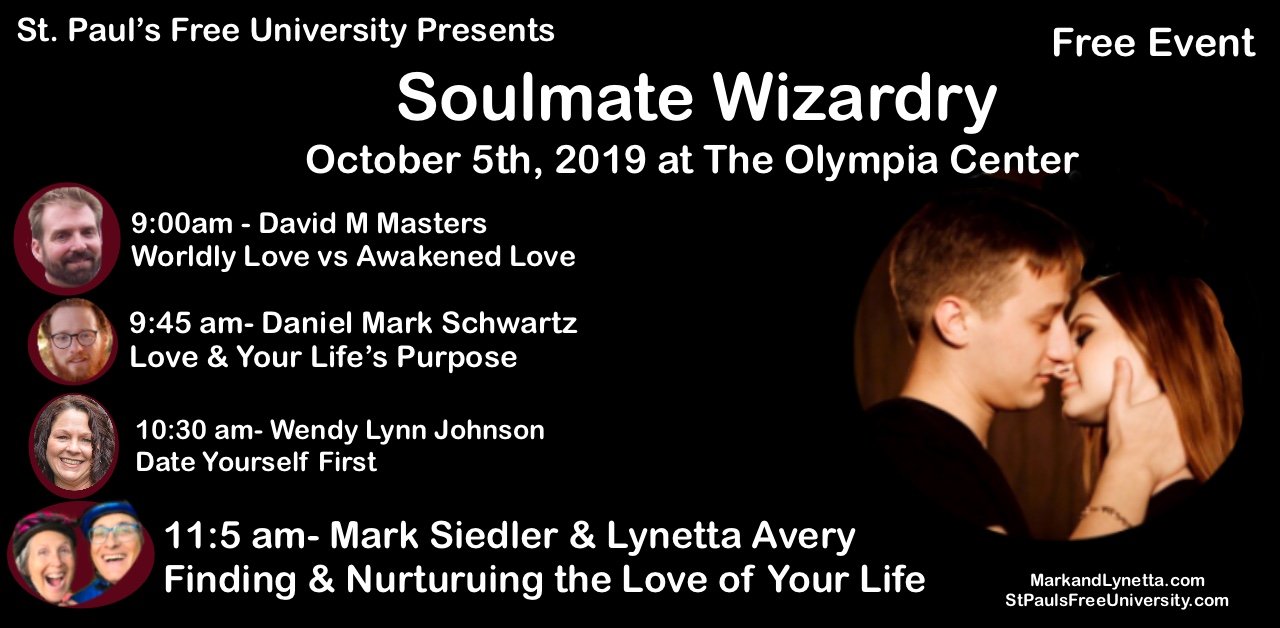
See you at the Soulmate Wizardry event.