Relief, Belief, and the Stories We Choose to Trust

There comes a point in life where you begin to notice that nearly everyone is reaching for something that helps them breathe a little easier. Not because people are weak. Because being human can hurt.
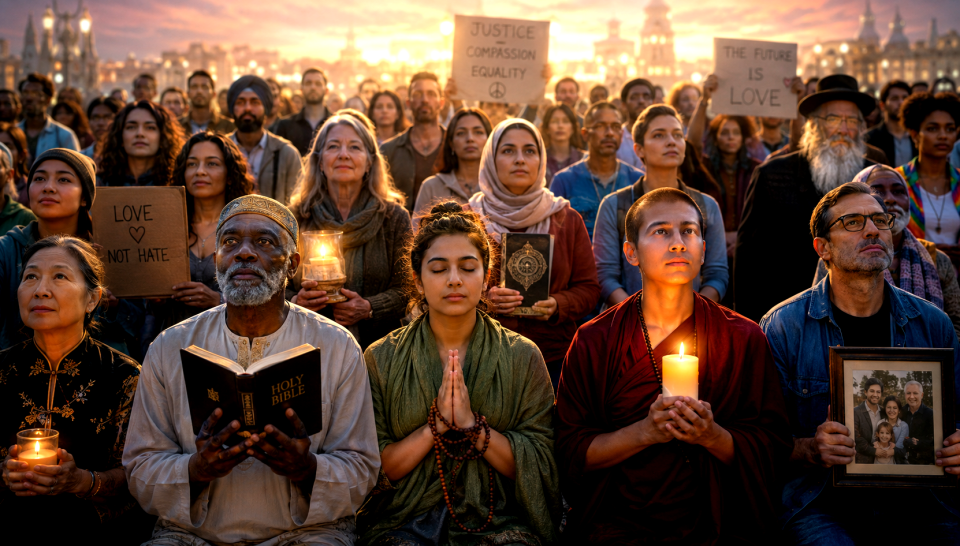
We are all carrying something. Financial pressure. Loneliness. Health struggles. Fear about the future. Grief over the past. Questions without answers. And when the weight becomes too much, the mind naturally searches for relief, meaning, reassurance, and hope.

And honestly, I think we’re all doing the best we can with what we have. <3

Some people find comfort in faith. Some in science. Some in politics. Some in spirituality. Some in self-help. Some in prayer. Some in meditation. Some in activism. Some in conspiracy. Some in entertainment. Some in community. Some in numbing themselves long enough to get through another day.

Everyone is trying to stabilize their emotional world somehow.

And I believe it is important that we learn how to speak about these things with compassion instead of arrogance.

Because once you understand this, you stop seeing people merely as “wrong,” and begin seeing them as human beings trying to manage uncertainty, pain, fear, and hope in the best way they currently know how.

That changes the conversation.

Within Christianity, for example, many believers find tremendous peace in the promise that Jesus will return, restore justice, heal suffering, and establish a better reality beyond the hardships of this present world. For countless people, this belief is not merely theological. It is emotional oxygen. It helps them endure loss, poverty, illness, injustice, and disappointment.

And whether someone interprets scripture literally, symbolically, mystically, historically, or devotionally, the emotional result can still be deeply real: comfort, hope, direction, meaning, forgiveness, and relief.

Others find reassurance in the idea that humanity is evolving into higher consciousness. Some believe hidden technologies or secret knowledge will eventually free humanity. Others place hope in political systems, social reform, economic change, disclosure movements, or the emergence of better leadership.

Every generation seems to create stories about rescue.

“The right leader is coming.”
“The corrupt system is collapsing.”
“The hidden truth is about to be revealed.”
“The world is about to change.”
“Justice is finally coming.”
“Good people will finally be vindicated.”

And sometimes these stories become incredibly elaborate.

People may begin believing that hated public figures have secretly been arrested, replaced, cloned, removed, judged, exposed, or defeated behind the scenes. These narratives often provide emotional satisfaction because they resolve tension psychologically before reality visibly changes.

The story becomes emotional pain relief.

That does not necessarily mean the believer is stupid.

It means they are human.

Human beings are storytellers by nature. We organize reality through narrative. We interpret uncertainty through symbols, explanations, predictions, and emotional frameworks that help us feel safer inside a very unpredictable world.

Even outside religion or conspiracy, this happens constantly.

A person may believe:
“If I just manifest correctly, everything will change.”
“If I buy this program, my suffering will end.”
“If I finally find the right relationship, I’ll feel whole.”
“If I obtain secret knowledge others don’t have, I’ll finally feel secure.”
“If I become spiritually advanced enough, pain will disappear.”

Again, none of this deserves mockery.

Because underneath nearly all belief systems is the same human longing:

“I want relief.”
“I want meaning.”
“I want safety.”
“I want justice.”
“I want love.”
“I want peace.”
“I want this all to make sense.”

That is profoundly human.

And this is why prayer, worship, meditation, visualization, fasting, healing work, philosophy, personal growth, spiritual practice, and even community movements can feel so powerful. They organize emotional energy. They create coherence. They give structure to uncertainty. They help the mind and body move from chaos toward stability.

Sometimes they even create measurable positive change.

Hope itself is powerful.

But there is also something important we must gently acknowledge:

Relief is not always the same thing as truth.

Sometimes a belief comforts us because it is accurate.
Sometimes it comforts us because it is emotionally useful.
And sometimes we simply do not yet know which is which.

That is where humility becomes sacred.

I have found that some of the wisest people are not necessarily the ones who claim absolute certainty. They are the ones who can remain open, thoughtful, compassionate, curious, and grounded while navigating uncertainty.

Especially without becoming hateful toward people who believe differently.

Because once we become emotionally addicted to being “right,” we stop searching for truth and begin defending identity.

That is dangerous in religion.
Dangerous in politics.
Dangerous in spirituality.
Dangerous in science.
Dangerous everywhere.

So how do we reason out what is manageably true for ourselves without becoming cynical, fearful, or judgmental?

I believe it begins with a few simple principles.

First, notice how a belief affects your life.

Does it make you more loving?
More grounded?
More compassionate?
More peaceful?
More responsible?
More honest?
More emotionally stable?
More forgiving?
More connected to reality?

Or does it make you fearful, angry, superior, isolated, paranoid, hateful, or obsessed?

Because the fruit of a belief matters.

Second, allow room for mystery.

Not everything must be forced into immediate certainty. Some things may remain partially unresolved for a while. Mature spirituality and mature thinking can tolerate unanswered questions without collapsing emotionally.

Third, separate emotional comfort from evidence.

It is okay to admit:
“This comforts me.”
“This inspires me.”
“This gives me hope.”

Without necessarily claiming:
“Therefore it must absolutely be factual in every detail.”

That distinction alone can save people from tremendous conflict.

Fourth, remain teachable.

The moment we believe we have nothing left to learn, growth slows dramatically. Life has a way of humbling all of us eventually.

And finally, try to remember that most people are not your enemy.

Most are simply trying to survive emotionally, spiritually, financially, physically, and psychologically in a complicated world.

Some do that through Christianity.
Some through meditation.
Some through politics.
Some through alternative spirituality.
Some through science.
Some through philosophy.
Some through community.
Some through imagination.
Some through hope itself.

And perhaps the deeper question is not merely:
“What do you believe?”

But:
“What kind of human being are your beliefs helping you become?”

Because if a belief system helps someone become more loving, more responsible, more peaceful, more forgiving, more compassionate, and more genuinely helpful to others, there may already be something valuable happening there worth respecting.

Even while we continue searching for deeper truth together.

The New Age: What It Is, What It Isn’t, and Why It Emerged

The rise of what we loosely call New Age spirituality didn’t happen in a vacuum. It emerged during a period of deep cultural fatigue and spiritual disappointment—particularly in the late 1960s and 1970s—when many people quietly concluded that neither institutional Christianity nor Secular Humanism was adequately answering the deeper questions of meaning, ethics, purpose, and the future of humanity.

For some, Christianity felt overly rigid, moralistic, or disconnected from lived experience. For others, Secular Humanism seemed to strip life of mystery, transcendence, and soul. Into that gap stepped something new—or at least something newly packaged.

The New Age wasn’t born as a single movement with a central authority or manifesto. It arose organically, borrowing ideas, symbols, and practices from a wide range of older traditions: astrology, Hinduism, Taoism, Gnostic Christianity, Theosophy, Spiritualism, Wicca, and other Neo-pagan streams. England served as one of its early incubators in the 1960s, with communities like the Findhorn Community and the Wrekin Trust experimenting with alternative spiritual living.

From there, the ideas traveled quickly.

In North America, early mileposts included New Age seminars hosted by the Association for Research and Enlightenment and the founding of the East-West Journal in 1971. Popular culture soon amplified the message, most famously through figures like Shirley MacLaine, who brought metaphysical curiosity into mainstream conversation.

What began as small circles of seekers gradually became a broad, decentralized spiritual marketplace.

Criticism, Controversy, and Consolidation

By the 1980s and 1990s, the New Age movement faced increasing criticism—from academics, religious leaders, and cultural commentators alike. Channeling was mocked. Seminar leaders were scrutinized for the wealth they accumulated. Claims about the “scientific” properties of crystals were challenged and often debunked.

Some critics went further. Carl Raschke, a professor of Religious Studies at the University of Denver, famously described New Age spirituality as:

“the spiritual version of AIDS… a breeding ground for a new American form of fascism.”

Whether one agrees with that assessment or not, it illustrates the intensity of the reaction.

And yet—despite ridicule, critique, and internal excess—the New Age didn’t collapse. It stabilized. It adapted. It diversified. By the early decades of the 21st century, it had become a persistent and influential presence in North American spiritual life, with millions of adherents engaging selectively rather than dogmatically.

The New Age That Does Not Exist

Much confusion about the New Age comes not from what it is—but from what it is assumed to be. There is no massive, underground, highly coordinated New Age organization secretly infiltrating governments, churches, schools, or media. That narrative emerged largely from fear-based counter-cult movements rather than evidence.

Likewise, many traditions have been incorrectly lumped into the New Age category. For example, Tasawwuf (Sufism) has at times been dismissed as a New Age cult. In reality, Sufism is an ancient mystical stream within Islam, long predating the New Age and historically existing in tension with more legalistic expressions of the faith. It has no actual structural connection to New Age spirituality.

Similarly, in the 1980s and early 1990s, some conservative Christian groups failed to distinguish between the Occult, Satanism, Wicca, Neo-pagan religions, and New Age practices—often treating them all as interchangeable or even criminal. In truth, these are very different phenomena with distinct histories, beliefs, and motivations.

Oversimplification breeds fear. Discernment requires nuance.

Common New Age Beliefs (But Not Universal Ones)

The New Age is not a creed—it is a menu. Followers are often encouraged to “shop” for ideas and practices that resonate personally. That said, several recurring themes appear frequently:

Monism

All that exists flows from a single divine source or energy.

Pantheism

Everything that exists is God. Divinity is not external but inherent in all things, including the self.

Panentheism

God both permeates the universe and transcends it simultaneously.

Reincarnation

The soul is reborn repeatedly across multiple human lives, evolving through experience.

Karma

Actions accumulate moral or energetic consequences that influence future incarnations.

Auras

The body emits an energetic field that reflects emotional, spiritual, and physical states—interpretable by those trained to perceive it.

Personal Transformation

Intense mystical experiences—often induced through meditation, guided imagery, hypnosis, or altered states—are believed to awaken latent human potential such as healing abilities, psychic perception, or cosmic insight.

Planetary Transformation

As enough individuals awaken, a global shift in consciousness is expected to follow—spiritual, psychological, ecological, and cultural.

Ecological Responsibility

The Earth is often viewed as Gaia—a living, conscious entity deserving reverence and protection.

Universal Religion

All religions are seen as different paths up the same mountain. No single path is ultimate; all eventually lead to the same summit.

New World Order (Utopian Vision)

As the Age of Aquarius unfolds, humanity is expected to enter a harmonious global era marked by world cooperation, the end of war, disease, hunger, and discrimination, and a shift from national allegiance to planetary responsibility.


The New Age is neither the savior of humanity nor the villain of faith. It is a response—a mirror—reflecting humanity’s ongoing hunger for meaning, unity, healing, and transcendence.

Where it invites curiosity, it can be useful.
Where it abandons discernment, it can mislead.
Where it seeks transformation without responsibility, it can drift into fantasy.

As with all spiritual movements, the question is not “Is it right or wrong?”
The better question is:

Does it lead us toward greater humility, compassion, responsibility, and truth—or away from them?

That question matters far more than labels ever will.


Are You a Victim of This Life?

Have you ever stopped long enough to look around to see that everyone and everything around you is telling you what to do, what to believe, and what to think? Are you a victim of this life?

From birth, you’ve been programmed to think small. You’ve been allowed to exercise your imagination as a fanciful kid’s toy and as you’ve matured you’ve been taught that if you think it’s anything more, then you’re a fool.

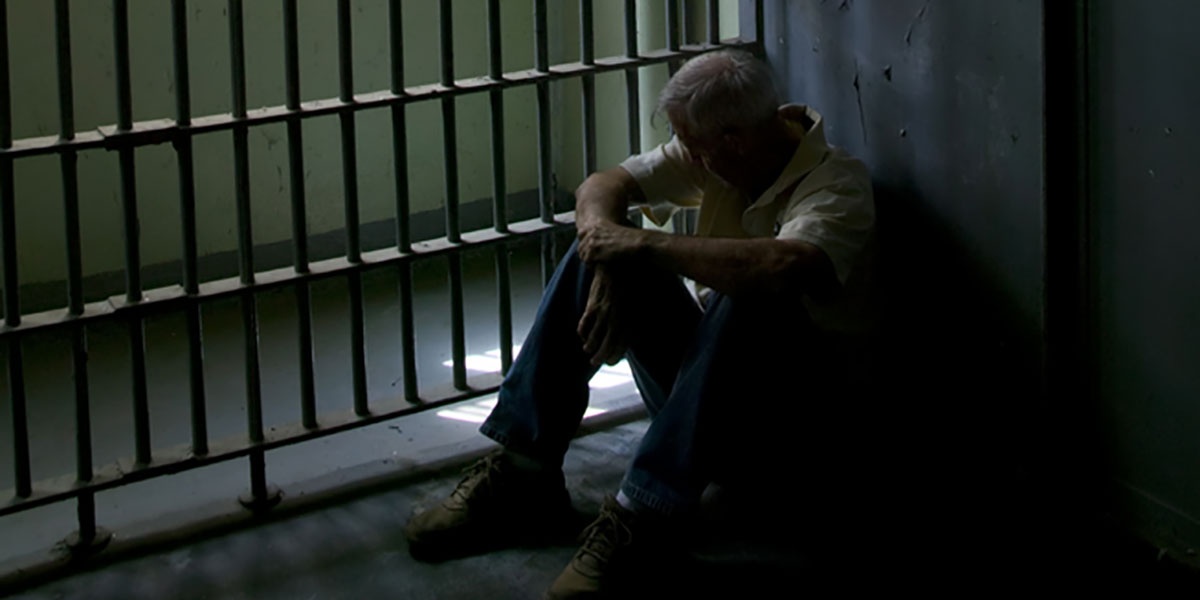
Every once in awhile your imagination presents to you a glimpse of the life that is waiting for you, then your programming kicks in, as you responsibly brush those thoughts aside, and slip back into the thought prison that’s been created for you. This prison of deception restrains you from exercising your full potential and reaching out to enjoy the life that is your divine birthright.

You think you’re unworthy, not educated enough, or were not born into the right family… all the things they want you to believe, yet none of these things are real. Your limiting beliefs are the prison bars that separate you from the life you are sacredly entitled to. And these thoughts are not yours, they’ve been strategically planted there to diminish you, to restrain you onto a life of service, as a slave to the system.

You have been tricked into believing that you have no special gifts, skills, or abilities. Even though sharing your gifts, kills, and abilities are the primary reason for your existence. That’s your reason for your being here in the first place.

Abundance and joy are elusive because you’ve been programmed to shrink down in fear of taking the risks necessary to reach out in faith and create for yourself the amazing life that is waiting for you. You fear what might happen if you make a mistake or fail, and you’re ready to bail at the first sight of resistance.

And when you’re feeling like something’s just not right, rather than think it through, you reach for comfort food, drink, smoke, drugs, magazines, videos, or other media to distract you and keep you numb to the endless possibilities that await you, if you could only break the spell you’re under.

You are enveloped in a sea of apathy, where you are exposed to so much information and distracted by so much stimuli that there is little hope of connecting with your higher self. Any thought of dissatisfaction is met with news that dictates that your life could be worse. This is to create that knee-jerk reaction which keeps you small.

Yet, there is this still small voice inside you which can be heard above all the noise of the constant barrage of programming that yearns for something more, and you think to yourself, “There must be more to this life than this.”

This is your divine spark of life that remains pleading that you take hold of your sacred authority and start living the life you were meant to live, to grasp and embody your purpose, message, passion, and mission in this life, to be the man or woman you were called to be in fullness and grace.

You are not a single-celled organism, you are a powerful creator, with the power of the whole world in your hands. This is your birthright.

Living life to its fullest is not an easy path to take. There will be resistance and challenges along the way, but you can do this, if you really want it.

Social Prison of the Mind

If you know someone who is comfortable inside the box dictated by our socially engineered lives, after you have spent some time in exploration outside the box, sharing your ideas, feelings, and data obtained outside with someone inside, this conversation can be difficult at best.

Society imprisons us by structural cages of thought which are more effective high levels of containment than any bars of any cell in any prison. When you put a prisoner behind bars, he or she longs for the life which exists on the other side of the bars.

How more effective would it be if you could make the prisoner believe that life on the other side of the bars would cause him or her to burst into flames and experience painful longsuffering death. If you could do this, then managing prisoners could be very easy. If effectively administered, with this level of fear, you would not even need bars at all.

You could paint a line on the floor and condition a prisoner to believe that crossing the line will cause him to burst into painful flame. Just in case the prison thinks there is the potential of a greater life on the other side of the line, all you have to do is to show him a dancing flame with a soundbite of agonized screaming, and the fear is reignited. The prisoner rejects the thought of life on the other side of the line.

After a while, you can even eliminate the line as a boundary, because the prisoner knows anything “over there” is flaming pain and death.

While this may sound ridiculous on the surface, this is the life that peoples of the world live in the prisons of their minds every minute of every day.

Social engineering constructs the invisible cells of our minds which are the highest level of containment, reinforced by fear. To keep you from thinking outside the cell or box, the boundaries of the perimeters are shown a dancing and screaming flame on the television, or via some other media, to keep us afraid of thinking outside the box.

There are so many sequential layers of the fear. Fear of not being accepted or loved. Fear of not being clothed, fed, or a roof over your head. Fear of pain or being punished. Fear of being prevented from having the experiences you desire.

Speaking of desire, even what you want can be dictated by the social engineers. How impressive is that?

There are socially-engineered acceptable methods of getting what you want. Any method of attaining those things which you desire outside the commonly held view of what is acceptable is confusing or rejected by those who safely reside inside the social prison.

Some methods will be punished by law, and others are disregarded as freak accidents, such as being hit by lightning or winning the lottery.

Acceptable methods would include, going to school, followed by secondary education, working very hard in a professional trade for which you have paid to be trained, and keeping one’s self focused on the things you desire, in a high level of debt, while maintaining a reasonable credit score.

This is the society of consumers which has been socially engineered.

Managing a consumer’s indebtedness can be a difficult balancing act, so there has been a mechanism initiated by the engineers whereby if a consumer has gotten out of control, every once and a while, an indebted consumer can start the cycle over again by filing bankruptcy, because having a hoard of active consumers is far more critical to the operation of the social machine than actually paying one’s debts.

Yet, every now and then, someone gets a glimpse of life outside the box.

Even though it is frightening, more and more of us, are questioning the socially-engineered prisons of our minds and daring to explore life outside the box.