Branding Masters Remastered: How to Build a Brand of Integrity, Strength, and Legacy

Branding is no longer about clever logos, flashy taglines, or marketing gimmicks. In a world flooded with noise, consumers crave something deeper, something real. They are searching for leaders and brands that stand for something enduring.

When David M. Masters introduced Branding Masters: How to Brand Yourself or Create a Business Brand Strategy in 2015, it became a lifeline for entrepreneurs, coaches, and creators who wanted more than a business plan, they wanted purpose. But a decade later, the landscape has shifted dramatically. Social media has multiplied voices, trust has become scarce, and audiences can sense insincerity from a mile away. Branding has evolved. And so must we.

This completely updated and expanded edition—Branding Masters Remastered—is more than a revision. It is a remastering.

In these pages, Masters invites you to step into a new way of thinking about branding, not as a marketing tactic but as a reflection of your very essence. Your brand is not simply what you sell; it is how you live, how you serve, and how people remember you long after you are gone.

You will learn how to:

    • Anchor your brand in integrity. Discover why trust is the most valuable currency and how to cultivate it daily.
    • Create emotional connection. Move beyond persuasion and into presence—making people feel seen, heard, and valued.
    • Collaborate for strength. Shift from isolation to partnership, unlocking networks of resilience and opportunity.
    • Develop endurance. Stop chasing quick wins and start building steady practices that sustain influence for decades.
    • Evolve without losing your soul. Adapt to cultural and technological shifts without betraying your essence.
    • Turn setbacks into redemption. Learn how to transform crises into defining stories that build credibility.
    • Invest in legacy. Build systems, relationships, and stories that outlive you and bless generations.

Through compelling stories of entrepreneurs, leaders, teachers, and everyday people, Masters reveals how ordinary individuals build extraordinary influence when they align their work with timeless values. You’ll hear about the teacher whose classroom became her ministry, the baker whose bread carried love, the business owner who rediscovered purpose after burnout, and the leaders who turned failure into testimony.

You’ll also encounter vivid lessons from Scripture and history: Joseph’s stewardship in Egypt, Esther’s courageous influence, David’s psalms that still comfort hearts, Paul’s letters written in chains, and Jesus’ servant leadership that reshaped the world. These examples are not offered as distant metaphors but as living blueprints for modern branding rooted in service and love.

What sets Branding Masters Remastered apart is its combination of inspiration and action. Every chapter integrates reflection questions, brand equity “deposits,” and conversational coaching that transform ideas into lived experience. Rather than sterile lists, you will find practices woven into real-world dialogue, helping you embody what you read and apply it in your work, relationships, and leadership.

This is not a book about hype. It is not about manipulating perception or chasing trends. It is about the long game; the kind of branding that carries weight, withstands storms, and leaves a story worth telling. It is about becoming a leader who builds with integrity, serves with love, and endures with faithfulness.

If you are an entrepreneur, leader, or creative longing to build something that matters, something that will not just succeed today but endure tomorrow, this book is your companion, your coach, and your guide.

Because one day, your name will be spoken in the past tense. What will they say?

With Branding Masters Remastered, David M. Masters shows you how to build a brand of integrity, strength, and legacy, one that testifies not only to what you accomplished, but to who you were.
 

Elements of a Good Slogan Today

The world is changing, and some of the clever methods of deriving catchy phrases to sell products back in the day need to change to reimagine the necessary elements of a good slogan today. Let’s take a look at what is working for the branding masters.

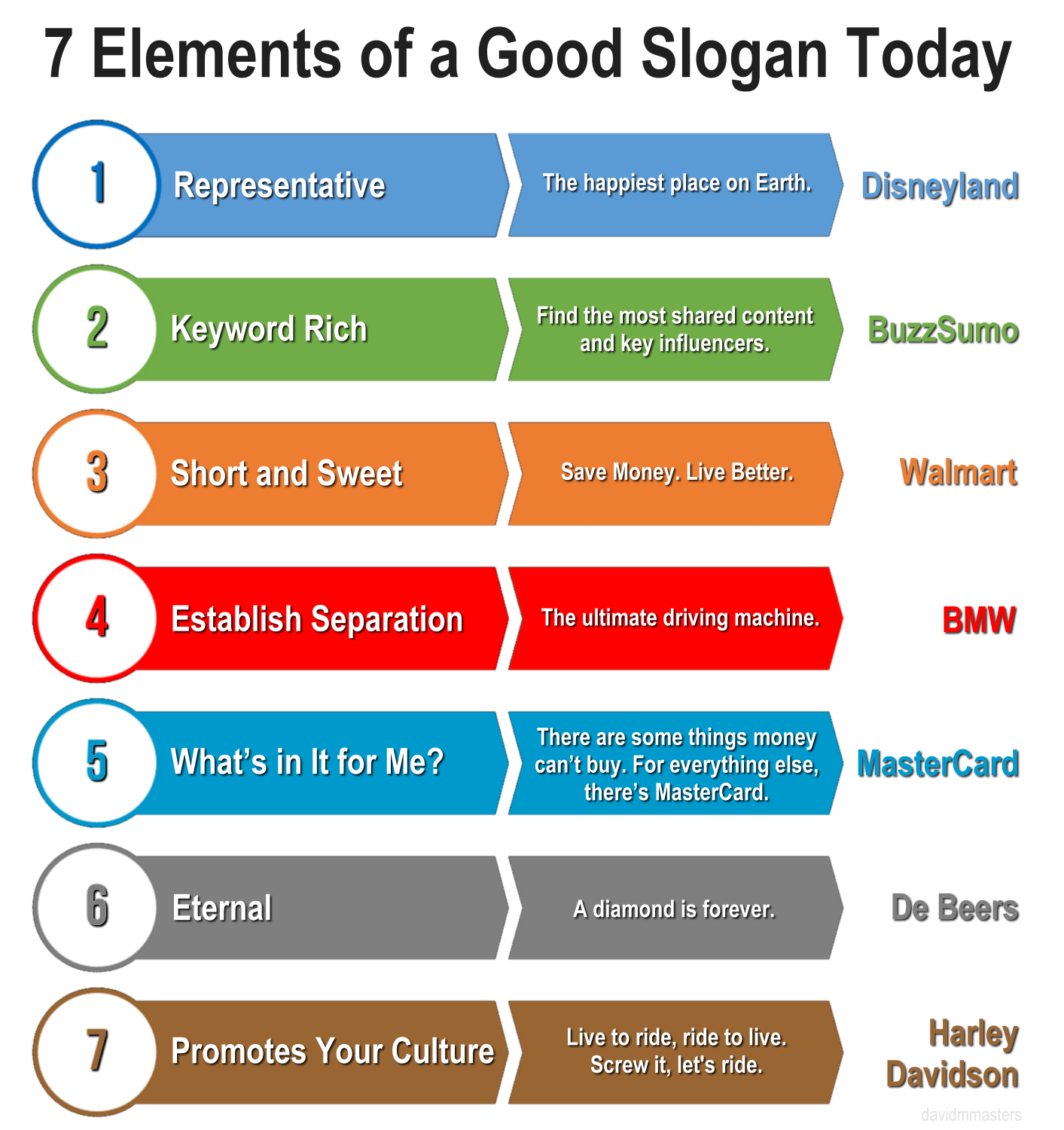
7 elements of a good slogan today

A common link associating the taglines of yesterday to modern marketplaces remains, “Yes,” slogans help to uplift the brand and should sustain their message long after you’ve read or heard their words.

If you are interested in how to create your best brand catchphrase, here are the common elements of a good slogan today

7 Elements of a Good Slogan Today

1. Representative

Your slogan must represent you, your company, your brand’s image in such a way as to reinforce your values and what you offer to the world.

Example: Disneyland, “The happiest place on Earth.”

2. Keyword Rich

This is a completely new concept, but as our world changes, so does the need to change the way we do business and encourage others to align with our brands. Include one or more keywords related to what you do that are not present in the name of your brand into your slogan. This gives you a digital advantage over other jingles.

Example: BuzzSumo, “Find the most shared content and key influencers”

3. Short and Sweet

Short, so that your brand’s slogan is less than 10 words in length because, in the best-case scenarios, people will be able to memorize it, recite it, and associate it with you and your brand. So, you can start with the best 30 words that describe (a) who you are, (b) what you do, and (c) how you do it (“representative”) and render it down to the sweetest phrase of 10 words or less.

Example: Walmart, “Save Money. Live Better.”

4. Establish Separation

There’s a good chance that you and your brand are not the only source of satisfaction of the needs of your potential clients or buyers, so use your slogan to separate your brand from anyone else who may be also vying for your target market. Ask yourself, what makes your brand different? Then include the answer on your slogan.

Example: BMW: “The ultimate driving machine.”

5. What’s In It for Me?

This is the only question your customer is asking, and you would be wise to include at least one main benefit that you know your customer wants in your brand’s keyphrase, and it should be the number one thing they want when they think of your product or service.

Example: MasterCard: “There are some things money can’t buy. For everything else, there’s MasterCard.”

6. Eternal

You want your catchphrase to linger on for generations unscathed by time or technology, so don’t tie it too closely to the resources at your disposal today, know that many things will change, and you and your brand’s intention is to survive the test of time. Do not limit your slogan to how we do it today when a shift in tech could change it forever, and your slogan will suddenly be outdated.

Bad Example: Verizon’s “Can you hear me now? Good.” The slogan was retired when the technology had advanced enough that quality of connection among providers was no longer an issue.

Good Example: De Beers: “A diamond is forever.”

7. Promotes Your Culture

Your brand should be able to connect so well to your customers that you become an extension of the way they want to live their lives. This is your brand’s culture. Done right; your customers will be waving flags with your slogan on them or tattooing your catchphrase on their bodies.

Example: Harley Davidson: Past, “Live to ride, ride to live.” and currently, “Screw it, let’s ride.”

And just in case you thought we were being too serious, you can take a seriousness-break and try out this Advertising Slogan Generator, just for fun.

Branding Masters

© 2015 Excerpt from Branding Masters by David M Masters


Who Are You Known As?

You owe yourself the honor of seeing that you are represented in the world in a way that is in accordance with how you would like to be known and/or remembered. So, who are you known as?

You know who you are. You know how you think, what’s important to you, what makes your heart sing, etc.… but are you presenting yourself in such a way, so others can see you for who you are?

More often than not, we are oblivious to how others perceive the public image we project of ourselves.

Nowadays, we have these huge social media billboards posted all over the Internet. You may think of yourself as being a certain kind of person, but what do you look like on the World Wide Web?

In a worst-case scenario, since nearly no one knows it will come, how would you be seen by those who looked you up online after hearing that you had died in an accident today? Chances are, no one has your password, so your social media life would be frozen in time at the sound of your flatline.

Beeeeeeeeep.

Looking at some random people’s social media, you could safely assume that this person would be known as someone who hates the President. This person believes in aliens. Here’s an avid conspiracy theorist. This person falls in love with a different person every month and vacillates between hating and loving prospective lovers.

Here’s a sarcastic critic of just about everyone and everything. Here’s somebody who relentlessly posts shameless selfies. This guy never wears a shirt and has pineapple-hair. This person is clearly always in a drunken stupor, and here’s the world’s biggest fan of marijuana.

I had a friend who was clearly identified as a thrill seeker, so it was no surprise when he was involved in a fatal accident. In his case, his social media was an accurate representation of his tendency to tempt fate. But there was so much more to him that those of us who knew him well saw in him which was not represented on the Internet.

If your ability to post on social media was curtailed by your ability to live, how would you be remembered? It might be worth taking a look at. Maybe it’s time to post something congruent with how you might like to be remembered?

And that’s just your virtual personality. What about in real life?

In real life, at school, work, hanging with friends, we often represent ourselves in one way, when the identity of our authentic self is quite different. We might hide our sensitive side, or present ourselves as bolder, to either prevent ourselves from being vulnerable or to advance our position among peers or coworkers.

You are far more than people might think who you are or what you do.

Chances are, even your family members may not know your best attributes. What you believe,

Maybe it’s time to take a look at how you are perceived in the community. Ask friends and coworkers whom you can trust how they see you. Do they see you the way you want to be seen?

Branding Masters

Who are you? Today might be a good take to take a look at your personal brand.

Is It Time to Rebrand?

Holistic entrepreneurs are not only doing great work in the world, they are also cognizant of their own spiritual wellness. This is why I am blessed to be surrounding myself with creative triunistic (body/mind/spirit) conscious individuals who are ever evolving and expanding.

As my clients evolve, likewise their lives and their business environments change and adaptation is necessary to maintain congruency with the ongoing metamorphosis.
It becomes necessary to contemplate changing your brand (the representation of who you are and what you do) to embrace and harness the power of your expansion to allow further opportunities and expansion.

Your brand is not only what you say it is, it is what people think about you when they hear your name or the name of your business. If not tended to, your brand can be very weak. Given the proper attention people will recognize the impression you desire to communicate when your name comes to mind. It is a powerful but delicate balancing act.

We love doing the things we love, that is why we do what we do, but as we evolve those things we love – those things we are deeply passionate about – are also subject to change.

Upon conception of your foray into the public medium, you brand yourself initially as you see yourself and like to represent who you are and what you do to others. Often this is apparent when you first meet and/or greet someone, exchange pleasantries and introduce yourself. What you say in the first 30 seconds establishes your brand.

It makes sense that as you change, so should the way you introduce yourself to others (your brand).

So how do you establish who you are and what you do?

Periodically checking with your inner self and query where your passions are and compare them to where you were. Ask yourself is my brand (the way I have been representing/introducing myself) an adequate representation of where I am today?

If not, it may be time to revisit how you represent yourself to others and consider rebranding.

Making these changes as often as necessary (there are no hard and fast rules about when, only when you recognize you have changed enough to communicate the adjustments to others) will open doors and invite further expansion of your efficacy in the community and the world at large.

If you’re considering that it is time for a personal or professional review, ask yourself these questions,

Where did I come from?
How did I get here?
What offerings, tools, skills and special abilities do I have?
What was I most enthusiastic about in the past?
What makes my heart sing today?
Is something calling me, beckoning me to bring it forth?
Can I accept the challenge to expand who I am or what I do?
If so, what would that look like?
Can including this vision in my brand further my evolution or expansion?

The answers to these and other questions that might come to mind will help you determine whether it is time to make adjustments to your brand.

Branding Masters

Are you ready?

Branding You dot Com

Branding-You-dot-com-Connect-the-dotsOne of the best communication tools available is to establish a platform from which to deliver your message.

Your brand can do a great deal of the heavy lifting when attempting to communicate or deliver a message to your audience.

Effective branding will establish you as an authority and will pre-qualify your target audience. Properly branded, makes you more identifiable and accessible to your supporters.

Start with a dot-com to connect your dots.

Who are you?

The very fist consideration in branding one’s self, is to establish your name – and to distinguish it as apart from those who have similar names.

In the current level of technology in the world’s methods of communication, the dot-com is the definitive qualifier for effective branding.

Your ability to purchase your own dot-com may determine what your brandable name might be.

For instance, if your name is John Smith and you discover that johnsmith.com is not available, you must continue to research additional variations until you find a brandable dot-com.

If after exploring all the possible variations of your name to establish your dot-com identity only to find that they have already been scooped up by others sharing your name (which you may have never known how common your name was prior to this exercise) there may be a last-ditch-effort available to you.

You could resort to using dashes, like: john—r-smith.com but if you must do this, I would also suggest in backing it up with another domain extension (like a dot-net or some other available extension without the hyphens).

You should have two dot-coms one representing who you are (your personal name) and what you do.

What do you do?

Next is to establish your brand in your area of interest or expertise.

Let’s say that you make homemade beer; to brand yourself you might attempt to get homemadebeer.com. You discover that domain is taken, so you must do additional work to find an available dot-com that pertains to you.

This is an excellent procedure to encourage you to expand your scope to include an arena for fans and fellow aficionados to interact with you, so you expand your scope to include room for others bolstering your influence.

Your resulting dot-coms from this exercise might result in obtaining:

Johnronaldsmith.com
Privatelabelbeer.com

Establishing your identity and are of interest or expertise in the dot-com arena is your first order of business and all of your activities after securing your dot-coms should reflect your branding.

If most of your friends call you “Johnny,” but your dot-com is John, then start correcting your friends – and by all means, anytime you do anything in public – make certain that you are identified as “John Ronald Smith”. Not John R. Smith. You must identify with and protect your brand, just as if it was your trademark (and it is).

What about the rest of the dot family?

A common question I get asked is, “What if my name-dot-com is not available, can’t I just get the dot-net or some other Internet extension?”

My initial response is, “No.”

The reason is simply that as a general rule, people who use the Internet tend to automatically type dot-com following a domain name. The risk is, of course, that someone else can hijack your identity or fan base by having the dot-com.

That said; the dot-com extension should always be your preference. To establish further protection of your brand, you may want to purchase some of the associated domain extensions (i.e., dot-net, dot-org, dot-info) to prevent someone else from diluting your branding.

Branding Masters

Securing your dot-com identity should be your first course of business prior to coming up with a name for any new endeavor. If you come up with a great name for a new project that you are working on and the dot-com is not available… keep working on the name until you find a dot-com-brandable name.