Active vs. Passive Investing Two Very Different Ways of Carrying the Weight of Enterprise

In the world of business and finance, the word “investor” can mean many different things. Two people may both claim that title, yet their roles, risks, and responsibilities may be vastly different. Some investors operate from a passive position, participating through funding structures, government programs, or managed capital. Others operate from an active position, where their personal livelihood, reputation, and daily labor are intertwined with the outcome of the enterprise itself.

Both models exist in every economy. Both serve functions within society. But they represent very different relationships with risk, responsibility, and the human side of enterprise. Understanding this difference can help us better appreciate the many ways businesses come into existence, and the many ways they survive.

The Passive Investor

Passive investors often operate within structured systems of finance. Their role is frequently centered around capital allocation, strategic partnerships, and resource access.

In many cases, these individuals or organizations are highly skilled at navigating complex funding ecosystems. They may work effectively with federal programs, grants, tax incentives, municipal partnerships, or economic development initiatives.

From the outside, these ventures often look impressive.

Ribbon cuttings.
Press releases.
Public recognition.
Economic development awards.

These projects can bring jobs, services, and infrastructure to a community, and the people behind them are often well respected in civic and political circles.

Yet in many of these structures, the investor’s personal financial exposure may be limited. The risk may be spread across government incentives, institutional funds, tax advantages, or pooled capital structures.

This doesn’t necessarily make the work less valuable, it simply means the nature of the risk is different.

The individual may be investing strategy and influence more than personal survival.

The Active Investor

Now contrast that with the active investor, who is often indistinguishable from the entrepreneur.

This is the individual whose personal livelihood is directly tied to the success or failure of the business.

There is no grant waiting to refill the bank account. There is no institutional safety net cushioning the fall.

Instead, there is often a deep personal commitment, sometimes bordering on a calling.

The active investor may be:

    • personally securing loans
    • investing personal savings
    • mortgaging property
    • working long hours to keep operations afloat
    • solving problems no one else even sees

For these individuals, the business is not simply a financial instrument. It is a lifeline.

When the economy shifts, when supply chains tighten, when customers disappear, the responsibility does not shift to a board or a funding agency.

The buck stops with them.

The Human Element of Enterprise

There is something deeply human about the active investor model.

These entrepreneurs often know their employees personally. They understand the ripple effect of every payroll check. They feel the weight of each decision because it affects not only profit margins, but real people’s lives.

They may not always appear on stage at civic ceremonies. They may not have polished public relations campaigns.

But they carry something quietly powerful:

skin in the game. Their investment is not just financial. It is personal.

Two Different Energies

Neither model is inherently superior.

Large infrastructure projects often require structured capital, public-private partnerships, and complex financing tools that passive investors are uniquely equipped to manage.

At the same time, many of the most resilient and innovative companies in the world were built by people who risked everything they had to bring an idea to life.

The difference is not simply financial. It is energetic.

One system distributes risk across institutions.

The other concentrates responsibility in the hands of a single determined human being.

Active vs Passive Investing

A Simple Comparison

Dimension Passive Investing Active Investing
Primary Role Capital allocation and resource coordination Direct ownership and operational responsibility
Financial Exposure Often shared across institutions, funds, or incentives Frequently personal and direct
Funding Sources Grants, government programs, institutional capital, tax incentives Personal savings, loans, private capital
Day-to-Day Involvement Strategic oversight, partnerships, public relations Operational leadership, daily decision-making
Public Visibility Often highly visible through civic and political networks Often less visible but deeply embedded in the business
Risk Structure Distributed risk Concentrated risk
Personal Consequences Reputation and financial portfolio impact Personal livelihood often tied to success
Decision Timeline Often long-term strategic planning Continuous real-time problem solving
Community Perception Seen as economic developers or project leaders Seen as local business owners or entrepreneurs
Emotional Investment Often strategic Often deeply personal

The Quiet Courage of Entrepreneurship

Many communities thrive because both types of investors exist.

Large projects often require complex financing structures and institutional partnerships.

But the heartbeat of most economies is still found in the small and mid-sized businesses run by individuals whose names are on the door, whose families depend on the outcome, and whose courage keeps the enterprise alive during difficult seasons.

These are the entrepreneurs who wake up each day knowing that the future of their company, and often the livelihood of others, rests on the decisions they make.

That kind of responsibility requires something beyond financial strategy. It requires conviction.

When you hear someone described as an investor, it is worth asking a deeper question:

What kind of investor are they?

Are they participating through systems that distribute the risk?

Or are they standing in the arena where every decision carries personal consequences?

Both play roles in shaping the economic landscape.

But they represent two very different relationships with enterprise, responsibility, and the weight of building something that must stand on its own.

And sometimes, understanding that difference helps us appreciate the quiet courage of those who choose to build their future with everything they have on the line.


The Entrepreneurial Spectrum: Why Some Make It, Some Dab, and Most Quietly Disappear

Because I am a business consultant, and because I’ve had some measurable success, I tend to attract people who want to “start something.” A business. A side hustle. A big idea. A freedom plan. And over the years, a pattern has become impossible to ignore. Entrepreneurial desire is not a yes-or-no condition. It is a spectrum—a wide one.

On one end, you have what I call the Entrepreneurial Rock Kicker.

This is the person who occasionally gets inspired. Maybe they hear a podcast. Maybe they watch a viral video. Maybe a friend “made it big” in six months with what sounds like little effort and no risk. The rock kicker picks up an idea, turns it over in their hand, imagines a new life… and then puts it back down when it feels heavy.

At the other extreme is the Compelled Entrepreneur.

This person is not dabbling. They are driven. Sometimes obsessed. They have a dream that won’t leave them alone. They are willing, perhaps uncomfortably so, to risk reputation, comfort, certainty, and even relationships to bring that vision to life. These are the people who don’t ask, “What if this fails?” They ask, “What happens if I don’t try?”

Between these two poles lives a crowded middle:

    • The paycheck refugee who just wants out from under a boss
    • The “motivated” person who is unwilling to make sacrifices
    • The idea-holder who wants grants, loans, or investors before proof
    • The opportunist who sees systems or people as something to exploit
    • And yes… the grifter, the con, and the short-term manipulator

But the most puzzling, and honestly, the most frustrating, group of all is the one that looks promising.

The Entrepreneurial Dabbler

The dabbler is the one who catches my attention.

They have enthusiasm. Real enthusiasm. They seek me out, talk about vision, say the right things; and I get excited. I lean in. I start thinking about strategy. I imagine what they could build. We begin a coaching relationship… and then reality quietly introduces itself.

What they were actually expecting was this:

    • A little money
    • A little effort
    • A little discomfort
    • And then… filthy rich

Yes, instant success stories exist. We’ve all heard them. They are incredibly inspirational. But what most people who hear these stories do not understand, is that the “instant” part is almost always a myth.

The reported story is usually the final chapter, not the first twelve drafts. The invisible years, relationships, failures, and expenses are edited out for dramatic effect. The myth inspires, but it also misleads.

If someone is unwilling to invest in the tools required to see a vision through, they are statistically unlikely to succeed. I see this constantly in the digital business world.

There are endless free tools now: free software, free platforms, free trials, and while those can be useful early on, I watch people refuse to pay for what actually moves the needle. They won’t pay the “rent,” and business, online or offline, always has rent.

Think about a brick-and-mortar store:

    • Rent is due before customers arrive
    • Utilities run whether sales happen or not
    • Employees must be paid before profits exist
    • Advertising costs money before visibility
    • Networking requires time, travel, and presence

People may drive past a storefront for a year before walking in with a wallet. Don’t expect the universe, or anyone else to believe in you, or truly support you and your dream or cause, if you are not fully invested. Paying the rent and maintenance is the lever that propels your momentum forward.

And every single day, businesses close not because the idea was bad, but because the owner could not or would not stay long enough for the momentum to build or the vision to mature.

Pre-Entrepreneurial Readiness Test

Answer honestly. Score yourself as you go.

Give yourself 1 point for each “yes.”

      1. Are you willing to invest money before you see results?
      2. Can you tolerate months of invisible effort?
      3. Will you continue even when no one is cheering?
      4. Are you open to being wrong, and adjusting fast?
      5. Can you delay gratification longer than your peers?
      6. Are you willing to look foolish in the early stages?
      7. Will you pay for tools you don’t yet fully understand?
      8. Can you keep showing up without external validation?
      9. Are you willing to outgrow people you care about?
      10. Would you pursue this even if it took five years?

Scoring Insight

      • 0–3 points: You like the idea of entrepreneurship more than the reality.
      • 4–6 points: You are curious, but underprepared.
      • 7–8 points: You have real potential if you mature your mindset.
      • 9–10 points: You are already an entrepreneur, results are a matter of time.

This is not judgment. It’s clarity.

Preparatory Actions to Increase Your Odds of Success

If you are serious, or want to become serious, here is where to start:

    1. Budget for belief
      Decide in advance what you will invest before results show up.
    2. Choose tools intentionally
      Don’t chase shiny software. Commit to a few essentials and master them.
    3. Build stamina, not hype
      Consistency beats excitement every time.
    4. Normalize discomfort
      Confusion, doubt, and slow traction are not signs of failure—they are signs of growth.
    5. Track effort, not just outcome
      Success lags effort. Measure what you can control.
    6. Pay the rent
      Mentorship, platforms, visibility, and systems all cost something. Accept it.
    7. Decide who you are becoming
      Businesses succeed when identities mature faster than circumstances.

Entrepreneurship is not for everyone, and that’s okay.

But if you are going to step into this arena, do it with eyes open and spine straight. Don’t dabble and call it destiny. Don’t flirt with commitment and blame the world when it doesn’t reward you.

If you are called, truly called, you will find a way.

And if you’re not yet called, the most powerful move you can make is to tell yourself the truth… before the market does it for you. That honesty alone can save you years, or prepare you for a lifetime of meaningful work.


Being Open and Available

There are people who are on the fringe of your business, people who are acquaintances, those who are prospective clients, clients and associates, and if you think of these categorically as concentric circles of, at the center are your lifelong clients and friends. The goal would be to continually invite people into the next level of your business relationship.

To do this you must be available. Create a method of communication which may be accessed anytime your prospective client might need to get ahold of you. This is fairly easy to manage in this digital age, and/or with a virtual assistant.

You don’t necessarily have to be available 24/7 but your communication method does need to be available, so at least they can send you an email, text, or leave a voicemail.

In order for this to have any hope or working, you do need to reply as soon as possible. The highest success rates for converting prospects to clients comes from live interaction in the moment of contact. If this is not part of your marketing paradigm then make sure your people know that if they leave a message you will get back to them as soon as you can and do it, remembering that the longer it takes you to return the call, the more likely that your prospect will go elsewhere.

Before you meet with a prospective client, acquaint yourself with his or her business, and personality, so that you can have some idea about how to best communicate, relate, and help them. Fortunately, this is much easier in this day and age due to most everyone having a web presence and social media activity.

When you meet with a prospective client be sure to show them your best stuff. Leave them with something of value, a tip, secret, tool, technique, something that builds their confidence in your ability to be their go-to man or woman. You have skills, skills that they need. Make it easy for him or her to think of you in their hour of need.

Adjust your business model to not be a one-shot deal with your clients, building long-term business relationships over time, with regular consistency reduces your marketing expenses and increases your profitability over time. Make your business model all about repeat business, ‘ere the importance of keeping the door open over time.

Let them know that you will be contacting them in the future and make sure that you follow up. Remain in your prospect’s conscious awareness. People are different and prefer to be contacted in different ways. Try to reach out live and in person. If your potential client is unresponsive, find better ways to keep the lines of communication open, such as texts, emails, message chats, etc.

Out of sight, equates to out of mind, and if you’re not reaching out to your clients, they are unlikely to reach out to you in their hour of need,

Once you’ve met with your client or prospective client, you want to leave the meeting in such a way to be open and inviting to avail yourself to continue to do business or build a relationship with your people.

Following your meeting, recap what you have discussed. This lets them know you’ve been attentive and care about their needs or concerns, and this review can also achieve a greater degree of clarity, as they refine their assertions, or clear up any misunderstanding you may have had during the meeting.

A follow-up email is an excellent way to document the meeting and create a hard copy of the meeting which can easily be accessed by either of you in the future.

7 Steps How to Put Yourself Out There Online

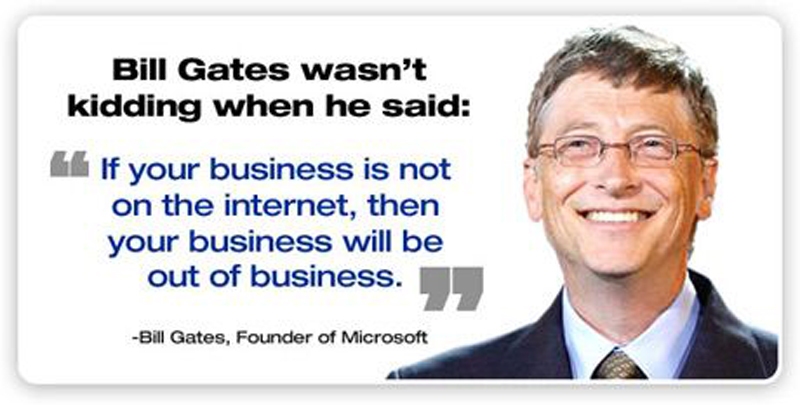
If you have a business, an online presence and campaign can benefit (and may be mandatory for) your continued financial growth and outlook into the future.

1. Get Your Domain(s)

When I’m working with a client, I usually make sure they have several domains in their quiver. If possible, and in order of importance, they are:

The Top 4 Dot Coms You Should Own

  1. Your name dot com
  2. The name of your business dot com, dot net and dot org
  3. What you do dot com
  4. The name of your leading product or service dot com

These are the top 4 dot coms you should own at the very least. First and foremost, your domain collection is about protecting you, your brand, who you are and what you do. There are thieves hiding amongst the landscape of the Internet looking for people and businesses, like yours, who will target domains associated with you and your business, by them and hold them hostage for a premium. And sometimes, it’s worth paying a premium for a dot com that clearly defines your product or service.

2. Post a Basic Site Presence

Let’s say you’ve covered the basics and have your domains safely tucked away in your GoDaddy account, what next? Start by minimally setting up small websites for each dot com. No need to panic here, you don’t have to spend a lot of time or money investing in a web team to get the job done. I walk my clients through a simple 7 to 10 minute process to quickly and easily get this done through their existing GoDaddy account. No need to fret over it, this is a simple DIY web presence. No need to hire it our when you can do it yourself.

3. Who You Are, What Your Do and Where

Of course, this is only the start. Next up, you must know and define what you do and decide where you will position yourself in the marketplace. This is the real work of preparing to launch an effective online presence. Depending on how confident you are and where you are in your business’ life span, this may create a bit of frustration or friction, but trust me, it’s worth it. The information and data gleaned from this process is invaluable and will keep you focused on your business goals.

After you’ve collected all the data from your research and documentation, there comes the moment when you want to integrate this information on your web site. This is where you say, “goodbye,” to your basic web site. Now, it’s time for an upgrade.

4. Upgrade Your Web Site

You may need to upgrade your hosting account with GoDaddy, who has an excellent reputation for call-in phone support (avoid any unnecessary upsells. Their support team can be very aggressive in attempting to sell you products and services that you don’t really need). So, give them a call and tell them you want to upgrade your hosting account and use a user-friendly web platform, like WordPress, for your web presence. WordPress is not only easy, but is extremely powerful and there are many pre-designed templates (themes) and plugins that you can use to make your life online easier; and the price is right: Free.

It doesn’t take long for me to bring my novice clients up to speed and soon they are rocking the Internet like a web superstar. I would say, try it yourself; if it seems too overwhelming, consider hiring it out. If you outsource your web development, be prepared to learn enough about what is going on behind the scenes to make certain that you’re not being taken advantage of and be prepared to take an active role as you build your web presence.

5. Add Content Regularly

As you continue to build your web presence the basic rule of thumb is, “Content is King.” That is to say, posting valuable content about you, your business and what you do on a regular basis will serve you well in the data-infested murk and mire of the Internet. It’s all about being able to be ferreted out in the swamp. Your content will help people find you.

6. Internet Marketing

You will also need to do some online marketing, minimally some Google Adwords, and have some social media representation, such as Facebook presence.

You hear a lot about Search Engine Optimization (some good, some bad), nonetheless, it is necessary to have an understanding of SEO and take advantage of it when and where you can. Effective marketing online campaigns should be your best marketing tool dollar-for-dollar, if done right.

7. Keep On Keeping On

Like anything else in life, don’t think of your online presence as a one-shot deal. Nothing will deteriorate your online presence more than stagnation.

Everything on the Internet is changing every minute of every day. What worked like gangbusters yesterday, could be a worthless strategy tomorrow.

Telecommute Job Online

It takes a village to run a successful village and your web team is a priceless asset. Yes, you can start small and do it yourself, but as you grow be thinking about ways you can expand your web marketing to catapult your business to the next level.