When a Successful Business Suddenly Stops Working: What Next?

There is an interesting thing that happens in business. You struggle. You experiment. You make mistakes. You lose money. You try something else. You finally figure out what works. Then one day you look around and think, We made it.
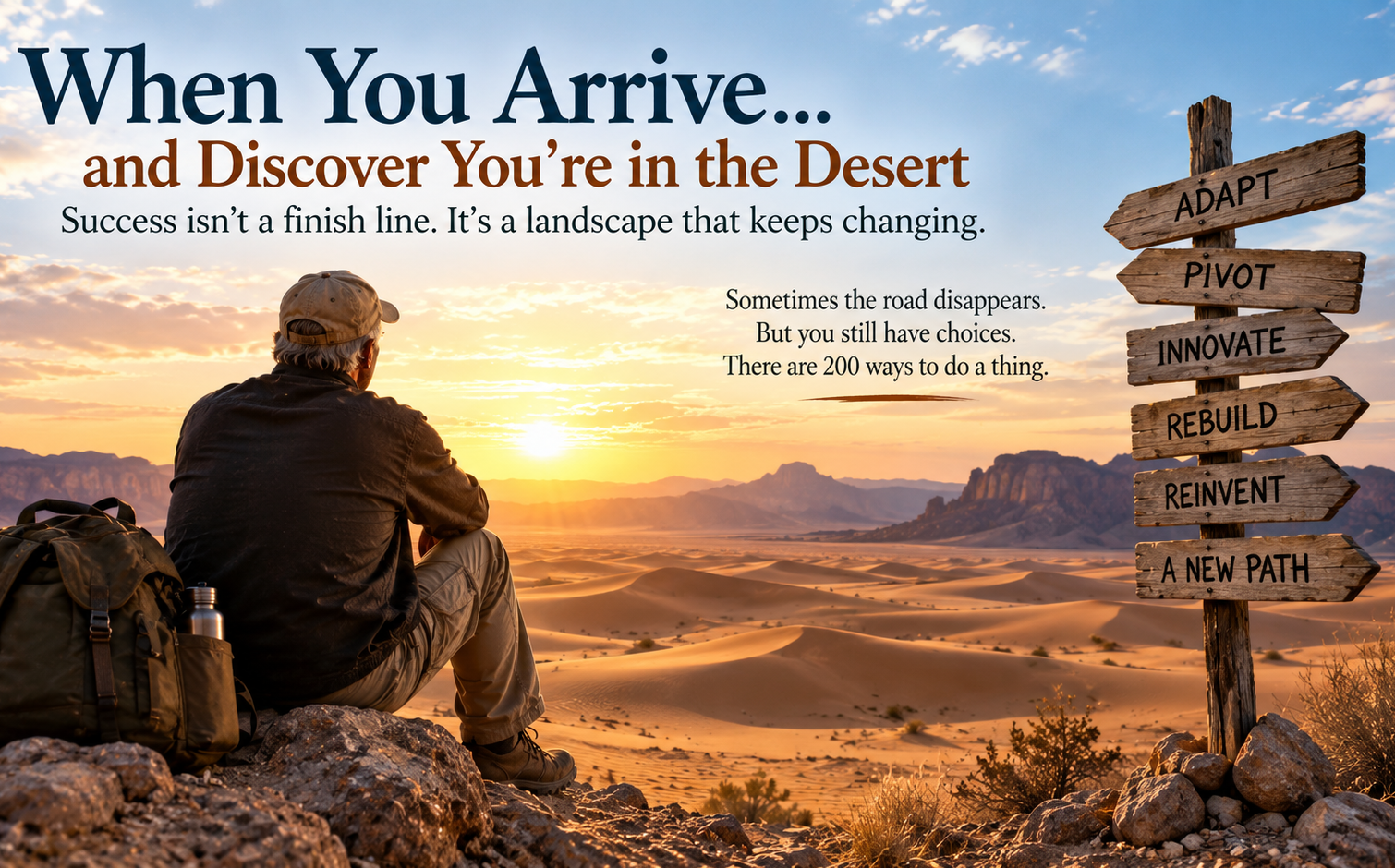
The business is working. Customers are coming. Bills are being paid. Maybe you’re making more money than you ever expected. Wonderful.

I’ve watched clients reach this place many times. And quite often, that’s the last time I see them. Which is perfectly fine with me. Great. No problem. I’ve done my job. Go forth and prosper.

But every once in a while, I hear from one of them again. And the conversation sounds considerably different.

Somehow, between We made it! and What happened? they woke up alone in the desert. Nothing in sight but sand.

Meanwhile, somewhere miles behind them, the business they thought was safely established is beginning to crumble.

Nobody Moved the Desert

That’s the strange part. Usually, they didn’t suddenly become stupid. They didn’t forget how to run a business. They may have been doing exactly what made them successful.

The world around the business changed.

    • The foreign supplier manufacturing a critical component goes under.
    • The FDA prohibits an ingredient central to the product line.
    • A manufacturer discontinues something you’ve built your entire offering around.
    • Your biggest wholesale customer changes management and drops you.
    • A competitor undercuts your pricing.
    • Black-hat competitors attack your online presence.
    • Your payment processor suddenly decides your perfectly legal industry is too risky.
    • Your shopping-cart platform is acquired, “improved,” glitches repeatedly, and eventually becomes unusable.
    • A social-media platform changes its rules and your reach disappears almost overnight.
    • Search algorithms change and suddenly customers who used to find you easily can’t find you at all.
    • Advertising costs double.
    • Shipping rates make your previously profitable product difficult to sell.
    • A tariff turns yesterday’s margins into today’s losses.
    • A landlord sells the building.
    • A key employee leaves and takes years of institutional knowledge with them.
    • Your best salesperson retires.
    • A trademark dispute appears from nowhere.
    • Your bank changes its lending policies.
    • Customer tastes change.
    • Technology makes part of your offering obsolete.
    • A new regulation changes how you’re allowed to operate.
    • Someone who controls a piece of technology your company depends upon decides to shut it down.

Or perhaps nothing dramatic happens at all. Sales simply begin slipping. Five percent. Then another five. Nothing alarming enough to panic over.

Until one morning you look at the numbers and realize you’ve been walking into the desert for eighteen months.

Success Is Not a Finish Line

Running a business, brick-and-mortar, online, or some combination of the two, is rarely a do it once and you’re done forever proposition.

If it were, many of the brands we grew up loving would still be here.

Markets move. People move. Technology moves. Culture moves. Money moves. Your customers move. Even you move.

A business that remains exactly the same is operating in a world that doesn’t. That’s worth thinking about. Because one of the most dangerous moments in business can actually arrive immediately following success.

When something isn’t working, we’re curious. We investigate. We experiment. We ask questions.

When something works spectacularly, we have a completely different response:

Don’t touch anything!

LOL.

Understandable. But dangerous.

Yesterday’s Answer Can Become Tomorrow’s Problem

This doesn’t mean constantly changing everything. That’s another excellent way to destroy a perfectly good business. There is a difference between reacting to every gust of wind and noticing that the climate is changing.

The business owners I’ve worked with who tend to weather major disruptions aren’t necessarily smarter than everybody else.

They keep looking. They notice anomalies.

    • Why did inquiries drop this month?
    • Why are customers suddenly asking that question?
    • Why are returns increasing?
    • Why did our advertising cost change?
    • Why is this supplier taking longer?
    • Why is everybody suddenly finding us through a channel that barely mattered last year?

Individually, these may mean nothing. Sometimes they are footprints in the sand.

The Early Warning System

You don’t need to live terrified that something will destroy your business. That would be exhausting. You can remain curious instead.

Periodically ask: What are we depending upon that we don’t control?

That’s a magnificent business question.

    • One supplier?
    • One employee?
    • One social platform?
    • One search engine?
    • One customer?
    • One product?
    • One payment processor?
    • One advertising channel?
    • One person who knows how everything works?

Then ask: If that disappeared tomorrow, what would we do?

You don’t necessarily have to do anything. You’re simply looking around. Curiosity is considerably cheaper than panic.

And Then the Desert Appears Anyway

Even with preparation, things happen. You can be diligent, intelligent, diversified, and paying attention… and still get blindsided.

Suddenly, there you are. Sand. Sand. More sand. Now what?

First, don’t automatically assume the business must be saved. That’s important.

Sometimes the price of rebuilding is greater than what you are willing to pay. Maybe you’ve changed. Maybe your priorities have changed. Maybe you’ve already given this business twenty years of your life and the disruption gives you permission to ask a question you’ve secretly wanted to ask for five: Do I even want to do this anymore?

Closing a business isn’t necessarily failure. Sometimes it’s completion.

But if you look at the wreckage and say, “No. I’m not finished yet,” then we have a different conversation.

There Are 200 Ways to Do a Thing

I say this all the time: There are 200 ways to do a thing. Probably more.

The problem is that when Way Number 1 made us successful, we tend to forget Ways 2 through 200 exist.

Supplier disappeared?

There may be another supplier, another material, another design, another manufacturing method, another country, or another product configuration.

Marketing channel collapsed?

There are other channels, audiences, partnerships, messages, referral systems, media, and ways of becoming discoverable.

Product became impossible to sell?

Maybe the knowledge surrounding the product becomes the new product.

Location disappeared?

Maybe the business no longer needs that location.

The original model may be dead while the value underneath it remains very much alive. That’s where recovery often begins.

Not with: How do we put everything back exactly the way it was?

But: What were we really giving people, and what other form could that take now?

That’s a much more interesting question.

Don’t Build Your House in the Sand

This isn’t a solicitation for consulting work. If your business is thriving, I’m delighted. Enjoy it. Celebrate it. Take everybody out for dinner. Just don’t confuse success with permanence.

Occasionally walk around the edges of what you’ve built. Look for cracks. Look toward the horizon. Ask inconvenient questions while you can still afford leisurely answers.

And if you wake up one morning and discover that somehow you’ve wandered into the desert… don’t immediately conclude you’re stranded.

Look around. You have choices. You can decide the journey has cost enough and walk away with your head held high. Or you can start looking for another route.

Because the disappearance of the way you were doing it does not necessarily mean the disappearance of what you were meant to do.

There are 200 ways to do a thing.

You only need to find the next one.


Building a Sustainable Legacy on Work with Cumulative Impact

There are a hundred things you could do today. Answer emails. Tweak your website. Run an ad. Join another webinar. Chase a new idea that promises faster results, easier growth, or some hidden shortcut that only a few seem to know about. And to be fair, many of those things do produce results. But the deeper question – the one that quietly determines the trajectory of your life, your work, and your legacy – is this:

What can you do today that will still be working for you a year from now? Five years from now? Even after you’ve moved on to something else entirely?

That’s a different kind of thinking. That’s the shift from activity… to accumulation.

Most people are busy. But very few people are building.

There is a kind of effort that disappears the moment you stop doing it. Advertising is a perfect example. You spend the money, you get the exposure, and when the campaign ends… so does the visibility.

There’s nothing inherently wrong with that. Advertising has its place. It’s excellent for immediate traction – launching a program, filling seats, generating short-term revenue. But it doesn’t stay. It doesn’t compound.

Over time, if that’s where most of your energy goes, you begin to feel like you’re running on a treadmill, always moving, always working, but never quite arriving.

Now contrast that with something different:

    • A blog post written today that continues to be discovered months or years from now.
    • A video that quietly builds trust with someone you’ve never met.
    • A book that speaks on your behalf when you’re not in the room.

That’s not just effort. That’s equity.

If I were to give you one simple practice, one thing that almost anyone can do, regardless of where they are in their journey, it would be this:

Write 500 words a day.

Not because writing is magical. But because of what writing becomes.

Five hundred words is a blog post.
Five hundred words is a message.
Five hundred words is clarity, captured.

And over time?  Five hundred words a day becomes:

    • A body of work
    • A voice that can be found
    • A book that already exists in pieces

You don’t have to “be a writer.” You just have to be someone who is willing to document what matters. Because documented thought becomes discoverable thought. And discoverable thought becomes influence.

Media That Works While You Sleep

We are living in a time where your voice can travel farther than ever before.

A simple video – recorded in a quiet moment, with no production team, no elaborate setup – can reach someone at exactly the right moment in their life. And more importantly… It can keep reaching people.

A podcast episode doesn’t expire. A YouTube video doesn’t vanish. Even a short-form clip, when done with intention, can ripple outward in ways you never see.

The question isn’t whether you should create media. The question is:

Are you creating things that continue to work for you… or only things that require you to show up again tomorrow just to stay visible?

Blog Posts: The Quiet Giants

There is something almost understated about a well-written blog post. It doesn’t shout, interrupt, or demand attention. And yet… it is one of the most powerful long-term assets you can create.

Why?

Because it is:

    • Searchable – People find it when they need it
    • Evergreen – It doesn’t expire
    • Credibility-building – It demonstrates how you think
    • Magnetic – It attracts those who resonate with your message

A blog post is like planting a flag in the landscape of ideas. Over time, those flags become a map. And people begin to find their way to you… without you having to chase them.

Other Work That Compounds

Let’s expand the lens a bit. If we’re looking for actions that create lasting and cumulative impact, here are a few that rise to the surface:

    1. Build a Signature Framework

Give structure to what you already know.

When you take your lived experience, your methods, your insights – and organize them into a clear framework – you create something that can be taught, shared, and scaled.

This becomes:

        • A course
        • A workshop
        • A book
        • A defining piece of your identity
    1. Create Foundational Content (Cornerstone Pieces)

Instead of scattering your efforts across dozens of disconnected ideas, focus on creating a few deep, meaningful pieces that represent your core message.

Think:

        • “Everything I believe about this topic, in one place”
        • “If someone only read this, they would understand me”

These pieces become anchors. Everything else can branch from them.

    1. Develop an Email List (A Relationship Asset)

Social media platforms come and go. Algorithms change. But an email list? That’s a direct line.

Not just to an audience – but to people who have said, “I want to hear from you.”

Over time, this becomes one of the most valuable and stable assets you can build.

    1. Record Your Stories

Your experiences – what you’ve been through, what you’ve learned, what you’ve overcome – are not just personal memories.

They are transferable wisdom.

When you record them:

        • You preserve meaning
        • You create connection
        • You give others a path they can follow

And unlike trends, stories don’t age out.

    1. Strengthen Strategic Relationships

Not all growth is content. Some of the most powerful compounding happens through people.

A single aligned relationship can:

        • Open doors
        • Expand reach
        • Multiply opportunities

But like everything else that lasts, it requires intention. Not networking for gain – but connection for alignment.

    1. Create Systems That Outlast Your Mood

Let’s be honest. Some days, you won’t feel like doing the work. That’s where systems come in.

When you create:

        • A content rhythm
        • A publishing schedule
        • A repeatable process

You remove the need to decide from scratch every day. And consistency begins to carry you.

The Long Game Is a Different Game

Here’s what I’ve seen, time and time again:

People underestimate what they can build in a year…
Because they overestimate what will matter in a day.

The shiny objects will always be there. The urgent will always feel important. But the work that stays – the work that compounds, that builds, that quietly grows beneath the surface – that requires a different kind of discipline. Not intensity. But devotion.

A Simple Daily Question

If you take nothing else from this, take this: At the beginning of your day, ask yourself:

“What can I do today that will still be working for me a year from now?”

Then do that first. Before the emails. Before the distractions. Before the world tells you what matters. Because a life built on compounding effort doesn’t happen by accident. It happens by choosing – again and again – to invest in what lasts.

And over time… That choice becomes your legacy.


There are a hundred things you could do today that will help promote your life’s purpose, business, program, organization, ministry, or help to build your legacy. But what thing or things could you do, what investment could you make, what effort could you put forth, that will have lasting and cumulative impact on what you want to achieve over time? That is the real question.

Sure, you could chase this or that shiny object, attend a class or webinar, or spend money on advertising, but do these things offer lasting support for what it is that you are trying to accomplish. Advertising is great for promoting something that you want to achieve currently, like promoting a program, soliciting revenue, or selling a product, but once you’ve spent the money, the advertising is gone, and you don’t have anything to show for it but a few sales that you made.

You can tell the story about how you spent money on advertising and what the results of that effort was, but that’s about it. And if you pubish your story, that’s a way to stretch those dollars into something that has cumulative effect. At least it’s not just a throw away effort.

And successful ad campaigns can burn up a lot of activity and time to conduct thoroughly. So what are efforts that you can focus on that have lasting cumulative impact?

You could write a paragraph, a page, or my favorite, 500 words that could be a blog post or potentially be a contribution to what would become a book written by you.

You could create a media item that could have lasting impact, like a podcast, a TikTok, X video post, or a YouTube short or add a video to your Channel.

I find that blog posts have lasting impact, as they are highly searchable, everlasting, and attract clients and like-minded people.

What are some other things you could do? Please expand upon this premise.