When a Successful Business Suddenly Stops Working: What Next?

There is an interesting thing that happens in business. You struggle. You experiment. You make mistakes. You lose money. You try something else. You finally figure out what works. Then one day you look around and think, We made it.
The business is working. Customers are coming. Bills are being paid. Maybe you’re making more money than you ever expected. Wonderful.

I’ve watched clients reach this place many times. And quite often, that’s the last time I see them. Which is perfectly fine with me. Great. No problem. I’ve done my job. Go forth and prosper.

But every once in a while, I hear from one of them again. And the conversation sounds considerably different.

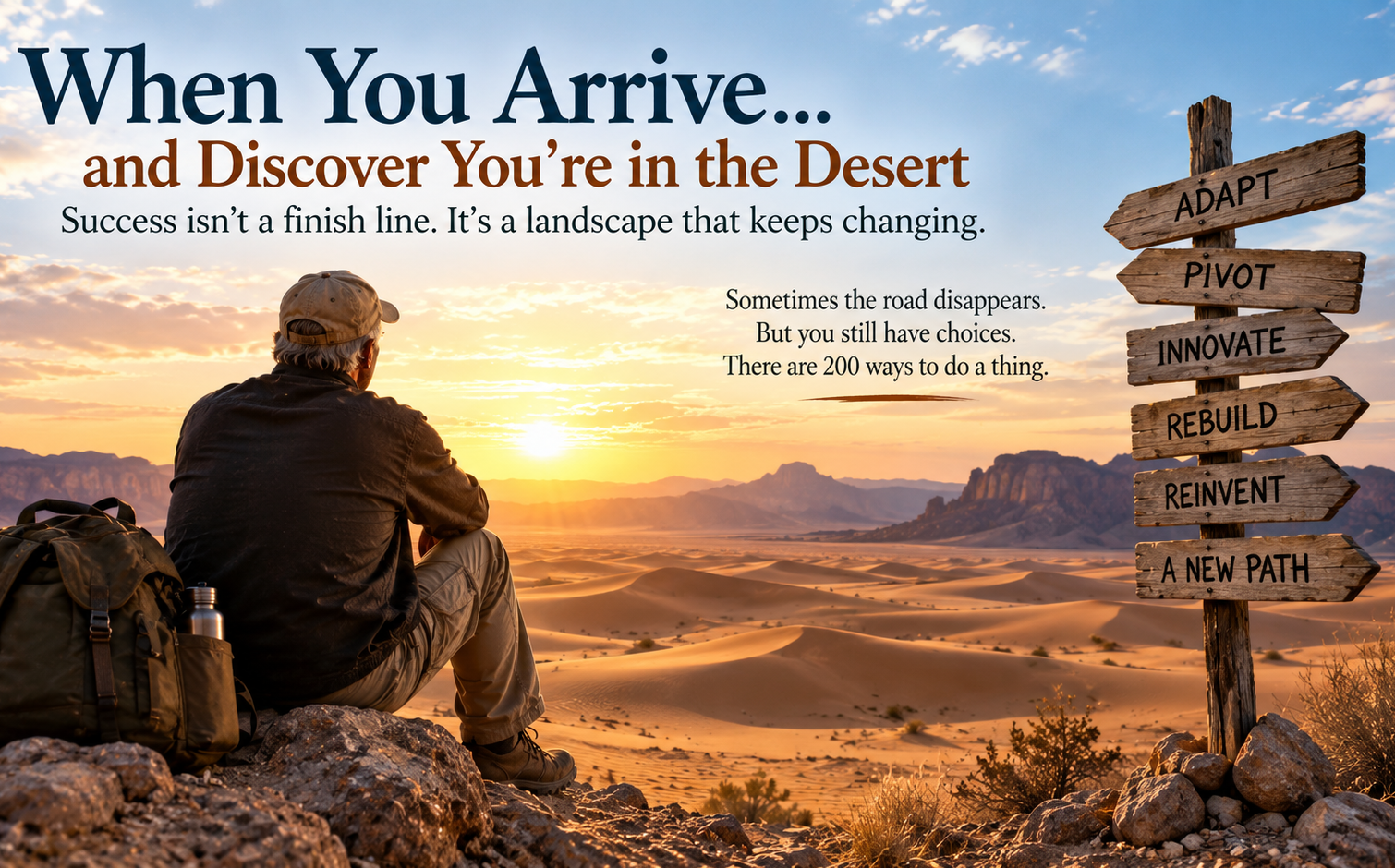
Somehow, between We made it! and What happened? they woke up alone in the desert. Nothing in sight but sand.

Meanwhile, somewhere miles behind them, the business they thought was safely established is beginning to crumble.

Nobody Moved the Desert

That’s the strange part. Usually, they didn’t suddenly become stupid. They didn’t forget how to run a business. They may have been doing exactly what made them successful.

The world around the business changed.

    • The foreign supplier manufacturing a critical component goes under.
    • The FDA prohibits an ingredient central to the product line.
    • A manufacturer discontinues something you’ve built your entire offering around.
    • Your biggest wholesale customer changes management and drops you.
    • A competitor undercuts your pricing.
    • Black-hat competitors attack your online presence.
    • Your payment processor suddenly decides your perfectly legal industry is too risky.
    • Your shopping-cart platform is acquired, “improved,” glitches repeatedly, and eventually becomes unusable.
    • A social-media platform changes its rules and your reach disappears almost overnight.
    • Search algorithms change and suddenly customers who used to find you easily can’t find you at all.
    • Advertising costs double.
    • Shipping rates make your previously profitable product difficult to sell.
    • A tariff turns yesterday’s margins into today’s losses.
    • A landlord sells the building.
    • A key employee leaves and takes years of institutional knowledge with them.
    • Your best salesperson retires.
    • A trademark dispute appears from nowhere.
    • Your bank changes its lending policies.
    • Customer tastes change.
    • Technology makes part of your offering obsolete.
    • A new regulation changes how you’re allowed to operate.
    • Someone who controls a piece of technology your company depends upon decides to shut it down.

Or perhaps nothing dramatic happens at all. Sales simply begin slipping. Five percent. Then another five. Nothing alarming enough to panic over.

Until one morning you look at the numbers and realize you’ve been walking into the desert for eighteen months.

Success Is Not a Finish Line

Running a business, brick-and-mortar, online, or some combination of the two, is rarely a do it once and you’re done forever proposition.

If it were, many of the brands we grew up loving would still be here.

Markets move. People move. Technology moves. Culture moves. Money moves. Your customers move. Even you move.

A business that remains exactly the same is operating in a world that doesn’t. That’s worth thinking about. Because one of the most dangerous moments in business can actually arrive immediately following success.

When something isn’t working, we’re curious. We investigate. We experiment. We ask questions.

When something works spectacularly, we have a completely different response:

Don’t touch anything!

LOL.

Understandable. But dangerous.

Yesterday’s Answer Can Become Tomorrow’s Problem

This doesn’t mean constantly changing everything. That’s another excellent way to destroy a perfectly good business. There is a difference between reacting to every gust of wind and noticing that the climate is changing.

The business owners I’ve worked with who tend to weather major disruptions aren’t necessarily smarter than everybody else.

They keep looking. They notice anomalies.

    • Why did inquiries drop this month?
    • Why are customers suddenly asking that question?
    • Why are returns increasing?
    • Why did our advertising cost change?
    • Why is this supplier taking longer?
    • Why is everybody suddenly finding us through a channel that barely mattered last year?

Individually, these may mean nothing. Sometimes they are footprints in the sand.

The Early Warning System

You don’t need to live terrified that something will destroy your business. That would be exhausting. You can remain curious instead.

Periodically ask: What are we depending upon that we don’t control?

That’s a magnificent business question.

    • One supplier?
    • One employee?
    • One social platform?
    • One search engine?
    • One customer?
    • One product?
    • One payment processor?
    • One advertising channel?
    • One person who knows how everything works?

Then ask: If that disappeared tomorrow, what would we do?

You don’t necessarily have to do anything. You’re simply looking around. Curiosity is considerably cheaper than panic.

And Then the Desert Appears Anyway

Even with preparation, things happen. You can be diligent, intelligent, diversified, and paying attention… and still get blindsided.

Suddenly, there you are. Sand. Sand. More sand. Now what?

First, don’t automatically assume the business must be saved. That’s important.

Sometimes the price of rebuilding is greater than what you are willing to pay. Maybe you’ve changed. Maybe your priorities have changed. Maybe you’ve already given this business twenty years of your life and the disruption gives you permission to ask a question you’ve secretly wanted to ask for five: Do I even want to do this anymore?

Closing a business isn’t necessarily failure. Sometimes it’s completion.

But if you look at the wreckage and say, “No. I’m not finished yet,” then we have a different conversation.

There Are 200 Ways to Do a Thing

I say this all the time: There are 200 ways to do a thing. Probably more.

The problem is that when Way Number 1 made us successful, we tend to forget Ways 2 through 200 exist.

Supplier disappeared?

There may be another supplier, another material, another design, another manufacturing method, another country, or another product configuration.

Marketing channel collapsed?

There are other channels, audiences, partnerships, messages, referral systems, media, and ways of becoming discoverable.

Product became impossible to sell?

Maybe the knowledge surrounding the product becomes the new product.

Location disappeared?

Maybe the business no longer needs that location.

The original model may be dead while the value underneath it remains very much alive. That’s where recovery often begins.

Not with: How do we put everything back exactly the way it was?

But: What were we really giving people, and what other form could that take now?

That’s a much more interesting question.

Don’t Build Your House in the Sand

This isn’t a solicitation for consulting work. If your business is thriving, I’m delighted. Enjoy it. Celebrate it. Take everybody out for dinner. Just don’t confuse success with permanence.

Occasionally walk around the edges of what you’ve built. Look for cracks. Look toward the horizon. Ask inconvenient questions while you can still afford leisurely answers.

And if you wake up one morning and discover that somehow you’ve wandered into the desert… don’t immediately conclude you’re stranded.

Look around. You have choices. You can decide the journey has cost enough and walk away with your head held high. Or you can start looking for another route.

Because the disappearance of the way you were doing it does not necessarily mean the disappearance of what you were meant to do.

There are 200 ways to do a thing.

You only need to find the next one.


Copyright vs. Publishing Rights: What Every Author Must Know

I was thirteen years old the first time I learned that you don’t always have the right to use something… even if you know it by heart. I was playing bass in a nightclub band, yes, underage. The drummer and I weren’t allowed to hang out in the bar area between sets. We were sent to the restaurant… or the parking lot… depending on the venue. But what really caught my attention wasn’t the rules about age. It was the rules about music. We could play certain songs in some clubs… but not in others.

At thirteen, that didn’t make sense to me. Same band. Same songs. Same musicians. Why would one place allow it, and another not? That’s when I first heard about organizations like ASCAP and BMI. Some clubs paid licensing fees to one. Some to the other. Some to both. And if they didn’t… You couldn’t legally perform certain songs.

That moment changed something in me. Because I realized something simple… and powerful:

If I wrote my own songs, nobody could tell me where I could – or couldn’t – play them.

So at fourteen… I started writing.

That early experience planted a seed that followed me throughout my life.

When I later worked in Christian drug and alcohol rehabilitation, I ran into the same problem again, but in a different form. There wasn’t good material to teach from.

When there was something close, there was always a process:

    • Request permission
    • Wait for approval
    • Pay licensing fees
    • Follow strict usage rules

So once again, I made a decision that would shape my path: I wrote my own material.

Textbooks. Workbooks. Training systems.

Not because I had to… But because it was simpler, cleaner, and gave me full control, and over time, that became a pattern in my life: If I couldn’t find the right material… I created it. If I didn’t want restrictions… I owned it.

Let’s pause for a moment, because this is where a lot of people get confused.

Here’s the simplest way to understand copyright: Copyright is ownership of a creative work.

If you write it, record it, design it, or create it… you automatically own the copyright the moment it exists in a tangible form.

That includes:

    • Books
    • Songs
    • Articles
    • Courses
    • Graphics
    • Even social media content

You don’t have to “file” anything to have copyright (though registration strengthens your legal protection).

What copyright gives you is the exclusive right to:

    • Reproduce the work
    • Distribute it
    • Perform or display it
    • Create derivative works

In short: You control how your work is used.

Now here’s where many creators, myself included, learn lessons the hard way.

Publishing rights are not the same as copyright.

    • Copyright = Ownership
    • Publishing rights = Permission to produce, distribute, and profit from the work

You can own the copyright… and still give someone else control over publishing.

And that’s exactly what I did at one point. I signed publishing agreements that allowed a publisher to print and distribute my work. At the time, it seemed like a good move. And in many ways, it was.

Until it wasn’t.

Here’s something most people don’t think about: You are not the same person ten years from now.

What you believe evolves. How you teach evolves. What you would say… changes. But your published work? That version is frozen in time.

And if you’ve signed away publishing control, you may not be able to:

    • Update it
    • Revise it
    • Pull it from circulation
    • Replace it with a better version

Which leads to a strange situation. You grow… but your work doesn’t. And one day, someone might say: “Didn’t you write…?” And quote something that no longer reflects who you are.

That’s not just awkward. It can feel like being tied to a past version of yourself that you’ve already outgrown.

Let’s address something that comes up more often than people realize.

When I am hired to write a book for someone else… I am the copyright holder by default. Not the person whose name is on the cover.

Let that sink in.

Authorship (the name on the book) and copyright ownership are not automatically the same thing.

Unless there is a written agreement that transfers copyright:

    • The writer owns the work
    • The client receives a license to use it (unless otherwise specified)

Now, if the client pays for full rights and we agree in writing… Then yes, the copyright can be transferred.

At that point:

    • They own the work
    • They control its use
    • They can publish, edit, or repurpose it as they wish

But without that agreement? The writer owns the intellectual property.

This is where misunderstandings, and conflicts, can arise.

Just because your name is on something… Does not mean you own it.

We live in a time where content is everywhere. Books, blogs, courses, AI-generated material, social media posts, it’s constant.

But very few people stop to ask:

    • Who owns this?
    • Who controls it?
    • Who benefits from it long-term?

And even fewer think ahead to the bigger question: Will this still represent me in 10 years?

Looking back, I can see a clear thread through my life. From that thirteen-year-old kid in a nightclub band… to writing my own training materials… to navigating publishing contracts… to working with authors today… The lesson has remained the same:

Ownership is not about control for control’s sake.
It’s about alignment with who you are becoming.

Because if you don’t own your words… You may one day find yourself living under them.

If you’re creating something today, ask yourself:

    • Do I want full control over this long-term?
    • Am I okay with this version representing me years from now?
    • What rights am I giving away, and why?

There’s no single “right” answer. But there is a right awareness. And once you have that… You’ll make very different decisions.

7 Day Author Remastered

Publisher / Author Contract Checklist

What I Wish I Had Paid Closer Attention To…

If you’re about to sign a publishing agreement, or hire someone to write for you, slow down here. This is not about distrust. This is about clarity. Because once something is signed, you are no longer operating on intentions… you are operating on terms.

Here are the key areas you’ll want to understand before you move forward.

    1. Copyright Ownership (Who Actually Owns the Work?)

This is the foundation of everything.

        • Does the author retain copyright?
        • Is copyright being transferred to the publisher or client?
        • Is the transfer full, partial, or conditional?

Watch for:
Language like “work made for hire” or “assignment of rights.”

That means you may be giving up ownership entirely.

Simple Rule:
If you don’t own the copyright, you don’t control the future of the work.

    1. Publishing Rights (Who Controls Distribution?)

Even if you own the copyright, you may be granting publishing rights.

        • Who has the right to print and distribute the book?
        • Is it exclusive or non-exclusive?
        • Can you publish it elsewhere at the same time?

Watch for:
“Exclusive worldwide rights” with no expiration.

That can lock your work into one publisher indefinitely.

    1. Duration of Agreement (How Long Are You Locked In?)

This is one of the most overlooked clauses.

        • Is the contract for a fixed term (e.g., 3–5 years)?
        • Is it tied to “life of copyright” (which can mean decades)?
        • Are there renewal terms—and who controls them?

Watch for:
Agreements with no clear end date.

Simple Rule:
Everything should have a defined exit.

    1. Reversion of Rights (How Do You Get Your Work Back?)

This is your safety net.

        • Under what conditions do rights return to you?
        • If the book goes out of print, do rights revert automatically?
        • Is there a formal process required?

Watch for:
Vague or missing reversion clauses.

Simple Rule:
If they stop using it… you should be able to reclaim it.

    1. Creative Control (Can You Update or Revise Your Work?)

Remember what we talked about—you evolve.

        • Can you revise or update the material?
        • Who approves changes?
        • Can the publisher alter your work without your consent?

Watch for:
Publisher-controlled edits without approval rights.

    1. Royalties and Payment Structure

Understand how you get paid.

        • What percentage do you earn?
        • Based on retail price or net profit?
        • When are payments made? (monthly, quarterly, annually)
        • Are there minimum payout thresholds?

Watch for:
“Net profit” language—it can be reduced by expenses you don’t control.

    1. Advance Payments (If Any)
        • Are you receiving an advance?
        • Is it recoupable (paid back from royalties)?
        • What happens if sales don’t meet expectations?

Simple Truth:
An advance is not always a bonus—it’s often a prepayment.

    1. Format Rights (Print, Digital, Audio, Courses, etc.)

Your content can live in many forms.

        • Does the agreement include:
          • Print books
          • eBooks
          • Audiobooks
          • Translations
          • Film or media rights
        • Can you use your own content in courses or programs?

Watch for:
Broad “all media, now known or hereafter developed” clauses.

That can include things that don’t even exist yet.

    1. Marketing Responsibilities (Who Is Doing What?)

Don’t assume anything.

        • Is the publisher responsible for marketing?
        • Or is it primarily on you?
        • Are there specific deliverables listed?

Watch for:
Promises made verbally but not written into the contract.

    1. Termination Clauses (What If Things Go Sideways?)

Not every agreement works out.

        • Can either party terminate the contract?
        • Under what conditions?
        • What happens to rights after termination?

Watch for:
One-sided termination rights.

    1. Ghostwriting Agreements (If You’re Hiring or Being Hired)

This is where confusion happens most often.

        • Who owns the copyright?
        • Is the writer credited—or anonymous?
        • Is there a full transfer of rights upon payment?
        • Can the writer reuse any part of the material?

Simple Rule:
If you want full ownership, it must be clearly stated in writing.

    1. Attribution and Credit
        • Whose name is on the cover?
        • Is there a “written by,” “with,” or “as told to” credit?
        • Can the publisher change attribution later?

This matters more than people think—especially long-term.

My Experiential Disclosure

Most people don’t get into publishing to fight over contracts. They get into it to share a message. To help people. To make a difference.

But here’s the truth:

The more meaningful your message is… the more important it is to protect it.

You don’t have to become a legal expert. But you do need to become aware. Because once your work is out in the world… It has a life of its own.

The question is:

Will you still be the one guiding it?