In our work, whether in coaching, ministry, or mentoring, we often return to timeless truths to guide others through their unique love journeys. One such cornerstone has been Dr. Gary Chapman’s “5 Love Languages,” which gave millions a way to understand how we give and receive love.

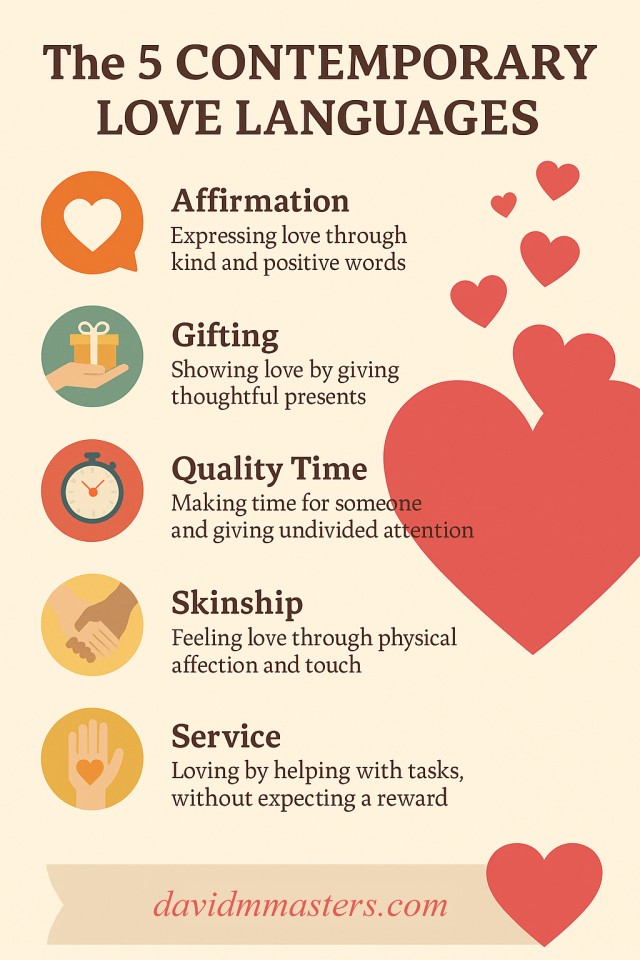
But love evolves, just as language does. Recently, a client described her love language not as “physical touch” but as skinship, a tender, intentional type of touch that feels sacred, nurturing, and safe.
This word stunned me in the best way. “Skinship” said what so many of us try to describe. It felt more human, more emotionally intelligent. And it’s not alone. As we explore deeper relationships in a rapidly changing world, new expressions are emerging, modern love languages for modern lives.
Classic vs Contemporary Love Languages
Here’s a comparison between the original 5 Love Languages and updated, culturally nuanced counterparts that may better reflect how people express and feel love today.
| Original Love Language | Contemporary Expression | Description |
| Words of Affirmation | Pebbling | Sending small, frequent tokens—like sweet texts, memes, or emojis—that say “I’m thinking of you.” Named after penguins who present pebbles to court each other. |
| Quality Time | Shared Experiences | Not just time together, but co-creating memorable moments through new, exciting, or bonding activities. |
| Receiving Gifts | Intentional Offerings | Thoughtful, symbolic gifts—not about materialism but emotional meaning and timing. |
| Acts of Service | Goal-Support & Accountability | Supporting each other’s dreams, responsibilities, and projects; showing up with reliability and shared vision. |
| Physical Touch | Skinship | Safe, non-sexual physical affection such as hand-holding, gentle stroking, hugs—nurturing intimacy through touch. |
Where “Skinship” Comes From
Coined in Japan in the 1950s and later embraced in Korea, the word skinship combines “skin” and “kinship.” Originally referring to parent-child bonding, it evolved to include close, platonic, and romantic touch that expresses safety and deep affection, without necessarily being sexual.
In a world that often hyper-sexualizes touch, skinship invites us to reclaim it as sacred, healing, and emotionally expressive.
Expanding the Framework for Modern Love
As a coach, minister, or spiritual guide, you may find that your clients don’t resonate with the classic five. That’s okay—language is just a starting point. What matters most is connection.
Here are other emerging modern expressions to consider:
-
- Emotional Labor & Listening – Feeling loved when someone is attuned, reflective, and holds emotional space.
- Healthy Debate – A love language for thinkers: connection deepened through challenging and expanding one another’s mind respectfully.
- Intentional Presence – Undistracted, sacred time carved out for connection; not just physical proximity but emotional availability.
What This Means for Coaches and Relationship Guides
If you’re working with clients:
-
- Ask deeper questions. “What makes you feel most loved?” Listen for nuance. “I love when he brings me coffee” might signal service or shared goals.
- Mirror their language. If they say “skinship,” honor it. That may carry more emotional weight than the clinical “physical touch.”
- Invite creative expression. Help clients craft their own unique languages. One couple might bond over puzzles; another, through activism.

Chapman gave us a gift: a framework. But frameworks are meant to be built upon. As society changes, as connection takes on digital and emotional layers, we need language that reflects our truth.
“Skinship” isn’t just a new word—it’s a reminder that love is evolving, and so must we.
So keep listening, keep learning, and keep loving in the language that speaks to the soul.