There are people who rise because life was kind to them, and then there are people who rise because someone had to. If you are reading this, there is a good chance you belong to the second group. You learned early how to make things work, how to carry weight, how to create stability when none existed, and somewhere along the way, that ability became your identity. You didn’t just succeed; you became the one others relied on. That’s admirable. It’s also dangerous when left unexamined.
The Hidden Cost of Being the One Who Makes It Happen
Many high-capacity people don’t realize this until later in life: The same trait that made you indispensable may now be quietly draining you.
If you:
-
-
- Feel most alive when helping others reach their next level
- Find yourself repeatedly partnering with brilliant but unstable people
- Step in just as things might fall apart
- Are admired for your resilience, but rarely met with reciprocity
-
Then this message is for you.
Because what looks like leadership from the outside can feel like quiet exhaustion on the inside.
Some of us learned to equate meaning with responsibility. Not because we wanted to, but because we had to.
When responsibility arrives too early in life, it doesn’t just shape behavior, it shapes belief:
“If I don’t hold this together, everything falls apart.”
That belief can follow you into:
-
-
- Career
- Business
- Ministry
- Marriage
- Partnerships
- Leadership roles
-
And it often attracts a specific kind of person.
Survivors are compelling.
They’re intelligent, visionary, are often wounded, and unfinished, yet there is something compelling and familiar about them.
Survivors carry momentum, intensity, and promise.
And they are magnetically drawn to people who can:
-
-
- Stabilize them
- Resource them
- Believe in them
- Carry the parts they cannot yet carry themselves
-
At first, it feels like destiny. Later, it often feels like betrayal.
Not because anyone intended harm, but because dependency cannot mature into equality without friction, and friction is where these partnerships often break.
A Question That Changes Everything
Here is the question most people never stop to ask:
“Am I inspired by this person — or activated by them?”
There is a difference. Inspiration expands you. Activation consumes you.
Activation feels powerful. It also feels urgent, heavy, and familiar.
If your body tenses while your mind races with possibility, that’s not clarity. That’s an old contract waking up.
The Shift
At some point – and for many, this comes later in life – a different question emerges:
“What would I build if no one needed saving?”
That question is unsettling because it removes urgency, rescue, and identity reinforcement.
It asks something much harder: Who are you when your strength is no longer required for survival?
That’s not a philosophical question. That’s a developmental one.
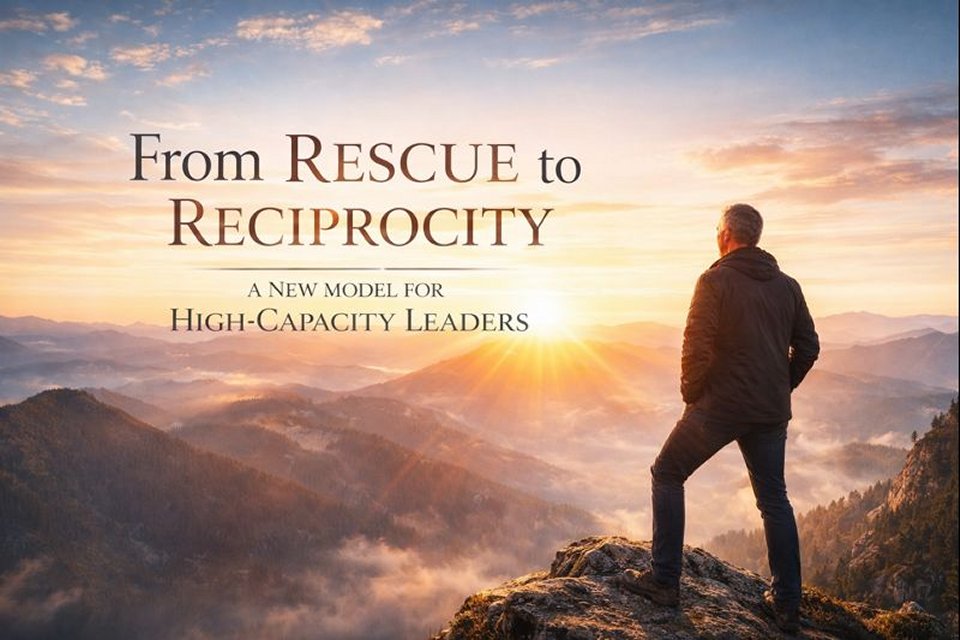
From Rescue to Reciprocity
Here is a simple, uncomfortable practice I offer my clients:
Before committing to any partnership, opportunity, or alliance, ask:
-
- Is this person already standing without me?
- Do I feel energized — without feeling responsible?
- Am I being invited to co-create, or to carry?
- If I say “no” or “not yet,” does the connection remain intact?
If the connection collapses under boundaries, it was never a partnership. It was a transaction, paid for with your life force.
A New Definition of Strength
Strength is not how much you can endure. Strength is knowing when endurance is no longer required. The next level is not found by doing more, it’s found by doing differently.
By choosing:
-
-
- Equals over dependents
- Stability over intensity
- Alignment over admiration
- Legacy over repetition
-
A message for builders, leaders, survivors, and those who carry others
If you recognize yourself here, know this: There is nothing wrong with you.
Your capacity was forged in necessity. Your resilience saved lives, possibly your own, but the season of survival does not have to be the season of legacy.
The next chapter is not about proving anything. It’s about choosing partnerships, purposes, and paths that do not require you to disappear in order to succeed.
And that, for many high-capacity people, is the most challenging work of all.