Meet Miss Interpretation

I’m a communicator; it’s what I do.

How can something so simple, like stacking words in a certain order to convey one’s thoughts, be so complicated?

I can assemble a little 140-character text (laughing and giggling about how innovative, clever and humorous I’ve been in my word assembly) and press SEND.

Within moments, I receive a barrage of complaints, accusations and abbreviations, like OMG, WTF and/or blocked, unfriended, deleted or reported as spam.

Now, I feel bad because SHE reared her pretty head and stuck that cute little nose right in the middle of my attempt to reach out and communicate with others.

With a name like, “Interpretation,” you’d think she’d exert all her efforts in helping people understand what message I was trying to convey… BUT NO-o-o-o, she’s got to stretch, twist and garble it all so as to have the worst possible outcome.
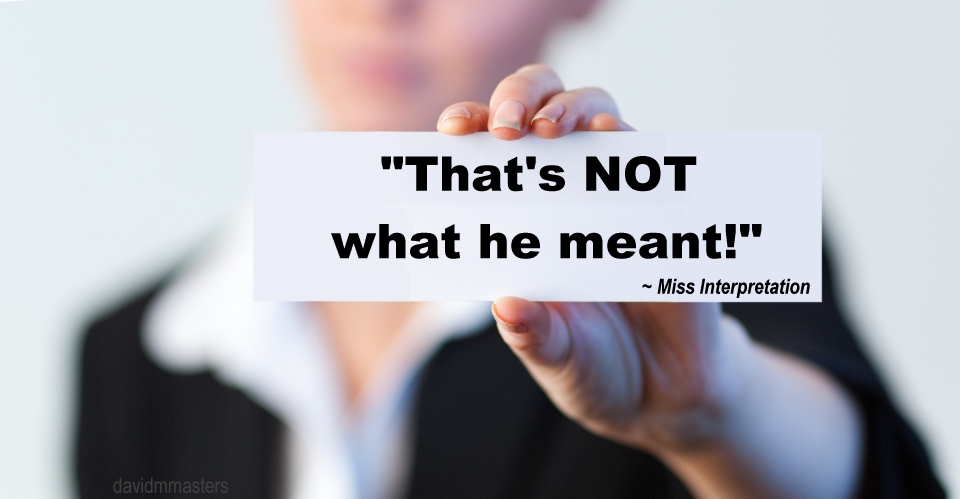
Thats not what he meant to say Miss Interpretation misinterpretation

Little Miss Interpretation has been at this as long as I can remember. As a kid, I’d try to express myself to my parents and get sent to my room or punched in the face. I’ve said things (and been fairly adequately quoted) from the pulpit, stage, conference room, boardroom, classroom or office with the best intentions, only to have MI mess things up for me.

There I was, fully intent on effectively communicating when she walks in and gets everyone all riled up, offended, objecting and ranting about something that wasn’t even intended to be included in what I was talking about. How does she do it?

“That’s not what he meant to say.”

~ Miss Interpretation

She gets inside people’s head and rifles through all their personal belongings and grabs words, ideas and thoughts that still hold emotional charge from the past and waves it in front of their face:

“See this! Look at that! Remember this? What about that?”

A relentless barrage of old information that is highly charged with negative emotion, causing the individual to think that danger may be ahead.

A person can’t help but recoil in self-preservation and protect themselves from such a vicious attack, and…

Forget everything I’ve ever said before this moment.

Now, all attention is on this word – or phrase – that harkens to a time that may have been dangerous (or at the very least unpleasant) and now I (the messenger who used the word or phrase with the best of intentions) am an assailant.

How does she wield so much power over us? And I’m the first to admit, that even though I work hard on kicking her to the curb every time she tries to interrupt someone else’s monologue, I too, have fallen victim to her manipulative influence and subject to mounting up to do battle or cut-and-run.

She does seem to have access to all my personal baggage accumulated since birth, and she’ll use anything she can get her hands on to derail (initiating fight or flight response) an otherwise potentially meaningful exchange of information between two people.

Why does she do it?

I don’t know… I think it’s because she hangs out with that little child inside us and that’s how she gets her kicks. Or maybe her intentions are good; it’s just that in an effort to protect us from harm’s way, she sees everything as a potential threat… even when it may not be a threat at all.


Just words

Exchanged between two people

Looking for a home

in our hearts and minds

The Truth and Nothing But the Truth

you cant handle the truthLet’s talk about truth…

What is truth? What does that mean to you?

How can you know whether something is true, or not?

When someone asserts an absolute, its easy to question the credibility of the messenger as well as the veracity of the message.

For anything to be true, it must be based on fact(s) and/or based in reality; though a truth could also be based on collective beliefs based on much less fact and/or reality as it is known. Truth can also be either subjective or objective.

The measure of truth highly depends on the information that is available for evaluating the prospective truth based on the perspective of the investigator.

In my own life, I have asserted many things as absolute truths based on my valuation of the material that was available at the time. Interestingly, I have lived long enough to discover that many of the things that I believed to be true, based on information that was available (or that I was fed) at the time, required reevaluation as new information came to light.

Truth in its highest form would be absolute, but who are we to assert that we could be the authority on anything? One truth about truth is, “seek and you will find.” As long as there is a quest for the truth with a desire to come to a particular outcome, some searcher, somewhere, sometime will derive the conclusion sought.

Yet, we are responsible to seek and maintain our own truths as we travel along this life’s journey; it is a sacred gift, not bestowed on other life forms on this planet. The key is to be open to the idea that truth is a moving target, ever evolving, as we observe, grow and gather information along our individual paths.

The truth, then, is as varied as we are; each of us determining our own truths from moment to moment.

What if someone does not ascribe to our idea of what is true about a particular idea or concept?

This is where one should practice the wisdom of decorum. If you maintain the belief that an idea that is true, yet it is clearly not accepted by the masses, you must proceed with caution and good judgment out of respect for your potential audience.

You are absolutely right What you believe is true Keep sharing your light with those who can hear youPeople are not able to hear any message or see anything without a proper sense of congruency to have an intellectual connection with your idea (cognitive dissonance).

Anytime someone shares an idea that I experience cognitive dissonance with, I say:

“Thank you for sharing. You are absolutely right. What you believe is true. Keep sharing your light with those who can hear you.”

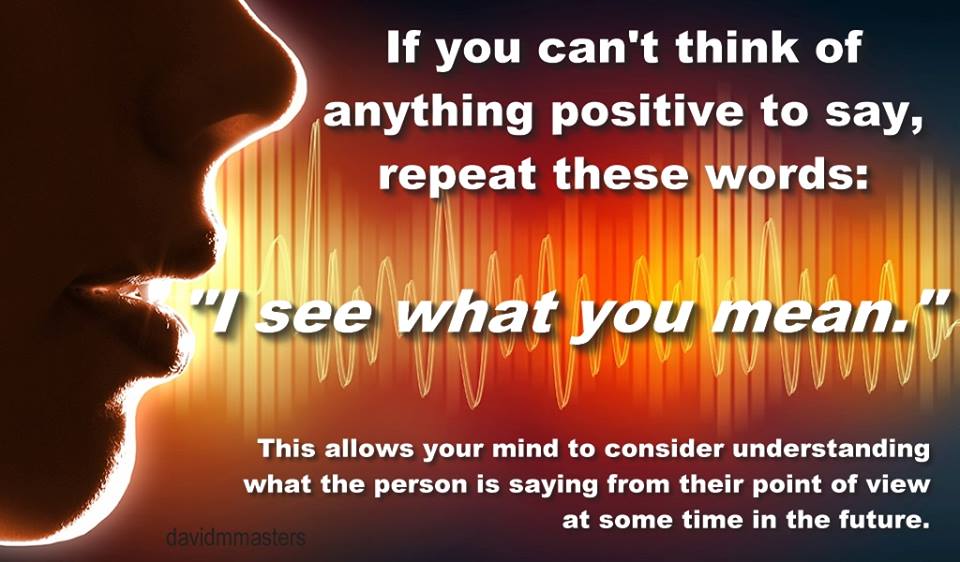
If you cant think of anything positive to say repeat these words I see what you mean

If I can decipher enough congruency to get a grip on what they are trying to say form their perspective, and I am unable to find an appropriate positive or uplifting response, I simply say:

“I see what you mean.”

This allows my mind to consider understanding what the person is saying from their point of view at some time in the future.

It always amazes me, when I hear a concept – that upon the initial discovery of the idea – I find hard to believe; but, if I do not violently reject it and allow new information to be gathered and evaluated over time, the concept may begin to appear more credible. The new idea starts to become visible and possibly more credible than other ideas that I held closely previously. This concept may create a challenge for comprehension based on its conflict with old ideas in light of new information or discoveries, ergo anything is possible.

I find solace in the precept that all truth resides within the truth continuum, and that all of it, whether previously thought to be true or presently, even if only held to be true by a single individual, resides within the truth continuum. Therefore, anything and everything thought to be true, just is.

Keep an open mind. Don’t judge others for where they are in the truth continuum and do not overtly assert your ideas. Share openly but humbly, allowing your audience the opportunity to let your idea(s) sink in as they begin to collect more information, possibly challenging things that they once revered as absolute.

Debate is folly and overwhelm causes others to discard any value that your message might have.

Share compassionately, and don’t waste your efforts on those who cannot possibly comprehend what you are trying to say, but never stop… Those with the ears to hear will hear you.

I’m listening… Are you?