If you’re a coach, consultant, counselor, practitioner, therapist, financial advisor, attorney, minister, or just about any other professional, you’ve probably heard some version of this: “Can I ask you a quick question?” Of course they can. And because they’re your friend, you usually answer.
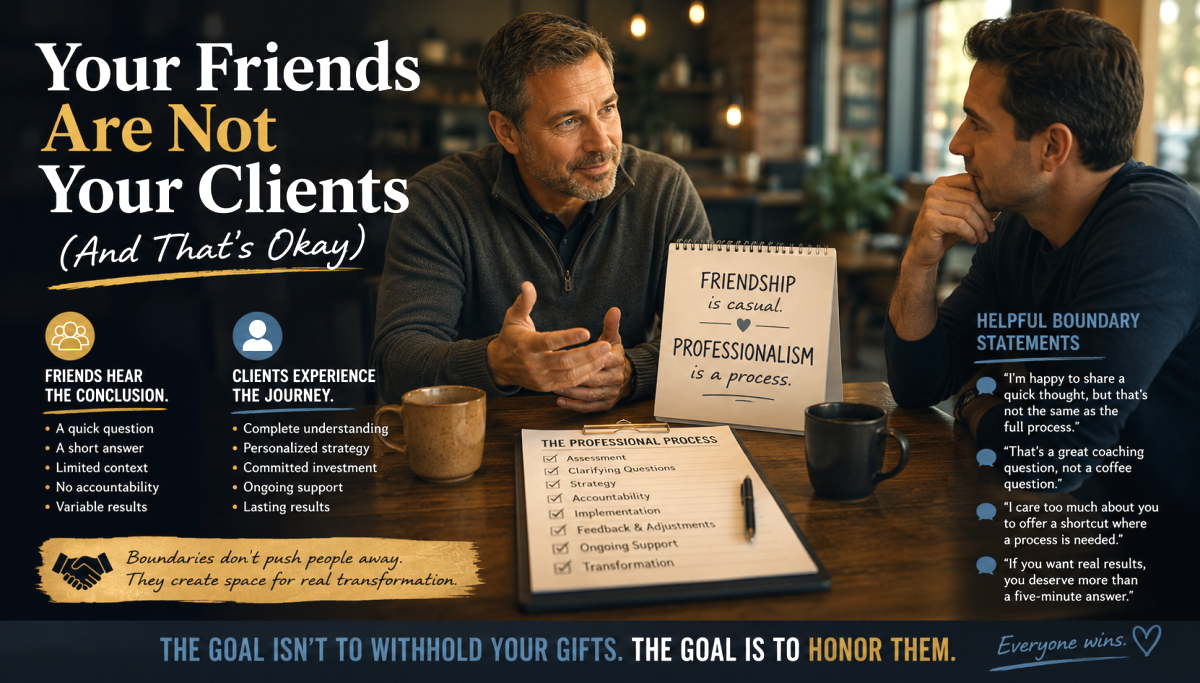
Five minutes later, you’re halfway through what would normally be a paid consultation. Twenty minutes later, they’re asking follow-up questions. An hour later, they’ve mentally enrolled in your expertise without ever enrolling in your process.
Then comes my favorite part. Several weeks later they tell you… “I tried what you said.” Followed by, “It didn’t really work.”
Or perhaps… “I thought you were going to help me with the rest.”
Wait… The rest?
Here’s the part that’s easy to forget. Professional results rarely come from professional answers. They come from professional processes.
A paid client doesn’t simply receive information. They receive observation. Clarification. Questions they didn’t know to ask. Context. History. Strategy. Accountability. Adjustments. Encouragement. Honest feedback. Someone walking beside them long enough to notice when they’re unknowingly sabotaging themselves.
Most breakthroughs don’t happen because of one brilliant sentence. They happen because someone stays with the process. That’s difficult to do over coffee.
Friends often hear the conclusion. Clients experience the journey. Those are very different things.
Imagine asking a surgeon one question at a backyard barbecue. You wouldn’t expect them to perform surgery beside the potato salad. The conversation isn’t the procedure.
The same is true in nearly every profession. Your accountant can answer a tax question. That doesn’t replace a comprehensive tax strategy.
Your attorney may explain a law. That doesn’t establish legal representation.
A mechanic may suspect what’s making the noise. That isn’t the same as diagnosing the vehicle.
Likewise, a coach may offer an idea. But coaching isn’t advice. It’s partnership.
Something else quietly happens when people become paying clients. They become invested. Investment changes attention. Attention changes implementation. Implementation changes outcomes.
People tend to value what they’ve intentionally committed themselves to.
That isn’t about money. It’s about ownership.
Friends also have another advantage that clients don’t. They already know us. Sometimes a little too well. Because they know us socially, they unconsciously assume our expertise must also be casual. It isn’t.
Our friendship is casual. Our profession is not.
Healthy boundaries don’t protect income. They protect relationships.
I’ve found it helpful to say things like:
“I’d be happy to give you a quick thought, but I don’t want to pretend that’s the same as walking through the whole process together.”
Or…
“There’s a much bigger picture here than I can responsibly answer over lunch.”
Or simply…
“That’s a great coaching question, not a coffee question.”
People usually understand. And if they don’t… That tells you something important too.
The professionals reading this already know the feeling. You genuinely want your friends to succeed.
You care.
You hope they flourish.
But caring about someone doesn’t require pretending that a casual conversation can replace a thoughtful professional engagement.
Your friends deserve honesty.
Your clients deserve excellence.
Fortunately…
Those two things can coexist beautifully.
Sometimes the most caring thing a professional can say isn’t,
“Sure, let’s solve your life in fifteen minutes.”
Sometimes it’s,
“I care too much about you to offer a shortcut where a process is needed.”
That isn’t withholding your gifts.
That’s respecting them.
And perhaps respecting your friend enough to invite them into the kind of transformation that only commitment can produce.