Deductive Reasoning the Key to Unlock Clarity in Uncertainty

Let’s be honest: life doesn’t come with a manual. Every day, you’re faced with choices, decisions, and people whose motives may be less than transparent. You’re navigating a world full of unknowns, uncertainties, and—let’s face it—sometimes flat-out deception. But what if you could give yourself an edge? That edge is deductive reasoning, the key to unlock clarity in uncertainty.

It’s not magic. It’s not perfect. But it’s one of the most reliable tools you can have in your toolkit for making sense of what’s going on around you. Think of it as a flashlight in the dark. You may not see everything, but you’ll see enough to take your next step with confidence.

Let’s break it down.

How to Use Deductive Reasoning

Deductive reasoning is simply drawing logical conclusions based on what you know. It works from the general to the specific, narrowing down possibilities until you land on the most reasonable explanation.

It’s the difference between guessing blindly and making an educated guess.

Here’s the basic process:

    1. Look at the Past.
      The greatest predictor of future behavior is past behavior. If someone has consistently acted a certain way, odds are high they’ll keep doing it. Want to know if a business partner is trustworthy? Look at how they’ve treated past partners. Want to know if a product will work? Look at its track record.
    2. Check the Stats.
      What does the data say? Statistics aren’t perfect, but they give you a starting point. If 90% of people with certain traits behave in a particular way, and you’re dealing with someone who fits that profile, don’t ignore the numbers. You’re not prejudging—you’re stacking the odds in your favor.
    3. Go Simple (Occam’s Razor).
      The simplest explanation is usually the right one. If you’re trying to figure out why someone ghosted you, the answer is probably exactly what it looks like—they lost interest or were scared of confrontation. Not that they were abducted by aliens.

Already, you’re working smarter than most people who flounder in wishful thinking, denial, or emotional chaos.

But here’s where it gets exciting: you can stack even more tools on top of deductive reasoning to create a nearly bulletproof system.

Other Tools to Supercharge Your Deductive Reasoning

While deductive reasoning is powerful, it’s not infallible. People change. Circumstances shift. Hidden agendas lurk beneath polished surfaces.

That’s why it’s wise to combine deductive reasoning with other methods of discernment.

Here are some you can layer in:

Intuition.
Sometimes, your gut knows what your mind hasn’t processed yet. Pay attention to subtle feelings of unease or excitement—they can be early warning signs or confirmations. Intuition doesn’t replace logic, but it works beautifully alongside it.

Muscle Testing (Applied Kinesiology).
Muscle testing taps into your subconscious or energetic system to verify truths that might not be visible on the surface. While it shouldn’t stand alone, adding muscle testing to your reasoning stack can flag hidden inconsistencies or validate conclusions—especially when dealing with smooth-talking deceivers.

Ask Better Questions.
The quality of your conclusions is directly tied to the quality of your questions. Instead of asking, “Why did this happen to me?” ask, “What patterns led to this?” or “What assumptions am I making that need testing?”

Triangulate Sources.
Don’t rely on a single source of information. Cross-reference what you’re being told. This applies whether you’re vetting a news story, a romantic interest, or a business opportunity. Multiple independent confirmations strengthen your conclusion.

Behavioral Baselines.
Establish a baseline of normal behavior for a person or system before making judgments. If someone suddenly deviates from their baseline, that’s a clue worth investigating.

Pattern Recognition.
Learn to see patterns over time. A one-off incident doesn’t tell you much. But repeated patterns? Those are gold. Deductive reasoning thrives on patterns, so train your eye to spot them.

Mentor Input.
Run your conclusions by someone wiser or more experienced. A trusted mentor can help catch blind spots you didn’t see.

Archetypal Analysis.
And now, let’s add a deeper layer: archetypes.

Every human being operates from universal archetypal patterns—recurring character types that show up in myths, stories, and psychology across time and cultures. You don’t have to be a psychologist to recognize them.

Is someone showing up as a Victim, always casting blame and avoiding responsibility? A Saboteur, undermining their own success? A Lover, led by passion and connection? A Warrior, driven by courage and conquest?

When you begin to see people’s dominant archetypes, you gain insight into their motivations, weaknesses, and likely behavior under stress.

For example:

    • The Victim archetype will seek pity and use manipulation to avoid accountability.
    • The Saboteur will find a way to ruin opportunities even when everything’s going right.
    • The Hero will push through obstacles but may neglect self-care.
    • The Shadow Lover may seduce with charisma but fear true intimacy.

By recognizing these patterns, you add another predictive layer to your reasoning. It’s not about labeling people, but about spotting tendencies that help you forecast probable outcomes.

Why This Works

Each tool—logic, data, intuition, muscle testing, archetypal analysis—acts like a filter. Even if deception slips past one filter, it’s unlikely to sneak past them all.

When you combine these tools, you’re not just reacting to life. You’re reading the field. You’re decoding behaviors. You’re living as a conscious, discerning participant rather than a blind follower.

And yes, you’ll still be wrong sometimes. Nobody gets it right 100% of the time. But you’ll be right most of the time. And that’s enough to save you from heartbreak, scams, betrayal, wasted time, and poor decisions more often than not.

Putting It All Together

Let’s say you’re vetting a new romantic partner.

    • You look at their past relationship history (deductive reasoning, past data).
    • You check statistics (what do studies say about their attachment style?).
    • You keep it simple (Occam’s razor: are they really that “busy,” or just not prioritizing you?).
    • You notice a knot in your stomach (intuition: something’s off).
    • You muscle test whether their claims align with their truth.
    • You ask questions that reveal deeper motivations.
    • You spot their archetypal patterns (are they Lover? Saboteur? Victim?).

By the time you’ve layered these insights, you’re no longer relying on one flimsy clue. You’re seeing a whole picture.

And that, my friend, is power.

Final Thoughts: Becoming a Master of Discernment

Deductive reasoning isn’t about being suspicious, cynical, or jaded. It’s about equipping yourself to see things as they are, so you can respond wisely, lovingly, and powerfully.

Life rewards those who are discerning. And discernment is built on the steady layering of logic, intuition, experience, insight, and yes—even the timeless wisdom of the archetypes.

Use all your tools. Trust yourself. And when in doubt? Ask:

    • “What’s the simplest explanation?”
    • “What patterns am I seeing?”
    • “What archetype am I dealing with?”

Then step forward boldly, knowing you’ve done your homework.

And remember: The truth is always there. You just need enough light to see it.


Intuitive Inner Wisdom Part of Your New Evolutionary Journey

The world around us is founded on logic and reason, whereas the concept of intuition has taken the backseat. Even so, that inexplicable inner voice nudges us towards decisions, actions, or even cautionary measures. How to develop intuition. Have you ever found yourself in a situation where your gut feeling tugs at you, guiding you towards a path that defies logical explanation? Or do you remember feeling a subtle but undeniable sense of unease about a circumstance even though there was no tangible evidence to support it?

Intuition, often described as the gut instinct or inner knowing, operates beyond the confines of conscious rational thought. The silent whisper speaks volumes without words, offering insights and clues that bypass the analytical mind. Like a compass pointing north, intuition serves as our internal guide, steering us towards what feels right or warning us of potential pitfalls.

However, despite its significance, intuition frequently faces neglect in our society. From a young age, we’re conditioned to prioritize intellect over instinct, relegating intuition to the realm of the unreliable and unverifiable. Authority figures dictate our decisions, from parents guiding our choices to experts shaping our perceptions. We’re encouraged to conform to established norms and systems, often at the expense of disconnecting from our intuitive selves.

Yet, therein lies the paradox: while society may undervalue intuition, countless anecdotes and experiences attest to its validity and importance. How often have we heard stories of individuals who followed their gut instinct and found success or ignored it to their detriment? The intuitive nudge, though subtle, is often accompanied by a sense of certainty that defies logical explanation.

So why do we ignore our intuition? The answer lies in societal conditioning and a lack of emphasis on inner guidance. We’re taught to rely on external validation and authority, undermining our trust in our instincts. Additionally, the fear of being perceived as irrational or illogical can lead us to dismiss intuitive insights, opting for seemingly rational decisions.

Learning to honor and cultivate our intuition becomes essential as we navigate life’s complexities. It’s about reclaiming our innate wisdom and reconnecting with our authentic selves. By tuning into our intuition, we access a deeper reservoir of knowledge and insight, empowering us to make decisions aligned with our true desires and values.

But how do we tap into our intuition amidst the noise of everyday life? It begins with quieting the mind and creating space for reflection and introspection. Practices such as meditation, journaling, or simply spending time in nature can help us tune into our inner voice. Trusting ourselves and giving credence to our intuitive inner whisperings, even when they defy logic, is paramount.

Cultivating a sense of mindfulness allows us to discern between fear-based anxieties and genuine intuitive guidance. Learning to differentiate between the voice of fear and the voice of intuition is crucial in making informed decisions. While fear may manifest as doubt or uncertainty, intuition often feels like a quiet, assured knowing.

Embracing intuition is about reclaiming our sovereignty and trusting in our inherent wisdom. It’s about acknowledging that the answers we seek often lie within us, waiting to be unearthed. By honoring our intuition and allowing it to guide us, we embark on a journey of self-discovery and empowerment, navigating life’s twists and turns with clarity and confidence.

Even though society undervalues intuition, its significance cannot be overstated. It serves as our inner compass, offering invaluable guidance in a complex world. We unlock a profound source of wisdom and insight by cultivating a deeper connection with our intuition and learning to trust its whispers.

So, the next time you feel that inexplicable tug at your heart or sense a subtle warning in the depths of your being, listen. Your intuition may be leading you towards something extraordinary. How to develop intuition follows:

Steps to Release Your Intuitive Inner Wisdom

Rethink Your Understanding of Intuition

Traditionally, intuition is often dismissed as unreliable, overshadowed by the prominence of logical thinking. Yet, our bodies and hearts possess a nuanced ability to discern beyond the limitations of the mind. To tap into intuition, redefining our perceptions of it is crucial. By shedding the notion of intuition as unreliable, we can embrace its potency as a formidable inner guide.

Trust Your Body’s Signals

The body, through its somatic responses, often senses situations before the mind can comprehend them. Pay attention to bodily cues:

Notice if you instinctively lean away or cross your arms around specific individuals.

Acknowledge sudden tightness in the stomach or the appearance of goosebumps.

Tune into heart rate changes or hair standing on end.

Your body is a conduit for intuition, offering insights that precede conscious thought. You can deepen your connection to intuition by honing sensitivity to bodily sensations.

Document Your Impressions

When experiencing events or meeting people, jot down immediate impressions and sensations. Capture feelings, mental images, or even subtle tastes and smells without overthinking. Later, compare these notes with hindsight to discern patterns and refine intuitive abilities.

Engage in Inner Dialogue

During moments of indecision, engage in a dialogue between your heart and mind. Picture yourself mediating between these two aspects of yourself.

Listen Attentively to Each Perspective

The mind may emphasize caution, drawing from past experiences and external authority.

The heart speaks with compassion and optimism, urging alignment with passions and dreams.

Choose the path that resonates with a sense of expansiveness and authenticity, guided by intuition’s non-verbal language of feeling.

Decode Your Dreams

Dreams offer a window into subconscious desires, fears, and needs. Please pay attention to recurring symbols and patterns as they unveil deeper insights into personal struggles and aspirations.

Embrace Meditation

Meditation serves as a conduit for subconscious communication, quieting the conscious mind to access intuitive wisdom. Research indicates that meditation enhances the brain’s ability to evaluate decisions by increasing grey matter in the prefrontal cortex.

Address Emotional Healing

Unresolved emotional trauma can cloud intuitive clarity. Acknowledging and healing emotional wounds creates space for trust in your inner guidance.

Connect with Nature

Immersing oneself in nature fosters a sense of belonging and tranquility, aligning internal rhythms with the natural world. This state of presence heightens intuitive receptivity and resets neural networks.

Activate Your Right Brain

Engage in activities that stimulate the brain’s right hemisphere, the seat of intuition and creativity. Explore pursuits such as daydreaming, artistic expression, or musical endeavors to tap into intuitive depths.

Distinguish Intuition from Anxiety

Discerning between intuition and anxiety is crucial. Intuition offers calm assurance in the present moment, while anxiety manifests as fear-driven apprehension fixated on past traumas or future catastrophes.

Intuitively Evolve

Your continued evolution includes:

    • Trusting your intuition.
    • Requiring a shift in perspective.
    • Embracing inner wisdom over external validation.

You reclaim agency in decision-making by honoring intuitive nudges and cultivating awareness of bodily sensations, dreams, and emotional landscapes. Embrace intuition as a guiding force, leading you back to your authentic self as you continue evolving.

Playing With Your Higher Self

You could play games with your higher self to strengthen your intuitive muscles. A book has been written by intuitive, Heidi Connolly, who with her co-author,  Helen Lang, have developed a compendium of assorted games and activities that you can use to better learn how to develop intuition, with less of the “work” and mostly the fun of play as you go.

For more information, see the book Playing With Your HIGHER Self: Psychic Games For Your Intuitive Muscle.


Are You Psychic?

Ever wonder if there is such a thing as being psychic?

Society would like you to think that psychic abilities are mere fiction or something to be avoided (if it does exist) because it would be evil, if it did exist. The subject of psychic abilities has become so convoluted and filled with false information that you could hardly make any sense of the idea of the possibility of having psychic ability impossible to understand or even think about without confusion or fear.

Still, there is something inside of us that would like to believe that someone could possess psychic abilities, so we are attracted to various types of entertainment where we see performance artists who are skilled in using sleight of hand or mind tricks to thrill us with the idea that such a thing could be possible.

Not to worry, even if you were to start to believe in the possibilities, the system has already stacked the deck against your idea that psychic abilities might exist and there is a huge amount of data available to make you feel like a fool, even if you had entertained the idea that there is more out there than we could possibly decipher using pure logic.

This idea that logic and reason is the ultimate litmus test of what is possible and what is not is in direct contradiction of the advancements we have witnessed in the last 150 years. Many of the conveniences we enjoy today are the result of someone allowing their mind to expand beyond known and accepted reality. Those who were active participants in these advancements, explain the breakthroughs as, “coming from somewhere outside one’s self,” or “as seen in a vision.”

Not one of them indicate any idea that their inspiration to approach something completely inconceivable as having any connection with any psychic ability whatsoever. Instead those who possess these abilities use more acceptable terms, like creativity, ingenuity, having the ability to use forward-thinking imagination or to see things from “outside the box;” all socially acceptable concepts to diffuse any psychic offense.

are you psychic do i have psychic abilities

The reality of it all is that human beings are blessed with all kinds of psychic abilities that vary in type, style and function from one individual to another and most of them have been suppressed by many methods. Social mores would dictate any reference to psychic abilities are folly, misinformation dominates the information highway and in our modern world even elements introduced to the air we breathe, the food we eat and the water that we drink may inhibit the development of our innate psychic abilities.

We are all connected to something so much more outside of ourselves than we could ever imagine, yet we are distracted by any means possible to keep us from embracing the idea by our fear-focused attention to the media and flood of data bombarding us 24/7. How could we even manage the space in which we could initiate an original thought on present-day planet earth?

Take a minute to think about this: If psychic abilities were the nonsense that we’ve been led to believe it is, then why would the government be spending billions of dollars researching and weaponizing all things psychic and paranormal?

Regardless of what they’d like you to believe, you have an inner knowingness that there exists some psychic ability inside of you. You know that you have had psychic experiences. You may have “felt” someone looking at you, and turned to catch someone doing just that. There is no way you could have known otherwise.

In fact, you have intuitively known many things that might be conceived as precognition. You can’t explain how you “knew” something, like there was an impending danger prior to an accident, knew someone had ulterior motives, something was “wrong” with a particular person or animal, or you “felt” as if you might be going the wrong direction.

Call it what you want these abilities abound within you, though they may be mostly dormant and could be awakened. Your psychic abilities can have a profound effect on all that you turn your attention toward including your profession, business, athletic performance, philosophy, creative endeavors and the arts as well as personal satisfaction, greater love, fulfillment and happiness in life.

Not to mention that embracing one’s psychic abilities (or however you feel comfortable referring to it) is an integral part of the next phase of our human evolution.

This awareness is awakening within you now as you evolve.

Intuitive Intuition

Along the journey of my life and my desire to learn and grow while exercising my life’s calling of helping others achieve their highest and best I spend a lot of time introspectively examining what is inside me and ways that I can expand my skills and capabilities, not only for myself, but to maximize my offerings to others.

Early on, I recognized my lack of intuition. Having knowledge of this led me to conclude that this valuable skill was not only important but necessary. When assembling teams, I always sought someone to be a key player who was highly intuitive. Another thing that occurred to me was that either you were born to be intuitive, or not, and that it was a skill that you could acquaint yourself with. So, my personal growth regimen included education, tactics and skills related to bridging the gap between my not being born intuitive and desiring the benefits of having intuition.

My early attempts to attain a greater sense of intuition led me to advanced training in hypnosis and Neural Linguistic Programming (NLP) along with other disciplines. That was then.

It time, and with advances in scientific knowledge and technology, it became common knowledge we are all born with intuition, but in most of us, our intuitive abilities are ignored or suppressed early in life.

Now I realize my attempts to address the subject of intuitive intuition by relying on my power of mind were in vain. Certainly I learned a lot about myself and others, yet my level of intuition was not affected much with all my attempts to take a rational approach exercising mind control and brain power.

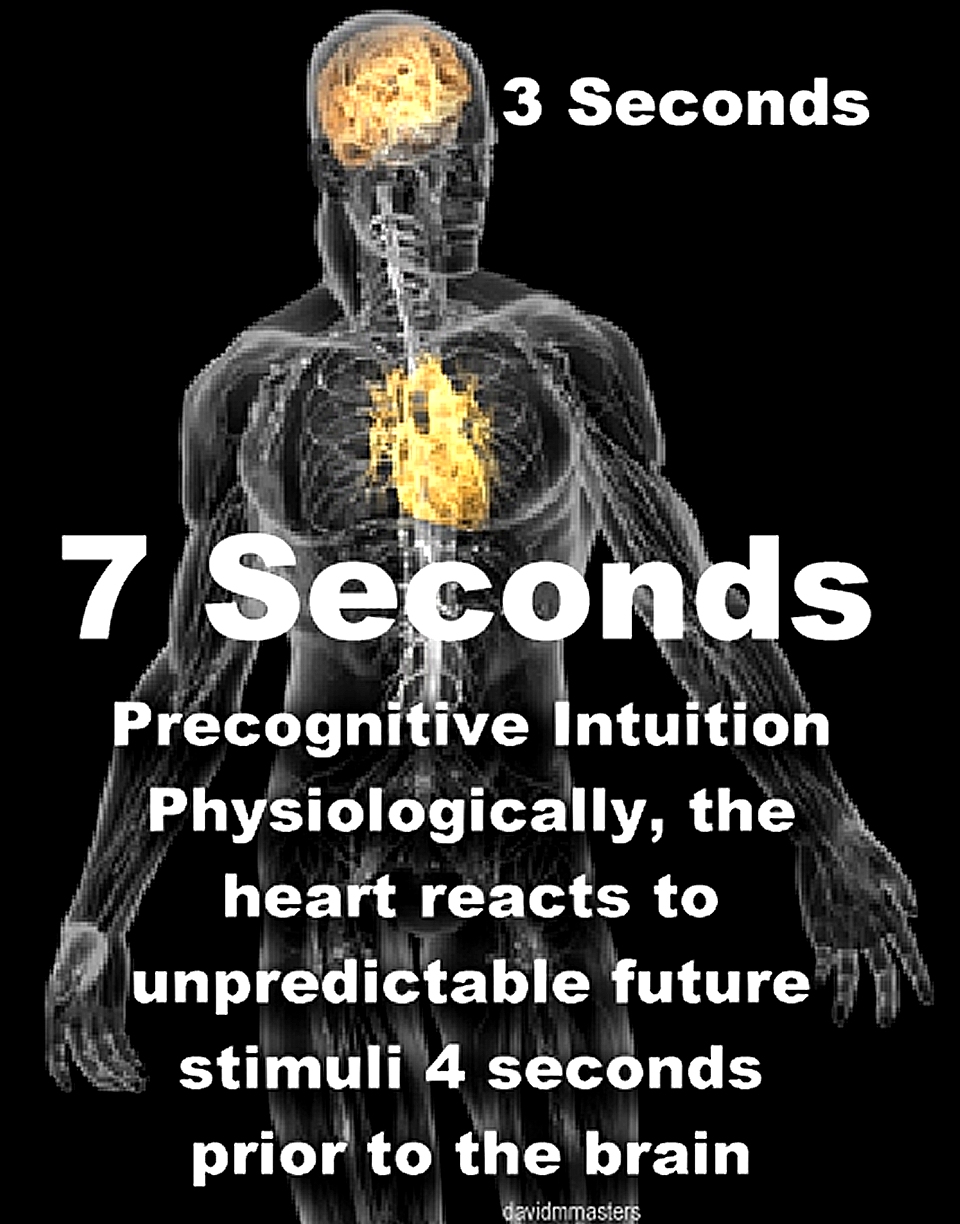
intuitive intuition heart 7 seconds mind 3 seconds precognitive intuition

Current scientific knowledge reveals that the seat of intuition does not reside in the brain or the mind, but in the heart. The heart has an independent mind of its own, and intuition is initiated from electrical impulses from the heart that are delivered to the brain (4 seconds later) for the mind to discern (taking an additional 3 seconds). So, it’s a one-two punch, where I had ignored the first – and most important – part of the process. (To tell the truth, to think about “thinking” with the heart sounded weak or at least ill-advised to me back in the day.)

Are you like me?

Do You Want Intuitive Intuition?

Finally, we have enough information to ascertain better methods of turning up the volume on our intuitive skills and abilities.

I am now in search of a more heart-centered approach to strengthen my intuitive muscle, now that I know where to focus my attention: Away from my head and toward my heart, where intuition is first alerted.

The normal process for someone who has a naturally high functioning intuition takes 7 second from the first impulse initiated by the heart to cognitive recognition. The heart knows something is going to happen, even before there is any indication that something’s amiss, it reacts a full 4 seconds prior to the brain.

You may say it’s impossible to know the future, but intuitive people know something’s going to happen before it happens more often than not. If you don’t believe me just ask someone who was born with high functioning intuition. Chances are you already know someone, if you’re not one.

So, here I go, off on another tangent in my self-improvement regimen to develop my psychic powers…


Integrity Intuition Imagination

Key components that Holistic Entrepreneurs share (among other attributes) are integrity, intuition and imagination. Emerging amidst this evolution in the business world are entrepreneurs and business professionals who see their professions as so much more than just cash flow, or as a source of revenue.

integrity intuition imagination heart centered business holistic entrepreneurs

Integrity

First off, these businesspeople have integrity – a sense of doing the right thing even if no one’s watching, keeping their word and seeking to do no harm – while engaged in either their private or business practices. They always seek to arrive at win/win solutions and are more likely to negotiate and compromise for the greater good.

Their professional interested stem from the base resonance of their heart, giving them a sense of fulfilling their life’s purpose while contributing to the community at large in an effort to make the world a better place for this and future generations.

They feel as though their business activities are a result of accepting their life’s mission, embracing their “calling” and finding ways to deliver their personal “message” (also a part of their life’s mission). This congruency of vibration among the areas of living their intended purpose (or reason for coming to our planet) while striving to find ways to stay on-track with their mission while delivering their unique “message,” offers them a great deal of satisfaction.

Staying on the high road of an integrous lifestyle increases efficiency tremendously, while increasing energy, joy and a better life (‘ere it is unlikely you will find an authentic, integrous Holistic Entrepreneur suffering from depression or burnout from their professional endeavors).

Intuition

Intuition is the Holy Grail of the Holistic Entrepreneur, as they operate from a more heart-centered position (as opposed to purely logical focused on the analytical/money hungry position). Instead of making professional or business decisions placed purely on statistics or science, the Holistic Entrepreneur might be inclined to turn his or her attention inward, checking with his/her heart, while asking themselves

How does this make me feel?

Feelings are their inner guidance system, assisting their navigation, helping them chart the course of their life’s mission, while attempting to avoid distractions or being thrown off-course. For some, intuition coherence comes naturally, for others it must be birthed and exercised for their ability to intuitively discern or identify and communicate with their inner guidance system.

The downside is that unless you’ve surrounded yourself with like-minded Holistic Entrepreneurs who appreciate such things, “Intuition” may be perceived by support staff as being unfounded, unrealistic falderal, dismissing it as nonsensical.

Imagination

A high-functioning imagination is the Holistic Entrepreneur’s secret superpower, enabling them to see outside the box, have an increased ability to problem-solve or see most anything from other perspectives.

Imagination circumvents years of research and development, great costs and loss of valuable time in our fast-paced get-it-now world.

Visualizing a particular outcome fueled by the power of an empowered imagination increases the potential of a positive outcome exponentially.

Many see imagination as a child-like tool, wielded by immature fools who fantasize for no good reason; for how could you trust someone who lives in a fantasy world? They persist in this perspective of complete denial, even though many of our greatest advancements on this planet are the result of exercising the skillful use of one’s imagination (which is discounted as “luck,” because “even a broken clock is right twice a day,” or some other common dismissal).